Ontario Securities Commission Bulletin
Issue 49/04 - January 29, 2026
Ont. Sec. Bull. Issue 49/04
• Ontario Securities Commission and Ahmed Kaiser Akbar
• Oasis World Trading Inc. et al.
• Ontario Securities Commission and Ron Carter Hew
• Notice of Correction -- Ontario Securities Commission and Benjamin Ward
• Ontario Securities Commission and Ron Carter Hew -- ss. 127(1), 127.1
• Ontario Securities Commission and Ahmed Kaiser Akbar -- ss. 126.1(1)(b), 126.2(1)
• Oasis World Trading Inc. et al.
• Ontario Securities Commission and Ron Carter Hew -- ss. 127(1), 127.1
• Harvest Portfolios Group Inc.
• Temporary, Permanent & Rescinding Issuer Cease Trading Orders
• Temporary, Permanent & Rescinding Management Cease Trading Orders
- - - - - - - - - - - - - - - - - - - - - - - - - - - - - - - - - - - - - - - - - - - - - - - - - -
SLC Holdings Inc. et al. -- s. 127
FILE NO.: 2026-6
BETWEEN:
Section 127 of the Securities Act, RSO 1990, c S.5
PROCEEDING TYPE: Application relating to a transaction
HEARING DATE AND TIME: January 27, 2026, at 3:00 p.m.
LOCATION: By videoconference
The purpose of this proceeding is to consider the application filed by SLC Holdings Inc. dated January 22, 2026, requesting an order that all trading in securities of Stracon Group Holding Inc., shall not commence, or shall immediately cease, unless and until the amalgamation between Stracon Canada and Stracon Holdings S.A. has been completed, and other related relief related to the amalgamation.
The hearing set for the date and time indicated above is the first case management hearing in this proceeding, as described in subsection 13(3) of the Capital Markets Tribunal Rules of Procedure.
Any party to the proceeding may be represented by a representative at the hearing.
IF A PARTY DOES NOT ATTEND, THE HEARING MAY PROCEED IN THE PARTY'S ABSENCE AND THE PARTY WILL NOT BE ENTITLED TO ANY FURTHER NOTICE IN THE PROCEEDING.
This Notice of Hearing is also available in French on request of a party. Participation may be in either French or English. Participants must notify the Tribunal in writing as soon as possible if the participant is requesting a proceeding be conducted wholly or partly in French.
L'avis d'audience est disponible en français sur demande d'une partie, que la participation à l'audience peut se faire en français ou en anglais et que les participants doivent aviser le Tribunal par écrit dès que possible si le participant demande qu'une instance soit tenue entièrement ou partiellement en français.
Dated at Toronto this 27th day of January, 2026
For more information
Please visit capitalmarketstribunal.ca or contact the Registrar at registrar@capitalmarketstribunal.ca.
File No. _____________
BETWEEN:
1. The Applicant, SLC Holdings Inc. ("SLCH"), requests that the Tribunal make the following orders:
(a) an order granting SLCH standing to bring this application under section 127 of the Securities Act, R.S.O. 1990, c. s.5. (the "Act");
(b) an order pursuant to section 127(1)2 of the Act that all trading in securities of the Respondent, Stracon Group Holding Inc. ("Stracon Canada"), shall not commence, or, if trading has commenced, shall immediately cease, unless and until the amalgamation between Stracon Canada and Stracon Holdings S.A. ("Stracon Original") (the "Amalgamation") has been completed and is effective under the laws of Peru;
(c) an order pursuant to section 127(1)5 of the Act prohibiting the Respondent from providing to any person or company: (i) the Respondent's prospectus dated December 16, 2025 (the "Prospectus"); and (ii) any other disclosure document that contains a material misrepresentation or materially misleading omission concerning the Amalgamation;
(d) in the alternative to paragraph 1(b), an order pursuant to section 127(1)2 of the Act directing that trading in any securities of the Respondent shall not commence, or, if trading has commenced, shall cease, unless and until the Ontario Securities Commission is satisfied that the Respondent has: (i) corrected the material misrepresentations and materially misleading omissions in the Prospectus concerning the Amalgamation; and (ii) made the necessary corrective disclosure, including by way of press release, concerning the past misrepresentations and omissions;
(e) an order for an expedited hearing;
(f) the costs of this proceeding, plus all applicable taxes; and
(g) such further and other relief the Tribunal may deem just.
Overview
2. SLCH seeks a cease trading order pursuant to section 127 of the Act in respect of the securities of Stracon Canada.
3. Stracon Canada's Prospectus contains a fundamental misrepresentation: that it owns all of the assets of Stracon Original, as a result of the cross-boarder Amalgamation purportedly completed on November 1, 2025.
4. Contrary to the Prospectus, the Amalgamation has not been completed as a matter of Peruvian law, and the assets of Stracon Original (worth hundreds of millions of dollars) have not transferred to Stracon Canada.
5. A cease trade order is necessary to protect the investing public from the harm that will undoubtedly occur if Stracon Canada's securities begin trading on the TSX based on this fundamental misrepresentation in the Prospectus.
The Parties
6. The applicant, SLCH, is an investment holding company incorporated under the laws of Barbados. It is the plaintiff in an ongoing Peruvian civil action against Stracon Original seeking US$26 million for breach of contract.
7. The non-party, Stracon Original, is a corporation incorporated under the laws of Peru. Stracon Original holds, directly or indirectly, a majority interest in five operating companies that provide mining services in Peru, Canada, Mexico, and Chile. Stracon Original 's assets are worth hundreds of millions of dollars.
8. The respondent, Stracon Canada, is a reporting issuer in Ontario. Following a continuation from the Yukon to Ontario in November 2025, it is a corporation existing under the Ontario Business Corporations Act, R.S.O. 1990, c. B.16.
9. Stracon Canada's shares have been conditionally approved for listing on the Toronto Stock Exchange under the symbol "STG".
The Option Action
10. On August 25, 2025, SLCH commenced a civil action against Stracon Original in Lima, Peru for US$26 million. SLCH alleges that Stracon Original breached the terms of an option agreement under which SLCH was entitled to purchase shares of a third-party company acquired by Stracon Original.
The Amalgamation
11. Steps related to the Amalgamation began in late 2024.
12. On December 17, 2024, 843636 Yukon Inc. (subsequently named Stracon Canada) was incorporated under the laws of the Yukon.
13. On March 11, 2025, Stracon Canada registered a "branch" in Peru, Stracon Group Holdings, Inc. Sucursal del Peru (the "Peruvian Branch").
14. On October 17, 2025, Stracon Original and Stracon Canada entered an amalgamation agreement (the "Amalgamation Agreement") that states:
[the parties] wish to proceed with a long-form amalgamation in accordance with section 183 of the YBCA; and that this transaction shall be considered, for all Peruvian and accounting purposes, as an amalgamation by virtue of which the assets and liabilities of [Stracon Original] shall be assigned to and absorbed into [Stracon Canada's] existing Peruvian Branch...
15. The Amalgamation Agreement provides that Stracon Original "shall transfer, universally and in bulk, its rights, obligations, legal relationships, and in general, all its assets..." to the Peruvian Branch, and that Stracon Original and Stracon Canada shall continue as Stracon Canada, ceasing to exist as separate entities.
SLCH's Objection to the Amalgamation in Peru
16. Under Peruvian law, a creditor (including a contingent creditor) of an entity participating in an amalgamation has a statutory right to object to the amalgamation on the basis that the transaction would prejudice the creditor's interests. Where a timely objection is made, the amalgamation does not take legal effect unless and until the objection is withdrawn or determined by the court.
17. The Peruvian statutory scheme requires the amalgamating entity to publish notice of the proposed amalgamation in an official gazette on three separate occasions. A creditor has 30 days from the date of the final publication to deliver an objection.
18. In Peru, an amalgamation does not take effect unless and until the transaction is formalized by public deed registered in the Peruvian corporate registry. To be validly registered, the deed must include a "certificate of no opposition" sworn by an officer of each amalgamating entity, confirming that they have not been served with an objection within the thirty-day objection period.
19. In this case, the final gazette publication occurred on November 25, 2025, and the objection period expired on December 29, 2025 (on account of the weekend and public holidays for Christmas and Boxing Day).
20. On December 5, 2025, SLCH commenced a proceeding in the Superior Court of Lima (Commercial Court) objecting to the Amalgamation. Stracon Original was served with notice of this proceeding on December 30, 2025.
21. Notwithstanding the foregoing, on January 2, 2026, Stracon Original and Stracon Canada attempted to register the amalgamation deed, relying on a "certificate of no opposition" sworn by Stephen Dixon (as CEO of Stracon Original) on December 26, 2025 and issued before the objection period had expired.
22. On January 19, 2026, the Registrar of the Peruvian Corporate Registry suspended the registration of the deed of amalgamation on the grounds that a judicial proceeding opposing the amalgamation is pending before the Court. The Registrar has suspended the registration until a final decision is issued by the Court in SLCH's proceeding opposing the Amalgamation. The Registrar's decision is subject to confirmation by the Registry Tribunal.
23. As a result, the Amalgamation has not been completed. The assets of Stracon Original have not transferred to Stracon Canada under Peruvian law.
The Fundamental Misrepresentations Contained in the Prospectus
24. The Prospectus ignores this reality.
25. It does not provide full, true and plain disclosure of all material facts relating to the securities of Stracon Canada, as required by section 56(1) of the Act.
26. The core misrepresentation in the Prospectus is the following (underlined for emphasis):
Amalgamation between STRACON Group Holding Inc. (formerly 843636 Yukon Inc.) and STRACON Holdings S.A.: On November 1, 2025, STRACON Group Holding Inc. (formerly 843636 Yukon Inc.) and STRACON Holdings S.A. completed a long-form amalgamation in accordance with Section 183 of the YBCA, and such transaction was deemed to be, for all Peruvian legal and accounting purposes, an amalgamation by virtue of which the assets and liabilities of STRACON Holdings S.A. were assigned to the Peruvian Branch in such a way that such Peruvian Branch absorbed in a single act and universally the assets and liabilities of STRACON Holdings S.A.
As a result of the amalgamation, on November 1, 2025:
(i) In accordance with Section 188 of the YBCA, STRACON Group Holding Inc. (formerly 843636 Yukon Inc.) continued its existence as the Company, organized under the YBCA with the same name and Canadian federal tax identification (i.e., the same Canada Revenue Agency business number). The Peruvian Branch remained the Peruvian Branch of the Company; and
(ii) STRACON Holdings S.A. ceased to exist separately from the Company for Canadian and Peruvian legal and tax purposes.
27. Contrary to the Prospectus, the Peruvian Branch has not "absorbed" the assets and liabilities of Stracon Original, and Stracon Original continues to exist separately from Stracon Canada under Peruvian law.
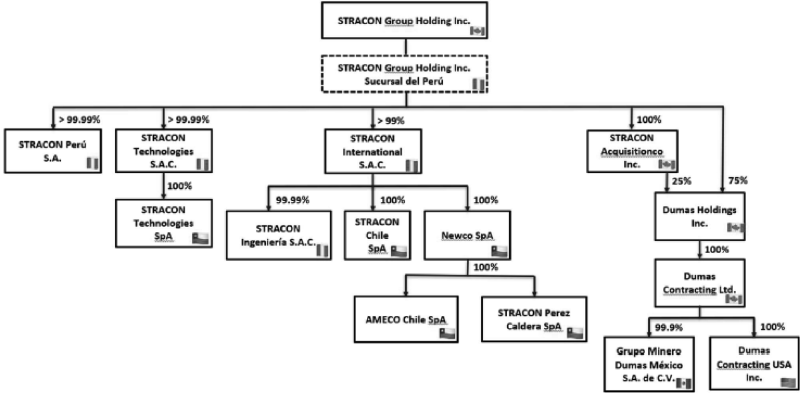
28. This misrepresentation is repeated throughout the Prospectus, including in the corporate organizational chart contained therein, which purports to identify the "material wholly-owned subsidiaries [of Stracon Canada] ... as of the date of this prospectus." The chart depicts Stracon Canada (through its Peruvian Branch, identified in the chart by the hashed outline) as the owner of several subsidiaries, that, in fact, continue to be held by Stracon Original (which is absent from the chart):
29. The Prospectus also fails to disclose SLCH's objection to the Amalgamation, which is pending before the Superior Court of Peru.
30. By virtue of the misrepresentation, the Prospectus also violates National Instrument 41-101 ("NI 401-101").
31. Section 3.1(1) of NI 401-101 requires a prospectus to be in the form of Form 41-101F1. Under Form 41-101F1, a prospectus must "[g]ive particulars of any material facts about the securities being distributed that are not disclosed under any other Items and are necessary in order for the prospectus to contain full, true and plain disclosure of all material facts relating to the securities to be distributed" (s. 29.1).
32. The Prospectus' failure to disclose SLCH's objection to the Amalgamation, as well as its misstatements that the Amalgamation is complete, are contrary to the disclosure requirement in Form 41-101F1, section 29.1. The Prospectus does not satisfy the requirements of Form 41-101F1 and accordingly violates NI 401-101, section 3.1(1).
The Order Requested is Necessary to Protect the Public and the Applicant Should be Granted Standing
33. An Order pursuant to section 127 of the Act cease-trading the securities of Stracon Canada unless and until the Amalgamation takes effect under Peruvian law is necessary to protect the investing public and maintain the integrity of Ontario's capital markets.
34. In the absence of such an order, Stracon Canada's securities will trade on the basis of a fundamental misrepresentation in the Prospectus: that Stracon Canada owns hundreds of millions of dollars in assets that, in fact, remain assets of Stacon Original under Peruvian law.
35. The Tribunal should exercise its discretion to permit SLCH to bring this application under section 127 of the Act because:
(a) the application relates to both past and contemplated future conduct regulated by Ontario securities law;
(b) the relief sought is future-looking and not purely enforcement in nature;
(c) the Tribunal has the authority to impose an appropriate remedy in the circumstances;
(d) SLCH is directly affected by Stracon Canada's conduct. SLCH has a USD $26 million claim against Stracon Original and Stracon Canada. SLCH therefore has a direct interest in Stracon Canada's ability to satisfy its liabilities. A class proceeding commenced by investors who purchase Stracon Canada's securities in reliance on materially misleading public disclosure would expose Stracon Canada to substantial liability and could materially impair SLCH's ability to enforce any judgment it may obtain against Stracon Canada; and
(e) it is in the public interest for the Tribunal to hear the applicable. This application engages the fundamental purposes of the Act, namely, protecting investors and fostering confidence in capital markets.
36. The Applicant intends to rely on the following evidence at the hearing:
(a) Affidavit(s) of the Applicant to be sworn; and
(b) Such further and other evidence as the lawyers may advise and the Tribunal may permit.
JANUARY 22, 2026 |
ADAIR GOLDBLATT BIEBER LLP |
|
401 Bay Street, Suite 3200 |
||
Toronto, ON M5H 2Y4 |
||
|
||
Simon Bieber (56219Q) |
||
Tel: 416.351.2781 |
||
Email: sbieber@agbllp.com |
||
|
||
Robert Trenker (68606A) |
||
Tel: 416.300.0660 |
||
Email: rtrenker@agbllp.com |
||
|
||
David Ionis (79542U) |
||
Tel: 437.222.0061 |
||
Email: dionis@agbllp.com |
||
|
||
Caroline Harrell (84738D) |
||
Tel: 416.583.1652 |
||
Email: charrell@agbllp.com |
||
|
||
Tel: 416.499.9940 |
||
Fax: 647.689.2059 |
||
|
||
Lawyers for the Applicant |
||
|
||
SLC HOLDINGS INC. |
-and- |
STRACON GROUP HOLDING INC. et al |
Applicant |
Respondent |
|
|
||
ONTARIO CAPITAL MARKETS TRIBUNAL |
||
|
||
NOTICE OF APPLICATION |
||
|
||
ADAIR GOLDBLATT BIEBER LLP |
||
401 Bay Street |
||
Suite 3200 |
||
Toronto, ON M5H 2Y4 |
||
|
||
Simon Bieber (56219Q) |
||
Tel: 416.351.2781 |
||
Email: sbieber@agbllp.com |
||
|
||
Robert Trenker (68606A) |
||
Tel: 416.300.0660 |
||
Email: rtrenker@agbllp.com |
||
|
||
David Ionis (79542U) |
||
Tel: 437.222.0061 |
||
Email: dionis@agbllp.com |
||
|
||
Caroline Harrell (84738D) |
||
Tel: 416.583.1652 |
||
Email: charrell@agbllp.com |
||
|
||
Tel: 416.499.9940 |
||
|
||
Lawyers for the Applicant |
||
Ontario Securities Commission and Ahmed Kaiser Akbar
FOR IMMEDIATE RELEASE
January 22, 2026
TORONTO -- The Tribunal issued its Reasons and Decision in the above-named matter.
A copy of the Reasons and Decision dated January 21, 2026 is available at capitalmarketstribunal.ca.
Subscribe to notices and other alerts from the Capital Markets Tribunal:
For Media Inquiries:
For General Inquiries:
1-877-785-1555 (Toll Free)
FOR IMMEDIATE RELEASE
January 21, 2026
TORONTO -- The Tribunal issued an Order in the above-named matter.
A copy of the Order dated January 21, 2026 is available at capitalmarketstribunal.ca.
Subscribe to notices and other alerts from the Capital Markets Tribunal:
For Media Inquiries:
For General Inquiries:
Oasis World Trading Inc. et al.
FOR IMMEDIATE RELEASE
January 23, 2026
TORONTO -- The Tribunal issued its Reasons for Decision on a Motion in the above-named matter.
A copy of the Reasons for Decision on a Motion dated January 22, 2026, is available at capitalmarketstribunal.ca.
Subscribe to notices and other alerts from the Capital Markets Tribunal:
For Media Inquiries:
For General Inquiries:
Ontario Securities Commission and Ron Carter Hew
FOR IMMEDIATE RELEASE
January 26, 2026
TORONTO -- The Tribunal issued its Reasons and Decision and an Order in the above-named matter.
A copy of the Reasons and Decision and the Order both dated January 23, 2026, are available at capitalmarketstribunal.ca.
Subscribe to notices and other alerts from the Capital Markets Tribunal:
For Media Inquiries:
For General Inquiries:
Notice of Correction -- Ontario Securities Commission and Benjamin Ward
File No. 2025-21
(2026), 49 OSCB 756. Please be advised that the following typographical error has been corrected in the Reasons and Decision dated January 16, 2026 in the above matter:
• In the Citation on the cover page, "Ward (Re), 2026 ONCMT 2" is replaced with "Ontario Securities Commission v Ward, 2026 ONCMT 2".
FOR IMMEDIATE RELEASE
January 27, 2026
TORONTO -- The Tribunal issued a Notice of Hearing to consider the application filed by SLC Holdings Inc. dated January 22, 2026, requesting an order that all trading in securities of Stracon Group Holding Inc., shall not commence, or shall immediately cease, unless and until the amalgamation between Stracon Canada and Stracon Holdings S.A. has been completed, and other related relief related to the amalgamation.
A first case management hearing will be held on January 27, 2026 at 3:00 p.m. by videoconference.
A copy of the Notice of Hearing dated January 27, 2026, and Application dated January 22, 2026, are available at capitalmarketstribunal.ca
Members of the public may observe the hearing by videoconference, by selecting the "View by Zoom" link on the Tribunal's hearing schedule, at capitalmarketstribunal.ca/en/hearing-schedule.
Subscribe to notices and other alerts from the Capital Markets Tribunal:
For Media Inquiries:
For General Inquiries:
Katanga Mining Limited and Ontario Securities Commission
FOR IMMEDIATE RELEASE
January 27, 2026
TORONTO -- The Tribunal issued an Order in the above-named matter.
A copy of the Order dated January 27, 2026 is available at capitalmarketstribunal.ca.
Subscribe to notices and other alerts from the Capital Markets Tribunal:
For Media Inquiries:
For General Inquiries:
Katanga Mining Limited and Ontario Securities Commission
FOR IMMEDIATE RELEASE
January 27, 2026
TORONTO -- The Tribunal issued an Order in the above-named matter.
A copy of the Order dated January 27, 2026 is available at capitalmarketstribunal.ca.
Subscribe to notices and other alerts from the Capital Markets Tribunal:
For Media Inquiries:
For General Inquiries:
File No. 2025-11
Adjudicators: |
Andrea Burke |
January 21, 2026
WHEREAS on January 20, 2026, the Capital Markets Tribunal held a hearing by videoconference regarding a motion brought by Jack Marks to vary the date for serving and filing Jack Marks' written submissions on the merits set out in the Tribunal's order dated November 17, 2025;
ON HEARING the submissions of the representatives for each of Jack Marks, CNSX Markets Inc. (CNSX), and the Ontario Securities Commission, and on reading the materials filed by Jack Marks and CNSX;
IT IS ORDERED THAT:
1. by no later than 4:30 p.m. EST on January 30, 2026, Jack Marks shall serve and file written submissions on the merits of the application and this date is peremptory to Jack Marks;
2. by no later than 4:30 p.m. EST on March 6, 2026, CNSX shall serve and file responding written submissions on the merits of the application;
3. by no later than 4:30 p.m. EDT on March 13, 2026, Jack Marks shall serve and file reply written submissions on the merits of the application, if any; and
4. by no later than 4:30 p.m. EDT on April 2, 2026, the Ontario Securities Commission shall serve and file written submissions on the merits of the application, if any.
Ontario Securities Commission and Ron Carter Hew -- ss. 127(1), 127.1
BETWEEN:
File No. 2025-19
Adjudicators: |
M. Cecilia Williams |
January 23, 2026
(Subsection 127(1) and s. 127.1 of the Securities Act, RSO 1990, c S.5)
WHEREAS the Capital Markets Tribunal held a combined merits and sanctions and costs hearing in writing to consider whether to make findings against, and impose sanctions on, Ron Carter Hew;
AND WHEREAS the Tribunal made findings against Hew in its Reasons and Decision issued on January 23, 2026;
ON READING the materials filed by the Ontario Securities Commission, and Hew having not filed any materials, although having been properly served;
IT IS ORDERED THAT:
1. pursuant to paragraph 2 of subsection 127(1) of the Securities Act (the Act), trading in any securities or derivatives by Hew shall cease permanently;
2. pursuant to paragraph 2.1 of subsection 127(1) of the Act, the acquisition of any securities by Hew shall cease permanently;
3. pursuant to paragraph 3 of subsection 127(1) of the Act, any exemptions contained in Ontario securities law shall not apply to Hew permanently;
4. pursuant to paragraphs 7 and 8.1 of subsection 127(1) of the Act, Hew shall resign any positions that he holds as a director or officer of an issuer or registrant;
5. pursuant to paragraphs 8 and 8.2 of subsection 127(1) of the Act, Hew is permanently prohibited from becoming or acting as a director or officer of any issuer or registrant;
6. pursuant to paragraph 8.5 of subsection 127(1) of the Act, Hew is permanently prohibited from becoming or acting as a registrant or as a promoter;
7. pursuant to paragraph 9 of subsection 127(1) of the Act, Hew shall pay an administrative penalty of $100,000.00; and
8. pursuant to section 127.1 of the Act Hew shall pay $38,282.87 for costs of the Commission's investigation and hearing.
Katanga Mining Limited and Ontario Securities Commission -- s. 17 of OSA, s. 2(2) of Tribunal Adjudicative Records Act, 2019, and Rule 8(4) of CMT Rules of Procedure
BETWEEN:
File No. 2024-16
Adjudicators: |
Jane Waechter (chair of the panel) |
Russell Juriansz |
|
Dale R. Ponder |
January 27, 2026
(Section 17 of the Securities Act, RSO 1990, c S.5, subsection 2(2) of the Tribunal Adjudicative Records Act, 2019, SO 2019, c 7, Sched 60, and Rule 8(4) of the Rules of Procedure)
WHEREAS the Capital Markets Tribunal held a confidential hearing by videoconference on February 13, 2025, to consider an Application made by Katanga Mining Limited pursuant to section 17 of the Securities Act for an order permitting Katanga to disclose certain information received from the Ontario Securities Commission in connection with the Commission's confidential investigation of Katanga to internal and external counsel of Katanga's parent company, Glencore International AG and Glencore plc;
AND WHEREAS on March 15, 2025, the Tribunal issued an order whereby the adjudicative records in this application were marked as confidential, with certain exceptions, and requested submissions from the parties on whether any of those adjudicative records should remain confidential;
ON READING the written joint submission of Katanga and the Commission and on considering that the parties consent to this order;
IT IS ORDERED THAT:
1. pursuant to subsection 2(2) of the Tribunal Adjudicative Records Act, 2019 and rule 8(4) of the Tribunal's Rules of Procedure, only the filed redacted versions of the following materials shall be made available to the public:
a. Katanga's Application Record, dated December 27, 2024;
b. Katanga's Written Submissions, dated December 27, 2024;
c. Katanga's Supplementary Application Record, dated February 4, 2025;
d. the Commission's Written Submissions, dated February 7, 2025; and
e. the transcript of the February 13, 2025, oral hearing.
Katanga Mining Limited and Ontario Securities Commission -- s. 17 of OSA, s. 2(2) of Tribunal Adjudicative Records Act, 2019, and Rule 8(4) of CMT Rules of Procedure
BETWEEN:
File No. 2025-12
Adjudicators: |
Jane Waechter (chair of the panel) |
Russell Juriansz |
|
Dale R. Ponder |
January 27, 2026
(Section 17 of the Securities Act, RSO 1990, c S.5, subsection 2(2) of the Tribunal Adjudicative Records Act, 2019, SO 2019, c 7, Sched 60, and Rule 8(4) of the Rules of Procedure)
WHEREAS the Capital Markets Tribunal held a confidential hearing by videoconference on November 11, 2025, to consider an Application made by Katanga Mining Limited pursuant to section 17 of the Securities Act for an order permitting Katanga to disclose certain information received from the Ontario Securities Commission in connection with the Commission's confidential investigation of Katanga to its parent company, Glencore plc for disclosure in a civil proceeding in the United Kingdom;
AND WHEREAS on November 20, 2025, the Tribunal dismissed Katanga's application and on November 25, 2025 the Tribunal issued an order whereby the adjudicative records in this application were marked as confidential, with certain exceptions, and requested submissions from the parties on whether any of those adjudicative records should remain confidential;
ON READING the written joint submission of Katanga and the Commission and on considering that the parties consent to this order;
IT IS ORDERED THAT:
1. pursuant to subsection 2(2) of the Tribunal Adjudicative Records Act, 2019 and rule 8(4) of the Tribunal's Rules of Procedure, only the filed redacted versions of the following materials shall be made available to the public:
a. Katanga's Application Record, dated August 6, 2025;
b. the Commission's Application Record, dated September 2, 2025;
c. Katanga's Written Submissions, dated September 12, 2025;
d. Katanga's Supplementary Application Record, dated September 17, 2025;
e. the Commission's Written Submissions, dated October 10, 2025;
f. Katanga's Second Supplementary Application Record, dated November 4, 2025; and
g. the transcript of the November 11, 2025 oral hearing.
Ontario Securities Commission and Ahmed Kaiser Akbar -- ss. 126.1(1)(b), 126.2(1)
Citation: Ontario Securities Commission v Akbar, 2026 ONCMT 3
Date: 2026-01-21
File No. 2024-7
(Subsections 126.1(1)(b) and 126.2(1) of the Securities Act, RSO 1990, c S.5)
Adjudicators: |
James Douglas (chair of the Panel) |
|
Sandra Blake |
||
M. Cecilia Williams |
||
|
||
Hearing: |
June 20, 23, 24, 25, and 26, 2025 |
|
|
||
Appearances: |
Stacy Reisman |
For the Ontario Securities Commission |
Hansen Wong |
||
|
||
Mitchell Fournie For Ahmed Kaiser Akbar |
||
[1] The Ontario Securities Commission brought this application for enforcement proceeding pursuant to s. 127 of the Securities Act{1} (Act) against the respondent, Ahmed Kaiser Akbar. The Commission alleges that Akbar perpetrated a fraud and made misleading or untrue statements contrary to ss. 126.1(1)(b) and 126.2(1) of the Act in relation to two press releases issued by SoLVBL Solutions Inc. and other public filings made by SoLVBL. For the reasons following, and despite the able submissions of counsel for the Commission, we conclude that the Commission failed to prove that Akbar's conduct was a breach of either s. 126.1(1)(b) or s. 126.2(1).
[2] Akbar is a lawyer with considerable experience in securities law and the workings of the capital markets. In December 2021, Akbar's licence to practise law was suspended by the Law Society of Ontario. It remains suspended.
[3] Akbar was instrumental in the formation, financing and operation of Agile Blockchain Inc., a predecessor company of SoLVBL. Akbar, Rahim Allani and Gad Caro were, directly or indirectly through Akbar's spouse and Allani's and Caro's corporations, the initial investors in and principal lenders to Agile.
[4] On February 10, 2021, SoLVBL was formed through a reverse takeover of Agile and continued to carry on the business of Agile. Its common shares were listed for trading on the Canadian Stock Exchange.
[5] Following the reverse takeover, SoLVBL's officers and directors were replaced with nominees of Agile and included Agile's CEO, Raymond Pomroy, and Agile's CFO, Khurram Qureshi.
[6] From the outset, SoLVBL experienced serious financial problems. It had no revenue, was operating at a loss and had a working capital deficiency. Its MD&A for the three months ended March 31, 2021, included a going concern statement. SoLVBL's share price declined steadily through the winter and spring of 2021, and it continued to rely on loans from Akbar, Allani and Caro to fund its ongoing operations.
[7] Regardless of whatever formal titles he may or may not have held, the evidence is clear that, during the relevant period, Akbar was legal counsel to SoLVBL. He performed all the functions one might expect to be performed by in-house counsel of a small publicly traded company, despite not being technically employed in that capacity.
[8] In late April 2021, Akbar, Allani and Caro discussed forming a new company to use SoLVBL's technology to produce non-fungible tokens. On April 27, 2021, Akbar incorporated New Foundation Technologies Corp. Akbar has been the sole director and officer of New Foundation since its incorporation.
[9] On April 29, 2021, SoLVBL entered into a technology licensing agreement with New Foundation pursuant to which New Foundation was granted an exclusive, worldwide licence to use SoLVBL's technology to develop non-fungible token products. The licence agreement called for payment of a one-time fee of $120,000 to SoLVBL. New Foundation's source of funding for the licence fee was, directly or indirectly, Akbar, Allani and Caro. No work was ever performed under the licence agreement and New Foundation never had any business, employees, revenue, products or customers.
[10] On May 13, 2021, and June 3, 2021, SoLVBL issued separate press releases (the Press Releases) that dealt with the licence agreement between SoLVBL and New Foundation and which the Commission alleges contained misrepresentations, either overtly or by omission. Akbar prepared the initial drafts of the Press Releases and sent them for review to Allani, Caro, Pomroy, and, for the May press release, Qureshi.
[11] In each of June and July, 2021, SoLVBL filed a Form 7-Monthly Progress Report with the CSE. SoLVBL also filed a Form 10-Notice of Proposed Significant Transaction with the CSE in June 2021. The Commission submits that these filings contained the same or similar misrepresentations as the Press Releases. Akbar prepared the initial drafts of the filings before they were sent to Pomroy and thereafter filed by SoLVBL.
[12] In July 2021, SoLVBL completed two private placements. Research Capital was the investment adviser to SoLVBL for both financings. The initial financing proposal from Research Capital was made in April 2021. As legal counsel to SoLVBL, Akbar was intimately involved in the efforts associated with shepherding the private placements to successful completion.
[13] SoLVBL raised a total of $4 million through the two private placements. Some of the proceeds were used to repay the loans that had been made, directly or indirectly, by Akbar, Allani and Caro to SoLVBL. Other amounts of the proceeds were used to pay operating expenses, including fees payable to Akbar under an independent contractor agreement he entered into with SoLVBL in July 2021.
[14] On June 18, 2025, the respondent brought a motion seeking to admit into evidence the transcript from the voluntary investigative interview of Stephen Metcalfe, a representative of Research Capital.
[15] During the merits hearing, the parties advised that they had resolved the motion and the Commission was consenting to entering certain redacted excerpts of the Metcalfe transcript as evidence. The Tribunal issued an order reflecting the agreement reached by the parties.{2}
[16] The Commission alleges that:
a. Akbar engaged or participated in acts, practices, or a course of conduct relating to securities that he knew or reasonably ought to have known perpetrated a fraud on persons or companies, contrary to s. 126.1(1)(b) of the Act; and
b. Akbar made statements and omissions that he knew, or reasonably ought to have known, were misleading or untrue and would reasonably be expected to have a material impact on the price or value of a security, contrary to s. 126.2(1) of the Act.
[17] The Commission asks us to find that Akbar was not a credible witness. It submits that Akbar's testimony was frequently self-serving and inconsistent with documentary evidence and testimony from other witnesses. In addition, the Commission cites numerous examples where it argues that Akbar was successfully impeached during cross-examination using the transcript from a prior compelled examination.
[18] Akbar disputes that he was not a credible witness. He points to instances where, in his submission, the Commission has mischaracterized the evidence or is asking us to draw unsupportable inferences from the evidence. On the issue of impeachment more generally, Akbar submits that the alleged instances of impeachment do not pertain to any relevant and material facts and, moreover, cannot be used to support an inference of liability.
[19] We agree with the Commission's submission that Akbar's testimony was, on occasion, inconsistent with the documentary record and the testimony of other witnesses. For example, his attempt to explain a statement in a SoLVBL public filing drafted by him concerning New Foundation's approaching "a few other technology companies with capabilities to develop NFT products" as meaning New Foundation looked at their websites can only be described as fatuous. Similarly, his testimony concerning the role played or to be played by Allani's company in the business of New Foundation was neither consistent with anything in the documentary record nor with Allani's testimony.
[20] We also agree that there were numerous instances in which Akbar was impeached in cross-examination using the transcript from his prior compelled examination. For example, his testimony in chief on the issue of who comprised New Foundation's "mission-driven team" referenced in the June press release was shown to be inconsistent with his testimony on his compelled examination.
[21] More generally, we find Akbar to have been an evasive, and at times argumentative, witness in cross-examination. Coupled with the testimonial inconsistencies and instances of impeachment described above, we find that Akbar was not a generally credible and reliable witness. That said, we agree with Akbar's submission that we cannot infer a breach of Ontario securities law from testimonial impeachment alone, nor does our finding that Akbar was not a credible witness necessarily lead to a conclusion that Akbar committed the alleged breaches referred to above.
[22] The May press release made statements of fact about:
a. a request for proposal from New Foundation which was won by SoLVBL;
b. New Foundation being an international company; and
c. the upcoming signing of the License Agreement.
[23] The June press release made statements of fact about:
a. Vicky Arora, the Director of Licensing for New Foundation;
b. New Foundation's customers in the USA, Europe and Asia;
c. New Foundation being a US-based company with offices in Los Angeles and London, UK; and
d. New Foundation's mission-driven teams.
[24] The Press Releases omitted, among other information, the facts that:
a. New Foundation was incorporated on April 27, 2021, in Ontario by Akbar who was the sole officer and director;
b. New Foundation shared common shareholders and office space with SoLVBL; and
c. those shareholders had outstanding loans to SoLVBL.
[25] The evidence establishes, and we find that:
a. there was no request for proposal in writing or otherwise;
b. New Foundation was an Ontario company with no international ties;
c. New Foundation had no employees, including a Director of Licensing, and no teams;
d. New Foundation had no customers; and
e. the License Agreement was signed prior to the publication of the May press release.
[26] As indicated above, Akbar prepared the initial drafts of the Press Releases. This is clear from the documentary record and was not disputed by Akbar. Despite some changes being made by others, we find that the substance of the statements at issue in the Press Releases remained the same from Akbar's first draft. Similarly, no attempt was made following the first drafts to address the factual misrepresentations in and omissions from the Press Releases referred to above.
[27] Akbar attempted to characterize the impugned statements as aspirational. On their face, the statements purport to be factual, with no qualifying contingencies and no language to suggest they are forward-looking. They are presented as statements of fact.
[28] We find that the statements made in the Press Releases are false and misleading. They created the misleading impression that SoLVBL won a competitive request for proposal and was entering into a transaction with an established international company, with multiple offices, previous business activity and established customers. The evidence clearly demonstrates that none of this was true.
[29] We agree with the Commission's submission that the Forms 7 and Form 10 referred to above contain the same or similar misrepresentations and omissions as found in the Press Releases. However, Akbar submits that it would be an error of law, and procedurally unfair, for the Tribunal to make findings of liability based on allegations that are not anchored in the Application for Enforcement Proceeding (AEP), particularly where the allegations involve fraud. In support of his position, Akbar cites the Court of Appeal for Ontario's decisions in Rodaro v Royal Bank of Canada{3} and Marketology Media Inc. v DGA North American Inc.{4}
[30] The underpinning for Akbar's submission lies in the language of the AEP. After extensively detailing the alleged misrepresentations in the Press Releases, the AEP briefly references allegations of misrepresentations in SoLVBL's Management Discussion and Analyses from May 31, 2021, to May 1, 2022, which the Commission says were "primarily" drafted by Akbar. It also alleges a failure to correct an entry in SoLVBL's financial statements. The AEP later returns to the issue of SoLVBL's failure to correct public filings, but again specifically refers only to the company's MD&A and financial statements. Nowhere in the AEP is there any reference to the Forms 7 or the Form 10. Importantly, the Commission did not pursue any issue of misrepresentations in SoLVBL's MD&A or financial statements at the hearing.
[31] The Commission relies on a paragraph in the AEP that uses the term "other public filings" but makes no specific reference to what those are. The Commission cites the Divisional Court's decision in Phillips v Ontario (Securities Commission){5} in support of its position. Relying on the Court's decision in that case, the Commission argues that the fact that the Forms 7 and Form 10 were drafted by Akbar and produced by SoLVBL, were contained in the Commission's disclosure, were never the subject of a particulars motion by Akbar, were discussed in the investigator's affidavit filed at the hearing and were discussed in the opening statement and again during the hearing without objection, is a full answer to Akbar's position on point.
[32] None of the cases cited by the parties were directly on point. Rodaro holds that it is an error on the part of a trial judge in a civil action to find liability on a theory never pleaded and upon which the parties did not join issue at the trial.{6} Marketology reinforces the principle that it is not open to a trial judge to decide a civil case on a basis that was neither pleaded nor explored in evidence.{7}
[33] In Phillips, the Divisional Court held that the Commission's Statement of Allegations (now an AEP) should not be treated in the same manner as a criminal information or indictment but should rather be viewed through the lens of the Tribunal's public interest jurisdiction where "fairness requires sufficient particularization of the allegations to define the issues, prevent surprise and to enable the parties to prepare for the hearing".{8} The Court went on to find that the Statement of Allegations in the case, which clearly alleged that the individual respondents made misrepresentations contrary to s. 44(1) of the Act but did not refer to the specific evidence relied upon to establish that breach, did not, on the facts of the case, constitute a denial of procedural fairness.
[34] Unlike the facts in our case, Phillips did not address the question of procedural fairness in the context of an AEP that did provide particulars which were later abandoned at the hearing and replaced by new and different particulars. In our view, it is understandable that Akbar did not seek particulars of the allegations in the AEP because particulars of the impugned statements in the MD&A and financial statements were provided. Similarly, while the Forms 7 and Form 10 were in the Commission's disclosure and referenced in the Ferguson affidavit, so were the MD&A and the financial statements. The Commission's opening statement made no specific reference to the Forms 7 and Form 10. When the Chair questioned the purpose of putting the Forms 7 and Form 10 to Pomroy during his examination in chief, Commission counsel described the documents as going to "Mr. Akbar's role" at SoLVBL and part of the "factual matrix". Lastly, when questioned during closing submissions as to whether, in respect of this issue, the Commission had met the requirements of s. 8 of the Statutory Powers Procedure Act (SPPA), {9} which requires that "reasonable information" regarding allegations against the good character of a respondent be provided, Commission counsel simply referred us back to Phillips, a decision that does not specifically address s. 8 of the SPPA.
[35] Viewing this issue through the lens of our public interest jurisdiction and relying upon the principles articulated in Phillips, we conclude that there was insufficient particularization of the allegations relating to the Forms 7 and Form 10 to define the issues, prevent surprise and allow the respondent to prepare for the hearing. Accordingly, we decline to make any determination of liability related to alleged misrepresentations or omissions in those documents.
[36] The Commission alleges that Akbar directly engaged in acts or a course of conduct that constituted a fraud contrary to s. 126.1(1)(b) of the Act. We disagree. We have concluded that the statements and omissions at issue were false or misleading. We have also concluded that Akbar initially drafted the Press Releases which contained the false or misleading statements and omissions and provided his drafts to SoLVBL. However, it was SoLVBL, not Akbar, that made the false or misleading statements and omissions to the investing public when it issued the Press Releases.
[37] Importantly, the Commission did not allege that Akbar participated in a fraud perpetrated on the investing public by SoLVBL, nor did it allege that Akbar perpetrated a fraud on SoLVBL. The gravamen of the Commission's case against Akbar was that, in drafting press releases that contained false statements and omissions, Akbar was the direct perpetrator of a fraud on the investing public contrary to s. 126.1(1)(b) of the Act, a proposition which we find unsupportable in both fact and law.
[38] Subsection 126.1(1)(b) of the Act provides, in part:
A person or company shall not, directly or indirectly, engage or participate in any act, practice or course of conduct relating to securities, ... that the person or company knows or reasonably ought to know,
...
(b) perpetrates a fraud on any person or company.
[39] A fraud analysis under this subsection has two steps, as set out by the Tribunal in Bridging Finance Inc. (Re):{10}
a. determining whether a fraud has occurred, and
b. assessing whether the respondent, directly or indirectly, participated in an act or conduct, related to securities, that they knew (or reasonably ought to have known) perpetrated the fraud.{11}
[40] The term "fraud" is not defined in the Act. Previous Tribunal decisions have consistently applied the test for fraud as set out by the Supreme Court of Canada in R v Théroux.{12} A finding of fraud requires proof of:
a. Objective element:
i. A prohibited act, which can be an act of deceit, falsehood or other fraudulent means, and
ii. Deprivation caused by that act, which includes detriment, prejudice, or risk of prejudice to the financial interests of the victims.
b. Subjective element:
i. Knowledge of the prohibited act, and
ii. Knowledge that the act could have as a consequence the deprivation of another.
[41] If the conduct of a person or company, whether or not a respondent, meets both elements of the test, the first step of the fraud analysis under the Act, namely a finding that there was a fraud, is satisfied.
[42] Once the Tribunal has found that there was a fraud, the second step in the analysis is to consider whether those named as respondents have, as s. 126.1(1)(b) requires, directly or indirectly, participated in any act or conduct, related to securities, that they knew or reasonably ought to have known perpetrated the fraud.{13}
[43] For the second step of the analysis, where the respondent is the alleged perpetrator of the fraud, as is the case with Akbar, the "knows or reasonably ought to know" requirement in s. 126.1(1)(b) is already satisfied by the initial finding of fraud, it being an included or lower standard of subjective mental element than as required under the Théroux test to make that initial finding as against the perpetrator.{14} Therefore, the Commission need show only that the fraudulent conduct was related to securities. That requirement is satisfied if the conduct is directed at investors or other capital markets participants, so as to bring it within the broad protective jurisdiction of the Act.{15} The result for the purposes of the analysis of the alleged breach by Akbar, the sole alleged perpetrator of the fraud at issue, is that steps one and two can effectively be combined.
[44] The Commission failed to establish that Akbar's conduct in drafting the Press Releases containing false statements and omissions and providing them to SoLVBL breached s. 126.1(1)(b) of the Act. Viewed in isolation, the false statements and omissions would arguably satisfy the need to find a prohibited act in accordance with the first branch of the objective element of the Théroux test. However, the statements and omissions were not made to investors, as alleged by the Commission, and therefore were not related to securities as required under the second step of the Bridging framework and by the language of s. 126.1(1)(b) itself. Moreover, providing the draft Press Releases to SoLVBL did not itself cause any loss or risk of loss to investors as required to satisfy the second branch of the objective element of the Théroux test. Considering these conclusions, it is not necessary for us to consider the remaining subjective elements of the fraud test.
[45] The first step of the objective element of the Théroux test is to determine if there was a prohibited act. An act of deceit or falsehood is established by demonstrating that the respondent represented a situation as being of a certain character when it was not{16} and includes situations where misrepresentations were made to induce others to act.{17} Fraud by "other fraudulent means" includes any act that a reasonable person would consider to be dishonest{18} and can encompass omissions or non-disclosure of important facts.{19}
[46] The Commission alleges that Akbar directly perpetrated the fraud at issue. The Commission does not allege that Akbar perpetrated the fraud against SoLVBL. Nor does the Commission allege that Akbar was a participant in a fraud perpetrated by SoLVBL. Regarding the latter, when the Panel asked the Commission during oral argument whether it intended to make submissions about whether Akbar had participated in a fraud perpetrated by SoLVBL, the Commission responded in the negative and confirmed that their sole argument was that Akbar directly perpetrated the fraud at issue.
[47] Akbar's alleged act of fraud was drafting the Press Releases containing the false and misleading information and omissions. Akbar, the Commission alleges, drafted the false statements knowingly to craft a false narrative of a success story for SoLVBL and further concealed the truth with the omissions.
[48] In oral argument, the Commission took the position that it was Akbar's entire course of conduct leading up to the publication of the Press Releases that constitutes the fraud. That course of conduct includes Akbar's:
a. involvement with SoLVBL's predecessor company and the reverse take-over that created SoLVBL;
b. significant loans to SoLVBL;
c. introduction of members of SoLVBL's board to the company;
d. intimate involvement with New Foundation;
e. drafting the Press Releases containing the false statements and omissions; and
f. exploitation of Pomroy's trust.
[49] The Commission further submits that Akbar caused the publication because he knew that Pomroy:
a. had no experience as a Chief Executive Officer of a public company;
b. relied on Akbar as SoLVBL's company counsel; and
c. trusted Akbar entirely.
[50] The Commission argues that Akbar exploited Pomroy's trust by providing him with the Press Releases containing the false statements, while not telling Pomroy that the statements were false.
[51] Pomroy's evidence was that there were things about being an officer of a public company that he did not know much about, including press releases, so he relied on Akbar to help him. He also testified that Akbar regularly drafted SoLVBL's press releases. Pomroy stated that he had known Akbar for a long time, he trusted what Akbar presented to him and there was no indication that his trust was misplaced. He, therefore, did not double check documents Akbar gave him.
[52] Pomroy testified that he reviewed and approved the Press Releases. Pomroy also confirmed in testimony that it was his practice with press releases to circulate them to management, including the Chief Financial Officer, for comment after receiving the drafts from Akbar.
[53] Akbar submits that the Commission cannot use Pomroy's alleged reliance on him to hold Akbar liable for alleged misstatements to the investing public which were made by SoLVBL, following authorization and approval by Pomroy.
[54] Akbar submits that the Commission has not identified any acts or course of conduct carried out by him in his individual capacity that would amount to a contravention of s. 126.1(1)(b) of the Act. At no point did Akbar, in his personal capacity, do anything to represent to the investing public a situation to be of a certain character when it was not. SoLVBL, the public issuer and corporate entity, made the statements in the Press Releases which were published by it on the authority and approval of its management.
[55] We are not persuaded by the Commission's submissions that Akbar's preparation of the initial drafts of the Press Releases and their delivery to Pomroy constituted a breach of s. 126.1(1)(b) of the Act. While, as we previously found, the draft Press Releases contained misrepresentations and misleading omissions of fact, the draft Press Releases and the statements made therein are not, in isolation, an "act, practice or course of conduct relating to securities" such as to bring them within the proscriptive language of s. 126.1(1)(b) of the Act. The Press Releases arguably become acts relating to securities only when they are issued or published by SoLVBL. Before that, they are simply documents internal to SoLVBL, which are unavailable to investors or the capital markets more generally.
[56] Nor do we accept that Akbar's overall course of conduct contravenes the proscriptive language of s. 126.1(1)(b) of the Act. The Commission submits that we should not focus on the fact that SoLVBL issued or published the Press Releases. Rather, the Commission argues that we should do as the Supreme Court of Canada did in R v Zlatic{20} and look to the substance of the matter which, as argued by the Commission, extends to Akbar's entire course of conduct as outlined above.
[57] We are of course bound by Zlatic. However, that case involved the general fraud provisions of s. 380 of the Criminal Code.{21} Subsection 126.1(1)(b) of the Act, in contrast to those general provisions, contains specific proscriptive requirements that have been developed through decisions interpreting and applying the language of the subsection.{22} We decline to ignore those specific requirements and look to a concept of broad substance when we are tasked with determining what constitutes securities fraud under that subsection of the Act.
[58] A fraud contrary to s. 126.1(1)(b) of the Act must both be related to securities and directed against a person(s) or company. The Commission has not alleged that Akbar committed a fraud against SoLVBL, the person that received Akbar's false statements and omissions. The alleged fraud is against the investing public, who were the recipients of the Press Releases. However, Akbar did not make the statements at issue to the investing public; SoLVBL did. If SoLVBL had declined to issue the Press Releases as drafted there would be no act or conduct relating to securities and directed to the investing public such as to engage our jurisdiction under s. 126.1(1)(b).
[59] Moreover, there is insufficient evidence for us to conclude that Akbar caused SoLVBL to issue the Press Releases. Pomroy's evidence that he trusted and relied on Akbar is, in this instance, insufficient. While SoLVBL was in serious financial straits, there was no evidence that it was not an operating company. It had a Chief Executive, albeit inexperienced, a Chief Financial Officer and an independent board. Although Akbar knew members of the board and introduced them to SOLVBL, there was no evidence that he controlled them. While Akbar was a significant shareholder and debtholder of SoLVBL, we saw no evidence that he controlled SoLVBL's activities. Pomroy admitted to circulating the draft Press Releases to SoLVBL's management and to reviewing and approving the documents himself.
[60] The Commission's sole argument in this regard is that Pomroy trusted and relied on Akbar. This does not, in our view, amount to evidence that Akbar "caused" SoLVBL to make the public statements that give rise to the alleged fraud. While Pomroy's trust may have been misplaced, there was no evidence that Akbar deceived Pomroy or otherwise duped him or SoLVBL into issuing the Press Releases.
[61] Accordingly, in the circumstances and having regard to the restrictive manner in which the Commission pled and argued its case, we cannot find that Akbar's drafting of the Press Releases and/or his other impugned conduct constituted a breach of s. 126.1(1)(b) of the Act.
4.5 Did Akbar make misleading or untrue statements contrary to s. 126.2(1) of the Act?
4.5.1 Introduction
[62] The Commission further alleges that Akbar, as the maker of the false or misleading statements in the Press Releases, breached s. 126.2(1) of the Act. Again, we disagree. Our earlier finding that it was SoLVBL, not Akbar, that made the false or misleading statements and omissions in the Press Releases is wholly dispositive of the issue of Akbar's liability under s. 126.2(1). Importantly, the subsection does not allow for liability of persons or companies other than those who make the impugned statement or statements. Accordingly, any liability for corporate actors involved in the making of such impugned statement or statements by a corporation would have to be addressed under s. 129.2 of the Act, an issue which was not before us in this case.
[63] Subsection 126.2(1) of the Act provides:
A person or company shall not make a statement that the person or company knows or reasonably ought to know,
(a) in a material respect and at the time and in the light of the circumstances under which it is made, is misleading or untrue or does not state a fact that is required to be stated or that is necessary to make the statement not misleading; and
(b) would reasonably be expected to have a significant effect on the market price or value of a security, ...
[64] There are four elements that must be satisfied to give rise to liability under the subsection:
(i) a person or company must make a statement that is misleading or untrue;
(ii) the person or company must know, or reasonably ought to know, that the statement is misleading or untrue;
(iii) the statement must be material; and
(iv) the statement must reasonably be expected to have a significant effect on the market price or value of a security.
[65] It is tautological that the proscription applies only to statements made to investors or the investing public, otherwise the materiality and market impact requirements of elements (iii) and (iv) could not be satisfied. In other words, the subsection does not purport to regulate the internal communications of corporations or their communications with external advisors.
[66] The Tribunal's recent decision in TeknoScan Systems Inc. (Re){23} clarified that a misleading statement made by a corporation in a notice to investors was not a statement of the individual corporate managers or directors who prepared and approved the statement. In that case, the notice in question was from the corporation to its shareholders, was signed by the President and CEO of the corporation and was prepared and approved by the individual respondents in their capacities as officers and/or directors of the corporation. In reaching the conclusion that the individual respondents were not personally liable under s. 126.2(1) of the Act for the misleading statements in the notice, the Tribunal held, "As a factual matter, the Notice was issued on behalf of TeknoScan, which was a fully functioning corporate entity, and the Notice was not a statement made by each of the Individual respondents."{24}
[67] The Commission's argument in support of its position that Akbar was the maker of the impugned misleading or untrue statements in the Press Releases was identical for the purposes of his alleged liability under s. 126.2(1) of the Act as it was for the purposes of his alleged liability under s. 126.1(1)(b). Namely, the Commission argues that, although SoLVBL issued or published the Press Releases containing the misleading or untrue statements, it did so only because Pomroy relied upon Akbar to have provided accurate and truthful drafts. Our reasons for rejecting this argument as a basis for finding Akbar to have perpetrated the alleged fraud under s. 126.1(1)(b) apply equally to the Commission's submission that Akbar made the impugned statements for the purposes of establishing the first element of liability necessary to prove a breach of s. 126.2(1).
[68] Accordingly, the Tribunal's reasoning in TeknoScan would appear to apply with equal force to the facts of this case and to lead to a dismissal of the allegation that Akbar breached s. 126.2(1) of the Act. However, the Commission argues that: (i) past jurisprudence of the Tribunal confirms that an individual can be responsible for making misleading statements published by a corporation contrary to s. 126.2(1); (ii) the facts in our case are distinguishable from those in TeknoScan; and (iii) a finding that Akbar "made" the misleading or untrue statements in the Press Releases in breach of s. 126.2(1) is consistent with a purposive and contextual interpretation of the subsection.
[69] In support of its first argument, the Commission cites three prior decisions of the Tribunal. Two are settlement approvals{25} which, in our view, are distinguishable and of limited precedential value, in particular because in both cases the individual respondents admitted to making the impugned statements and, in one case, the individual respondent was actually quoted in the press releases in issue. The third case cited by the Commission is Sulja Bros. Building Supplies, Ltd. et al.,{26} where the Tribunal provided no rationale for concluding that the CEO of a company was liable for a breach of s. 126.2(1) of the Act for failing to stop the issuance by the company of press releases containing misleading or untrue statements or to correct those statements before the press releases were issued.{27} As we explain below, we do not find Sulja to be helpful in deciding the case before us.
[70] The Commission's attempt to distinguish the facts of this case from those of TeknoScan is again predicated on its argument that the trust that Pomroy reposed in Akbar caused Akbar to become the maker of the impugned statements which he, in turn, caused SoLVBL to publish. In support of this argument, the Commission offered no additional evidence that Akbar either personally published the Press Releases or duped Pomroy or SoLVBL into publishing them. Nevertheless, the Commission says the facts of its case are different from those in TeknoScan where the corporate officers and directors drafted and approved the offending notice which was subsequently sent by the corporation to its shareholders.
[71] In support of its third argument, the Commission submits that the Act does not provide that only corporations can be liable for the statements published by a corporation, a rather broad negative proposition with which we do not disagree in the abstract. The Commission goes on to submit that it is open to us to find that a person or company is the maker of misleading or untrue statements for the purposes of finding liability under s. 126.2(1) of the Act, regardless of who published those statements, and that such an interpretation would be consistent with the investor protection purposes of the Act.
[72] Akbar responds to the Commission's arguments by referring to the panel's reasons in TeknoScan and specifically to the language from those reasons quoted above. He also refers us to two decisions from capital markets tribunals in other jurisdictions that dealt with similar misrepresentation proscriptions. The first was the decision of the British Columbia Securities Commission (the BCSC) in Re Cerisse,{28} which dealt with corporate misrepresentations in press releases drafted by an individual who was neither an officer nor a director of the corporation. In dismissing the allegations of misrepresentation against the individual, the BCSC reached the following conclusion: "We find that the mere drafting of press releases combined with attending to the mechanics of dissemination of those releases cannot be said to constitute a respondent 'making' a statement for the purposes of section 50(1)(d)."{29}
[73] The BCSC also held in Cerisse that, while the misrepresentation proscription at issue did not extend to individual corporate actors, the appropriate remedy against officers and directors who authorize, permit or acquiesce in corporate misrepresentations was under s. 168.2 of the British Columbia Securities Act,{30} which is similar to s. 129.2 of the Act.{31}
[74] The second decision Akbar refers to is Re Bluforest Inc.,{32} a decision of the Alberta Securities Commission (the ASC). In that case, the ASC was dealing with a preliminary issue concerning the liability of individuals for corporate misrepresentations where it was unclear whether the notice of hearing adequately alleged that the individual respondents authorized, permitted or acquiesced in the misrepresentations, thereby engaging the deemed liability provision in s. 194(3) of the Alberta Securities Act,{33} which is similar to s. 129.2 of the Act. Before concluding that the notice of hearing in the case did not give adequate notice to the individual respondents of liability exposure under the aforesaid Alberta provision, the ASC quoted extensively from the decision of the Court of Appeal of Alberta in Alberta (Securities Commission) v Workum.{34} The following excerpt from that quote is apposite:
A fundamental principle of corporate law is that a registered corporation is an entity separate and distinct from its officers and members. The concept is one of limited liability. A corporation acts through its officers and directors, but they are not personally liable. The corporate veil will only be pierced if a statute clearly imposes personal liability, or in certain other situations, such as a sham company -- neither alleged nor applicable in this case. Here, the Act, through [what was then] section 194(4) as well as other provisions, provides a means of imposing personal liability for corporate acts. The corporate veil otherwise remains in place.{35}
[75] Akbar responds to the Commission's statutory interpretation argument by submitting that its adoption would result in an unlimited expansion of potential liability under s. 126.2(1) of the Act, reaching beyond corporate officers and directors to anyone who participated in drafting corporate communications. He argues that such an interpretation would be inconsistent with the intent of the Legislature as expressed in s. 129.2 of the Act which limits the extension of liability to corporate officers and directors who authorize, permit or acquiesce in the offending misrepresentation.
[76] In our view, the reasoning of the decisions in TeknoScan, Cerisse and Bluforest is to be preferred to the bald conclusion in Sulja. Unlike the panels in TeknoScan, Cerisse and Bluforest, the panel in Sulja provided no interpretive analysis of how they arrived at their decision to find the respondent corporate officer in breach of s. 126.2(1). Importantly, the decision makes no reference to s. 129.2 of the Act.
[77] We disagree with the Commission's submission that the facts in our case are distinguishable in any material respect from the facts in TeknoScan. Both cases involved allegations of breach of s. 126.2(1) of the Act against individuals who drafted corporate communications which were later disseminated to investors by the corporation. The only factual distinction is that the individuals in TeknoScan were officers and directors of the corporation, whereas Akbar was neither an officer nor a director of SoLVBL at the relevant time.
[78] As to the Commission's statutory interpretation argument, we again adopt the reasoning in TeknoScan, Cerisse and Bluforest. To the extent that the Legislature intended individual respondents to be liable for corporate misrepresentations under s. 126.2(1) of the Act, its intent is expressed in, and limited by, the language of s. 129.2 of the Act, which extends liability to officers and directors who authorize, permit or acquiesce in the misrepresentations of the corporation but not to others such as employees or external consultants.
[79] Accordingly, we are unable to find that the Commission has satisfied the first element required to establish liability under s. 126.2(1) of the Act on the part of Akbar for the impugned statements in the Press Releases. As a result of this conclusion, it is unnecessary for us to consider whether the Commission has satisfied the other required elements through the evidence it led in this case.
[80] In conclusion, we dismiss the application for enforcement proceeding brought by the Commission against Akbar in its entirety. That said, we find Akbar's conduct in this matter to have been reprehensible and unworthy of a lawyer and trusted advisor in the capital markets context. Had the Commission framed its allegations against Akbar differently, we might properly have concluded that it would have been in the public interest to impose sanctions on Akbar under s. 127 of the Act, even absent a contravention of Ontario securities law.
Dated at Toronto this 21st day of January, 2026
{1} RSO 1990, c S.5 (Act)
{2} (2025), 48 OSCB 6083
{3} 2002 CanLII 41834 (ONCA) (Rodaro) at paras 60-63
{4} 2024 ONCA 799 (Marketology) at para 29
{5} 2016 ONSC 7901 (Div Ct) (Phillips)
{6} Rodaro at paras 60-63
{7} Marketology at para 29
{8} Phillips at para 54, quoting YBM Magnex International Inc (Re) (2000), 23 OSCB 1171 at para 6
{9} RSO 1990, c S.22
{10} 2024 ONCMT 23 (Bridging)
{11} Bridging at paras 34-35
{12} 1993 CanLII 134 (SCC) (Théroux) at para 27; Meharchand (Re), 2018 ONSEC 51 (Meharchand) at para 119, citing Théroux at para 20; First Global Data Ltd. (Re), 2022 ONCMT 25 (First Global) at para 346; Feng (Re), 2023 ONCMT 12 at para 37; Bridging at para 34
{13} Bridging at para 35
{14} Bridging at para 36
{15} Act, s 1.1; Committee for the Equal Treatment of Asbestos Minority Shareholders v Ontario (Securities Commission), 2001 SCC 37 at paras 39-45; Pezim v British Columbia (Superintendent of Brokers), 1994 CanLII 103 (SCC) at p 589
{16} Théroux at para 18
{17} Bradon Technologies Ltd (Re), 2015 ONSEC 26 at para 157, citing Théroux at paras 26-27
{18} R v Zlatic, [1993] 2 SCR 29 at 44-45; Solar Income Fund (Re), 2022 ONSEC 2 at para 85, aff'd Kadonoff v OSC, 2023 ONSC 6027; Meharchand at para 120; Quadrexx Hedge Capital Management (Re), 2017 ONSEC 3 at para 20, aff'd Quadrexx Hedge Capital Management Ltd. v Ontario Securities Commission, 2020 ONSC 4392 [Quadrexx]
{19} Hogg (Re), 2024 ONCMT 15 (Hogg), aff'd Hogg v Chief Executive Officer, 2025 ONSC 6214 (Div Ct), at para 136; Money Gate Mortgage Investment Corporation (Re), 2019 ONSEC 40 at para 223
{20} 1993 CanLII 135 (SCC)
{21} RSC 1985, c C-46, s 380
{22} Bridging at paras 30-37; Hogg at paras 131-147
{23} 2024 ONCMT 32 (TeknoScan)
{24} TeknoScan at para 237
{25} Kallo (Re), 2024 ONCMT 29; Pomroy (Re), 2024 ONCMT 10
{26} 2010 ONSEC 27 (Sulja)
{27} Sulja at para 32
{28} 2017 BCSECCOM 27 (Cerisse)
{29} Cerisse at para 103 [emphasis in original]
{30} RSBC 1996, c 418
{31} Cerisse at para 102
{32} 2020 ABASC 138 (Bluforest) [https://www.asc.ca/-/media/ASC-Documents-part-1/Notices-Decisions-Orders-Rulings/Enforcement/2020/08/Bluforest-Inc-DECISION-20200824-5896410.pdf]
{33} RSA 2000, c s-4
{34} 2010 ABCA 405 (Workum)
{35} Workum at para 206
Oasis World Trading Inc. et al.
Citation: Oasis World Trading Inc (Re), 2026 ONCMT 4
Date: 2026-01-22
File No. 2023-38
Adjudicators: |
Mary Condon (chair of the panel) |
|
Andrea Burke |
||
Sandra Blake |
||
|
||
Hearing: |
June 2 and July 4, 2025 |
|
|
||
Appearances: |
Johanna Braden |
For the Ontario Securities Commission |
Hanchu Chen |
||
|
||
Janice Wright |
For Oasis World Trading Inc., Zhen (Steven) Pang and Rikesh Modi |
|
Greg Temelini |
||
[1] The respondents brought a motion to permanently stay this enforcement proceeding against them on the ground of abuse of process. The respondents say that the Commission withheld unquestionably relevant documents and information from them that ought to have been disclosed throughout the proceeding and has demonstrated a fundamental misunderstanding of its disclosure obligations.
[2] We dismissed the respondents' motion on July 9, 2025.{1} These are our reasons for dismissing the respondents' motion and instead granting alternative relief requiring the Commission to conduct a further review of its disclosure and make additional disclosure as applicable, in accordance with its obligations under the Capital Markets Tribunal Rules of Procedure (Rules of Procedure).
[3] These reasons also address our preliminary decision to hear the stay motion when it was brought in the middle of the merits hearing, rather than at the end of the evidentiary portion of the hearing.
[4] This proceeding involves allegations of market manipulation, unregistered trading and failure to establish and maintain systems of control and supervision, against Oasis World Trading Inc., an Ontario company, and two individual respondents associated with Oasis. The alleged market manipulation involves traders in China trading on the Toronto Stock Exchange (TSX) and the Australian Securities Exchange (ASX).
[5] The respondents allege that the Commission has repeatedly withheld relevant documents and information that ought to have been disclosed to them, has sought ways to limit disclosure and has taken positions throughout this proceeding that are contrary to the Commission's disclosure obligations. They further allege that the issue is not simply about late disclosure of certain relevant documents in one proceeding, nor is it about one Commission team's approach to disclosure, but it is instead about the Commission itself not accepting its disclosure obligations.
[6] The respondents assert that at virtually every turn in this proceeding, the Commission has demonstrated its unwillingness to adhere to well-established disclosure obligations, thereby acting in a manner contrary to its responsibilities in the exercise of enforcement powers.
[7] The respondents rely on numerous instances of alleged disclosure deficiencies, as well as the Commission's asserted positions in respect of the same, as grounds for their motion. They say that these instances (particularly when considered together) are offensive to society's notions of fair play and decency. We summarize these instances in chronological order below.
[8] In June 2024, prior to the commencement of the merits hearing, the respondents brought a motion seeking wide-ranging relief related to disclosure, primarily focused on the Commission's witness summaries. On August 27, 2024, the Tribunal issued an order granting some of the requested relief.{2} The Tribunal's Reasons for Decision{3} explained why the Tribunal found the Commission's witness summaries deficient in some respects and ordered the Commission to serve revised witness summaries.
[9] The respondents allege that the 2024 motion is one example of numerous disclosure failures by the Commission, including its failure to disclose the substance of its witnesses' anticipated evidence in accordance with the Rules of Procedure. They emphasize that the Tribunal disagreed with the Commission's position that it need not disclose all of the substance of a witness's anticipated testimony, finding it inconsistent with the principles behind, and the plain words of, rule 28(3) of the Rules of Procedure.{4}
[10] On March 20, 2025, less than six weeks before the start of the merits hearing and well after the deadline set for the Commission to complete its disclosure of relevant documents, the Commission disclosed over 150 English translations of Chinese "QQ chats" as part of the book of documents it intended to rely on at the merits hearing. The Commission obtained many of these English translations years prior, during the investigation leading up to this enforcement proceeding. At the April 3, 2025, case management hearing, the final case management hearing before the start of the merits hearing, the respondents sought production of other English translations prepared by outside translators of relevant Chinese documents in the Commission's possession.
[11] The Commission initially asserted that internal English translations prepared by the Commission, and internal communications at the Commission about such translations, was subject to litigation privilege and not required to be disclosed. In response to this, the respondents clarified that they were not seeking production of internal Commission privileged work product. The Commission then addressed any English translations prepared by outside translators that had not been disclosed. It took the position that because the Chinese versions of these documents had already been produced, the respondents were not entitled to disclosure of any English translations in the Commission's possession unless the Commission intended to rely upon the English translations at the merits hearing.
[12] The Commission submitted that because the "relevant information" was available to the respondents in one form (i.e., the Chinese version which had been produced) the respondents were not entitled as part of disclosure to receive the information in another form (i.e., the existing English translations of the same documents). After we took a break to consider the parties' submissions, the Commission returned to indicate that its previously articulated broad legal position "is not necessarily supported" and it agreed to produce any withheld English translations prepared by outside translators.{5} We agreed with the Commission's revised position and issued an order clarifying that this should extend to certified as well as non-certified outside translations, which included translations in draft form.{6}
[13] On April 8, 2025, less than a month before the start of the merits hearing, the Commission delivered an affidavit of its investigator. The affidavit was delivered in compliance with previously scheduled timelines. It was in this affidavit, for the first time, that the Commission produced spreadsheets of excerpted trading data for each of the 239 Canadian instances of alleged manipulative trading and spreadsheets of excerpted and "blended" data for each of the 404 Australian instances of alleged manipulative trading.
[14] The respondents submit that despite this data forming the basis of the allegations of manipulative trading, prior to April 8 the Commission had only disclosed the Canadian trading data in un-excerpted form along with the time ranges of the relevant orders and trades in that data. The Commission provided the Australian data in three separate spreadsheets (orders, trades, quotes) that did not "blend" together information, but identified the time ranges of the relevant orders, trades and quotes. The respondents submit that this is another example of a problematic approach to disclosure, although an objection was not raised by the respondents before this motion.
[15] On May 7, 2025, during the merits hearing, the Commission's investigator gave evidence-in-chief explaining the significance of the data in three of the 643 spreadsheets of excerpted trading data contained in his affidavit. While doing so, he applied various filters and highlighting to assist in reviewing the extracted data, explaining why these instances of alleged manipulative activity were identified. The parties provided brief submissions about how best to deal with this real-time evidence for the purpose of the merits hearing record.
[16] We determined that any spreadsheets that the investigator filtered and highlighted during his examination should be marked as exhibits. The respondents did not object to this proposal but raised concerns about any intention to similarly highlight all 643 spreadsheets and seek to introduce those in evidence. The Commission stated that was not its intention.
[17] Nevertheless, on the night of May 7, 2025, the Commission provided the respondents with highlighted versions of all 643 excerpted spreadsheets. At the merits hearing on May 8, the Commission indicated that it intended to seek to mark as exhibits all of these highlighted excerpted spreadsheets in bundles, failing which it intended to have the investigator highlight each and every one of them in real-time during his evidence-in-chief.
[18] We received submissions from the parties on the issue. The respondents' initial position was that this disclosure was late and should be excluded. However, the respondents conceded that the highlighted spreadsheets might be helpful to us. The respondents therefore sought and were granted a full day adjournment following the completion of the investigator's examination-in-chief to give them the opportunity to review the highlighted spreadsheets.
[19] On May 26, 2025, during cross-examination, the respondents showed the Commission's investigator a copy of correspondence between the Commission and Oasis dated October 16, 2013, (October letter) in which the Commission stated that "it has become aware that..[Oasis] may be engaging in activity that may trigger the application of the registration and prospectus requirements under the Securities Act."{7} The letter requested that Oasis provide certain information to the Commission. The October letter related to a Commission investigation of Oasis resulting in a settlement between Oasis and Zheng (Steven) Pang in 2015. The respondents also showed the investigator a November 19, 2013, letter from Oasis (November letter) responding to the Commission's request for information. The November letter provided a detailed description of Oasis' business and the view that "while in the business of day trading, [Oasis] is exempt from the registration provisions in section 25 of the Securities Act Ontario under section 8.5 of National Instrument 31-103 in that all of its trades are made through Jitney acting as its agent."{8}
[20] The investigator confirmed that he reviewed this correspondence as part of his investigation. The Commission disclosed the November letter to the respondents but did not disclose the October letter.
[21] Initially, the Commission suggested that the October letter may not have been disclosed because it may not be relevant as it is a document from the Commission containing information requests. The Commission later submitted that because the requests for information contained in the October letter were repeated in the November letter, and there was nothing in the October letter that was not also in the November letter, the non-disclosure of the October letter did not raise any disclosure concerns. Ultimately, the Commission acknowledged that it should have disclosed the October letter. The Commission sought to justify the failure on the basis that disclosure need not be perfect, and the respondents could have brought a disclosure motion and did not.
[22] On the evening of May 27, 2025, the Commission provided further disclosure to the respondents of:
a. notes of a meeting between the Commission and a witness and her counsel;
b. a cut and pasted portion of an email between the witness's counsel and the Commission; and
c. a report from the Canadian Investment Regulatory Organization (CIRO) related to Oasis' current executing broker, Independent Trading Group Inc. (ITG).
[23] The meeting with the witness took place on May 8, before the witness was scheduled to testify on May 28. The Commission apologized for its inadvertence in making late disclosure of these materials.
[24] The parties made submissions about the late disclosure on May 28. The respondents raised concerns about the completeness of the Commission's disclosure. The Commission submitted that all necessary disclosure had now been made.
[25] We directed the Commission to:
a. disclose notes of any substantive communications between the Commission and the witness's counsel, including the original email that had been cut and pasted before it was disclosed;
b. provide information about the context in which the Commission received the CIRO report; and
c. review the Commission's disclosure of notes and emails regarding communications with potential witnesses at Jitney Trade/Canaccord and provide further disclosure of substantive communications.
[26] We directed the Commission to do so because:
a. the disclosure of a cut and pasted extract of a communication with a witness's counsel, instead of the relevant original email;
b. the late disclosure of the CIRO report without disclosing the context in which the report was obtained by the Commission; and
c. the late disclosure of the Commission's communications with a potential witness;
raised concerns about the completeness of the Commission's disclosure.
[27] The Commission did not make any submissions on May 28 that the notes of its meetings with witnesses might be subject to privilege. Nor did the Commission submit that its disclosure obligations were subject to a standard limiting disclosure of information obtained during witness preparation meetings to "new investigative facts".
[28] The Commission disclosed the original email that had been cut and pasted and further documents related to the CIRO report and how the Commission obtained the report.
[29] On May 29, the Commission also disclosed notes of three meetings with potential witnesses that took place in February 2025, and email communications between the Commission and one witness's counsel between March 31 and April 24, and on May 7. The Commission's email (May 29 email) that delivered these materials to the respondents stated: "These documents were not disclosed at the time because they provide no new investigative facts and, as such, in [its] view are not disclosable as generally understood. They are being disclosed to [the respondents] now out of an abundance of caution given the Panel's direction that the Commission re-review disclosure...and that the Commission disclose notes of 'any substantive communication'".{9}
[30] The Commission had previously disclosed meeting notes with individuals on its witness list, stating that such disclosure was made pursuant to its ongoing disclosure obligations.
[31] The parties made further submissions about the Commission's disclosure obligations on May 29. The merits hearing was adjourned until June 2 without any further evidence being heard. On June 2, the respondents advised that they intended to bring this stay motion. The disclosure issues between May 27 and May 29, together with the respondents' remaining concerns about disclosure given the Commission's May 29 email, were the precipitating factors in the respondents bringing this motion.
[32] On this stay motion we must determine the following issues:
a. Has the Commission engaged in conduct that is offensive to societal notions of fair play and decency such that continuing with the hearing in the face of such conduct would be harmful to the integrity of the justice system?
b. Is there an alternative remedy capable of redressing the alleged harm or prejudice?
[33] Before we turn to the substantive issues on the stay motion, we begin with a preliminary issue -- when is it appropriate to hear the respondents' motion? We decided to schedule the motion in the middle of the merits hearing, adjourning remaining dates, rather than wait until the conclusion of the evidentiary portion of the merits hearing, for the reasons below.
[34] On June 2, the respondents explained that they were bringing a motion to stay the proceeding because, not only did they receive late disclosure of various documents, but the Commission was operating on the basis of a fundamental misunderstanding of the law of disclosure such that the Commission's disclosure had been potentially irremediably tainted. The respondents had no confidence that they had received appropriate disclosure overall and argued it would be unfair to proceed with the merits hearing in the circumstances.
[35] The respondents requested that their stay motion be scheduled and heard as the next step in the proceeding, and the merits hearing be adjourned pending resolution of the motion. The Commission submitted that the stay motion was premature and the hearing and adjudication of the stay motion should wait until the conclusion of the merits hearing. We decided that the stay motion should be heard and adjudicated prior to resuming the merits hearing.
[36] When to hear and rule on a motion for a stay of a proceeding is a matter for the Tribunal's discretion{10} and may depend on a number of factors and considerations. As an overarching matter, we focussed on ensuring that the proceeding is procedurally fair as well as efficient.
[37] The parties did not refer us to any prior decisions of the Tribunal where a respondent sought to bring a stay motion mid-way through a merits hearing.
[38] We considered the framework questions set out inMega-C Power Corporation (Re){11} for deciding at what stage a motion should be heard, even though those questions were formulated in the context of a decision about whether a motion should be heard prior to the commencement of a merits hearing. Mega-C articulates these questions as follows:
a. "Can the issues raised in the motions be fairly, properly or completely resolved without regard to contested facts and the anticipated evidence that will be presented at the hearing on the merits? In other words, will the evidence relied upon on the motions likely be distinct from, and unique of, the evidence to be tendered at the hearing on the merits?"
b. "Is it necessary for a fair hearing that the relief sought in the motions be granted prior to the proceeding on its merits?"
c. "Will the resolution of the issues raised in the motions materially advance the resolution of the matter, or materially narrow the issues to be resolved at the hearing on the merits such that it will be efficient and effective to have them resolved in advance of the commencement of the hearing on the merits?"
[39] The Commission submitted that in this case all three of the Mega-C questions should be answered in the negative, indicating that it is preferable for the stay motion to be heard after the conclusion of the merits hearing. We disagreed.
[40] In our view, the issues raised in the respondents' stay motion could be properly resolved without us first having to hear the remaining evidence to be tendered in the merits hearing. Here the conduct allegedly amounting to an abuse of process (that is, a fundamental misunderstanding or misapplication of the Commission's disclosure obligations), does not depend on facts that need to be clarified through further evidence in the merits hearing.
[41] Unlike the circumstances in Groia v Law Society of Upper Canada,{12} we did not require the full evidentiary record of the merits hearing to assess the prejudice caused by the alleged abusive misconduct and tailor an appropriate remedy. We found further support in Mega-C which provides "motions relating to [the Commission's] disclosure obligations and motions for particulars, are the types of motions that should be brought and heard well in advance of the substantive hearing on the merits: they raise issues which can be fairly, properly and completely resolved without regard to contested facts and anticipated evidence that will be the subject matter of the hearing".{13}
[42] In addition, if the respondents' position that the Commission had not met its full disclosure obligations proved correct, the associated prejudice would be perpetuated or aggravated by continuing the merits hearing and deferring the stay motion until after the merits hearing is complete. We accepted the general principle that tainted or incomplete disclosure may impair the respondents' ability to make full answer and defence and risks procedural unfairness.{14}
[43] We were also mindful that deciding the stay motion at the earlier stage of the proceeding allowed for more than one possible remedy, while waiting until the conclusion of the hearing would allow no remedy other than a stay. The respondents specifically noted that hearing the motion at this stage would allow for corrective disclosure to be ordered in the event that a stay of the proceeding is not appropriate. This also weighed in favour of hearing the motion at this stage.{15}
[44] While the resolution of the respondents' motion before the conclusion of the merits hearing would not necessarily narrow the issues to be resolved at the hearing, unless the respondents were successful in obtaining a stay, we agreed that it was more efficient and effective for the merits hearing process to resolve the motion when it was brought.
[45] Ultimately, and primarily due to our consideration of the first two Mega-C questions as discussed above, we concluded that it was more efficient and fair for the merits hearing process to resolve the motion earlier rather than later and that there was nothing about the nature of the motion that required the evidentiary portion of the merits hearing to be completed before the motion could be fairly, properly and completely resolved.
[46] Before we turn to the substantive issues on the stay motion, we will outline the test to be applied when considering a motion for a stay of proceeding.
[47] A stay of proceeding for abuse of process is a drastic remedy available only in the clearest of cases.{16} The parties agreed that the test for a stay for abuse of process is as follows:
a. there is prejudice to a party's right to a fair hearing or the integrity of the justice system that will be manifested, perpetuated or aggravated through the conduct of the proceeding, or by its outcome;
b. there is no alternative remedy capable of redressing the prejudice; and
c. where there is still uncertainty over whether a stay is warranted, the interests in favour of granting a stay must outweigh the interest that society has in having a final decision on the merits.{17}
[48] There are two categories of cases where a stay of proceeding for abuse of process might be available. The main category is where the party's right to a fair hearing has been prejudiced and that prejudice will be carried forward through the conduct of the proceeding. The residual category is where continuing the proceeding would be offensive to the societal notions of fair play and decency and would be harmful to the integrity of the justice system.{18} The test for a stay for abuse of process is the same for both categories. The two categories are reflected in the first part of the test.
[49] When the residual category is invoked, the state conduct must be so troublesome that having a trial -- even a fair one -- will leave the impression that the justice system condones conduct that offends society's sense of fair play and decency which will harm the integrity of the justice system.{19}
[50] As explained by the Supreme Court of Canada in Canada (Minister of Citizenship and Immigration) v Tobiass, to satisfy the residual category warranting a stay of proceeding, generally (although there may be exceptional cases of past misconduct that is so egregious), it must appear that the offensive state conduct is likely to continue in the future.{20}
[51] The respondents sought a stay based solely on the residual category. They submitted that the Commission's fundamentally flawed approach to disclosure has infected the entire proceeding and represents established Commission practice which suggests a pervasive, systemic problem.
[52] In particular, the respondents focussed on the disclosure of notes of meetings with witnesses and potential witnesses and highlighted the Commission's submission that notes of meetings with witnesses and potential witnesses are not disclosable as a matter of course. The Commission submitted that several other senior counsel at the Commission share this same view. According to the respondents this was evidence that the issues raised on this motion are not about one Commission team's approach to disclosure, but is instead about the entire Commission's approach to disclosure-as widespread and wholly endorsed by senior counsel at the Commission. The respondents also submitted that the Commission:
a. repeatedly excluded from disclosure clearly relevant information;
b. demonstrated its unwillingness to adhere to well-established disclosure obligations; and
c. adopted a strident, anti-disclosure posture-often with shifting rationales offered for non-disclosure-in argument, only relenting with the threat of, or an actual, Tribunal order.
[53] The respondents further submitted that there is a legitimate concern that all proceedings before this Tribunal are or will be tainted by an incorrect interpretation and application of the law of disclosure as well as a failure to seriously and rigorously fulfil the public duties of officials prosecuting breaches of the Securities Act.
[54] The respondents alleged that the Commission's conduct was offensive to societal notions of fair play and decency and harmful to the integrity of the Tribunal's process.
[55] Disclosure obligations have been codified in rule 28 of the Rules of Procedure. Subrule 28(1) requires disclosure of "all non-privileged documents in the Commission's possession that are relevant to the Commission's allegations, including documents that have a reasonable possibility of being relevant to the respondents' ability to make full answer and defence".
[56] The Tribunal has consistently held that the Commission's disclosure obligation embodies a disclosure standard similar to that imposed on the Crown in criminal proceedings by R v Stinchcombe,{21} although it is important to note that in this proceeding, unlike in Stinchcombe, the respondents' liberty and Charter rights are not at stake. Further, even at its highest, the Stinchcombe standard does not require perfection in disclosure.{22} The underlying objective is overall fairness to the respondent.{23}
[57] In making disclosure, the Commission must err on the side of inclusion.{24}
[58] The Commission and the respondents fundamentally disagree about the scope of the Commission's disclosure obligations regarding communications with potential witnesses during hearing preparation sessions. The parties' written and oral submissions on the motion focussed primarily on this question. The respondents' submissions that the Commission's conduct around disclosure reflected a pervasive, systemic problem that was widespread and endorsed by senior counsel at the Commission also focussed primarily on this question.
[59] The respondents' position is that Commission notes of meetings with witnesses and potential witnesses are unquestionably relevant and must be disclosed.
[60] The Commission's position is that there is no absolute obligation on the Commission to disclose notes taken while counsel is preparing a witness to testify, as these notes may be subject to litigation privilege, but any relevant information the witness discloses during such meetings that is "new" or "different" should be disclosed.
[61] The parties did not refer us to any prior Tribunal decisions that have specifically considered how litigation privilege intersects with the Commission's duty to disclose information gained during witness hearing preparation sessions.
[62] In the circumstances, we find that the respondents' expectation that they would receive Commission notes of witness preparation meetings is not surprising, given that:
a. the Commission acknowledged that production of such notes is a frequent Commission practice;
b. the Commission produced numerous such notes to the respondents in this case under cover emails that indicated that the Commission was doing so pursuant to the Commission's "ongoing disclosure obligations"; and
c. there was an exchange between the parties at the final case management hearing regarding any additional disclosure that could be expected from the Commission, and the Commission stated that "[it] understands that there are notes [of contact with witnesses] that get disclosed, and [it] intend[s] to do that under the disclosure standard. And [it will] do that on a timely basis when [it has] relevant information that's in addition to what's in the disclosure to disclose"{25}.
[63] The Commission referenced numerous administrative and criminal law cases as well as extracts from the Public Prosecution Service of Canada Deskbook that recognize that litigation privilege applies to counsel's notes taken of witness preparation sessions where the dominant purpose is preparing for current or anticipated litigation, and that the residual disclosure obligation only extends to "new" or "different" information than previously disclosed.{26} The Commission first articulated this position in this proceeding on May 29 (without expressly referring to litigation privilege) and elaborated on it in the Commission's submissions on this motion. It reflects the reality that the notes of counsel's meetings to prepare witnesses for hearing can, and often do, reflect counsel's thinking and strategy.
[64] Based on the authorities provided by the Commission, we agree with the Commission's general proposition that it may claim that notes taken by counsel in connection with preparing a potential or actual witness to testify at a hearing are subject to litigation privilege and need not be disclosed. Instead, any relevant information the potential or actual witness discloses during such preparation meetings that is "new" or "different" from the Commission's prior disclosure to respondents in an enforcement proceeding should be disclosed. That disclosure of "new" or "different" information need not be made in the form of disclosing the actual notes taken by counsel.
[65] The respondents' submissions were focussed exclusively on an alleged absolute obligation of the Commission to disclose notes of meetings with potential or actual witnesses. The respondents did not assert that the Commission failed to meet the requirement to disclose (in a form other than production of the notes themselves) any relevant "new" or "different" information in the notes of the three meetings with potential witnesses in February 2025 that the Commission produced to the respondents on May 29. Neither party made any submissions or provided any evidence going to the question of whether these notes contained relevant "new" or "different" information not previously disclosed. We make no finding on this point.
[66] We did not find that the Commission's conduct in relation to disclosure was offensive to societal notions of fair play and decency such that continuing with the proceeding in the face of that conduct would be harmful to the integrity of the justice system. The respondents did not establish facts that warrant a finding of abuse of process in the residual category, and therefore we declined to grant a stay of the proceeding.
[67] As explained above, a significant part of the respondents' case was based on the principal submission, with which we disagree, that all counsel meeting notes made during witness preparation sessions must be disclosed by the Commission.
[68] In coming to our conclusion, we also considered the additional disclosure issues raised by the respondents, both singularly and in totality, and find that they do not amount to conduct that is so offensive or so egregious to satisfy the residual category. Where we did have concerns about particular disclosure issues raised by the respondents, we found that the errors in disclosure and errors in judgment calls relating to disclosure were not established to be likely to continue in the future and were not so egregious that they warranted a stay. We found the fact that the Commission ultimately acknowledged a number of these errors, albeit after first being challenged by the respondents as to the sufficiency of its disclosure, relevant to our consideration.
[69] While the Tribunal disagreed with the Commission's position on various aspects of the respondents' 2024 disclosure motion, including the motion in relation to the adequacy of the Commission's witness summaries, we do not conclude that the Commission's position on that motion is evidence of an abuse of process.
[70] The Commission initially proffered justification for not producing English translations of previously produced relevant Chinese documents on grounds that because the "relevant information" was available to the respondents in one form (i.e., the Chinese version which had been produced), the respondents were not entitled as part of disclosure to receive the information in another existing form (i.e., the existing English translations of the same documents). We reject this rationale unless there is some other valid reason (e.g. privilege) for not disclosing the second document.
[71] We also reject the Commission's initial explanation for failing to produce the clearly relevant October letter on grounds that its contents were repeated in the November letter, which was disclosed to the respondents. The Commission has an obligation to disclose relevant, non-privileged documents. We understand the principles underlying the Commission's disclosure requirements in rule 28 of the Rules of Procedure to encompass the obligation that all relevant non-privileged documents should be disclosed, including documents that contain some or all of the same information as other relevant documents that have already been disclosed. Indeed, this Tribunal has previously confirmed that even where there are two different versions of the same relevant (non-privileged) document, the Commission should not be deciding which version should be disclosed. If a document is relevant (and not privileged), both versions should be disclosed.{27}
[72] That said, these two examples (which raise similar issues) are not, in our view, sufficient to establish alone, or together with other issues raised by the respondents, an abuse of process arising from the Commission's approach to its disclosure obligations warranting a stay, particularly considering that the Commission acknowledged its error in both instances.
[73] The trading excerpts were created by the Commission's investigator by extracting and reformatting data that was produced in other forms to the respondents, and the Commission submitted that it was available to the respondents to create similar excerpts using the data and other information that was produced and provided to them. The Commission submitted that these excerpts were litigation aids, rather than documents subject to disclosure obligations.
[74] This point was not sufficiently briefed or argued by the parties and, as a result, we are unable to determine whether the trading extracts were litigation aids or documents that ought to have been disclosed in the ordinary course. However, in our view, regardless of the proper characterization of the documents, the respondents could have brought a motion for particulars seeking the relevant details of the examples of alleged market manipulation, prior to the commencement of the merits hearing. They also could have sought an adjournment of the merits hearing after receiving the voluminous trading extracts in the investigator's affidavit delivered before the start of the merits hearing. They did not do so.
[75] We conclude that issues relating to the admissibility of the highlighted trading data are neutral, given the respondents' acknowledgement that such highlighted spreadsheets would be useful to the Tribunal and their alternative proposal that they be given an adjournment to consider these documents, which was granted.
[76] Having decided that the respondents had not satisfied the test for a stay of proceeding, we considered whether an alternative remedy could address the disclosure issues they raised.
[77] We found that in this case the Commission made several errors with respect to both its disclosure obligations and in making judgment calls concerning disclosure.
[78] We acknowledge that arguments over disclosure are not uncommon in contested hearings and during this proceeding many disclosure matters had either been dealt with by a previous motion or been acknowledged and ameliorated, or were errors of judgment.
[79] While we accept the Commission's submission that we must assume good faith on the part of the Commission in the exercise of its function, we found a recurring disclosure issue, centering on the position that if disclosure has been provided in one form, it need not be provided in another existing form.
[80] Our finding of this recurring disclosure issue arose primarily from the Commission's initially proffered explanations seeking to justify the non-disclosure of English translations of previously produced Chinese documents and the non-disclosure of the October letter.
[81] This caused us to have concerns that there may have been other disclosure-related errors in an admittedly complex matter. In the interests of ensuring that the respondents have had the opportunity to make full answer and defence to the Commission's allegations, we ordered a review of disclosure be undertaken by the Commission, and specifically identified the Commission's obligation to disclose additional relevant non-privileged documents and information notwithstanding that the document or information may exist in another form that has already been disclosed.
[82] We also identified the Commission's obligation (consistent with its submissions) to disclose relevant "new" and "different" information received from communications with potential witnesses (or their counsel) where litigation privilege is claimed, in recognition of the fact that our May 28 direction was limited to communications with potential witnesses at Jitney Trade/Canaccord and did not extend to any and all notes of meetings with other potential witnesses that might exist.
[83] For these reasons, we dismissed the respondents' motion for a stay of proceeding but granted alternative relief as follows:
a. the Commission shall conduct a further review of all documents and other things in its possession not already disclosed to the respondents and make additional disclosure as applicable, in accordance with its obligations under rule 28 of the Capital Markets Tribunal Rules of Procedure, including that the Commission shall:
i. disclose any additional relevant documents and information notwithstanding that the document or information may exist in another form that has already been disclosed; and
ii. disclose all relevant communications with, and relevant previously undisclosed information received from, any persons who are witnesses in this proceeding or who at any time were potential witnesses and their counsel, subject to any claimed litigation privilege.
Dated at Toronto this 22nd day of January, 2026
{1} (2025), 48 OSCB 6347
{2} (2024), 47 OSCB 6865
{3} Oasis World Trading Inc (Re), 2024 ONCMT 20 (Oasis Motion Reasons)
{4} Oasis Motion Reasons at para 20
{5} Hearing Transcript, Oasis World Trading Inc (Re), April 3, 2025, at p 31 lines 10-15
{6} (2025), 48 OSCB 3267
{7} Exhibit 28, Letter dated October 16, 2013 at p 1
{8} Exhibit 29, Letter dated November 19, 2013 at p 4
{9} Exhibit 48, Motion Record of the Respondents, Affidavit of Janice Wright, Volume 1, Exhibit J
{10} R v La, 1997 CanLII 309 (SCC) (La) at para 27
{11} 2007 ONSEC 4 (Mega-C) at para 34; Azeff (Re), 2012 ONSEC 16 at para 380
{12} 2018 SCC 27 at para 144
{13} Mega-C at para 37
{14} La at para 23
{15} La at para 27
{16} Bridging Finance Inc (Re), 2023 ONCMT 24 at para 5; R v Babos, 2014 SCC 16 (Babos) at para 31
{17} Canada Cannabis Corporation (Re), 2023 ONCMT 41 (Canada Cannabis) at para 26, citing Babos at para 32
{18} Canada Cannabis at para 27; Gong (Re), 2023 ONCMT 28 (Gong) at para 10, citing Babos at para 31
{19} Gong at para 10, citing Babos at para 35
{20} 1997 CanLII 322 at para 91; see also Gong at para 17
{21} 1991 CanLII 45 (SCC) (Stinchcombe); BDO Canada LLP (Re), 2019 ONSEC 21 (BDO) at para 13; Kitmitto (Re), 2020 ONSEC 15 (Kitmitto) at para 19; Cormark Securities Inc (Re), 2023 ONCMT 23 at para 16; Shambleau v Ontario (Securities Commission), 2003 CarswellOnt 446 (Div Ct) at para 6
{22} Kitmitto at para 81
{23} Kitmitto at para 81
{24} BDO at para 14
{25} Hearing Transcript, Oasis World Trading Inc (Re), April 3, 2025 at p 22 line 23 to p 23 line 6
{26} R v O'Connor, 1995 CanLII 51 (SCC); Law Society of Upper Canada v Kivisto, 2016 ONLSTH 203 at paras 36-37; Gordenier v The Ontario Provincial Police, 2022 ONCPC 6 at paras 12-13; Exhibit 49, Motion Record of the Ontario Securities Commission, Affidavit of Yu Chen affirmed June 13, 2025, Exhibit 5, Public Prosecution Service of Canada Deskbook at pp 38 and 45; R v McKinnon, 2014 BCSC 245 at paras 12-14; R v Dunn, 2012 ONSC 2748 at paras 53-67; R v Card, 2002 ABQB 537 at para 19; Krull v The Ontario Provincial Police, 2021 ONCPC 9 at paras 8, 26, 28-29; R v Gateway Industries Ltd, 1998 CanLII 868 at para 23; LSUC v Dyment, 2014 ONLSTA 26 (CanLII) at paras 43-53
{27} Kitmitto at paras 42-45
Ontario Securities Commission and Ron Carter Hew -- ss. 127(1), 127.1
Citation: Ontario Securities Commission v Hew, 2026 ONCMT 5
Date: 2026-01-23
File No. 2025-19
(Subsection 127(1) and s. 127.1 of the Securities Act, RSO 1990, c S.5)
Adjudicator: |
M. Cecilia Williams |
|
|
||
Hearing: |
In Writing |
|
|
||
Appearances: |
Emma Seip |
For the Ontario Securities Commission |
|
||
No submissions were made on behalf of Ron Carter Hew |
||
[1] The Ontario Securities Commission alleges that Ron Carter Hew failed to comply with a trading ban imposed against him by an order of the Commission dated July 6, 2005 (the 2005 Order). The 2005 Order prohibited Hew from trading securities for 15 years, except for trading in registered retirement savings plans (RRSP) in which he had sole beneficial interest. Despite the 2005 Order, Hew opened and traded in accounts in his name which were not RRSPs while the Order was still in force.
[2] This enforcement proceeding combines the merits and the sanctions and costs hearings against Hew and is being conducted in writing, pursuant to an order dated October 22, 2025 (the October 2025 Order).{1}
[3] Hew did not participate in this proceeding and did not file any materials. As noted below, I am satisfied that I can proceed with the merits and sanctions and costs hearing without Hew's participation.
[4] The Commission filed three affidavits in connection with the merit and sanctions and costs hearing as follows:
a. the Affidavit of Service of Rima Jahshan;{2}
b. the Redacted Affidavit of Jody Sikora and attached exhibits, which include the banking records obtained in the Commission's investigation;{3} and
c. the Affidavit of Julia Ho to support the Commission's costs claim.{4}
[5] For the reasons below, I find that Hew contravened Ontario securities law pursuant to s. 122(1)(c) of the Securities Act (the Act){5} by breaching the 2005 Order. This conduct warrants sanctions under s. 127(1) of the Act including permanent market participation bans, an administrative penalty in the amount of $100,000, and costs pursuant to s. 127.1 of the Act of $38,282.87.
[6] Hew is an Ontario resident. His employment history includes wireless tech support, machine operator, operator assistant, and solderer.
[7] Hew entered into a settlement agreement with the Commission relating to allegations of engaging in unregistered advising (the 2005 Settlement Agreement). In that agreement, Hew admitted, among other things, that he had, over a twelve-year period, traded in the accounts of 17 individuals, without being registered to do so. Hew's trading resulted in investor losses totaling $600,000 to $800,000. He received payments totaling approximately $80,000 to $100,000.
[8] On July 6, 2005, an adjudicative panel of the Commission approved the 2005 Settlement Agreement and ordered that Hew cease trading in securities for a period of 15 years, except that he may trade in securities in an RRSP in which he had sole beneficial interest.{6}
[9] In the reasons for approving the settlement agreement,{7} the panel expressed that 15 years was "on the light side", that any future panel would take an "extremely dim view of any subsequent infraction", and that sanctions for any subsequent infraction would be much more severe.{8}
[10] Under the terms of the 2005 Order the trading ban expired on July 6, 2020.
[11] While the 2005 Order was in force, Hew opened three non-RRSP brokerage accounts with Questrade, Inc.:
a. an individual margin account opened on January 12, 2012 (the 2012 Margin Account);
b. an individual Tax-Free Savings Account opened on January 14, 2020 (TFSA); and
c. a second individual margin account opened on March 21, 2020 (the 2020 Margin Account).
[12] Questrade only maintains monthly statements for seven years, dating back to September 1, 2017. The Commission analyzed Hew's trading data for the above noted accounts between September 1, 2017, until the last day the 2005 Order was in force on July 5, 2020 (the Relevant Time).
[13] During the Relevant Time, Hew executed 964 trades, including 400 trades in the 2012 Margin Account and 564 trades in the TFSA. He traded a variety of instruments, including shares, exchange traded notes, exchange traded funds, and options, all of which constitute securities under the Act.{9} Hew did not execute any trades in the 2020 Margin Account. The Commission included the account in the allegations on the basis that opening the account was an act in furtherance of a trade. I reject that proposition for the reasons detailed below.
[14] Hew deposited $30,500 into the 2012 Margin Account and $19,000 into the TFSA. Factoring in the commissions charged by Questrade, Hew's trading in the 2012 Margin Account and the TFSA resulted in a net loss of US$20,118 during the Relevant Time.
[15] Subsection 7(2) of the Statutory Powers Procedures Act{10} and subrule 24(3) of the Capital Markets Tribunal Rules of Procedure provide that where notice of a written hearing has been given to a party to a proceeding and the party does not attend or participate in the hearing, the Tribunal may proceed without the party's participation and the party is not entitled to further notice in the proceeding.
[16] Prior to the first case management hearing, the Commission went to great lengths to serve Hew, both electronically and in person, and detailed these efforts in three affidavits of service and two affidavits of attempted service. It became clear that Hew was attempting to evade personal service. Despite the Commission's multiple attempts to effect service, Hew did not attend the first case management hearing. I decided to proceed in his absence on the basis that he was properly served by electronic delivery with the Notice of Hearing and Application for Enforcement Proceeding. The October 2025 Order included a timeline for Hew to provide any written evidence and submissions for the merits and sanctions and costs hearing. Hew failed to do so.
[17] The Jahshan Affidavit details the Commission's efforts to serve Hew with its materials for the merits and sanctions and costs hearing. I am satisfied that Hew has been properly notified and served and has chosen not to participate in this proceeding, and that it is appropriate to proceed in his absence.
[18] Under s. 122(1)(c) of the Act, every person who contravenes Ontario securities law is guilty of an offence. "Ontario securities law" as defined in the Act, includes a decision of the Commission and Tribunal to which a person is subject. The 2005 Order is a part of Ontario securities law.
[19] Trading, as defined in ss. 1(1) of the Act, includes any sale or disposition of a security for valuable consideration and any act in furtherance of a trade.
[20] The Commission alleges that Hew's conduct in breach of the trading ban began in January 2012 when he opened the 2012 Margin Account and his conduct thereafter in opening additional non-RRSP brokerage accounts and making hundreds of trades during the Relevant Time. The non-RRSP brokerage accounts were opened, and some trades took place, more than six years before the Application for Enforcement Proceeding was issued on September 16, 2025.
[21] Section 129.1 of the Act states that no proceeding shall be commenced later than six years from the date of the occurrence of the last event on which the proceeding is based. In Heidary (Re),{11} the Tribunal clarified that the "last event on which the proceeding is based" means "the last event in the series of events which forms the course of conduct." In Boyle (Re),{12} the Tribunal found that the respondent's "course of conduct" includes three elements:
a. a pattern of conduct composed of a series of acts,
b. over a period of time, and
c. evidencing a continuity of purpose.
[22] A continuity of purpose requires that the subsequent acts be like the original act and in line with a person's original intent.{13}
[23] I agree with the Commission that Hew has demonstrated a course of conduct of trading in contravention of the 2005 Order. The "series of acts" that make up the course of conduct includes trades that occurred more than six years before the Application for Enforcement Proceeding was issued as well as trades that continued until July 5, 2020.
[24] In arriving at this conclusion, I have excluded from my analysis the following elements included in the Commission's submissions:
a. the opening of the 2012 Margin Account; and
b. the Individual Margin Account opened on March 21, 2020.
[25] The Commission submits that by opening the accounts Hew engaged in acts in furtherance of a trade. It submits that without the accounts being opened, Hew would not have been able to make the securities trades that form the primary allegation against him in breach of Ontario securities law. There is a certain logic to the Commission's submission on this point. However, I am not familiar with any Tribunal decision that has found opening an account to be an act in furtherance of a trade. Nor has the Commission provided me with any authority for that conclusion. In the absence of any authority and given the lack of any, potentially contrary, submissions from Hew, I decline to conclude that opening an account is an act in furtherance of a trade.
[26] Given this conclusion, I cannot include the opening of the 2012 Margin Account in my analysis of whether there has been a course of conduct for the purposes of the limitation period.
[27] The Individual Margin Account is not referred to in the Application for Enforcement Proceeding. It would be unfair to Hew to include in my analysis an account that he was not aware was part of the allegations against him. In addition, there is no trading data in evidence for this account. The Commission's allegations regarding this account relate only to Hew's opening it as an act in furtherance of a trade. As indicated above, I have declined to make this finding. The allegations regarding this account support my hesitation to make the Commission's requested finding. Given that no trading ever occurred in this account, the mere opening of the account cannot reasonably be considered an act in furtherance of a trade.
[28] I conclude that Hew engaged in a course of conduct in breach of the 2005 Order that is not statute-barred because the evidence shows:
a. a pattern of trading in non-RRSP accounts;
b. that started at least as early as September 1, 2017, and continued up to July 6, 2020, when the trading ban expired; and
c. demonstrates a continuity of purpose to breach the trading ban.
[29] The evidence establishes that Hew traded securities in non-RRSP accounts while the 2005 Order, barring such activity, was in effect. The 2012 Margin Account and the TFSA Account were not RRSP accounts. Hew executed a total of 954 trades in those two accounts, between September 2017 and July 5, 2020. The instruments that he traded in included shares, exchange traded notes, exchange traded funds, and options all of which clearly fall within the definition of "securities" under the Act.{14}
[30] Hew could have traded in compliance with the 2005 Order by trading in an RRSP account. In fact, he did open an individual RRSP account through Questrade during the same period.{15} The details of this account are not in issue in this proceeding.
[31] Hew breached the 2005 Order, and therefore, contravened Ontario securities law by trading in non-RRSP accounts while that Order was in effect. The fact that he did so after agreeing to the trading ban in the Settlement Agreement shows intent and demonstrates a wilful disregard for Ontario securities law.
[32] Having found that Hew contravened Ontario securities law, I will now address the appropriate sanctions against him.
[33] The Tribunal may impose sanctions under s. 127(1) of the Act where it finds it to be in the public interest to do so.{16} The Tribunal's exercise of that jurisdiction must be consistent with the purposes of the Act, which include protecting investors from unfair, improper and fraudulent practices, and fostering fair and efficient capital markets and confidence in them.{17}
[34] Sanctions are protective and are intended to prevent future harm to investors and to the capital markets.{18}
[35] The Commission seeks the following sanctions and costs against Hew:
a. permanent market bans, including director and officer bans;
b. an administrative penalty in the amount of $100,000; and
c. costs of the investigation and hearing in the amount of $44,584.98.
[36] The Tribunal may consider a variety of factors with respect to sanctions, the applicability and importance of which will vary case-by-case.{19} The sanctioning factors most relevant in this case are discussed below.
[37] Hew's misconduct is serious. Compliance with Tribunal orders is a critical aspect of the regulation of Ontario's capital markets.{20} Failing to comply with Tribunal orders demonstrates a disregard for the rule of law and the Tribunal's processes and undermines the public's confidence in the capital markets.{21}
[38] Hew's trading in contravention of the 2005 Order was frequent and continuous in the two non-RRSP accounts from at least September 1, 2017, until the trading ban expired in July 2020. He traded 954 times over the almost three-year period for which records were available.
[39] As I concluded in the merits portion of these reasons, Hew clearly intended to trade in non-RRSP accounts. This shows wilful disregard for the Tribunal and for Ontario securities law.
[40] Hew failed to participate in this proceeding. There are therefore no mitigating factors for me to consider.
[41] In ordering sanctions, the Tribunal considers both specific and general deterrence. With regards to specific deterrence, Hew's misconduct warrants serious sanctions. Prior to the 2005 Order, Hew had been warned by the Commission that he was in breach of the Act. He ignored that warning and was subsequently sanctioned for his misconduct. The adjudicative panel of the Commission that approved the 15-year trading ban in the 2005 Settlement Agreement expressed skepticism that the agreed sanctions would be sufficient to deter further wrongdoing by Hew. Hew intentionally breached the 2005 Order, demonstrating that the skepticism was warranted. I share the same skepticism and therefore feel it is important to make the sanctions in this proceeding more severe than the 2005 Order to achieve both specific and general deterrence.
[42] In addition, it is critical that the sanctions against Hew demonstrate to any like-minded individuals that the Tribunal will not tolerate the wilful disregard of its orders and of Ontario securities law in general.
[43] The Commission seeks permanent market bans, including bans against trading or acquiring any securities. The Commission also seeks permanent director and officer bans with respect to any issuer or registrant against Hew.
[44] Participation in Ontario's capital markets is a privilege and not a right. Hew has shown that he is not worthy of that privilege. He intentionally breached a 15-year trading ban. The trading ban included a carve-out that allowed him to trade in RRSP accounts. The time-limited nature of the trading ban and the consideration shown Hew by providing a carve-out for retirement savings, was clearly not warranted. Given Hew's flagrant breach of the 2005 Order, no further consideration is appropriate, and I order a permanent prohibition against further trading and acquiring of securities with no carve-outs.
[45] The Commission also seeks an order permanently banning Hew from acting as a director or officer of any issuer or registrant. Although Hew's misconduct did not include any alleged abuse of his authority as director or officer of an issuer or registrant, the Commission submits that Hew's disregard for the rule of law and the Tribunal's processes should bar him from participating in the capital markets in any capacity.
[46] The Tribunal, in the Daniel Duic (Re){22} decision, ordered permanent director and officer bans for misconduct that involved the breach of a trading ban through personal trading. I also note that the permanent director and officer bans were ordered in that case even after taking into consideration several mitigating factors, including that Duic expressed remorse, accepted responsibility for his actions and cooperated with the Commission's investigation. No such mitigating factors are applicable here.
[47] Hew was required to comply with the terms of the 2005 Order, to which he agreed. Rather than do so, he chose to trade in non-RRSP accounts in direct contravention of the Order. I agree that his wilful disregard for the rule of law justifies Hew being permanently banned from participating in the capital markets as a director or officer of an issuer or a registrant.
[48] The Commission seeks an administrative penalty in the amount of $100,000. Determining the amount of an administrative penalty is not a science and the Tribunal may consider a variety of factors in arriving at an appropriate figure.{23} Among other things, the Tribunal will take a global view of all sanctions imposed and will consider specific and general deterrence as well as the level of administrative penalties imposed in other cases.{24}
[49] The Commission submits that the amount it is seeking as an administrative penalty is appropriate because:
a. breaching a Tribunal order is serious;
b. Hew has a history of misconduct and there is a heightened need for specific deterrence; and
c. Hew flagrantly disregarded the 2005 Order by not taking advantage of the carve-out available to him.
[50] The Commission cites two cases where an administrative penalty was ordered against an individual who had breached a trading ban by engaging in personal trading. I agree with the Commission that the first case, Daniel Duic, is of little assistance. The administrative penalty of $25,000 was ordered in circumstances that, unlike in this case, included significant mitigating factors. In addition, the decision is 17 years old, and the deterrent effect of such a penalty is negatively impacted by the passage of time. The other case, Dennis Wing (Re),{25} is a settlement and therefore of little value in this instance.
[51] In other cases involving breaches of a trading ban or a cease trade order where the breach was capital raising, the Tribunal has ordered administrative penalties in the range of $200,000 to $600,000.{26}
[52] The Commission notes that it is not seeking a disgorgement order because Hew's trading resulted in losses.
[53] Given the seriousness of Hew's misconduct and the need for enhanced specific deterrence, an administrative penalty of $100,000 is appropriate.
[54] Section 127.1 of the Act allows the Tribunal to order that a respondent who has contravened Ontario securities law pay the Commission's costs of the investigation and the proceeding. The Commission seeks total costs of $44,584.98.
[55] The Commission provided an affidavit in support of its request for costs. The Commission has calculated its "costs incurred" and "costs sought" in accordance with the approach recently approved by the Tribunal in Bridging.{27} That approach involves seeking recovery of costs for time incurred by all investigators, counsel and law clerks involved in the matter rather than just one investigator and counsel. While the Tribunal panel in Bridging did approve the approach, it also deducted costs from the "costs sought" in that case to account for certain inefficiencies in the hearing.{28}
[56] The amount of costs sought is also supported, the Commission submits, by Hew's evasion of service which added time and effort. This is largely, if not entirely, reflected, in my view, in the disbursements for which full recovery is sought.
[57] The Commission also submits that the costs its seeking are "significantly less" than the actual amounts incurred in the investigation and proceeding. By my calculation, the difference between the costs incurred and those sought is one percent. This does not represent a significant reduction.
[58] The amounts the Commission omitted in its costs sought are almost always excluded from the Commission's costs incurred calculation. They include:
a. time spent by members of the enforcement division's case assessment team;
b. time spent on e-discovery and analytics;
c. time spent by case leads and assistant investigators; and
d. time spent after November 18, 2025.
As a result, I do not view the exclusion of these costs from the costs sought calculation as much of a concession.
[59] Some further reduction to the Commission's costs is appropriate given the fact that this is a simple matter, is uncontested, is being conducted in writing and is a combined merits and sanctions and costs hearing. I therefore reduce the costs sought by 15% and order Hew to pay costs in the amount of $36,916.14. Adding in the disbursements incurred by the Commission in this matter, $1,366.73, I order total costs and disbursements to be paid by Hew in the amount of $38,282.87.
[60] For the above reasons, I order that:
a. pursuant to paragraph 2 of subsection 127(1) of the Act, trading in any securities or derivatives by Hew shall cease permanently;
b. pursuant to paragraph 2.1 of subsection 127(1) of the Act, the acquisition of any securities by Hew shall cease permanently;
c. pursuant to paragraph 3 of subsection 127(1) of the Act, any exemptions contained in Ontario securities law shall not apply to Hew permanently;
d. pursuant to paragraphs 7 and 8.1 of subsection 127(1) of the Act, Hew shall resign any positions that he holds as a director or officer of an issuer or registrant;
e. pursuant to paragraphs 8 and 8.2 of subsection 127(1) of the Act, Hew is permanently prohibited from becoming or acting as a director or officer of any issuer or registrant;
f. pursuant to paragraph 8.5 of subsection 127(1) of the Act, Hew is permanently prohibited from becoming or acting as a registrant or as a promoter;
g. pursuant to paragraph 9 of subsection 127(1) of the Act, Hew shall pay an administrative penalty of $100,000.00; and
h. pursuant to section 127.1 of the Act Hew shall pay $38,282.87 for costs of the Commission's investigation and hearing.
Dated at Toronto this 23rd day of January, 2026.
{1} (2025), 48 OSCB 8939
{2} Exhibit 1, Affidavit of Service of Rima Jahshan, sworn December 2, 2025 (Jahshan Affidavit)
{3} Exhibit 2, Redacted Affidavit of Jody Sikora, sworn November 27, 2025 (Sikora Affidavit)
{4} Exhibit 3, Affidavit of Julia Ho, sworn on November 28, 2025 (Ho Affidavit)
{5} RSO 1990, c S.5 (Act)
{6} Sikora Affidavit, Exhibit 4
{7} Hew (Re), 2005 CarswellOnt 3143
{8} Sikora Affidavit, Exhibit 3, at 36-37
{9} Act, s 1(1) "security", (d)-(f)
{10} RSO 1990, c s.22
{11} 2000 LNONOSC 79 at para 22
{12} 2006 ONSEC 5 (Boyle) at para 48
{13} Boyle at para 48
{14} Act, s 1(1) "security", (d)-(f)
{15} Sikora Affidavit at para 15 and Exhibit 7
{16} Committee for the Equal Treatment of Asbestos Minority Shareholders v Ontario (Securities Commission), 2001 SCC 37 at para 43
{17} Money Gate Mortgage Investment Corporation (Re), 2021 ONSEC 10 at para 7, aff'd Katebian v Ontario (Securities Commission), 2025 ONSC 3249
{18} Cartaway Resources Corp (Re), 2004 SCC 26 at paras 58-62
{19} Feng (Re), 2023 ONCMT 43 (Feng) at para 10, citing York Rio Resources Inc (Re), 2014 ONSEC 9 at para 34
{20} Valentine (Re), 2024 ONCMT 21 (Valentine) at para 20
{21} Valentine at para 20, citing Stinson (Re), 2023 ONCMT 50 at para 18
{22} 2008 ONSEC 20 at para 66
{23} Feng at para 73
{24} First Global Data Ltd (Re), 2023 ONCMT 25 at para 152
{25} 2018 ONSEC 25
{26} See, e.g., Nova Tech Ltd (Re), 2024 ONCMT 28 ($500,000 for breach of cease trade order); Valentine (Re), 2024 ONCMT 21 ($500,000 for breach of trading ban); Stinson (Re), 2023 ONCMT 50 ($600,000 for breach of cease trade order and other contraventions); MOAG Copper Gold Resources Inc (Re), 2020 ONSEC 29 ($200,000 and $400,000 for breach of cease trade order).
{27} Bridging Finance Inc (Re), 2025 ONCMT 10 (Bridging)
{28} Bridging at para 131
Ontario Securities Commission and Benjamin Ward -- s. 2(2) of Tribunal Adjudicative Records Act, 2019 and Rules 8(2), 8(4) of CMT Rules of Procedure
Citation: Ontario Securities Commission v Ward, 2026 ONCMT 2
Date: 2026-01-16
File No. 2025-21
(Subsection 2(2) of the Tribunal Adjudicative Records Act, 2019, SO 2019, c 7, Sch 60, and subrules 8(2) and (4) of the Capital Markets Tribunal Rules of Procedure)
Adjudicators: |
Cathy Singer (chair of the panel) |
|
Timothy Moseley |
||
Andrea Burke |
||
|
||
Hearing: |
In writing; final written submissions received December 19, 2025 |
|
|
||
Appearances: |
Matthew McMurray |
For the Ontario Securities Commission |
Benjamin Ward |
On his own behalf |
|
[1] In this proceeding, the Ontario Securities Commission alleges that Benjamin Ward has breached an order against him, arising from a settlement of an earlier proceeding. That order required, among other things, that Ward resign all positions as a director or officer of any issuer, and that Ward be prohibited from taking on any such role for six years.
[2] Ward brings this motion, asking that this entire proceeding (including all hearings and adjudicative records) be confidential and not accessible by the public. Alternatively, if a confidentiality order is not granted, Ward seeks a permanent stay of this proceeding. The Ontario Securities Commission opposes the motion.
[3] These are our reasons for dismissing Ward's motion. He has not met the requirements for the broad confidentiality order he seeks. We dismiss the motion without prejudice to Ward's ability to bring a further, more targeted, confidentiality motion in future, should he choose to do so.
[4] However, we are ordering that certain portions of the adjudicative record on this motion be redacted and made confidential. Those portions do not factor into our decision, and they appear either to reference materials covered by a previous confidentiality order or to contain sensitive information that Ward may have included in his motion materials only because he anticipated that those materials would be made confidential.
[5] Ward filed no sworn evidence in support of his motion. The Commission filed the affidavit of its investigator, Paul Baik.{1}
[6] Ward was a respondent in the enforcement proceeding, Canada Cannabis Corporation (Re).{2} On February 21, 2020, following a confidential motion, the Ontario Securities Commission (in its adjudicative capacity, now the Capital Markets Tribunal) issued a confidentiality order (2020 Confidentiality Order). That order, and the reasons for it, provided that all materials filed with the Commission in connection with the order, as well as specific portions of Ward's compelled interview transcripts, be kept confidential. The Tribunal later ordered that a redacted version of the 2020 Confidentiality Order and accompanying reasons be delivered to the other Canada Cannabis respondents and published on the Tribunal website.
[7] On October 28, 2022, Ward entered into a settlement agreement with the Commission in the Canada Cannabis proceeding. The Tribunal issued an order on November 4, 2022, approving the settlement (Settlement Order).{3} The Settlement Order and settlement agreement are publicly available on the Tribunal's website.
[8] The Settlement Order required Ward to resign any positions he held as a director or officer of any issuer and prohibited him from becoming or acting as a director or officer of any issuer for six years. The Commission alleges that Ward breached the director and officer ban by remaining a director and officer of two issuers.
[9] Under subrules 8(2) and (4) of the Capital Markets Tribunal Rules of Procedure and subsection 2(2) of the Tribunal Adjudicative Records Act, 2019,{4} a panel may order that all or part of a hearing be confidential and held in the absence of the public, and all or part of an adjudicative record be confidential and not available to the public, if it determines that intimate financial or personal matters or other matters are of such nature that the public interest or the interests of a person served by avoiding disclosure of such matters outweighs the desirability of adhering to the principle that hearings should be open to the public and the adjudicative record should be available to the public.
[10] The Supreme Court has repeatedly affirmed that the open court principle is a pillar of our free and democratic society.{5} There is a strong presumption in favour of open courts, and accordingly, confidentiality orders should be made only in rare circumstances.{6}
[11] A person seeking a confidentiality order must show that openness presents a serious risk to a competing interest of public importance, that a confidentiality order is necessary to prevent the risk, and that the benefits of an order restricting openness outweigh its negative effects.{7}
[12] Ward submits that a blanket confidentiality order over this proceeding is required to give him a fair and full hearing. Ward says he intends to rely on materials and evidence made confidential under the 2020 Confidentiality Order. However, he neither identifies the specific materials and evidence he needs to rely on, nor explains how they are relevant or admissible. Further, he does not provide evidence of any specific risks, nor does he even identify any specific risks, that would arise if a blanket confidentiality order were not granted. He simply asserts that the materials are required to make full answer and defence. He says that these materials and evidence should be made confidential due to issue estoppel, detrimental reliance and promissory estoppel arising from the 2020 Confidentiality Order and his 2022 settlement with the Commission.
[13] The Commission submits that Ward's request for a blanket confidentiality order falls far below the threshold required. Ward also fails to address why narrow redactions based on a specific subset of materials and evidence (as opposed to a blanket confidentiality order) would not be a reasonable alternative measure.
[14] The Commission further submits that its Application for Enforcement Proceeding does not rely on any prior confidential information, and that any such confidential information is not relevant to this proceeding. Ward submits that the Commission does not know what information is covered by the Confidential Order and cannot judge whether any of it would be relevant to Ward and his defence in this proceeding. Because Ward has not identified the nature of the specific information he proposes to rely upon, we cannot determine whether any prior confidential information is or is not relevant to this proceeding and Ward's defence.
[15] We find that Ward bore the onus to identify the specific information he proposes to rely on in this proceeding, to explain why he believes it is relevant, and to explain why the information would present a serious risk to him or others without a confidentiality order. Ward cast his confidentiality request too broadly. For example, his broad request would include making confidential the entire Application for Enforcement Proceeding and all the evidence and materials that the Commission filed on this motion setting out the evidentiary basis for this proceeding, including multiple publicly available corporate records. Ward failed to meet the high standard for a confidentiality order.
[16] In addition, we are concerned that Ward may want to adduce in this proceeding materials and evidence that are covered by the 2020 Confidentiality Order. Ward may need to obtain a variation of that order before he does so.
[17] In his motion, Ward claimed that s. 11(d) of the Canadian Charter of Rights and Freedoms{8} protects his right to use any information in his defence that he wishes. We did not consider this claim, because s. 11(d) applies to individuals charged with an offence and not to proceedings before administrative tribunals.
[18] Ward requests that if a blanket confidentiality order is not granted, the panel should permanently stay this enforcement proceeding against him.
[19] A stay of a proceeding is a drastic remedy. To obtain a stay, a party must show that:
a. there is prejudice to the party's right to a fair hearing or the integrity of the justice system that will be manifested, perpetuated or aggravated through the conduct of the proceeding, or by its outcome;
b. there is no alternative remedy capable of redressing the prejudice; and
c. where there is still uncertainty over whether a stay is warranted, the interests in favour of granting a stay must outweigh the interest that society has in having a final decision on the merits.{9}
[20] Ward submits that to make full answer and defence in this proceeding he must rely on testimony and evidence which is subject to the 2020 Confidentiality Order, and permitting a public hearing would undermine the integrity of the Tribunal's administration of justice.
[21] We dismiss Ward's request for a stay. He has not established prejudice to his right to a fair hearing or the integrity of the justice system, nor has he established there are no alternative remedies to address his concerns, such as proposed narrow and justified redactions of specific items he wants to adduce as evidence in these proceedings. We also reiterate our concerns about whether Ward can introduce materials and evidence subject to the 2020 Confidentiality Order, without first obtaining a variation of that order.
[22] Nothing in our order or these reasons precludes Ward from bringing a further motion seeking confidentiality over any part of any further hearings and any specific relevant portions of the adjudicative record going forward. However, prior to Ward filing any motion materials seeking a confidentiality order, there shall be a case management hearing to address the panel's procedural requirements for such a motion. The case management hearing will be held by videoconference, at a date and time to be fixed by the Registrar on receipt of submissions from the parties suggesting possible hearing dates.
[23] We recognize that Ward will not be able to seek a targeted confidentiality order over the Commission's written submissions or affidavit evidence in the merits, sanctions and costs hearing (Commission's materials) until he reviews them. The Commission is due to deliver those materials on or about the date of issuance of this decision and these reasons.
[24] As a result, the Commission's materials will be kept confidential for a brief period of time to give Ward the opportunity to review them and determine whether he has concerns with any portions being available to the public. Ward should have a reasonable opportunity to seek, promptly, a permanent confidentiality order over portions of such materials. The Commission's materials will remain confidential from the time of their filing, as set out in paragraph 26 below.
[25] We have considered the adjudicative record on this motion and have, on our own initiative, decided that certain portions of the record should be redacted. We did not take those portions into account in making our decision, and they:
a. may disclose information made confidential by the 2020 Confidentiality Order; and/or
b. may disclose information that Ward included because he expected that the motion materials would be made confidential.
[26] For the above reasons, we order that:
a. the Confidentiality Motion is dismissed without prejudice to Ward bringing a new confidentiality motion specific to particularized evidence after the conclusion of a case management hearing arranged to address the procedural and scheduling issues for the motion;
b. pursuant to subrule 8(4) of the Rules of Procedure and ss. 2(2) of the Tribunal Adjudicative Records Act, 2019, the portions of the adjudicative record on the Confidentiality Motion set out in Appendix A to our order are confidential and shall not be disclosed to the public; and
c. pursuant to subrule 8(4) of the Rules of Procedure, the Commission's submissions on the merits, sanctions and costs, and its affidavit evidence for the merits, sanctions and costs hearing (Commission's materials), will remain confidential from the date they are filed, as set out below:
i. if Ward informs the Registrar by email, within seven days of the date of filing of the Commission's materials, that he has concerns with any portion of the Commission's materials being available to the public, and a case management hearing is scheduled to take place within seven days of the date of his email, then the Commission's materials will remain confidential until the end of the case management hearing; or
ii. if Ward informs the Registrar by email, within seven days of the date of filing of the Commission's materials, that he has concerns with any portion of the Commission's materials being available to the public, and a case management hearing is not scheduled to take place within seven days of the date of his email, then the Commission's materials will become public immediately at the end of the seven days from the date of Ward's email to the Registrar, unless Ward obtains a further order extending the period they will be kept confidential; or
iii. if Ward does not inform the Registrar within seven days from the date of the filing of the Commission's materials that he has concerns with the materials being available to the public, then the materials will become public immediately at the end of the seven days.
Dated at Toronto this 16th day of January, 2026
{1} Exhibit 1, Affidavit of Paul Baik, sworn on December 11, 2025
{2} 2022 ONCMT 34
{3} (2022), 45 OSCB 9468
{4} SO 2019, c 7, Sch 60
{5} Canada Broadcasting Corp v Named Person, 2024 SCC 21 (Canada Broadcasting) at paras 1 and 27; Sherman Estate v Donovan, 2021 SCC 25 (Sherman Estate) at para 1
{6} Canada Broadcasting at para 32; Sherman Estate at paras 2-3, 30
{7} Sherman Estate at para 3; Sierra Club of Canada v Canada (Minister of Finance), 2022 SCC 41 at para 53
{8} Canadian Charter of Rights and Freedoms, s.2(b), Part 1 of the Constitution Act, 1982, being Schedule B to the Canada Act 1982 (UK), c 11
{9} R v Babos, 2014 SCC 16 at para 32
Notice of Correction -- Advantagewon Oil Corp.
The Order for Advantagewon Oil Corp. published January 22, 2026 in (2026), 49 OSCB 791, contained an error in the date line and has been corrected to "DATED this day of January 14, 2026". The corrected version is published in Chapter B.2 of this Bulletin.
National Policy 11-206 Process for Cease to be a Reporting Issuer Applications and Multilateral Instrument 11-102 Passport System -- Application for an order that the issuer is not a reporting issuer under applicable securities laws -- Filer wholly-owned by an affiliated group of issuers, in addition there are 107 holders of incentive securities post-arrangement, the valuation method relevant to the incentive securities is determination by the Filer's board, at its sole discretion.
Securities Act, R.S.A. 2000, c. S-4, s. 153.
Securities Act, R.S.O. 1990, c. S.5, as am., s. 1(10)(a)(ii).
Citation: Re STEP Energy Services Ltd., 2026 ABASC 7
January 22, 2026
The securities regulatory authority or regulator in each of the Jurisdictions (the Decision Maker) has received an application from the Filer for an order under the securities legislation of the Jurisdictions (the Legislation) that the Filer has ceased to be a reporting issuer in all jurisdictions in Canada in which it is a reporting issuer (the Order Sought).
Under the Process for Cease to be a Reporting Issuer Applications (for a dual application)
(a) the Alberta Securities Commission is the principal regulator for this Application,
(b) the Filer has provided notice that subsection 4C.5(1) of Multilateral Instrument 11-102 Passport System (MI 11-102) is intended to be relied upon in British Columbia, Saskatchewan, Manitoba, Québec, New Brunswick, Prince Edward Island, Nova Scotia, Newfoundland and Labrador, and
(c) this order is the order of the principal regulator and evidences the decision of the securities regulatory authority or regulator in Ontario.
Terms defined in National Instrument 14-101 Definitions and MI 11-102 have the same meaning if used in this order, unless otherwise defined.
This order is based on the following facts represented by the Filer:
1. A corporate predecessor of the Filer, also named STEP Energy Services Ltd. (STEP), ARC Energy Fund 8 Canadian Limited Partnership, ARC Energy Fund 8 United States Limited Partnership, ARC Energy Fund 8 International Limited Partnership and ARC Capital 8 Limited Partnership (collectively, ARC Energy Fund 8) and 2659160 Alberta Ltd. (the Purchaser, and together with ARC Energy Fund 8, the Purchaser Parties) entered into an arrangement agreement dated October 17, 2025 (the Arrangement Agreement), pursuant to which the Purchaser Parties agreed to acquire all of the issued and outstanding common shares of STEP (Common Shares) by way of a statutory plan of arrangement (the Arrangement) under section 193 of the Business Corporations Act (Alberta) (the ABCA), other than the Common Shares already owned, controlled or directed, directly or indirectly, by ARC Energy Fund 6 Canadian Limited Partnership, ARC Energy Fund 6 United States Limited Partnership, ARC Energy Fund 6 International Limited Partnership and ARC Capital 6 Limited Partnership (collectively, ARC Energy Fund 6), the Purchaser Parties, or any other person controlled or managed, directly or indirectly, by ARC Financial Corp. (such persons collectively with ARC Energy Fund 6 and ARC Energy Fund 8, the ARC Funds). ARC Financial Corp. is the investment manager for each of ARC Energy Fund 8 and ARC Energy Fund 6.
2. STEP disclosed its intention to cause the Common Shares to be delisted from the Toronto Stock Exchange (TSX) promptly following the completion of the Arrangement and to make an application to cease to be a reporting issuer in its press release dated October 17, 2025 announcing the Arrangement Agreement. The full details of the Arrangement and the intention of STEP to delist the Common Shares from the TSX and make an application to cease to be a reporting issuer are contained in a management information circular of STEP dated October 28, 2025, which was filed on SEDAR+.
3. Shareholder approval of the Arrangement, including majority of the minority approval, was obtained by STEP at a special meeting of the holders of Common Shares held on December 12, 2025. STEP then obtained a final order approving the Arrangement from the Alberta Court of King's Bench on December 15, 2025, and pursuant to the Arrangement, the Purchaser Parties acquired on the effective date of the Arrangement, December 16, 2025 (the Effective Date), all of the issued and outstanding Common Shares other than those already owned by the ARC Funds.
4. The Purchaser was a corporation wholly owned by the limited partnerships comprising ARC Energy Fund 8. By virtue of the completion of the Arrangement, the Purchaser, ARC Energy Fund 8 and ARC Energy Fund 6 beneficially owned, controlled or directed, directly or indirectly, all of the outstanding Common Shares.
5. The Common Shares were delisted from the TSX as of the close of markets on December 17, 2025.
6. The Common Shares were previously assigned a ticker symbol (Ticker Symbol) by the Financial Industry Regulatory Authority in the United States (FINRA), and were quoted for trading on the "Pink" market organized by the OTC Markets Group in the United States under the symbol "SNVVF". The Ticker Symbol was removed by FINRA on December 18, 2025, prior to market open.
7. On January 1, 2026, STEP amalgamated with the Purchaser by way of a long form amalgamation under the ABCA (the Amalgamation) to form the Filer.
8. The Filer is a corporation existing under the ABCA. The Filer's head office is located in Calgary, Alberta.
9. STEP was and the Filer is a reporting issuer in all of the provinces of Canada.
10. The Filer is not in default of securities legislation in any jurisdiction.
11. The Filer is authorized to issue an unlimited number of common shares (Filer Shares).
12. The Filer has the following incentive securities outstanding (the Incentive Securities):
(a) options pursuant to its Stock Option Plan (the Option Plan);
(b) restricted share units pursuant to its Performance and Restricted Share Unit Plan (the PRSU Plan), which are equity-settled securities;
(c) performance share units pursuant to the PRSU Plan, which are equity-settled securities;
(d) deferred share units pursuant to its Deferred Share Unit Plan (the DSU Plan), which are cash-settled securities;
(e) phantom performance share units pursuant to its Phantom Long Term Incentive Plan (the Phantom LTIP Plan), which are cash-settled securities;
(f) phantom restricted share units pursuant to the Phantom LTIP Plan or its Phantom Restricted Share Unit Plan (the Phantom RSU Plan), which are cash-settled securities.
13. The Incentive Securities were granted prior to the Arrangement in the normal course under the Option Plan, the PRSU Plan, the DSU Plan, the Phantom LTIP Plan or the Phantom RSU Plan (collectively, the Incentive Plans), and are held by current or former directors, officers or employees of the Filer.
14. The Arrangement did not constitute a "change of control" under the Incentive Plans, and did not require the termination or settlement, or otherwise alter the terms, of the Incentive Securities. The Incentive Securities were intentionally excluded from the Arrangement to preserve the ongoing alignment of the holders of Incentive Securities with the long-term performance of the Filer's business and the interests of the ARC Funds. The ARC Funds are reliant on the existing management team and employees to operate the business of the Filer.
15. Pursuant to the Amalgamation, any Incentive Securities that had previously been exercisable into or redeemable for Common Shares will be exercisable into or redeemable for Filer Shares.
16. As of January 16, 2026, all of the Filer Shares are held by the ARC Funds.
17. All of the Incentive Securities were distributed under the prospectus exemption found in section 2.24 of National Instrument 45-106 Prospectus Exemptions.
18. As of January 7, 2026, there are 107 holders of Incentive Securities (with some holders holding more than one kind of Incentive Securities), of which 79 are based in Alberta and 28 are based in the United States.
19. The Incentive Plans include, and have included since their inception, provisions for the determination of the value of the relevant shares if the shares are not listed on a stock exchange. Specifically, the determination of value shall be by the board of directors of the Filer in its sole discretion.
20. The Filer is not required to maintain a listing for its shares or remain a reporting issuer pursuant to the terms of any of the Incentive Plans.
21. No securities of the Filer, including debt securities, are traded in Canada or another country on a marketplace as defined in National Instrument 21-101 Marketplace Operation or any other facility for bringing together buyers and sellers of securities where trading data is publicly reported.
22. The Filer is not eligible to use the simplified procedure under National Policy 11-206 Process for Cease to be a Reporting Issuer Applications because its outstanding securities will be beneficially owned by more than 15 securityholders in a jurisdiction of Canada and more than 51 securityholders worldwide.
Each of the Decision Makers is satisfied that the order meets the test set out in the Legislation for the Decision Maker to make the order.
The decision of the Decision Makers under the Legislation is that the Order Sought is granted.
OSC File #: 2025-0727
Section 144 of the Securities Act (Ontario) -- Application for a partial revocation of a failure-to-file cease trade order -- Issuer cease traded due to failure to file audited annual financial statements and management's discussion and analysis -- Issuer applied for a variation of the cease trade order to permit the Issuer to complete a private placement to accredited investors and family, friends and business associates -- Issuer will use proceeds to bring itself into compliance with its continuous disclosure obligations -- Partial revocation granted subject to conditions.
Securities Act, R.S.O. 1990, c. S.5, as am., s.144.
National Policy 11-207 Failure-to-File Cease Trade Orders and Revocations in Multiple Jurisdictions.
1. Advantagewon Oil Corp. (the Issuer) is subject to a failure-to-file cease trade order (the FFCTO) issued by the Ontario Securities Commission, its principal regulator (the Principal Regulator) on May 5, 2023.
2. The Issuer has applied to the Principal Regulator for a partial revocation order of the FFCTO (the Order).
Terms defined in National Instrument 14-101 Definitions or in National Policy 11-207 Failure-to-File Cease Trade Orders and Revocations in Multiple Jurisdictions (NP 11-207) have the same meaning if used in this Order, unless otherwise defined.
3. This decision is based on the following facts represented by the Issuer:
a. The Issuer was incorporated as "Advantagewon Oil Corp." under the Business Corporations Act (Ontario) on July 10, 2013.
b. The Issuer's head office is located at 4 Claudia Dr., Whitby, Ontario, L1M 1K7.
c. The Issuer is a reporting issuer under the securities legislation of the provinces of British Columbia, Ontario and Alberta. The Issuer is not a reporting issuer in any other jurisdictions in Canada.
d. The Issuer's authorized share capital consists of an unlimited number of common shares (the Common Shares). The Issuer currently has 50,744,453 Common Shares issued and outstanding. Other than the issued and outstanding Common Shares, the Issuer has no securities outstanding.
e. The Issuer's securities are not listed on any stock exchange or quotation system. The Issuer was previously listed on the Canadian Securities Exchange (CSE), under the trading symbol "AOC". On May 8, 2023, trading in the securities of the Issuer was halted. The Issuer was subsequently delisted from the CSE on August 30, 2024.
f. The FFCTO was issued as a result of the Issuer's failure to file the following continuous disclosure documents as required by Ontario securities law:
i. audited annual financial statements for the year ended December 31, 2022,
ii. management's discussion and analysis (MD&A) relating to the audited annual financial statements for the year ended December 31, 2022, and
iii. certification of the foregoing filings as required by National Instrument 52-109 Certification of Disclosure in Issuers' Annual and Interim Filings (NI 52-109).
(collectively, the Unfiled Documents).
g. The Unfiled Documents were not filed in a timely manner as a result of financial difficulties.
h. Subsequent to the failure to file the Unfiled Documents, the Issuer also failed to file the following documents:
i. audited annual financial statements for the year ended December 31, 2023,
ii. MD&A relating to the audited annual financial statements for the year ended December 31, 2023,
iii. audited annual financial statements for the year ended December 31, 2024,
iv. MD&A relating to the audited annual financial statements for the year ended December 31, 2024,
v. unaudited interim financial statements for the interim periods ended March 31, 2025, June 30, 2025 and September 30, 2025,
vi. MD&A relating to the financial statements referred to in subparagraph v above,
vii. certification of the foregoing filings, as required by NI 52-109,
viii. the executive compensation disclosure required by Form 51-102F6V Statement of Executive Compensation -- Venture Issuers for the years ended December 31, 2023 and 2024,
ix. the audit committee disclosure required by Form 52-110F2 Disclosure by Venture Issuers, for the years ended December 31, 2023 and 2024, and
x. the corporate governance disclosure required by Form 58-101F2 Corporate Governance Disclosure (Venture Issuers), for the years ended December 31, 2023 and 2024.
(together with the Unfiled Documents, the Unfiled Continuous Disclosure).
i. Subsequent to the issuance of the FFCTO, the Issuer filed the following documents:
i. audited annual financial statements for the period ended December 31, 2022,
ii. MD&A relating to the audited annual financial statements for the year ended December 31, 2022,
iii. unaudited interim financial statements for the interim periods ended March 31, 2023, June 30, 2023, September 30, 2023, March 31, 2024, June 30, 2024, September 30, 2024,
iv. MD&A relating to the financial statements referred to in subparagraph iii above,
v. certification of the foregoing filings, as required by NI 52-109.
j. The Issuer has failed to pay certain fees to the Principal Regulator including, but not limited to, those in connection with the Unfiled Continuous Disclosure.
k. The Issuer is seeking a partial revocation of the FFCTO to be able to complete a private placement of up to $150,000 by way of convertible debentures (each a Convertible Debenture) in the province of Ontario (the Private Placement), with each Convertible Debenture to be issued in the principal amount of C$1,000, bearing interest at an annual rate of 8% payable in arrears in equal installments semi-annually, and maturing on the date that is 24 months from the date of the issuance (Maturity Date). The principal amount and any accrued interest under the Convertible Debentures will be convertible into units at a price of $0.0175 per unit, with each unit consisting of one common share and one warrant. Each warrant will entitle the holder to purchase one additional common share at an exercise price of $0.05, expiring 24 months from the date of issuance. The terms and conditions of the Convertible Debentures and the warrants will provide that the Convertible Debentures can not be converted and the warrants can not be exercised for common shares until a full revocation order is obtained in respect of the FFCTO.
l. The Issuer intends to use the proceeds of the Private Placement to resolve outstanding fees, prepare audited annual financial statements and pay all other costs associated with applying for a full revocation of the FFCTO, with the remainder for working capital purposes.
m. The Issuer intends to prepare and file the Unfiled Continuous Disclosure and pay all outstanding fees within a reasonable period of time following the completion of the Private Placement. The Issuer also intends to apply to the Principal Regulator for a full revocation of the FFCTO within that time period.
n. The Private Placement will be conducted on a prospectus exempt basis with subscribers located in the province of Ontario and each distribution made in respect of the Private Placement will be to subscribers who qualify for the accredited investor prospectus exemption in accordance with section 73.3 of the Securities Act (Ontario) (the Act) and section 2.3 of National Instrument 45-106 Prospectus Exemptions (NI 45-106).
o. The proposed placees of the Private Placement include the following three directors of the Issuer, Frank Kordy, Tom Bryson and Allen Greenspoon (the Proposed Placees).
p. As the Proposed Placees are insiders of the Issuer, the Issuer is subject to Multilateral Instrument 61-101 Protection of Minority Security Holders in Special Transactions (MI 61-101). The Issuer intends to rely on the exemptions from the formal valuation and minority approval requirements of MI 61-101 contained in sections 5.5(b) and 5.7(1)(b) of MI 61-101. Therefore, there are no approvals in respect of, or in connection with, the Private Placement that must be obtained at a meeting of securityholders of the Issuer.
q. The Issuer has not had discussions with proposed subscribers to the Private Placement other than the Proposed Placees; however, discussions with the Proposed Placees was limited to the approval of the Private Placement at large rather than discussions or negotiations with the Proposed Placees in respect of their individual participation in the Private Placement.
r. The Issuer has not entered into any subscription agreements with the Proposed Placees.
s. The Issuer is not currently involved in any discussions relating to a reverse take-over, merger, amalgamation or other form of combination or transaction similar to any of the foregoing.
t. Other than the failure to file the Unfiled Continuous Disclosure, the Issuer is not in default of any of the requirements of the Act or the rules and regulations made under the Act and is not in default of the requirements of the FFCTO. The Issuer's SEDAR+ and SEDI profiles are up to date and accurate.
u. The Issuer intends to allocate the proceeds from the Private Placement as follows:
Description
Cost
Audit fees payable to the Issuer's auditor in connection with the preparation and filing of the Issuer's late annual filings for the year ended December 31, 2023.
$25,000
Audit fees payable to the Issuer's auditor in connection with the preparation and filing of the Issuer's late annual filings for the year ended December 31, 2024.
$25,000
Legal fees payable to the Issuer's legal counsel in connection with the application for this partial revocation order.
$10,000
Legal fees payable to the Issuer's legal counsel in connection with application for a full revocation order.
$25,000
Filing fees associated with obtaining the partial revocation order, filing the Unfiled Continuous Disclosure and the application for full revocation of the FFCTO, including fees payable to the applicable regulators, including (i) all amounts owing to the Principal Regulator, the British Columbia Securities Commission (BCSC) and the Alberta Securities Commission (ASC) for unpaid participation fees, filing fees and late fees, and (ii) all amounts payable to the Principal Regulator, BCSC and ASC for participation fees, filing fees and late fees when the Issuer files its late annual filings for the year ended December 31, 2023 and 2024 and any other continuous disclosure documents.
$38,808
Working capital, general, and administrative expenses.
$26,192
Total:
$150,000
v. The Issuer reasonably believes the Private Placement will be sufficient to bring its continuous disclosure obligations up to date and pay all related outstanding fees, pay costs in connection with an application for a full revocation of the FFCTO, and provide it with sufficient working capital to continue its business until the FFCTO is fully revoked.
w. As the Private Placement would involve a trade of securities and acts in furtherance of trades, the Private Placement cannot be completed without a partial revocation of the FFCTO.
x. Effective November 5, 2025, Ms. Andra Enescu and Mr. Stan Dimakos resigned as directors of the Issuer. On the same date, Mr. Frank Kordy, Mr. Tom Bryson and Dr. Allen Greenspon were appointed as directors of the Issuer. Other than the aforementioned appointments, there have been no changes to the Issuer's directors or executive officers since the date of the FFCTO.
y. Since the issuance of the FFCTO, except for the Private Placement, there have not been any material changes in the business, operations or affairs of the Issuer that have not been disclosed to the public.
z. The Private Placement will be completed in accordance with all applicable laws.
aa. Prior to completion of the Private Placement, the Issuer will:
i. provide any subscriber to the Private Placement with:
i. a copy of the FFCTO; and
ii. a copy of this partial revocation order.
ii. obtain from each subscriber a signed and dated acknowledgment which clearly states that all of the Issuer's securities, including the securities issued in connection with the Private Placement, will remain subject to the FFCTO, and that the issuance of a partial revocation order does not guarantee the issuance of a full revocation order in the future.
bb. Upon issuance of this partial revocation order, the Issuer will issue a news release announcing the partial revocation order and the intention to complete the Private Placement as well as file a material change report. Upon completion of the Private Placement, the Issuer will issue a news release and file a material change report. As other material events transpire, the Issuer will issue appropriate news releases and file a material change reports as applicable.
4. The Principal Regulator is satisfied that a partial revocation of the FFCTO meets the test set out in the Legislation for the Principal Regulator to make the decision.
5. The decision of the Principal Regulator under the Legislation is that the FFCTO is partially revoked solely to permit the Private Placement, provided that:
a. prior to completion of the Private Placement, the Issuer will:
i. provide to each subscriber participating in the Private Placement with a copy of the FFCTO,
ii. provide to each subscriber participating in the Private Placement with a copy of this partial revocation order; and
iii. obtain a signed and dated acknowledgement from each subscriber participating in the Private Placement that clearly states that the securities of the Issuer acquired by the subscribers participating in the Private Placement will remain subject to the FFCTO until a full revocation order is granted, and that a partial revocation of the FFCTO does not guarantee the issuance of a full revocation order in the future.
b. The Issuer will make available a copy of the written acknowledgements referred to in subparagraph 5(a)(iii) to staff of the Principal Regulator on request;
c. This Order only varies the FFCTO and does not provide an exemption from the prospectus requirement; and
d. This partial revocation order will terminate on the earlier of the closing of the Private Placement and 60 days from the date hereof.
DATED this day of January 14, 2026.
OSC File #: 2025/0676
NP 11-203 Process for Exemptive Relief Applications in Multiple Jurisdictions -- Exemption granted to exchange traded alternative mutual funds from the 10% of NAV margin deposit limit in subsection 6.8(1) and paragraph 6.8(2)(c) of NI 81-102 to permit each fund to deposit as margin portfolio assets of up to 35% of the fund's NAV with any one dealer in Canada or the U.S. and up to 70% of each fund's NAV with all dealers in the aggregate, for transactions involving exchange traded specified derivatives -- Each fund's investment objectives and strategies permit the fund to invest in exchange traded specified derivatives -- Relief granted subject to condition that relief is relied on by each fund only with respect to investments in derivatives that are exchange traded specified derivatives, that the amount of margin held by any one dealer on behalf of that fund does not exceed 35% of the fund's NAV, and that the amount of margin held by dealers in the aggregate on behalf of that fund does not exceed 70% of the fund's NAV as at the time of deposit -- National Instrument 81-102 Investment Funds.
National Instrument 81-102 Investment Funds, ss. 6.8(1), 6.8(2)(c) and 19.1.
January 22, 2026
The principal regulator in the Jurisdiction has received an application from the Filer on behalf of Harvest Premium Yield Canadian Bank ETF, Harvest Premium Yield Enhanced ETF and the other existing and future mutual funds managed by the Filer, or an affiliate of the Filer, that are subject to National Instrument 81-102 Investment Funds (NI 81-102) and are permitted by their investment objectives and investment strategies to invest in Exchange Traded Specified Derivatives (as defined herein) (each, a Harvest ETF and collectively, the Harvest ETFs) for a decision under the securities legislation of the Jurisdiction (the Legislation), for an exemption, pursuant to section 19.1 of NI 81-102, from:
(i) subsection 6.8(1) of NI 81-102, which restricts an investment fund from depositing portfolio assets as margin with a member of a regulated clearing agency or dealer that is a member of a self-regulatory organization that is a participating member of the Canadian Investor Protection Fund for a transaction in Canada involving certain specified derivatives in excess of 10% of the net asset value (NAV) of the investment fund at the time of deposit; and
(ii) paragraph 6.8(2)(c) of NI 81-102, which restricts an investment fund from depositing portfolio assets as margin with a member of a regulated clearing agency or dealer for a transaction outside of Canada involving certain specified derivatives in excess of 10% of the NAV of the investment fund as at the time of deposit;
to permit each Harvest ETF to deposit, as margin, portfolio assets of up to 35% of each Harvest ETF's NAV as at the time of deposit with any one futures commission merchant in Canada or the United States (each a Dealer) and up to 70% of each Harvest ETF's NAV at the time of deposit with all Dealers in the aggregate, for transactions involving standardized futures, clearing corporation options, options on futures, or cleared specified derivatives, such as cleared swaps, that are traded or cleared on or through a stock exchange or futures exchange, a recognized clearing agency, or a swap execution facility that is exempted from recognition as an exchange under subsection 21(1) of the Securities Act (Ontario) (together, Exchange Traded Specified Derivatives) (the Requested Relief).
Under the Process for Exemptive Relief Applications in Multiple Jurisdictions (for a passport application):
(i) the Ontario Securities Commission is the principal regulator for this application; and
(ii) the Filer has provided notice that subsection 4.7(1) of Multilateral Instrument 11-102 Passport System (MI 11-102) is intended to be relied upon in each of the other provinces and territories of Canada (together with the Jurisdiction, the Canadian Jurisdictions).
Terms defined in NI 81-102, National Instrument 14-101 Definitions, and MI 11-102 have the same meaning if used in this decision, unless otherwise defined.
This decision is based on the following facts represented by the Filer:
1. Each Harvest ETF is or will be an exchange traded alternative mutual fund (as defined in NI 81-102) governed by the laws of a Jurisdiction of Canada and a reporting issuer under the laws of the Jurisdictions.
2. Each Harvest ETF is or will be subject to NI 81-102, subject to any exemptions therefrom that may be granted by the securities regulatory authorities.
3. The units of the Harvest ETFs (the Units) are or will (subject to satisfying the Toronto Stock Exchange's original listing requirements) be listed on the TSX.
4. No existing Harvest ETF is in default of securities legislation in any of the Jurisdictions.
5. The investment objective and investment strategies of each Harvest ETF permit or will permit the Harvest ETF to invest in Exchange Traded Specified Derivatives.
6. Harvest Premium Yield Canadian Bank ETF seeks to provide unitholders with (i) the opportunity for capital appreciation by investing, directly or indirectly, on a levered basis, in a portfolio of equity securities of Canadian banks; (ii) regular cash distributions; and (iii) lower overall volatility of portfolio returns than would otherwise be experienced by owning the securities held by Harvest Premium Yield Canadian Bank ETF, directly. To achieve lower overall volatility of portfolio returns and generate monthly premiums, Harvest Premium Yield Canadian Bank ETF will write covered call and/or covered put options on the equity securities held in its portfolio. The level of option writing may vary based on market volatility and other factors.
7. Harvest Premium Yield Enhanced ETF seeks to provide unitholders with (i) the opportunity for capital appreciation by investing, directly or indirectly, on a levered basis, in a portfolio of equity securities that are listed on a recognized North American stock exchange and have a market capitalization of at least US$10 billion at the time of investment; (ii) regular cash distributions; and (iii) lower overall volatility of portfolio returns than would otherwise be experienced by owning the equity securities directly. To achieve lower overall volatility of portfolio returns and generate monthly premiums, Harvest Premium Yield Enhanced ETF will write covered call and/or covered put options on the equity securities held in its portfolio. The level of option writing may vary based on market volatility and other factors.
8. Except to the extent that the Requested Relief is granted and other exemptive relief is applicable, the investment strategies of the Harvest ETFs are, or will be, limited to the investment practices permitted by NI 81-102.
9. The Filer or sub-adviser to the Harvest ETFs is, or will be, authorized to establish, maintain, change and close brokerage accounts on behalf of the Harvest ETFs. In order to facilitate transactions on behalf of the Harvest ETFs, the Filer, or sub-adviser to the Harvest ETFs, will establish one or more accounts (each an Account) with one or more Dealers.
10. Each Dealer in Canada is a member of the Canadian Investment Regulatory Organization and is registered in the applicable Canadian Jurisdictions as a futures commission merchant or equivalent.
11. Each Dealer in the United States (each a U.S. Dealer) is regulated by the Commodity Futures Trading Commission (the CFTC) and the National Futures Association (the NFA) in the United States and is required to segregate all assets held as margin on behalf of clients, including the Harvest ETFs. Each U.S. Dealer is subject to regulatory audit and must have insurance to guard against employee fraud. Each U.S. Dealer has a net worth, determined from its most recent audited financial statements, in excess of the equivalent of C$50 million. Each U.S. Dealer has an exchange assigned to it as its designated self-regulatory organization (the DSRO). As a member of a DSRO, each U.S. Dealer must meet capital requirements, comply with the conduct rules of the CFTC, NFA and its DSRO, and participate in an arbitration process with a complainant.
12. Each Dealer is a member of the exchanges, clearing agencies or swap execution facility through which the Exchange Traded Specified Derivatives are primarily traded. Each such exchange, clearing agency and swap execution facility is obliged to apply its surplus funds and the security deposits of its members to reimburse clients of failed members.
13. A Dealer will require, for each Account, that portfolio assets of the Harvest ETF be deposited with the Dealer as collateral for transactions in Exchange Traded Specified Derivatives (Margin). Margin represents the minimum initial amount of portfolio assets that must be deposited with a Dealer to initiate trading in specified derivatives transactions or to maintain the Dealer's open position in standardized futures.
14. Levels of Margin are established at a Dealer's discretion. At no time will more than 70% of the NAV of each Harvest ETF be deposited as Margin with all Dealers in the aggregate.
15. The records of each Dealer will show that the applicable Harvest ETF is the beneficial owner of the Margin, and evidence that, subject to the satisfaction of the Dealer's applicable margin requirements, the applicable Harvest ETF will have the right to the return of the portfolio assets deposited as Margin with the Dealer, such assets being of the same issue as the deposited margin, including the same class and series, if applicable, and having the same current aggregate market value of the deposited margin at the time of such return.
Reasons for the Requested Relief
16. The use of Margin is an essential element of investing in Exchange Traded Specified Derivatives for the Harvest ETFs.
17. The Requested Relief would allow the Harvest ETFs to invest in Exchange Traded Specified Derivatives more extensively, which would allow the Harvest ETFs to pursue their investment strategies more efficiently and flexibly.
18. Opening Accounts and transacting with multiple Dealers acting as clearing brokers adds complexity and cost to the management of the Harvest ETFs. Using fewer Dealers acting as clearing brokers will considerably simplify the Harvest ETFs' investments and operations and will reduce the cost of implementing each Harvest ETF's strategy. Using fewer Dealers also simplifies compliance and risk management, as monitoring the data, controls and policies of a smaller number of Dealers is less complex.
19. The principal regulator is satisfied that it would not be prejudicial to the public interest to grant the Requested Relief.
The principal regulator is satisfied that the decision meets the test set out in the Legislation for the principal regulator to make the decision.
The decision of the principal regulator under the Legislation is that the Requested Relief is granted provided that:
1. Each Harvest ETF will rely on this decision only with respect to investments in derivatives that are Exchange Traded Specified Derivatives;
2. Each Harvest ETF shall only use Margin such that the amount of Margin held by any one Dealer on behalf of the Harvest ETF does not exceed 35% of the net assets of the Harvest ETF, taken at market value as at the time of the deposit; and
3. Each Harvest ETF shall only use Margin such that the amount of Margin held by Dealers in aggregate on behalf of each Harvest ETF does not exceed 70% of the NAV of each Harvest ETF as at the time of the deposit.
Application File #: 2026/0005
SEDAR+ File #: 6381603
Ascend Wellness Holdings, Inc.
National Policy 11-203 Process for Exemptive Relief Applications in Multiple Jurisdictions -- exemption from the prospectus requirement for certain marketing activities not expressly permitted by National Instrument 71-101 The Multijurisdictional Disclosure System so that investment dealers acting as underwriters or selling group members of an issuer are permitted to use standard term sheets and marketing materials and conduct road shows (each as defined under National Instrument 41-101 General Prospectus Requirements) in connection with future offerings under an MJDS base shelf prospectus -- NI 71-101 does not contain equivalent provisions to Part 9A of National Instrument 44-102 Shelf Distributions -- relief granted, provided that any road shows, standard term sheets and marketing materials would comply with the approval, content, use and other conditions and requirements of Part 9A of NI 44-102, as applicable.
Securities Act, R.S.O. 1990, c. S.5, as am., ss. 53 and 74(1)2.
National Instrument 71-101 The Multijurisdictional Disclosure System, s. 11.3.
January 22, 2026
The principal regulator in the Jurisdiction has received an application from the Filer for a decision under the securities legislation of the Jurisdiction (the Legislation), pursuant to paragraph 74(1)2 of the Securities Act (Ontario), for an exemption from the prospectus requirement for certain marketing activities not expressly permitted by National Instrument 71-101 The Multijurisdictional Disclosure System (NI 71-101) so that investment dealers acting as underwriters (as defined in the Legislation) or selling group members of (a) the Filer, or (b) a selling securityholder of the Filer are permitted to (i) use Standard Term Sheets (as defined below) and Marketing Materials (as defined below), and (ii) conduct Road Shows (as defined below) in connection with future offerings under a Final Canadian MJDS Shelf Prospectus (as defined below) together with applicable supplements to be filed by the Filer in each of the provinces and territories of Canada (the Exemption Sought).
Under the Process for Exemptive Relief Applications in Multiple Jurisdictions (for a passport application):
(a) the Ontario Securities Commission is the principal regulator for this application, and
(b) the Filer has provided notice that subsection 4.7(1) of Multilateral Instrument 11-102 Passport System (MI 11-102) is intended to be relied upon in each of British Columbia, Alberta, Saskatchewan, Manitoba, New Brunswick, Nova Scotia, Prince Edward Island, Newfoundland and Labrador, Québec, the Northwest Territories, Nunavut and Yukon (together with the Jurisdiction, the Jurisdictions).
Terms defined in National Instrument 14-101 Definitions and MI 11-102 have the same meaning if used in this decision, unless otherwise defined.
This decision is based on the following facts represented by the Filer:
1. The Filer is a corporation incorporated under the laws of the State of Delaware. The Filer's head office address is located at 44 Whippany Road, Suite 101, Morristown, NJ 07960 and its registered office is located at 1209 Orange Street, Wilmington, DE 19801.
2. As of the date hereof, the Filer is a reporting issuer in each of the Jurisdictions and is not in default of its obligations as a reporting issuer under securities legislation of any such jurisdiction.
3. As of the date hereof, the Filer is an "SEC foreign issuer", as such term is defined in National Instrument 71-102 Continuous Disclosure and Other Exemptions Relating to Foreign Issuers.
4. The Filer has filed a registration statement on Form S-3 with the Securities and Exchange Commission (the Registration Statement), which Registration Statement contains, among other things, a shelf prospectus (the U.S. Shelf Prospectus) and may register for sale in the United States, from time to time, in one or more offerings and pursuant to one or more prospectus supplements, any combination of shares of Class A Stock, shares of preferred stock, warrants, debt securities, subscription rights and units (collectively, the Securities).
5. The Filer also filed a final MJDS prospectus in the Jurisdictions pursuant to NI 71-101 which includes the U.S. Shelf Prospectus (the final MJDS prospectus is referred to in this decision as the Final Canadian MJDS Shelf Prospectus) and will qualify the distribution in each Jurisdiction, from time to time, in one or more offerings and pursuant to one or more prospectus supplements, any combination of Securities.
6. National Instrument 44-102 -- Shelf Distributions (NI 44-102) sets out the requirements for a distribution under a (non-MJDS) shelf prospectus in Canada, including requirements with respect to advertising and marketing activities; in particular, Part 9A of NI 44-102 entitled Marketing In Connection with Shelf Distributions (Part 9A) permits the conduct of "Road Shows" and the use of "Standard Term Sheets" and "Marketing Materials" (as such terms are defined in National Instrument 41-101 General Prospectus Requirements (NI 41-101)) following the issuance of a receipt for a final base shelf prospectus provided that the approval, content, use and other applicable conditions and requirements of Part 9A are complied with. NI 71-101 does not contain provisions equivalent to those of Part 9A of NI 44-102.
7. In connection with marketing an offering in Canada under the Final Canadian MJDS Shelf Prospectus, investment dealers acting as underwriters or selling group members of the Filer may wish to conduct road shows (Road Shows) and utilize one or more standard term sheets (Standard Term Sheets) and marketing materials (Marketing Materials), as such terms are defined in NI 41-101. Any such Road Shows, Standard Term Sheets and Marketing Materials would comply with the approval, content, use and other conditions and requirements of Part 9A of NI 44-102, as applicable.
8. Canadian purchasers, if any, of securities offered under the Final Canadian MJDS Shelf Prospectus will only be able to purchase those securities through an investment dealer registered in the Jurisdiction of residence of the purchaser.
The principal regulator is satisfied that the decision meets the test set out in the Legislation for the principal regulator to make the decision.
The decision of the principal regulator is that the Exemption Sought is granted, provided that the conditions and requirements set out in Part 9A of NI 44-102 for Standard Term Sheets, Marketing Materials and Road Shows are complied with for any future offering under the Final Canadian MJDS Shelf Prospectus in the manner in which those conditions and requirements would apply if the Final Canadian MJDS Shelf Prospectus were a final base shelf prospectus under NI 44-102.
OSC File #: 2025-0733
Multilateral Instrument 11-102 Passport System and National Policy 11-203 Process for Exemptive Relief Applications in Multiple Jurisdictions -- National Instrument 52-107 Acceptable Accounting Principles and Auditing Standards (NI 52-107), s. 5.1 -- the Filer requests relief from the requirements under section 3.2 of NI 52-107 that financial statements be prepared in accordance with Canadian GAAP applicable to publicly accountable enterprises to permit the Filer to prepare its financial statements in accordance with U.S. GAAP.
National Instrument 52-107 Acceptable Accounting Principles and Auditing Standards, ss. 3.2 and 5.1.
Citation: Re AltaGas Ltd., 2026 ABASC 5
January 21, 2026
The securities regulatory authority or regulator in each of the Jurisdictions (each a Decision Maker) has received an application from the Filer for a decision under the securities legislation of the Jurisdictions (the Legislation) for an exemption (the Exemption Sought) from the requirements of section 3.2 of National Instrument 52-107 Acceptable Accounting Principles and Auditing Standards (NI 52-107) that the financial statements of the Filer (a) be prepared in accordance with Canadian generally accepted accounting principles (Canadian GAAP) applicable to publicly accountable enterprises and (b) disclose an unreserved statement of compliance with International Financial Reporting Standards (IFRS) in the case of annual financial statements and an unreserved statement of compliance with IAS 34 in the case of an interim financial report.
Under the Process for Exemptive Relief Applications in Multiple Jurisdictions (for a dual application):
(a) the Alberta Securities Commission is the Principal Regulator for this application;
(b) the Filer has provided notice that section 4.7(1) of Multilateral Instrument 11-102 Passport System (MI 11-102) is intended to be relied upon by it in each of British Columbia, Saskatchewan, Manitoba, Québec, New Brunswick, Prince Edward Island, Nova Scotia and Newfoundland and Labrador (the Passport Jurisdictions); and
(c) the decision is the decision of the Principal Regulator and evidences the decision of the securities regulatory authority or regulator in Ontario.
In this decision:
(a) unless otherwise defined herein, terms defined in National Instrument 14-101 Definitions, MI 11-102 and NI 52-107 have the same meaning if used herein;
(b) Existing Relief means the decision of the Decision Makers dated June 13, 2023 in Re AltaGas Ltd., 2023 ABASC 90;
(c) Handbook means the Chartered Professional Accountants of Canada Handbook; and
(d) rate-regulated activities has the meaning ascribed thereto in the Handbook.
This decision is based on the following facts represented by the Filer:
1. The Filer is a corporation formed by amalgamation under the Canada Business Corporations Act on January 1, 2025. The head office of the Filer is located in Calgary, Alberta.
2. The Filer is a reporting issuer in the Jurisdictions and each of the Passport Jurisdictions and is not in default of securities legislation in any jurisdiction in Canada.
3. The Filer carries on rate-regulated activities.
4. The Filer currently prepares and files its financial statements for annual and interim periods in accordance with United States generally accepted accounting principles (U.S. GAAP), as permitted by the Existing Relief.
5. The Filer is not an SEC issuer.
6. Were the Filer an SEC issuer, it would be permitted by section 3.7 of NI 52-107 to file financial statements prepared in accordance with U.S. GAAP.
7. The Existing Relief provides that it will terminate on the earliest of the following: (i) January 1, 2027; (ii) if the Filer ceases to have rate-regulated activities, the first day of the Filer's financial year that commences after the Filer ceases to have rate-regulated activities; and (iii) the first day of the Filer's financial year that commences on or following the later of: (A) the effective date prescribed by the International Accounting Standards Board (IASB) for a standard within IFRS for entities with rate-regulated activities (a Mandatory Rate-regulated Standard); and (B) two years after the IASB publishes the final version of a Mandatory Rate-regulated Standard. Accordingly, in the absence of further relief provided by Canadian securities regulators, the Filer will become subject to Canadian GAAP no later than January 1, 2027. Canadian GAAP includes IFRS as incorporated into the Handbook.
8. The issuance by the IASB of a Mandatory Rate-regulated Standard would result in the expiry of the Existing Relief, giving rise to the obligation of the Filer to commence financial statement preparation and reporting in accordance with IFRS pursuant to NI 52-107.
9. In January 2021, the IASB published the Exposure Draft -- Regulatory Assets and Regulatory Liabilities, which introduces a proposed standard of accounting for regulatory assets and liabilities applicable to entities with rate-regulated activities. In July 2024, the IASB concluded its re-deliberations and confirmed readiness to move forward with a new IFRS Accounting Standard to supersede IFRS 14. In October 2025, the IASB published an update on the review and comment process on the proposed standard, including the staff analysis and recommendations on certain issues, and indicated that the drafting and balloting process was continuing.
10. The IASB has publicly stated that it expects to publish the Mandatory Rate-regulated Standard in the second quarter of 2026, although the effective date (now expected to be January 1, 2029) has not been confirmed. The Filer will require sufficient time to: (a) interpret and implement such standard and transition from financial statement preparation and reporting in accordance with U.S. GAAP to IFRS; and (b) interpret and reconcile the implications on the customer rate setting process resulting from the implementation.
Each of the Decision Makers is satisfied that the decision meets the test set out in the Legislation for the Decision Makers to make the decision.
The decision of the Decision Makers under the Legislation is that:
(a) the Existing Relief is revoked;
(b) the Exemption Sought is granted to the Filer in respect of the Filer's financial statements required to be filed on or after the date of this order, provided that the Filer prepares such financial statements in accordance with U.S. GAAP; and
(c) the Exemption Sought will terminate in respect of the Filer on the earliest of the following:
(i) January 1, 2032;
(ii) if the Filer ceases to have rate-regulated activities, the first day of the Filer's financial year that commences after the Filer ceases to have rate-regulated activities; and
(iii) the first day of the Filer's financial year that commences on or following the later of:
(A) the effective date prescribed by the IASB for the Mandatory Rate-regulated Standard; and
(B) four years after the IASB publishes the final version of a Mandatory Rate-regulated Standard.
For the Commission:
OSC File #: 2025-0718
Temporary, Permanent & Rescinding Issuer Cease Trading Orders
Company Name |
Date of Temporary Order |
Date of Hearing |
Date of Permanent Order |
Date of Lapse/Revoke |
|
||||
THERE IS NOTHING TO REPORT THIS WEEK. |
||||
Company Name |
Date of Order |
Date of Revocation |
|
||
THERE IS NOTHING TO REPORT THIS WEEK. |
||
Temporary, Permanent & Rescinding Management Cease Trading Orders
Company Name |
Date of Order |
Date of Lapse |
|
||
THERE IS NOTHING TO REPORT THIS WEEK. |
||
Outstanding Management & Insider Cease Trading Orders
Company Name |
Date of Order or Temporary Order |
Date of Hearing |
Date of Permanent Order |
Date of Lapse/Expire |
Date of Issuer Temporary Order |
|
|||||
Performance Sports Group Ltd. |
19 October 2016 |
31 October 2016 |
31 October 2016 |
__________ |
__________ |
Company Name |
Date of Order |
Date of Lapse |
|
||
Agrios Global Holdings Ltd. |
September 17, 2020 |
__________ |
|
||
Sproutly Canada, Inc. |
June 30, 2022 |
__________ |
|
||
iMining Technologies Inc. |
September 30, 2022 |
__________ |
|
||
Alkaline Fuel Cell Power Corp. |
April 4, 2023 |
__________ |
|
||
mCloud Technologies Corp. |
April 5, 2023 |
__________ |
|
||
FenixOro Gold Corp. |
July 5, 2023 |
__________ |
|
||
HAVN Life Sciences Inc. |
August 30, 2023 |
__________ |
|
||
Perk Labs Inc. |
April 4, 2024 |
__________ |
Type |
Company |
Category of Registration |
Effective Date |
|
|||
Amalgamation |
Monarch Wealth Corporation and Queensbury Strategies Inc. |
Mutual Fund Dealer and Exempt Market Dealer |
December 29, 2025 |
|
|||
|
To Form: Monarch Wealth Corporation |
|
|
|
|||
Change in Registration Category |
Kayak Capital Management Inc. |
From: Investment Fund Manager, Portfolio Manager, Exempt Market Dealer and Commodity Trading Manager |
January 16, 2026 |
|
|||
|
|
To: Portfolio Manager and Commodity Trading Manager |
|
|
|||
New Registration |
First Tracks Asset Management Incorporated |
Portfolio Manager |
January 21, 2026 |
|
|||
New Registration |
Union Wealth Management Corporation |
Exempt Market Dealer |
January 23, 2026 |
|
|||
Change in Registration Category |
Samara Multi-Family Office Inc. |
From: Portfolio Manager and Exempt Market Dealer |
January 26, 2026 |
|
|||
|
|
To: Portfolio Manager, Exempt Market Dealer and Investment Fund Manager |
|
Canadian Investment Regulatory Organization (CIRO) -- Amendment of Approved Person Fees Component within the Annual Fee of Dealer Member Fee Model -- Notice of Commission Approval
January 29, 2026
The Ontario Securities Commission has approved CIRO's proposed amendment of the Approved Person (AP) Fees Component within the Annual Fee of Dealer Member Fee Model, revising the rate to $300 from $250 per AP of the Dealer Member (the Amendment).
CIRO published the Amendment for comment on October 8, 2025. Four comment letters were received. A summary of comments received and CIRO's responses was provided in the CIRO Approval Notice and no changes were made to the Amendment.
A copy of the CIRO Approval Notice, including text of the Amendments, can be found at www.osc.ca.
The Amendment will become effective on April 1, 2026.
In addition, the Alberta Securities Commission; the Autorité des marchés financiers; the British Columbia Securities Commission; the Manitoba Securities Commission; the Financial and Consumer Services Commission of New Brunswick; the Office of the Superintendent of Securities, Digital Government and Service Newfoundland and Labrador; the Office of the Superintendent of Securities, Northwest Territories; the Nova Scotia Securities Commission; the Office of the Superintendent of Securities, Nunavut; the Prince Edward Island Office of the Superintendent of Securities; the Financial and Consumer Affairs Authority of Saskatchewan; and the Office of the Yukon Superintendent of Securities have either not objected to or have approved the Amendment.
Toronto Stock Exchange -- Amendments to the Toronto Stock Exchange Company Manual -- Notice of Approval
(JANUARY 29, 2026)
In accordance with the Process for the Review and Approval of Rules and the Information Contained in Form 21-101F1 and the Exhibits thereto for recognized exchanges, Toronto Stock Exchange ("TSX" or "we") has adopted, and the Ontario Securities Commission has approved, certain amendments to Part I -- Introduction, Part III -- Original Listing Requirements, Part IV -- Maintaining a Listing -- General Requirements, Part VI -- Changes in Capital Structure of Listed Issuers and to Reporting Form 5 -- Dividend/Distribution Declaration ("Form 5") of the Toronto Stock Exchange ("TSX") Company Manual (the "Manual"), including certain ancillary housekeeping amendments (the "Amendments").
A copy of the Amendments can be found at www.osc.ca.
The Amendments were published for comment on August 28, 2025 (the "Request for Comments") and six comment letters were received. A summary of the comments submitted, together with TSX's responses, is attached at Appendix A. TSX thanks all commenters for their feedback and suggestions.
TSX has adopted the Amendments with the following changes:
1. Based on public feedback, TSX has withdrawn the proposed amendment to increase the dividend notification period and will maintain the current minimum five (5) trading days notice requirement in Section 428 of the Manual.
2. Based on public feedback, TSX is clarifying, via a tool tip in the Form 5, that the new tax reporting requirements must be provided to TSX at least once annually, and no later than 60 days after the calendar year-end or issuer's fiscal year-end. In addition, Section 428 of the Manual is being amended to clarify that the filing deadline for notional distributions is within 60 days after the record date of such notional distribution, which is generally expected to align with the finalization of year-end tax data.
3. Based on public feedback, TSX is amending the Form 5 to clarify that the board resolution requirement for TSX Trust clients applies to corporate issuers only, as this documentation is currently not required for non-corporate issuers. We are also clarifying within our LINX system (via a tool tip) that corporate issuers may upload the required board resolutions via their Form 5 submission, or they may continue to share the resolution with TSX Trust through existing alternative channels.
4. TSX is making clarification amendments to the definition of "dividends" to explicitly include distributions by investment funds and is relocating the definition to the Interpretation section of the Manual. Additionally, to ensure consistency and eliminate ambiguity, TSX is withdrawing the proposed new definition of "DRIP" and instead moving the existing definition from Section 617.1 to the Interpretation section of the Manual.
5. TSX is making certain housekeeping amendments to correct typographical errors, including certain housekeeping amendments in the French version of the Manual. Please note that for the French housekeeping amendments, they only appear in the French version of the Notice of Approval.
A blackline of the Amendments showing changes made since they were published in the Request for Comments is attached as Appendix B.
A blackline of the final Amendments is attached as Appendix C.
A clean version of the final Amendments is attached as Appendix D.
The Amendments will become effective on January 31, 2026.
List of Commenters:
Canadian ETF Association ("CETFA")
Computershare Canada ("Computershare")
Evolve ETFs ("Evolve")
Global X Investments Canada Inc. ("Global X")
Norbert Schlenker ("NS")
TD Asset Management ("TDAM")
Capitalized terms used and not otherwise defined in the Notice of Approval shall have the meaning in the Request for Comments.
|
Summarized Comments Received |
TSX Response |
|||
|
|||||
|
Proposed Amendment to Increase Notification Period from Five to Ten Trading Days |
||||
|
|||||
1. |
Four commenters expressed non-support for this proposal, citing the following reasons: |
TSX appreciates the feedback and the challenges raised by commenters regarding the proposed notice period. In light of the concerns expressed, we are withdrawing this specific proposal. The required notice period will therefore remain five trading days, keeping the current rule unchanged. |
|||
|
|||||
|
|
• |
The extended period forces declaration dates earlier, particularly around periods with many non-trading days (e.g., December) (Evolve, CETFA), causing operational challenges during an already demanding year-end preparation time (Evolve) and potentially resulting in misaligned ex-dates between top-level and underlying funds (CETFA); |
|
|
|
|
• |
The increased time between declaration and record dates makes it more difficult to accurately estimate income for distribution (Evolve, CETFA), increasing the risk of inaccurate distribution payments, especially for complex products like money market ETFs (Evolve) and increasing the risk of unnecessary return of capital, or deferred income (CETFA); |
|
|
|
|
• |
The proposed 10-day requirement would often force issuers to provide estimated distribution amounts before final calculations are available (Global X, CETFA), as taxable income and capital gains are only finalized after the tax year-end cutoff (typically December 15). These necessary estimates could lead to investors and brokers receiving information that may later require adjustment, potentially causing confusion or misaligned expectations (Global X); |
|
|
|
|
• |
The extended notification period would be operationally unworkable given that ETF distributions (especially for money market and fund-of-fund structures) depend on constantly changing factors such as cash flows, interest-rate moves, maturities, and underlying fund activity. (CETFA) |
||
|
|||||
|
Requirement to Upload Board Resolutions for Issuers using TSX Trust as Transfer Agent |
||||
|
|||||
2. |
Two commenters suggested clarification to ensure this requirement only applies to corporate issuers (TDAM), and/or applies only if TSX Trust ordinarily requires such documentation, given that ETF issuers using TSX Trust have not historically been required to provide resolutions. (CETFA) |
TSX is amending the Form 5 to clarify that the board resolution requirement for TSX Trust clients applies to corporate issuers only, as this documentation is currently not required for non-corporate issuers. We also intend to clarify within our LINX system (via a tool tip) that corporate issuers may upload the required board resolutions via their Form 5 submission, or they may continue to share the resolution with TSX Trust through existing alternative channels. |
|||
|
|||||
|
One commenter noted that investment funds or their manager do not generally require a resolution for every distribution that is declared, as the ability to declare distributions is delegated to the manager of the fund. (TDAM) |
|
|||
|
|||||
|
One commenter stated that ETF issuers using TSX Trust have not been required to provide resolutions and was of the view that extending this requirement would create unnecessary work. (CETFA) |
|
|||
|
|||||
|
Clarification Regarding Estimated Dividends |
||||
|
|||||
3. |
Three commenters expressed non-support for the proposed clarification that for estimated dividends, issuers must file an updated Form 5 upon determination of the exact amount, and cited the following reasons: |
This amendment is a clarification of an existing operational requirement and practice in the Manual. Currently, issuers must file a Form 5 for estimated amounts of dividends if the dividend is not known within 5 trading days of the record date. Issuers are not required to file the estimated amount more than 5 trading days before the record date, but may choose to do so at their discretion. For certainty, issuers are obligated to file a Form 5 specifying the final dividend amount, regardless of whether or not a filing was made in respect of an estimated dividend. |
|||
|
|||||
|
|
• |
Using potentially inaccurate estimates carries the risk of negative consequences for unitholders, such as unnecessary return of capital (if overestimated) or unexpected, larger year-end special distributions (if underestimated) (Evolve); |
||
|
|
• |
This requirement effectively doubles the administrative workload by forcing issuers to file and press release both the initial estimated figures and then the final confirmed amounts (Evolve, CETFA); |
||
|
|
• |
A single filing with confirmed final amounts remains the most efficient and reliable approach. (CETFA) |
||
|
|||||
|
Clarification Regarding Timing for Notional Distributions |
||||
|
|||||
4. |
One commenter requested clarification regarding the expression "within 30 trading days of the declaration" with respect to the timing of the Form 5 filing for notional distributions. The commenter expressed that notional distributions are often finalized well after the record date due to year-end tax calculations, and as such, was of the view that the 30-day period should therefore run from the announcement date rather than from record or effective dates. (CETFA) |
Consistent with the broader clarification to align annual tax reporting deadlines with existing CDS and Canada Revenue Agency ("CRA") requirements as noted in response #6 below, we have amended the proposed tax reporting requirement for notional distributions to within 60 days of the record date of such notional distribution, which should align with other tax reporting requirements contained herein to be made within 60 days after the calendar year-end or the issuer's fiscal year-end. |
|||
|
|||||
|
|
We note that the new tax reporting requirements apply to dividends declared in the 2026 calendar year, making the corresponding first filings due in early 2027. |
|||
|
|||||
5. |
One commenter noted that while the requirement to file a new Form 5 for notional distributions would increase the administrative burden, the commenter did not believe the requirement is unreasonable, as these distributions are typically annual year-end events. TDAM also specifically appreciated the 30-day allowance post-declaration for notification. (TDAM) |
TSX thanks the commenter for its feedback. Please see our response to comment #4 above. |
|||
|
|||||
|
Proposed Tax Reporting Requirements |
||||
|
|||||
6. |
Two commenters requested clarification on the scope of this proposed requirement, specifically regarding the term "all dividends": |
TSX is clarifying, via a tool tip in the Form 5, that the required tax information must be provided at least once annually and no later than 60 days after the calendar year-end or issuer's fiscal year-end. This timing aligns with requirements under the CDS hosted Canadian Tax Breakdown Reporting Service (the "CTBS"), which is required by CRA for tax compliance. The intent of this amendment is not to require periodic tax characterization with every dividend/distribution. For clarity, this is not intended to replace any tax filings required by CRA. |
|||
|
|||||
|
|
• |
Two commenters were of the view that if "all dividends" means this information is required for all distributions and not just annual tax reporting, it would pose operational challenges to issuers and result in low-quality data. (Evolve, CETFA) One commenter was of the view that this is because the true source and tax characteristics of dividends depend on year-long factors that fluctuate significantly (e.g., market performance, redemptions), making the periodic data meaningless or low quality, and requiring a laborious process using complex tax modules. (Evolve) Another commenter was of the view that this is because tax characteristics depend on variables determined only at year-end, making interim estimates misleading. (CETFA) |
||
|
|
• |
If the requirement is intended for annual reporting, two commenters requested clarification on whether the Form 5 submission will replace (not duplicate) the T3 form currently submitted to CDS. Without this replacement, the commenters were of the view that issuers will face duplicative reporting obligations. (Evolve, CETFA) |
||
|
|||||
|
|
As stated above, the new tax reporting requirements apply to dividends declared in the 2026 calendar year, making the corresponding first filings due in early 2027. |
|||
|
|||||
7. |
One commenter was supportive of the intent of this proposal to simplify the tax factor reporting process and allow for bulk loading, noting this would greatly simplify and reduce the burden on issuers. However, the commenter was of the view that providing the breakdown of income type for every distribution is impractical because the calculation of tax factors is a complex process performed only once per year (after year-end financial statements are audited). |
TSX thanks the commenter for its feedback. Please see our response to comment #6 above. |
|||
|
|||||
|
The commenter requested that TSX clarify that this requirement be carried out once a year, consistent with the current Canada Revenue Agency filing requirements (i.e., within 60 days of year-end). (TDAM) |
|
|||
|
|||||
8. |
One commenter expressed concern with the proposed requirement for periodic disclosure of the source and character of distributions, and was of the following views: |
TSX thanks the commenter for its feedback. Please see our response to comment #6 above. |
|||
|
|||||
|
|
• |
The level of detail required is more appropriate for operating companies and, for investment funds, would rely on estimates that materially differ from final year-end calculations; and |
|
|
|
|
• |
Such discrepancies could mislead investors or brokers, particularly regarding tax consequences (e.g., mischaracterizing an early distribution as a dividend when the final amount is largely return of capital). |
|
|
|
|||||
|
The commenter suggested that TSX limit this disclosure to final year-end information or make such disclosure optional for investment funds, with a clear distinction between estimates and final amounts. (Global X) |
|
|||
|
|||||
9. |
One commenter noted prior discussions confirming that new questions on SIFT status, income source, and income type breakdown will not be added, as this information is unavailable at the time of distribution. (CETFA) |
TSX thanks the commenter for its feedback. Please see our response to comment #6 above. |
|||
|
|||||
10. |
One commenter requested confirmation that any requirement to communicate annual tax characteristics will align with the existing mid-February CDS process. (CETFA) |
TSX thanks the commenter for its feedback. Please see our response to comment #6 above. |
|||
|
|||||
11. |
One commenter was not supportive of the proposed periodic tax reporting, viewing it as operationally unfeasible for ETF providers to fulfill on a current basis. The commenter asserts that current industry practice (true for all Canadian ETF providers and REITs) is to provide tax breakdowns to CDS that are inaccurate. The commenter was of the view that this is because providers are unaware of the tax components for individual distributions and instead use pro-rata estimates based on annual totals, ignoring actual portfolio income for the period. The commenter concluded that the rule fails to address this issue and may further incentivize the use of speculative estimates. (NS) |
The objective of the Amendments is to streamline the collection of data already required by CRA for tax compliance and pursuant to the CTBS, thereby reducing duplicate submissions and administrative burden for issuers. It is not the intent of the Amendments to alter the underlying methodology by which issuers, including investment funds, calculate or determine the tax character of their distributions. |
|||
|
|||||
|
|
Please also see our response to comment #6 above. |
|||
|
|||||
|
General Comments |
||||
|
|||||
12. |
Two commenters were supportive of the overarching goal of streamlining and centralizing dividend reporting (Evolve, TDAM), and two commenters were supportive of the goal of reducing administrative burden on issuers and enhancing efficiency.(TDAM, CETFA) |
TSX thanks the commenters for their feedback. |
|||
|
|||||
13. |
One commenter expressed concerns regarding the Amendments and had the following views: |
TSX maintains that the Amendments are strictly operational, aimed at increasing efficiency and reducing administrative burden for all issuers. They do not contravene conflicts of interest safeguards, they are not designed to restrict competition and they will not result in anti-competitive effects. The fundamental objective is to consolidate the data already required to be submitted to various entities (TSX, CDS, and, for some, TSX Trust) into a single filing, thereby establishing one comprehensive source of issuer dividend information and mitigating data errors. The Form 5 filing requirement already exists as a mandatory listing obligation for all companies, and the expansion of data fields does not change this; the inclusion of TSX Trust data fields is purely for efficiency and does not preclude any issuer from using a non-TMX transfer agent. TSX confirms that the internal governance process, including a review of its Conflicts Policies, was followed, and the proposal did not meet the criteria for review by the Conflicts Committee. Finally, the commenter's assertion of "no formal external consultations" is inaccurate, as this Notice and Request for Comments constitutes a robust, regulatory-mandated public consultation process where all stakeholders, including the commenter, have the opportunity to voice any concerns. |
|||
|
|||||
|
|
• |
Consolidating all dividend reporting (via Form 5 through TMX LINX) vertically integrates the entire process under TMX Group control, potentially compromising market fairness. |
|
|
|
|
• |
The Amendments could restrict competition due to issuer lock-in, barriers to entry, data monopolization, and regulatory capture. |
|
|
|
|
• |
There are conflict of interest and market consolidation concerns exacerbated by: |
|
|
|
|
|
• |
embedding TSX Trust into a regulated filing process, arguing this move is outside the ordinary course of business and should have required a Conflicts Committee analysis to ensure fairness for non-TMX transfer agents; |
|
|
|
|
• |
creating a "golden source" model that centralizes dividend data within TMX systems, limiting interoperability with non-TMX transfer agents; and |
|
|
|
|
• |
reducing issuer choice. |
|
|
|
• |
No formal external consultations were conducted. |
|
|
|
|||||
|
The commenter recommended that the Amendments not be approved until certain actions were taken, including, but not limited to initiating a public consultation process, conducting a competitive impact analysis and reviewing TSX's compliance with conflict of interest safeguards. (Computershare) |
|
|||
|
|||||
14. |
One commenter was supportive of TSX's proposal to simplify and streamline dividend reporting by issuers, and expects that the changes will improve consistency, uniformity, and efficiency at TSX, which would benefit TSX, issuers, and investors. (NS) |
TSX thanks the commenter for its feedback. |
|||
|
|||||
15. |
One commenter was of the view that a longstanding and significant problem with TSX's data policies exists, arguing TSX asserts a proprietary and copyright interest over mandated public information collected from issuers, such as dividend reporting. The commenter stated that because "facts are not copyrightable" in Canada, the practice of charging "high, exorbitant fees" for access to this data is contrary to the public interest. As a result, the commenter suggests that, in exchange for regulatory approval of TSX's proposed amendments, TSX be required to provide a public archive, free of copyright assertion and restrictions on republication, for all raw Form 5s and tax breakdown spreadsheets. (NS) |
While we appreciate this perspective, the scope of the Amendments is limited to the operational and policy changes within the Manual concerning dividend declaration and reporting requirements. The fundamental structure of TSX's data licensing model and the establishment of public data archives are matters that fall outside the purview of these specific Amendments. |
|||
Part I Introduction
[...]
"DRIP" means a dividend reinvestment plan that enables investors to receive listed securities in lieu of cash dividends earned on such securities. any plan for listed securities adopted by a listed issuer that allows existing holders of such listed securities to: (i) reinvest their cash dividends by purchasing, or (ii) receive, in lieu of their cash dividends, additional listed securities of the listed issuer. For purposes of this definition: (i) "plan" includes constating documents or similar documents governing the terms of a class of securities allowing for the reinvestment or payment of cash dividends or distributions in securities; and (ii) unlisted securities such as exchangeable securities or other securities which are economically equivalent will typically be permitted to participate in a DRIP for listed securities on an equivalent basis.
[...]
"dividend s" are payments made by corporations for purposes of the Canadian Income Tax Act, out of its profits to investors who own securities in the company. A dividend is usually paid in the form of cash and/or in additional securities of the company. For purposes of the TSX Company Manual, any reference to dividends shall also include payments made by listed issuers that are not considered corporations for purposes of the Canadian Income Tax Act. Examples include investment funds, closed end funds, exchangetraded funds etc. means any dividend, distribution, interest, security or right to which holders of listed securities have an entitlement, based on a specific record date. For clarity, any reference to dividends shall also include payments made by listed issuers that are not considered corporations for purposes of the Canadian Income Tax Act (including, but not limited to, distributions by investment funds, exchange traded funds and closed end funds, to security holders).
[...]
Dividends and Other Distributions to Security Holders
Notice to the Exchange
Sec. 428.
[...]
A minimum five ten (10) trading days' notification period applies to all dividends, including special year end dividends by income trusts and other similar non-taxable entities, whether or not:
(a) the exact amount of the dividend is known; or
(b) the dividend is to be paid in cash, trust units and/or other securities.
Since Notional Distributions do not result in the setting of an ex-dividend date, the notification period above will not apply to Notional Distributions. Notice of Notional Distributions must be filed within 60 30 trading days after the record date of such Notional Distribution date of declaration.
[...]
Due Bill Trading
Sec. 429.1.
For the purposes of this Section 429.1, "dividend" means any dividend, distribution, interest, security or right to which holders of listed securities have an entitlement, based on a specific record date.
Due Bill trading may be used at the discretion of the Exchange based on various relevant factors. However, the Exchange will normally defer ex-dividend trading and use Due Bills when the dividend per listed security represents 25% or more of the value of the listed security on the declaration date.
For trading purposes, Due Bills attach to such securities between the opening of business on the record date and the payment date (being the due bill period). The ex-dividend date is deferred to the first trading day after the payment date. The ex-date will be the due bill redemption date and the entitlements are paid one day after the due bill redemption date. By deferring the ex-dividend date through the use of Due Bills, sellers of the listed securities during this period can realize the full value of the listed securities they hold, by selling the securities with the Due Bills attached. Purchasers of the securities during the due bill period therefore pay full value for the securities, including the value of the dividend represented by the due bill. The seller, who is the holder on the record date and the prospective recipient of the dividend, therefore sells the right to the dividend to the purchaser.
[...]
Sec. 617.1. Dividend / Distribution Reinvestment Plans (DRIPs)
DRIPs are adopted by issuers to allow existing security holders to reinvest their cash dividends by purchasing additional securities of the listed issuer. In certain instances, DRIPs may also allow security holders to purchase additional securities, in excess of the dividend, in compliance with applicable securities laws (an "optional cash payment").
This section applies to any plan{1} for listed securities2 adopted by a listed issuer that allows existing holders of such listed securities to: (i) reinvest their cash dividends by purchasing, or (ii) receive, in lieu of their cash dividends, additional listed securities of the listed issuer. For purposes of this Section, the plans referred to above are collectively referred to as "DRIPs".
DRIPs that provide for the issuance of additional listed securities from treasury are subject to TSX preclearance. However, DRIPs providing for the payment of dividends solely with securities purchased on the secondary market do not require TSX approval, but may be subject to the normal course issuer bid policy if the purchasing trustee is deemed to be non-independent (Section 629(j)).
Other than as provided in footnote {12} below, any plan where existing holders of unlisted security may reinvest their cash dividends by purchasing, or receiving in lieu of their cash dividends, additional listed securities of the listed issuer will be reviewed under Section 607.
[...]
(e) Suspending or Terminating / Resuming or Reinstating a DRIP
Where a listed issuer proposes to suspend or terminate a DRIP, it must promptly:
(i) advise its security holders of the suspension or termination by way of issuing a news release; and
(ii)
(ii)notify TSX of the suspension or termination by filing a copy of the news release referred to in (i) above with TSX.
Where a listed issuer proposes to resume or re-instate a DRIP, it must notify its security holders and TSX by issuing and filing a news release as described above.
[...]
Form 5 -- Dividend/Distribution Declaration
WHEN TO FILE:
a) After the declaration of the dividend/distribution and at least 5
10trading days prior to the dividend/distribution record date or,b) Immediately after the decision has been made to omit or defer a dividend/distribution
[...]
For corporate issuers, p
Please attach the Board of Directors resolution or equivalent document approving the Dividend/Distribution, which will be shared with TSX Trust for the purposes of processing the Dividend/Distribution.
[...]
Regular Dividend/Distribution (Dividend/Distribution with fixed frequency, e.g. monthly or quarterly)
[...]
Is this the first time a dividend/distribution is being declared on this security with TSX?*
Yes
Frequency of Dividend/Distribution*
Bi-Weekly
Twice-
mMonthlyMonthly
Bi-Monthly
Quarterly
Semi-Annually
Annually
Interim
Not Applicable
[...]
Has the frequency of the dividend/distribution changed?
Yes
Bi-Weekly
Twice-
mMonthlyMonthly
Bi-Monthly
Quarterly
Semi-Annually
Annually
Interim
Not Applicable
No
[...]
Resumption (first Dividend/Distribution to be paid following an omission/deferral)
[...]
Frequency of Dividend/Distribution*
Bi-Weekly
Twice-
mMonthlyMonthly
Bi-Monthly
Quarterly
Semi-Annually
Annually
Interim
Not Applicable
[...]
Part I Introduction
[...]
Interpretation
[...]
"DRIP" means any plan for listed securities adopted by a listed issuer that allows existing holders of such listed securities to: (i) reinvest their cash dividends by purchasing, or (ii) receive, in lieu of their cash dividends, additional listed securities of the listed issuer. For purposes of this definition: (i) "plan" includes constating documents or similar documents governing the terms of a class of securities allowing for the reinvestment or payment of cash dividends or distributions in securities; and (ii) unlisted securities such as exchangeable securities or other securities which are economically equivalent will typically be permitted to participate in a DRIP for listed securities on an equivalent basis.
[...]
"dividends" means any dividend, distribution, interest, security or right to which holders of listed securities have an entitlement, based on a specific record date. For clarity, any reference to dividends shall also include payments made by listed issuers that are not considered corporations for purposes of the Canadian Income Tax Act (including, but not limited to, distributions by investment funds, exchange traded funds and closed end funds, to security holders).
[...]
"Notional Distribution" is a dividend by a listed issuer that is to be paid entirely in securities which are immediately consolidated following the dividend, resulting in no change to the number of securities held by security holders.
[...]
G. Outstanding Options, Incentive Plans and Dividend / Distribution Reinvestment Plans ("DRIPs")
[...]
Transfer and Registration of Securities
[...]
Sec. 348.
The transfer function involves keeping a ledger listing the security holders' names and addresses and the number of securities registered in the name of each security holder. The transfer agent issues new certificates and cancels old certificates. It may also provide such services to companies as the distribution of dividend cheques and proxy materials to shareholders and the administration of dividend reinvestment plansDRIPs.
[...]
D. Dividends and Other Distributions to Security Holders
Notice to the Exchange
Sec. 428.
All listed issuers declaring a dividend on listed sharessecurities must promptly notify the Exchange's Listed Issuer ServicesExchange of the particulars, except as provided below. Listed issuers must complete and file a Form 5-Dividend/Distribution Declaration ( Appendix H: "Form 5") (Appendix H: Company Reporting Forms) with the Exchange. For the purposes of Exchange requirements, "dividends" also includes distributions to holders of listed securities other than shares, such as units.The Form 5 must be filed for all dividends, whether paid in cash, combinations of cash/securities or Notional Distributions.
The Exchange must have sufficient time to inform its Participating Organizations and the financial community of the details of each dividend declared. There must be a clear understanding in the market-placemarketplace as to who is entitled to receive the dividend declared. Due to practical considerations, such as long holidays and weekends, the Exchange requires prior notice be given to the Exchange in advance of the dividend record date, the record date being the date of closing of the transfer books of the listed issuer. Listed issuers with tentative dividend plans should schedule their board meetings well in advance of the proposed record date.
A minimum five trading days' notification period applies to all distributionsdividends, including special year end distributionsdividends by income trusts and other similar non-taxable entities, whether or not:
(a) the exact amount of the
distributiondividend is known; or(b) the
distributiondividend is to be paid in cash, trust units and/or other securities.
Since Notional Distributions do not result in the setting of an ex-dividend date, the notification period above will not apply to Notional Distributions. Notice of Notional Distributions must be filed within 60 days after the record date of such Notional Distribution.
Where the exact amount of the distributiondividend is unknown, listed issuers should provide, at the time they file their Form 5, their best estimate of the anticipated amount of the distributiondividend and indicate that such amount is an estimate. Details regarding the payment of the distributiondividend in cash, trust units and/or other securities must be provided.
Upon determination of the exact amount of any estimated distributiondividend, listed issuers must disseminate the final details by press release and provide TSX's dividend administrator with a copy of the press releasefile an updated Form 5.
The dividend notification requirement does not apply to a distribution by a listed issuer that is to be paid entirely in securities which are immediately consolidated following the distribution, resulting in no change to the number of securities held by security holders. In such case, the listed issuer must disseminate a news release with the estimated distribution amount at least four (4) trading days prior to the record date. Upon determination of the exact amount of any estimated distribution, the listed issuer must disseminate the final details by way of news release in accordance with the TSX timely disclosure policy.
Listed issuers are required to evaluate the necessity of issuing a news release, upon dividend declaration, the filing of Form 5, and any subsequent amendments in accordance with the TSX Timely Disclosure Policy.
Ex-Dividend Trading
Sec. 429.
Determining whether the seller or the buyer is entitled to the dividend is accomplished through the procedure known as ex-dividend trading. On sharessecurities selling ex-dividend the seller retains the right to a pending dividend payment, and the opening bid quotation is usually reduced by the value of the dividend payable.
Since one trading day is allowed for the completion of the registration of a securities transaction, it is necessary that the sharessecurities commence trading on an ex-dividend basis at the opening of trading on the record date for the dividend. For example, if the record date for a dividend is Friday, the sharessecurities will commence trading on an ex-dividend basis at the opening of trading on that Friday (in the absence of statutory holidaysor any special settlement trading rules).
When a distribution is paid entirely in securities which are immediately consolidated following the distribution, resulting in no change to the number of securities held by security holders, ex-dividend trading will not apply.
When a Notional Distribution is announced, ex-dividend trading will not apply.
The ex-dividend date is set and published by TSX.In the event that the Exchange receives late notification of a dividend, the Exchange will not back-date ex-dividend trading. This generally means that ex-dividend trading will commence on the first trading day following such notification.
Due Bill Trading
Sec. 429.1.
For the purposes of this Section 429.1, "distribution" means any dividend, distribution, interest, security or right to which holders of listed securities have an entitlement, based on a specific record date.
Due Bill trading may be used at the discretion of the Exchange based on various relevant factors. However, the Exchange will normally defer ex-distributionex-dividend trading and use Due Bills when the distributiondividend per listed security represents 25% or more of the value of the listed security on the declaration date. Without the use of
For trading purposes, Due Bills , trading on an ex-distribution basis would commence at attach to such securities between the opening of tradingbusiness on the record date for the distribution and could result in a significant adjustment of the market price of the security. Security holders will then be deprived of the value of the distribution between the ex-distribution date and the payment date (being the due bill period). The ex-dividend date is deferred to the first trading day after the payment date. The ex-date will be the due bill redemption date and the entitlements are paid one day after the due bill redemption date. By deferring the ex-distributionex-dividend date through the use of Due Bills, sellers of the listed securities during this period can realize the full value of the listed securities they hold, by selling the securities with the Due Bills attached. Purchasers of the securities during the due bill period therefore pay full value for the securities, including the value of the dividend represented by the due bill. The seller, who is the holder on the record date and the prospective recipient of the dividend, therefore sells the right to the dividend to the purchaser.
For example, in the case of a stock split, Due Bills represent the entitlement to the additional split securities, or in the case of a special cash dividend, Due Bills represent the entitlement to the cash. The use of Due Bills will also avoid confusion regarding the market value of the listed securities.
When Due Bills are used, ex-distribution trading usually commences at the opening on the first trading day afterWithout the use of Due Bills, trading on an ex-dividend basis would commence at the opening of trading on the record date for the dividend and could result in a significant adjustment of the market price of the security. Security holders will then be deprived of the value of the dividend between the ex-dividend date and the payment date. In the event that the Exchange receives late notification of the payment date and the payment date has passed, ex-distributionthe Exchange will not back-date ex-dividend trading. This generally means that ex-dividend trading will generally commence on the first trading day following such notification .
The Exchange may also use Due Bills for distributions:
(i) Dividends which are subject to a condition which may not be satisfied before the normal
ex-distributionex-dividend trading date (i.e., on the record date). When Due Bills are used for conditionaldistributionsdividends, the condition must be met prior to the payment date.; and(ii) If the listed securities are inter-listed in the United States, TSX will implement due bill trading in alignment with the U.S. market. The objective is to reduce to the greatest extent possible instances where listed securities would trade at different prices in Canada and the United States due to differences in processing entitlement events.
Listed issuers should contact the Exchange to discuss the use of Due Bills well in advance of any contemplated record date for a distributiondividend.
Due Bill trading will not be implemented for special distributions of additional listed securities where such securities are immediately consolidated following the distributionNotional Distributions.
If TSX implements due bill trading, an issuer will be required to include in a press release the following information: (i) that TSX has determined to implement due bill trading for the dividend; (ii) the record date of the dividend; (iii) the due bill trading dates; (iv) the payment date of the dividend, or the estimate if the date is unknown; (v) the ex-dividend date; and (vi) the due bill redemption date, or the estimate if the date is unknown. These dates should be confirmed with TSX staff by pre-clearing the press release at least one business day prior to dissemination.
Late Notification
Sec. 430.
Failure of a company to give notice of a declared dividend the required number of trading days prior to the record date as required under Section 428 creates the possibility of unnecessary confusion at the last moment. Serious bona fide disputes may arise over who is entitled to the payment of the dividend, the market price of the stock may not reflect the amount of the dividend declared, and there may be delay and confusion in connection with the registration of new shareholders.
Obviously, such disputes and confusion interfere with the Exchange's main goal of providing an orderly market for listed securities. The Exchange's policy regarding a company which fails to follow the proper procedure is to hold such company liable for dividend claims made by both buyers and sellers of the sharessecurities involved.
Notification Procedure
Sec. 431.
Listed Issuer Services of theThe Exchange should be notified of a dividend declaration in writing by filing a Form 5-Dividend/Distribution Declaration via TMX LINX immediately following, or even during, the directors' meeting at which the decision to declare the dividend is made.
Dividend Omissions or Deferrals
Sec. 432.
Listed companies should notify the Exchange's Listed Issuer ServicesExchange immediately in writing by filing a Form 5-Dividend/Distribution Declaration via TMX LINX after any decision is made to omit or defer a dividend, if the omission or deferral constitutes a departure from the company's previously established dividend policy. This applies to all preferred shares as well as any other sharessecurities in respect of which the company has previously advised the Exchange of a dividend policy. Dividend omissions or deferrals may also give rise to timely disclosure obligations (see Sections 406 to 423.3 )).
Separate Notices to the Exchange
Sec. 433.
Separate notices should be filed by use of the applicable Company Reporting Form, in accordance with the corresponding filing instructions, with the Exchange regarding such corporate matters as dividends, notices of shareholders' meetings and quarterly or annual financial reports. Such diverse items often require immediate, or properly timed, action by the staff of the Exchange; therefore, such material, if filed together, should be properly itemized in the covering letter. The above procedure eliminates unforeseen and serious delays and ensures that the Exchange can provide accurate and quick routing of important information.
[Intentionally deleted.]
[...]
Conditional Dividend or Distribution
Sec. 435.2.
A listed company must not, without the prior consent of the Exchange, establish a firm record date for a dividend or other pro rata distribution to holders of listed securities if such dividend or pro rata distribution is subject to a condition which has not been met. Due Bill trading may be used for conditional dividends and other pro rata distributions as determined at the discretion of the Exchange. See Section 429.1 ..
[...]
Sec. 617.1. Dividend / Distribution Reinvestment Plans (DRIPs)
DRIPs are adopted by issuers to allow existing security holders to reinvest their cash dividends or distributions by purchasing additional securities of the listed issuer. In certain instances, DRIPs may also allow security holders to purchase additional securities, in excess of the dividend or distribution, in compliance with applicable securities laws (an "optional cash payment").
This section applies to any plan{1} for listed securities2 adopted by a listed issuer that allows existing holders of such listed securities to: i) reinvest their cash dividends or distributions by purchasing, or ii) receive, in lieu of their cash dividends or distributions, additional listed securities of the listed issuer. For purposes of this Section, the plans referred to above are collectively referred to as "DRIPs".
DRIPs that provide for the issuance of additional listed securities from treasury are subject to TSX pre-clearance. However, DRIPs providing for the payment of dividends or distributions solely with securities purchased on the secondary market do not require TSX approval, but may be subject to the normal course issuer bid policy if the purchasing trustee is deemed to be non-independent (Section 629(j)).
Other than as provided in footnote {12} below, any plan where existing holders of unlisted security may reinvest their cash dividends or distributions by purchasing, or receiving in lieu of their cash dividends or distributions, additional listed securities of the listed issuer will be reviewed under Section 607 ..
(a) Implementing a New DRIP
(i) All DRIPs must be pre-cleared with TSX other than DRIPs providing for the payment of dividends or distributions solely with securities purchased on the secondary market. Listed issuers must provide a draft copy of the DRIP to TSX for pre-clearance at least five (5) businesstrading days prior to the effective date of the DRIP.
[...]
(b) Requirements Applicable to DRIPs
(i) Each DRIP should provide for the principal terms and conditions pursuant to which security holders may participate in the DRIP. TSX requires, in particular, that:
a. the price per listed security at which securities will be issued not being lower than the VWAP on TSX (or another stock exchange where the majority of the trading volume and value of the listed securities occurs) for a period not less than five (5) trading days or more than 20 days immediately preceding the relevant date, less a 5% discount, taking into account any premium increasing the amount of the dividend
or distributionpayable or the optional cash payment;
[...]
(ii) Listed issuers must list a sufficient number of securities to cover issuances under the DRIP, including securities issuable pursuant to an optional cash payment, such number of securities being {32}:
[...]
(d) Amending a DRIP
Where a listed issuer proposes to amend a DRIP, it must pre-clear such amendment with TSX. TSX will require a black-lined copy of the DRIP showing the amendments at least five (5) businesstrading days prior to the effective date of any amendment.
Once the amendment has been pre-cleared, TSX will require a certified copy of the board resolution approving the amendment to the DRIP.
(e) Suspending or Terminating / Resuming or Reinstating a DRIP
Where a listed issuer proposes to suspend or terminate a DRIP, it must promptly:
(i) advise its security holders of the suspension or termination by way of issuing a news release; and
(ii)
(ii)notify TSX of the suspension or termination by filing a copy of the news release referred to in (i) above with TSX.
Where a listed issuer proposes to resume or re-instate a DRIP, it must notify its security holders and TSX by issuing and filing a news release as described above.
[...]
Sec. 629. Special Rules Applicable to Normal Course Issuer Bids
[...]
(j) A trustee or other purchasing agent (hereinafter referred to as a "trustee") for a pension, stock purchase, stock option,
dividend reinvestmentDRIP or other plan in which employees or security holders of a listed issuer may participate, is deemed to be making an offer to acquire securities on behalf of the listed issuer where the trustee is deemed to be non-independent. Trustees that are deemed to be non-independent are subject only to Subsections 629(k) and (l) and to the limits on purchases of the listed issuer's securities prescribed by the definition of "normal course issuer bid". Trustees that are non-independent must notify TSX before commencing purchases. A trustee is deemed to be non-independent where:[...]
(l) 5. Purchases During a Circular Bid-A listed issuer shall not make any purchases of its securities pursuant to a normal course issuer bid during a circular bid for those securities. This restriction applies during the period from the first public announcement of the bid until the termination of the period during which securities may be deposited under such bid, including any extension thereof. This restriction does not apply to purchases made solely as a trustee pursuant to a pre-existing obligation under a pension, stock purchase, stock option,
dividend reinvestmentDRIP or other plan.[...]
Sec. 639. Procedures Applicable to Odd Lot Selling and Purchase Arrangements
(g) [...]
TSX recognizes an exception from the requirement that either type of Arrangement be extended to all odd lot holders in the case of participants in stock ownership plans established by a listed issuer for its employees and in the case of participants in dividend reinvestment plansa DRIP. Since plans of this kind are intended to promote security ownership as an incentive to employees and security holders and provide a special advantage to its participants listed issuers may wish to exclude plan participants from an Arrangement. Accordingly, a listed issuer will be permitted to exclude from an Arrangement any participant in a bonus, profit-sharing, pension, retirement, incentive, stock purchase, stock ownership, stock option or similar plan instituted for employees of the listed issuer or its subsidiaries or any participant in a dividend reinvestment planDRIP instituted by the listed issuer. [...]
Form 5 -- Dividend/Distribution Declaration
WHEN TO FILE:
a) After the declaration of the dividend/distribution and at least 5 trading days prior to the dividend/distribution record date or,
b) Immediately after the decision has been made to omit or defer a dividend/distribution
HOW:
Via TMX LINX (issuer may also want to follow up with a phone call to the Dividend AdministrationAdministrator)
NOTICE TO FILER:
After completing the Form 5, return to the summary page and click Submit. Following successful submission of this Form 5 through TMX LINX, the filer will receive an email confirmation which will serve as proof of successful submission. If the filer does not receive an email confirmation, they should contact the Dividend Administrator at the number below to ensure proper notification is given to the Exchange. Failure to properly complete and submit this form may result in significant liability for the issuer. The listed issuer is solely responsible for the completeness and accuracy of the information provided in this Form 5. TSX does not verify the accuracy of the information filed.
For more information visit the Dividends and Other Distributions to Security Holders section of the TSX Company Manual.
QUESTIONS:
Dividend AdministrationAdministrator -- Call 416.947.4663.
NOTE:
If the dividend/distribution being declared is a stock dividend/distribution, the Company must also comply with the requirements in the Toronto Stock Exchange Company Manual under the headings "Stock Dividends" and "Additional Listings". For dividends without a cash component, a Form 5 is not required.
General
Issuer Name
Submitter Telephone Number*
Officer Contact Information
Name:*
Telephone Number*
Email*
Add Dividend/Distribution Record
TSX Security Symbol*
Type of Dividend/Distribution**
1. Regular Dividend/Distribution (Dividend/Distribution with fixed frequency, e.g. monthly or quarterly)
2. Occasional Dividend/Distribution (Dividend/Distribution with no fixed frequency, but not a special/extra Dividend/Distribution)
3. Special/Extra Dividend/Distribution (one-time Dividend/Distribution)
4. Omitted Dividend/Distribution (departure from a previously established dividend/distribution policy, e.g. monthly or quarterly -- a Dividend/Distribution expected but not declared)
5. Deferred Dividend/Distribution (postponement of a cumulative Dividend/Distribution payment)
6. Resumption (first Dividend/Distribution to be paid following an omission/deferral)
7. Notional Distribution
For corporate issuers, please attach the Board of Directors resolution or equivalent document approving the Dividend, which will be shared with TSX Trust for the purposes of processing the Dividend.
Regular Dividend/Distribution (Dividend/Distribution with fixed frequency, e.g. monthly or quarterly)
Declaration Date*
Payable Date in Canada*
Record Date in Canada*
Please note that if an issuer notifies TSX less than five trading days prior to the record date, in accordance with Section 430 of the TSX Company Manual, the issuer will be held liable for Dividend claims made by both buyers and sellers of the securities.
Is this the first time a dividend/distribution is being declared on this security with TSX?*
Yes
Frequency of Dividend/Distribution*
Bi-Weekly
Twice-
mMonthlyMonthly
Bi-Monthly
Quarterly
Semi-Annually
Annually
Interim
Not Applicable
Actual/approximate annual dollar amount of Dividend/Distribution per security (if known)
No
Has the frequency of the dividend/distribution changed?
Yes
Bi-Weekly
Twice-
mMonthlyMonthly
Bi-Monthly
Quarterly
Semi-Annually
Annually
Interim
Not Applicable
No
Except for variable dividend/distribution amount types, please specify if the amount per share changed from the previous declaration.
Certainty of Dividend/Distribution Amount*
The amount is actual/final
The amount is estimated
The amount is unknown at this time
Applicable Notes*
Please note that if the amount is an estimated/unknown amount, you must file an amended Form 5 when the amount is finalized.
Cash Amount per Dividend/Distribution*
For stock only dividends, refer to the NOTE on the summary page.
Currency of Dividend/Distribution*
Canadian Dollar
U.S. Dollar
Foreign
The Exchange will normally defer ex-dividend trading by using Due Bills when the Dividend per listed security represents 25% or more of the value of the security on TSX on the declaration date.
For information about Due Bills, please see Section 429.1 of the TSX Company Manual.
Are there Due Bills attached to this Dividend/Distribution?*
Yes
No
Is there a security portion as part of this Dividend/Distribution?*
Yes
Provide details (per security)*
No
Is the security also listed in the U.S?*
Yes
Please note if the security is listed on one of the following markets*
New York Stock Exchange
NYSE MKT
Nasdaq
No
Please note that if the information about the Dividend is material and the market has not been notified (i.e. via news release), the issuer must contact IIROC.
If the issuer has not notified the market yet, can TSX publish a dividend/distribution bulletin immediately?*
Yes
No
Reason for the delay*
Date when TSX can publish the bulletin*
Time when TSX can publish the bulletin*
Pre-Open
Post Market Close
Other
Please specify Time
Is the Issuer a specified investment flow-through (SIFT) trust?
Yes
Is this an "eligible" Distribution under the Canadian Income Tax Act.
Yes
No
No
Source of Income being distributed
• [box] % or rate Canadian
• [box] % or rate US
• [box] % or rate Other
If the source of income is not Canadian or US please specify
Is the Issuer a "corporation" pursuant to the Canadian Income Tax Act?
Yes, please provide the breakdown of income type received by the recipient:
• [box] % or rate of Dividends
• [box] % or rate Capital Gains
• [box] % or rate Other Income
No, please provide the breakdown of income type received by the recipient:
• [box] % or rate of Capital Gains
• [box % or rate of Interest
• [box] % or rate of Return of Capital
• [box] % or rate of Other Income
Additional Details/Comments
Occasional Dividend/Distribution (Dividend/Distribution with no fixed frequency, but not a special/extra Dividend/Distribution)
Declaration Date*
Payable Date in Canada*
Record Date in Canada*
Please note that if an issuer notifies TSX less than five trading days prior to the record date, in accordance with Section 430 of the TSX Company Manual, the issuer will be held liable for Dividend claims made by both buyers and sellers of the securities.
Is this the first time a dividend/distribution is being declared on this security with TSX?*
Yes
No
Certainty of Dividend/Distribution Amount*
The amount is actual/final
The amount is estimated
The amount is unknown at this time
Applicable Notes*
Please note that if the amount is an estimated/unknown amount, you must file an amended Form 5 when the amount is finalized.
Cash Amount per Dividend/Distribution*
For stock only dividends, refer to the NOTE on the summary page.
Currency of Dividend/Distribution*
Canadian Dollar
U.S. Dollar
Foreign
The Exchange will normally defer ex-dividend trading by using Due Bills when the Dividend per listed security represents 25% or more of the value of the security on TSX on the declaration date.
For information about Due Bills, please see Section 429.1 of the TSX Company Manual.
Are there Due Bills attached to this Dividend/Distribution?*
Yes
No
Is there a security portion as part of this Dividend/Distribution?*
Yes
Provide details (per security)*
No
Is the security also listed in the U.S?*
Yes
Please note if the security is listed on one of the following markets*
New York Stock Exchange
NYSE MKT
Nasdaq
No
Please note that if the information about the Dividend is material and the market has not been notified (i.e. via news release), the issuer must contact IIROC.
If the issuer has not notified the market yet, can TSX publish a dividend/distribution bulletin immediately?*
Yes
No
Reason for the delay*
Date when TSX can publish the bulletin*
Time when TSX can publish the bulletin*
Pre-Open
Post Market Close
Other
Please specify Time
Is the Issuer a specified investment flow-through (SIFT) trust?
Yes
Is this an "eligible" Distribution under the Canadian Income Tax Act.
Yes
No
No
Source of Income being distributed
• [box] % or rate Canadian
• [box] % or rate US
• [box] % or rate Other
If the source of income is not Canadian or US please specify
Is the Issuer a "corporation" pursuant to the Canadian Income Tax Act?
Yes, please provide the breakdown of income type received by the recipient:
• [box] % or rate of Dividends
• [box] % or rate Capital Gains
• [box] % or rate Other Income
No, please provide the breakdown of income type received by the recipient:
• [box] % or rate of Capital Gains
• [box % or rate of Interest
• [box] % or rate of Return of Capital
• [box] % or rate of Other Income
Additional Details/Comments
Special/Extra Dividend/Distribution (one-time Dividend/Distribution)
Declaration Date*
Payable Date in Canada*
Record Date in Canada*
Please note that if an issuer notifies TSX less than five trading days prior to the record date, in accordance with Section 430 of the TSX Company Manual, the issuer will be held liable for Dividend claims made by both buyers and sellers of the securities.
Certainty of Dividend/Distribution Amount*
The amount is actual/final
The amount is estimated
The amount is unknown at this time
Applicable Notes*
Please note that if the amount is an estimated/unknown amount, you must file an amended Form 5 when the amount is finalized.
Cash Amount per Dividend/Distribution*
For stock only dividends, refer to the NOTE on the summary page.
Currency of Dividend/Distribution*
Canadian Dollar
U.S. Dollar
Foreign
The Exchange will normally defer ex-dividend trading by using Due Bills when the Dividend per listed security represents 25% or more of the value of the security on TSX on the declaration date.
For information about Due Bills, please see Section 429.1 of the TSX Company Manual.
Are there Due Bills attached to this Dividend/Distribution?*
Yes
No
Is there a security portion as part of this Dividend/Distribution?*
Yes
Provide details (per security)*
No
Is the security also listed in the U.S?*
Yes
Please note if the security is listed on one of the following markets*
New York Stock Exchange
NYSE MKT
Nasdaq
No
Please note that if the information about the Dividend is material and the market has not been notified (i.e. via news release), the issuer must contact IIROC.
If the issuer has not notified the market yet, can TSX publish a dividend/distribution bulletin immediately?*
Yes
No
Reason for the delay*
Date when TSX can publish the bulletin*
Time when TSX can publish the bulletin*
Pre-Open
Post Market Close
Other
Please specify Time
Is the Issuer a specified investment flow-through (SIFT) trust?
Yes
Is this an "eligible" Distribution under the Canadian Income Tax Act.
Yes
No
No
Source of Income being distributed
• [box] % or rate Canadian
• [box] % or rate US
• [box] % or rate Other
If the source of income is not Canadian or US please specify
Is the Issuer a "corporation" pursuant to the Canadian Income Tax Act?
Yes, please provide the breakdown of income type received by the recipient:
• [box] % or rate of Dividends
• [box] % or rate Capital Gains
• [box] % or rate Other Income
No, please provide the breakdown of income type received by the recipient:
• [box] % or rate of Capital Gains
• [box % or rate of Interest
• [box] % or rate of Return of Capital
• [box] % or rate of Other Income
Additional Details/Comments
Omitted Dividend/Distribution(departure from a previously established dividend policy, e.g. monthly or quarterly -- a Dividend/Distribution expected but not declared)
Decision Date*
First Affected Payment Date*
Please note that if the information about the Dividend is material and the market has not been notified (i.e. via news release), the issuer must contact IIROC.
If the issuer has not notified the market yet, can TSX publish a dividend/distribution bulletin immediately?*
Yes
No
Reason for the delay*
Date when TSX can publish the bulletin*
Time when TSX can publish the bulletin*
Pre-Open
Post Market Close
Other
Please specify Time
Additional Details/Comments
Deferred Dividend/Distribution (postponement of a cumulative Dividend/Distribution payment)
Please note that TSX does not require another Form 5 until resumption of Dividend/Distribution
Decision Date*
First Affected Payment Date*
Initial Affected Period: From*
Initial Affected Period: To*
Please note that if the information about the Dividend is material and the market has not been notified (i.e. via news release), the issuer must contact IIROC.
If the issuer has not notified the market yet, can TSX publish a dividend/distribution bulletin immediately?*
Yes
No
Reason for the delay*
Date when TSX can publish the bulletin*
Time when TSX can publish the bulletin*
Pre-Open
Post Market Close
Other
Please specify Time
Additional Details/Comments
Resumption (first Dividend/Distribution to be paid following an omission/deferral)
Declaration Date*
Payable Date in Canada*
Record Date in Canada*
Please note that if an issuer notifies TSX less than five trading days prior to the record date, in accordance with Section 430 of the TSX Company Manual, the issuer will be held liable for Dividend claims made by both buyers and sellers of the securities.
Type of Dividend to be resumed*
Regular Dividend
Occasional Dividend
Special DividendFrequency of Dividend/Distribution*
Bi-Weekly
Twice-
mMonthlyMonthly
Bi-Monthly
Quarterly
Semi-Annually
Annually
Interim
Not Applicable
Type of Dividend/Distribution to be resumed*
Regular Dividend/Distribution
Occasional Dividend/Distribution
Special Dividend/Distribution
Certainty of Dividend/Distribution Amount*
The amount is actual/final
The amount is estimated
The amount is unknown at this time
Applicable Notes*
Please note that if the amount is an estimated/unknown amount, you must file an amended Form 5 when the amount is finalized.
Cash Amount per Dividend/Distribution*
For stock only dividends, refer to the NOTE on the summary page.
Currency of Dividend/Distribution*
Canadian Dollar
U.S. Dollar
Foreign
The Exchange will normally defer ex-dividend trading by using Due Bills when the Dividend per listed security represents 25% or more of the value of the security on TSX on the declaration date.
For information about Due Bills, please see Section 429.1 of the TSX Company Manual.
Are there Due Bills attached to this Dividend/Distribution?*
Yes
No
Is there a security portion as part of this Dividend/Distribution?*
Yes
Provide details (per security)*
No
Is the security also listed in the U.S?*
Yes
Please note if the security is listed on one of the following markets*
New York Stock Exchange
NYSE MKT
Nasdaq
No
Please note that if the information about the Dividend is material and the market has not been notified (i.e. via news release), the issuer must contact IIROC.
If the issuer has not notified the market yet, can TSX publish a dividend/distribution bulletin immediately?*
Yes
No
Reason for the delay*
Date when TSX can publish the bulletin*
Time when TSX can publish the bulletin*
Pre-Open
Post Market Close
Other
Please specify Time
Is the Issuer a specified investment flow-through (SIFT) trust?
Yes
Is this an "eligible" Distribution under the Canadian Income Tax Act.
Yes
No
No
Source of Income being distributed
• [box] % or rate Canadian
• [box] % or rate US
• [box] % or rate Other
If the source of income is not Canadian or US please specify
Is the Issuer a "corporation" pursuant to the Canadian Income Tax Act?
Yes, please provide the breakdown of income type received by the recipient:
• [box] % or rate of Dividends
• [box] % or rate Capital Gains
• [box] % or rate Other Income
No, please provide the breakdown of income type received by the recipient:
• [box] % or rate of Capital Gains
• [box % or rate of Interest
• [box] % or rate of Return of Capital
• [box] % or rate of Other Income
Additional Details/Comments
Notional Distribution
Declaration Date*
Payment Date/Consolidation Date*
Rate of Distribution*
Cash Component*
Yes
How much?
No
Additional Details/Comments
Part I Introduction
[...]
"DRIP" means any plan for listed securities adopted by a listed issuer that allows existing holders of such listed securities to: (i) reinvest their cash dividends by purchasing, or (ii) receive, in lieu of their cash dividends, additional listed securities of the listed issuer. For purposes of this definition: (i) "plan" includes constating documents or similar documents governing the terms of a class of securities allowing for the reinvestment or payment of cash dividends or distributions in securities; and (ii) unlisted securities such as exchangeable securities or other securities which are economically equivalent will typically be permitted to participate in a DRIP for listed securities on an equivalent basis.
[...]
"dividend" means any dividend, distribution, interest, security or right to which holders of listed securities have an entitlement, based on a specific record date. For clarity, any reference to dividends shall also include payments made by listed issuers that are not considered corporations for purposes of the Canadian Income Tax Act (including, but not limited to, distributions by investment funds, exchange traded funds and closed end funds, to security holders).
[...]
"Notional Distribution" is a dividend by a listed issuer that is to be paid entirely in securities which are immediately consolidated following the dividend, resulting in no change to the number of securities held by security holders.
[...]
G. Outstanding Options, Incentive Plans and Dividend / Distribution Reinvestment Plans ("DRIPs")
[...]
Transfer and Registration of Securities
[...]
Sec. 348.
The transfer function involves keeping a ledger listing the security holders' names and addresses and the number of securities registered in the name of each security holder. The transfer agent issues new certificates and cancels old certificates. It may also provide such services to companies as the distribution of dividend cheques and proxy materials to shareholders and the administration of DRIPs.
[...]
Dividends and Other Distributions to Security Holders
Notice to the Exchange
Sec. 428.
All listed issuers declaring a dividend on listed securities must promptly notify the Exchange of the particulars, except as provided below. Listed issuers must complete and file a Form 5-Dividend/Distribution Declaration ("Form 5") (Appendix H: Company Reporting Forms) with the Exchange. The Form 5 must be filed for all dividends, whether paid in cash, combinations of cash/securities or Notional Distributions.
The Exchange must have sufficient time to inform its Participating Organizations and the financial community of the details of each dividend declared. There must be a clear understanding in the marketplace as to who is entitled to receive the dividend declared. Due to practical considerations, such as long holidays and weekends, the Exchange requires prior notice be given to the Exchange in advance of the dividend record date, the record date being the date of closing of the transfer books of the listed issuer. Listed issuers with tentative dividend plans should schedule their board meetings well in advance of the proposed record date.
A minimum five trading days' notification period applies to all dividends, including special year end dividends by income trusts and other similar non-taxable entities, whether or not:
(a) the exact amount of the dividend is known; or
(b) the dividend is to be paid in cash, trust units and/or other securities.
Since Notional Distributions do not result in the setting of an ex-dividend date, the notification period above will not apply to Notional Distributions. Notice of Notional Distributions must be filed within 60 days after the record date of such Notional Distribution.
Where the exact amount of the dividend is unknown, listed issuers should provide, at the time they file their Form 5, their best estimate of the anticipated amount of the dividend and indicate that such amount is an estimate. Details regarding the payment of the dividend in cash, trust units and/or other securities must be provided.
Upon determination of the exact amount of any estimated dividend, listed issuers must file an updated Form 5.
Listed issuers are required to evaluate the necessity of issuing a news release, upon dividend declaration, the filing of Form 5, and any subsequent amendments in accordance with the TSX Timely Disclosure Policy.
Ex-Dividend Trading
Sec. 429.
Determining whether the seller or the buyer is entitled to the dividend is accomplished through the procedure known as ex-dividend trading. On securities selling ex-dividend the seller retains the right to a pending dividend payment, and the opening bid quotation is usually reduced by the value of the dividend payable.
Since one trading day is allowed for the completion of the registration of a securities transaction, it is necessary that the securities commence trading on an ex-dividend basis at the opening of trading on the record date for the dividend. For example, if the record date for a dividend is Friday, the securities will commence trading on an ex-dividend basis at the opening of trading on that Friday (in the absence of statutory holidays or any special settlement trading rules).
When a Notional Distribution is announced, ex-dividend trading will not apply.
The ex-dividend date is set and published by TSX. In the event that the Exchange receives late notification of a dividend, the Exchange will not back-date ex-dividend trading. This generally means that ex-dividend trading will commence on the first trading day following such notification.
Due Bill Trading
Sec. 429.1.
Due Bill trading may be used at the discretion of the Exchange based on various relevant factors. However, the Exchange will normally defer ex-dividend trading and use Due Bills when the dividend per listed security represents 25% or more of the value of the listed security on the declaration date.
For trading purposes, Due Bills attach to such securities between the opening of business on the record date and the payment date (being the due bill period). The ex-dividend date is deferred to the first trading day after the payment date. The ex-date will be the due bill redemption date and the entitlements are paid one day after the due bill redemption date. By deferring the ex-dividend date through the use of Due Bills, sellers of the listed securities during this period can realize the full value of the listed securities they hold, by selling the securities with the Due Bills attached. Purchasers of the securities during the due bill period therefore pay full value for the securities, including the value of the dividend represented by the due bill. The seller, who is the holder on the record date and the prospective recipient of the dividend, therefore sells the right to the dividend to the purchaser.
For example, in the case of a stock split, Due Bills represent the entitlement to the additional split securities, or in the case of a special cash dividend, Due Bills represent the entitlement to the cash. The use of Due Bills will also avoid confusion regarding the market value of the listed securities.
Without the use of Due Bills, trading on an ex-dividend basis would commence at the opening of trading on the record date for the dividend and could result in a significant adjustment of the market price of the security. Security holders will then be deprived of the value of the dividend between the ex-dividend date and the payment date. In the event that the Exchange receives late notification of the payment date and the payment date has passed, the Exchange will not back-date ex-dividend trading. This generally means that ex-dividend trading will commence on the first trading day following such notification
The Exchange may also use Due Bills for:
(i) Dividends which are subject to a condition which may not be satisfied before the normal ex-dividend trading date (i.e., on the record date). When Due Bills are used for conditional dividends, the condition must be met prior to the payment date; and
(ii) If the listed securities are inter-listed in the United States, TSX will implement due bill trading in alignment with the U.S. market. The objective is to reduce to the greatest extent possible instances where listed securities would trade at different prices in Canada and the United States due to differences in processing entitlement events.
Listed issuers should contact the Exchange to discuss the use of Due Bills well in advance of any contemplated record date for a dividend.
Due Bill trading will not be implemented for Notional Distributions.
If TSX implements due bill trading, an issuer will be required to include in a press release the following information: (i) that TSX has determined to implement due bill trading for the dividend; (ii) the record date of the dividend; (iii) the due bill trading dates; (iv) the payment date of the dividend, or the estimate if the date is unknown; (v) the ex-dividend date; and (vi) the due bill redemption date, or the estimate if the date is unknown. These dates should be confirmed with TSX staff by pre-clearing the press release at least one business day prior to dissemination.
Late Notification
Sec. 430.
Failure of a company to give notice of a declared dividend the required number of trading days prior to the record date as required under Section 428 creates the possibility of unnecessary confusion at the last moment. Serious bona fide disputes may arise over who is entitled to the payment of the dividend, the market price of the stock may not reflect the amount of the dividend declared, and there may be delay and confusion in connection with the registration of new shareholders.
Obviously, such disputes and confusion interfere with the Exchange's main goal of providing an orderly market for listed securities. The Exchange's policy regarding a company which fails to follow the proper procedure is to hold such company liable for dividend claims made by both buyers and sellers of the securities involved.
Notification Procedure
Sec. 431.
The Exchange should be notified of a dividend declaration in writing by filing a Form 5-Dividend/Distribution Declaration via TMX LINX immediately following, or even during, the directors' meeting at which the decision to declare the dividend is made.
Dividend Omissions or Deferrals
Sec. 432.
Listed companies should notify the Exchange immediately in writing by filing a Form 5-Dividend/Distribution Declaration via TMX LINX after any decision is made to omit or defer a dividend, if the omission or deferral constitutes a departure from the company's previously established dividend policy. This applies to all preferred shares as well as any other securities in respect of which the company has previously advised the Exchange of a dividend policy. Dividend omissions or deferrals may also give rise to timely disclosure obligations (see Sections 406 to 423.3).
Separate Notices to the Exchange
Sec. 433.
[Intentionally deleted.]
[...]
Conditional Dividend or Distribution
Sec. 435.2.
A listed company must not, without the prior consent of the Exchange, establish a firm record date for a dividend or other pro rata distribution to holders of listed securities if such dividend or pro rata distribution is subject to a condition which has not been met. Due Bill trading may be used for conditional dividends and other pro rata distributions as determined at the discretion of the Exchange. See Section 429.1.
[...]
Sec. 617.1. Dividend / Distribution Reinvestment Plans (DRIPs)
DRIPs are adopted by issuers to allow existing security holders to reinvest their cash dividends by purchasing additional securities of the listed issuer. In certain instances, DRIPs may also allow security holders to purchase additional securities, in excess of the dividend, in compliance with applicable securities laws (an "optional cash payment").
DRIPs that provide for the issuance of additional listed securities from treasury are subject to TSX preclearance. However, DRIPs providing for the payment of dividends solely with securities purchased on the secondary market do not require TSX approval, but may be subject to the normal course issuer bid policy if the purchasing trustee is deemed to be non-independent (Section 629(j)).
Other than as provided in footnote {1} below, any plan where existing holders of unlisted security may reinvest their cash dividends by purchasing, or receiving in lieu of their cash dividends, additional listed securities of the listed issuer will be reviewed under Section 607.
(a) Implementing a New DRIP
(i) All DRIPs must be pre-cleared with TSX other than DRIPs providing for the payment of dividends solely with securities purchased on the secondary market. Listed issuers must provide a draft copy of the DRIP to TSX for pre-clearance at least five (5) trading days prior to the effective date of the DRIP.
[...]
(b) Requirements Applicable to DRIPs
(i) Each DRIP should provide for the principal terms and conditions pursuant to which security holders may participate in the DRIP. TSX requires, in particular, that:
a. the price per listed security at which securities will be issued not being lower than the VWAP on TSX (or another stock exchange where the majority of the trading volume and value of the listed securities occurs) for a period not less than five (5) trading days or more than 20 days immediately preceding the relevant date, less a 5% discount, taking into account any premium increasing the amount of the dividend payable or the optional cash payment;
[...]
(ii) Listed issuers must list a sufficient number of securities to cover issuances under the DRIP, including securities issuable pursuant to an optional cash payment, such number of securities being{2}:
(d) Amending a DRIP
Where a listed issuer proposes to amend a DRIP, it must pre-clear such amendment with TSX. TSX will require a black-lined copy of the DRIP showing the amendments at least five (5) trading days prior to the effective date of any amendment.
Once the amendment has been pre-cleared, TSX will require a certified copy of the board resolution approving the amendment to the DRIP.
(e) Suspending or Terminating / Resuming or Reinstating a DRIP
Where a listed issuer proposes to suspend or terminate a DRIP, it must promptly:
(i) advise its security holders of the suspension or termination by way of issuing a news release; and
(ii) notify TSX of the suspension or termination by filing a copy of the news release referred to in (i) above with TSX.
Where a listed issuer proposes to resume or re-instate a DRIP, it must notify its security holders and TSX by issuing and filing a news release as described above.
[...]
Sec. 629. Special Rules Applicable to Normal Course Issuer Bids
[...]
(j) A trustee or other purchasing agent (hereinafter referred to as a "trustee") for a pension, stock purchase, stock option, DRIP or other plan in which employees or security holders of a listed issuer may participate, is deemed to be making an offer to acquire securities on behalf of the listed issuer where the trustee is deemed to be non-independent. Trustees that are deemed to be non-independent are subject only to Subsections 629(k) and (l) and to the limits on purchases of the listed issuer's securities prescribed by the definition of "normal course issuer bid". Trustees that are non-independent must notify TSX before commencing purchases. A trustee is deemed to be non-independent where:
[...]
(l) 5. Purchases During a Circular Bid-A listed issuer shall not make any purchases of its securities pursuant to a normal course issuer bid during a circular bid for those securities. This restriction applies during the period from the first public announcement of the bid until the termination of the period during which securities may be deposited under such bid, including any extension thereof. This restriction does not apply to purchases made solely as a trustee pursuant to a pre-existing obligation under a pension, stock purchase, stock option, DRIP or other plan.
[...]
Sec. 639. Procedures Applicable to Odd Lot Selling and Purchase Arrangements
(g) [...]
TSX recognizes an exception from the requirement that either type of Arrangement be extended to all odd lot holders in the case of participants in stock ownership plans established by a listed issuer for its employees and in the case of participants in a DRIP. Since plans of this kind are intended to promote security ownership as an incentive to employees and security holders and provide a special advantage to its participants listed issuers may wish to exclude plan participants from an Arrangement. Accordingly, a listed issuer will be permitted to exclude from an Arrangement any participant in a bonus, profit-sharing, pension, retirement, incentive, stock purchase, stock ownership, stock option or similar plan instituted for employees of the listed issuer or its subsidiaries or any participant in a DRIP instituted by the listed issuer. [...]
Form 5 -- Dividend/Distribution Declaration
WHEN TO FILE:
a) After the declaration of the dividend/distribution and at least 5 trading days prior to the dividend/distribution record date or,
b) Immediately after the decision has been made to omit or defer a dividend/distribution
HOW:
Via TMX LINX (issuer may also want to follow up with a phone call to the Dividend Administrator)
NOTICE TO FILER:
After completing the Form 5, return to the summary page and click Submit. Following successful submission of this Form 5 through TMX LINX, the filer will receive an email confirmation which will serve as proof of successful submission. If the filer does not receive an email confirmation, they should contact the Dividend Administrator at the number below to ensure proper notification is given to the Exchange. Failure to properly complete and submit this form may result in significant liability for the issuer. The listed issuer is solely responsible for the completeness and accuracy of the information provided in this Form 5. TSX does not verify the accuracy of the information filed.
For more information visit the Dividends and Other Distributions to Security Holders section of the TSX Company Manual.
QUESTIONS:
Dividend Administrator -- Call 416.947.4663.
NOTE:
If the dividend/distribution being declared is a stock dividend/distribution, the Company must also comply with the requirements in the Toronto Stock Exchange Company Manual under the headings "Stock Dividends" and "Additional Listings".
General
Issuer Name
Submitter Telephone Number*
Officer Contact Information
Name:*
Telephone Number*
Email*
Add Dividend/Distribution Record
TSX Security Symbol*
Type of Dividend/Distribution**
1. Regular Dividend/Distribution (Dividend/Distribution with fixed frequency, e.g. monthly or quarterly)
2. Occasional Dividend/Distribution (Dividend/Distribution with no fixed frequency, but not a special/extra Dividend/Distribution)
3. Special/Extra Dividend/Distribution (one-time Dividend/Distribution)
4. Omitted Dividend/Distribution (departure from a previously established dividend/distribution policy, e.g. monthly or quarterly -- a Dividend/Distribution expected but not declared)
5. Deferred Dividend/Distribution (postponement of a cumulative Dividend/Distribution payment)
6. Resumption (first Dividend/Distribution to be paid following an omission/deferral)
7. Notional Distribution
For corporate issuers, please attach the Board of Directors resolution or equivalent document approving the Dividend, which will be shared with TSX Trust for the purposes of processing the Dividend.
Regular Dividend/Distribution (Dividend/Distribution with fixed frequency, e.g. monthly or quarterly)
Declaration Date*
Payable Date in Canada*
Record Date in Canada*
Is this the first time a dividend/distribution is being declared on this security with TSX?*
Yes
Frequency of Dividend/Distribution*
Bi-Weekly
Twice-Monthly
Monthly
Bi-Monthly
Quarterly
Semi-Annually
Annually
Interim
Not Applicable
Actual/approximate annual dollar amount of Dividend/Distribution per security (if known)
No
Has the frequency of the dividend/distribution changed?
Yes
Bi-Weekly
Twice-Monthly
Monthly
Bi-Monthly Quarterly
Semi-Annually
Annually
Interim
Not Applicable
No
Except for variable dividend/distribution amount types, please specify if the amount per share changed from the previous declaration.
Certainty of Dividend/Distribution Amount*
The amount is actual/final
The amount is estimated
The amount is unknown at this time
Applicable Notes*
Cash Amount per Dividend/Distribution*
Currency of Dividend/Distribution*
Canadian Dollar
U.S. Dollar
Foreign
Are there Due Bills attached to this Dividend/Distribution?*
Yes
No
Is there a security portion as part of this Dividend/Distribution?*
Yes
Provide details (per security)*
No
Is the security also listed in the U.S?*
Yes
Please note if the security is listed on one of the following markets*
New York Stock Exchange
NYSE MKT
Nasdaq
No
If the issuer has not notified the market yet, can TSX publish a dividend/distribution bulletin immediately?*
Yes
No
Reason for the delay*
Date when TSX can publish the bulletin*
Time when TSX can publish the bulletin*
Pre-Open
Post Market Close
Other
Please specify Time
Is the Issuer a specified investment flow-through (SIFT) trust?
Yes
Is this an "eligible" Distribution under the Canadian Income Tax Act.
Yes
No
No
Source of Income being distributed
• [box] % or rate Canadian
• [box] % or rate US
• [box] % or rate Other
If the source of income is not Canadian or US please specify
Is the Issuer a "corporation" pursuant to the Canadian Income Tax Act?
Yes, please provide the breakdown of income type received by the recipient:
• [box] % or rate of Dividends
• [box] % or rate Capital Gains
• [box] % or rate Other Income
No, please provide the breakdown of income type received by the recipient:
• [box] % or rate of Capital Gains
• [box % or rate of Interest
• [box] % or rate of Return of Capital
• [box] % or rate of Other Income
Additional Details/Comments
Occasional Dividend/Distribution (Dividend/Distribution with no fixed frequency, but not a special/extra Dividend/Distribution)
Declaration Date*
Payable Date in Canada*
Record Date in Canada*
Is this the first time a dividend/distribution is being declared on this security with TSX?*
Yes
No
Certainty of Dividend/Distribution Amount*
The amount is actual/final
The amount is estimated
The amount is unknown at this time
Applicable Notes*
Cash Amount per Dividend/Distribution*
Currency of Dividend/Distribution*
Canadian Dollar
U.S. Dollar
Foreign
Are there Due Bills attached to this Dividend/Distribution?*
Yes
No
Is there a security portion as part of this Dividend/Distribution?*
Yes
Provide details (per security)*
No
Is the security also listed in the U.S?*
Yes
Please note if the security is listed on one of the following markets*
New York Stock Exchange
NYSE MKT
Nasdaq
No
If the issuer has not notified the market yet, can TSX publish a dividend/distribution bulletin immediately?*
Yes
No
Reason for the delay*
Date when TSX can publish the bulletin*
Time when TSX can publish the bulletin*
Pre-Open
Post Market Close
Other
Please specify Time
Is the Issuer a specified investment flow-through (SIFT) trust?
Yes
Is this an "eligible" Distribution under the Canadian Income Tax Act.
Yes
No
No
Source of Income being distributed
• [box] % or rate Canadian
• [box] % or rate US
• [box] % or rate Other
If the source of income is not Canadian or US please specify
Is the Issuer a "corporation" pursuant to the Canadian Income Tax Act?
Yes, please provide the breakdown of income type received by the recipient:
• [box] % or rate of Dividends
• [box] % or rate Capital Gains
• [box] % or rate Other Income
No, please provide the breakdown of income type received by the recipient:
• [box] % or rate of Capital Gains
• [box % or rate of Interest
• [box] % or rate of Return of Capital
• [box] % or rate of Other Income
Additional Details/Comments
Special/Extra Dividend/Distribution (one-time Dividend/Distribution)
Declaration Date*
Payable Date in Canada*
Record Date in Canada*
Certainty of Dividend/Distribution Amount*
The amount is actual/final
The amount is estimated
The amount is unknown at this time
Applicable Notes*
Cash Amount per Dividend/Distribution*
Currency of Dividend/Distribution*
Canadian Dollar
U.S. Dollar
Foreign
Are there Due Bills attached to this Dividend/Distribution?*
Yes
No
Is there a security portion as part of this Dividend/Distribution?*
Yes
Provide details (per security)*
No
Is the security also listed in the U.S?*
Yes
Please note if the security is listed on one of the following markets*
New York Stock Exchange
NYSE MKT
Nasdaq
No
If the issuer has not notified the market yet, can TSX publish a dividend/distribution bulletin immediately?*
Yes
No
Reason for the delay*
Date when TSX can publish the bulletin*
Time when TSX can publish the bulletin*
Pre-Open
Post Market Close
Other
Please specify Time
Is the Issuer a specified investment flow-through (SIFT) trust?
Yes
Is this an "eligible" Distribution under the Canadian Income Tax Act.
Yes
No
No
Source of Income being distributed
• [box] % or rate Canadian
• [box] % or rate US
• [box] % or rate Other
If the source of income is not Canadian or US please specify
Is the Issuer a "corporation" pursuant to the Canadian Income Tax Act?
Yes, please provide the breakdown of income type received by the recipient:
• [box] % or rate of Dividends
• [box] % or rate Capital Gains
• [box] % or rate Other Income
No, please provide the breakdown of income type received by the recipient:
• [box] % or rate of Capital Gains
• [box % or rate of Interest
• [box] % or rate of Return of Capital
• [box] % or rate of Other Income
Additional Details/Comments
Omitted Dividend/Distribution (departure from a previously established dividend policy, e.g. monthly or quarterly -- a Dividend/Distribution expected but not declared)
Decision Date*
First Affected Payment Date*
If the issuer has not notified the market yet, can TSX publish a dividend/distribution bulletin immediately?*
Yes
No
Reason for the delay*
Date when TSX can publish the bulletin*
Time when TSX can publish the bulletin*
Pre-Open
Post Market Close
Other
Please specify Time
Additional Details/Comments
Deferred Dividend/Distribution (postponement of a cumulative Dividend/Distribution payment)
Please note that TSX does not require another Form 5 until resumption of Dividend/Distribution
Decision Date*
First Affected Payment Date*
Initial Affected Period: From*
Initial Affected Period: To*
If the issuer has not notified the market yet, can TSX publish a dividend/distribution bulletin immediately?*
Yes
No
Reason for the delay*
Date when TSX can publish the bulletin*
Time when TSX can publish the bulletin*
Pre-Open
Post Market Close
Other
Please specify Time
Additional Details/Comments
Resumption (first Dividend/Distribution to be paid following an omission/deferral)
Declaration Date*
Payable Date in Canada*
Record Date in Canada*
Frequency of Dividend/Distribution*
Bi-Weekly
Twice-Monthly
Bi-Monthly
Quarterly
Semi-Annually
Annually
Interim
Not Applicable
Type of Dividend/Distribution to be resumed*
Regular Dividend/Distribution
Occasional Dividend/Distribution
Special Dividend/Distribution
Certainty of Dividend/Distribution Amount*
The amount is actual/final
The amount is estimated
The amount is unknown at this time
Applicable Notes*
Cash Amount per Dividend/Distribution*
Currency of Dividend/Distribution*
Canadian Dollar
U.S. Dollar
Foreign
Are there Due Bills attached to this Dividend/Distribution?*
Yes
No
Is there a security portion as part of this Dividend/Distribution?*
Yes
Provide details (per security)*
No
Is the security also listed in the U.S?*
Yes
Please note if the security is listed on one of the following markets*
New York Stock Exchange
NYSE MKT
Nasdaq
No
If the issuer has not notified the market yet, can TSX publish a dividend/distribution bulletin immediately?*
Yes
No
Reason for the delay*
Date when TSX can publish the bulletin*
Time when TSX can publish the bulletin*
Pre-Open
Post Market Close
Other
Please specify Time
Is the Issuer a specified investment flow-through (SIFT) trust?
Yes
Is this an "eligible" Distribution under the Canadian Income Tax Act.
Yes
No
No
Source of Income being distributed
• [box] % or rate Canadian
• [box] % or rate US
• [box] % or rate Other
If the source of income is not Canadian or US please specify
Is the Issuer a "corporation" pursuant to the Canadian Income Tax Act?
Yes, please provide the breakdown of income type received by the recipient:
• [box] % or rate of Dividends
• [box] % or rate Capital Gains
• [box] % or rate Other Income
No, please provide the breakdown of income type received by the recipient:
• [box] % or rate of Capital Gains
• [box % or rate of Interest
• [box] % or rate of Return of Capital
• [box] % or rate of Other Income
Additional Details/Comments
Notional Distribution
Declaration Date*
Payment Date/Consolidation Date*
Rate of Distribution*
Cash Component*
Yes
How much?
No
Additional Details/Comments
{
1}For the purposes of this Section 617.1, the term "plan" includes constating documents or similar documents governing the terms of a class of securities allowing for the reinvestment or payment of cash dividends in securities.{
21} For purposes of this Section 617.1, unlisted securities such as exchangeable securities or other securities which are economically equivalent will typically be permitted to participate in a DRIP for listed securities on an equivalent basis.{
32} The limits placed on a listed issuer in Sections 617.1(b)(ii) a. and b. are for TSX administrative purposes, and are not intended to be time-based restrictions imposed by TSX on the number of securities that may be issued pursuant to DRIPs.{
1}For the purposes of this Section 617.1, the term "plan" includes constating documents or similar documents governing the terms of a class of securities allowing for the reinvestment or payment of cash dividends in securities.{1
1} For purposes of this Section 617.1, unlisted securities such as exchangeable securities or other securities which are economically equivalent will typically be permitted to participate in a DRIP for listed securities on an equivalent basis.{2
2} The limits placed on a listed issuer in Sections 617.1(b)(ii) a. and b. are for TSX administrative purposes, and are not intended to be time-based restrictions imposed by TSX on the number of securities that may be issued pursuant to DRIPs.{1} For purposes of this Section 617.1, unlisted securities such as exchangeable securities or other securities which are economically equivalent will typically be permitted to participate in a DRIP for listed securities on an equivalent basis.
{2} The limits placed on a listed issuer in Sections 617.1(b)(ii) a. and b. are for TSX administrative purposes, and are not intended to be time-based restrictions imposed by TSX on the number of securities that may be issued pursuant to DRIPs.
TSX Inc. and TSX Venture Exchange Inc. -- Proposed Amendments and Request for Comments -- Joint Notice
TSX Inc. ("TSX") is publishing this Notice of Proposed Amendments and Request for Comments in accordance with the "Process for the Review and Approval of Rules and the Information Contained in Form 21-101F1 and the Exhibits Thereto", and TSX Venture Exchange ("TSXV" and together with TSX, the "Exchanges") is publishing this Notice of Proposed Amendments and Request for Comments, regarding the proposed introduction of a new suite of managed co-location products (the "Elastic Market Access Products" or "EMA Products" and each, an "EMA Product") with enhanced flexibility and scalability compared to traditional co-location offerings, and certain related fee changes (the "Proposed Fee Changes"), as further described below (collectively, the "Amendments").
Comments should be in writing and delivered by March 2, 2026 to:
Linda ZhangLegal Counsel, Regulatory AffairsTMX Group100 Adelaide Street West, Suite 300 Toronto, Ontario M5H 1S3Email: tsxrequestforcomments@tsx.com
A copy should also be provided to:
Comments will be made publicly available unless confidentiality is requested. The Proposed Amendments will only become effective following public notice and comment and approval by each of the Alberta Securities Commission, British Columbia Securities Commission and Ontario Securities Commission.
As part of the co-location products currently offered by the Exchanges (the "Current Co-Location Products"), the Exchanges provide space and power to co-location clients, and co-location clients supply their own hardware (i.e. clients place their own customized server and network infrastructure in a half or full physical cabinet in close proximity to the TMX matching engines).
The EMA Products are a proposed optional suite of co-location products, which combines the proximity of traditional co-location with the rapid deployment and scalability of a managed, on-demand infrastructure environment. Unlike the Current Co-Location Products, clients of the EMA products will not have to take a full or half cabinet, and will not have to purchase, install or maintain their own hardware within the co-location facilities. The Exchanges will provision clients of the EMA Products with hardware{1} on a shared computing infrastructure in the form of either a virtual private server and/or dedicated server{2} within physical cabinets in the Exchanges' data centre. Like the Current Co-Location Products, the EMA Products will provide access to the TMX matching engines and market data feeds through the TMX Extranet (i.e. the gateway to TMX matching engines and market data feeds).
While available to all market participants, the Exchanges believe that the EMA Products will particularly benefit small and mid-size firms and those who do not currently trade in Canada. These groups represent an often underserved market segment who may wish to co-locate but may find the total costs (relating to both the cabinet rental and required investment in hardware), time and effort associated with pursuing traditional co-location services to be prohibitive. Additionally, small and mid-size firms may lack the resources or expertise required to host and manage their own infrastructure on an ongoing basis. The EMA Products will provide on-demand scalability and will grow with clients' needs, offering flexibility without requiring physical infrastructure. Clients of the EMA Products will be able to request additional compute resources (e.g., taking another server or switching to a higher-tier server), as needed, through an online client portal, eliminating the need for potentially costly and lengthy physical deployment cycles to optimize their hardware.
Clients of the EMA Products will have the option to select a dedicated server and/or a virtual private server. All servers (whether a dedicated server or a virtual private server) can be combined with a 1 Gb/s connectivity{3}, 10 Gb/s connectivity, or the TMX Ultra 10Gb Connectivity.
The Proposed Fee Changes in connection with the EMA Products are set out in the table below:
Proposed EMA Product{1} |
CPU Configuration |
Memory (RAM) |
Storage (SSD) |
Proposed Monthly Fee |
|
||||
Hades Dedicated Server (Top-Tier) |
1 x 48-Core |
512 GB |
6 x 1.92 TB |
$4,000 |
|
||||
Rhodium Dedicated Server (Mid-Tier) |
1 x 24-Core |
256 GB |
2 x 1.92 TB |
$2,000 |
|
||||
Diamond Dedicated Server (Entry-Tier) |
1 x 6-Core |
32 GB |
2 x 480 GB (RAID 1) |
$1,500 |
|
||||
Gold Virtual Private Server |
4 vCPU |
6,656 MB |
75 GB |
$250 |
|
||||
Proposed Connectivity Options to TMX Extranet for EMA Products |
Proposed Monthly Fee |
|||
|
||||
Each 1Gb/s Connection |
$541 |
|||
|
||||
First 10Gb/s Connection{2} |
$1,777 |
|||
|
||||
Each additional 10Gb/s Connection{2} |
$1,185 |
|||
|
||||
First TMX 10G Ultra Connection{2} |
$5,200 |
|||
|
||||
Each additional TMX 10G Ultra Connection{2} |
$3,900 |
|||
__________
Notes:
{1} For the purposes of accessing the EMA Products, both new and existing clients will not have to pay any installation or set-up fees.
{2} First and additional connections are determined on a per client basis and will only take into consideration connectivity options subscribed for the EMA Products.
A blackline of the Co-Location Fee Schedule to reflect the Proposed Fee Changes is attached at Appendix A.
The Amendments will be implemented on March 31, 2026, subject to regulatory approval.
We anticipate a positive impact on the market structure, members, investors, issuers and the capital markets with respect to the Amendments. We believe that the EMA Products will have a positive impact because the products (i) are fair and reasonable; (ii) address an existing need for more accessible, flexible and scalable co-location offerings, particularly from small and mid-size firms; (iii) are designed to lower any existing barriers to access for market participants; (iv) enhance market participants' ability to tailor co-location operations to their diverse business needs by expanding the range of available co-location products offered by the Exchanges; and (v) remain entirely optional and available to all market participants.
The EMA Products are designed to be an optional, cost-effective solution that makes it easier for all clients, including small and mid-size firms who may have been historically underserved by traditional co-location offerings, and those seeking to trade in Canada but who do not currently do so, to co-locate with the Exchanges.
The Exchanges consider the Proposed Fee Changes to be fair and reasonable. In formulating the Proposed Fee Changes, a primary objective was to ensure they are positioned to promote accessibility across a wide client base, while simultaneously ensuring that the service is commercially viable. The absence of an initial set-up fee for EMA Products further underscores the Exchanges' commitment to promoting the accessibility of this suite of products, ensuring fair access and promoting robust market participation.
Please see below for (i) an example comparing the fees payable for a new client selecting the most affordable configuration currently offered for the Current Co-location Products versus the EMA Products, and (ii) an example comparing the fees payable for a new client selecting the most premium configurations. Each example assumes the client takes only one connectivity offering (i.e. no additional connections purchased). As demonstrated by the examples below, the monthly fees applicable for the EMA Products are substantially lower than those applicable to the Current Co-location Products.
Example 1: New client taking the Current Co-Location Products versus the EMA Products (Most Affordable Configuration)
Product Name |
New Client for the Current Co-location Products |
New Client for the EMA Products |
||||
|
||||||
Co-Location Product{1} |
Most affordable configuration for the Current Co-Location Products: |
Most affordable configuration for the EMA Products: |
||||
|
|
• |
one half cabinet{2} |
|
• |
one Virtual Private Server |
|
|
• |
one redundant 1Gb/s connection{2} |
|
• |
one 1Gb/s Connectivity |
|
||||||
Half cabinet |
$5,923 per month{2} |
N/A{3} |
||||
|
||||||
Initial Set Up Fee |
$5,923{4} |
N/A{5} |
||||
|
||||||
Virtual Private Server |
N/A |
$250 per month |
||||
|
||||||
First 1 Gb/s connectivity |
Included in half cabinet cost{2} |
$541 per month |
||||
|
||||||
Total Monthly Fees |
$11,846 for the first month, then $5,923 per month (excludes the one-time set up fee of $5,923 referred to above) |
$791 per month |
||||
__________
Notes:
{1} The table assumes implementation of the Proposed Fee Changes and does not take into account fee reductions for multi-year commitments to full cabinets.
{2} Please note that the price of full cabinets and half cabinets includes two 1 Gb/s Exchange connections.
{3} Please note that clients of the EMA Products will not have to purchase a full or half cabinet to access the EMA Products.
{4} The existing, one-time initial set up fee of $5,923 to take co-location products will continue to apply to new co-location clients of the Current Co-Location Products.
{5} For the purposes of accessing the EMA Products, both new and existing clients will not have to pay any installation or set-up fees.
Example 2: New client taking the Current Co-Location Products versus the EMA Products (Most Premium Configuration)
Product Name |
New Client for the Current Co-location Products |
New Client for the EMA Products |
||||
|
||||||
Co-Location Product{1} |
Most premium configuration for the Current Co-Location Products:{2} |
Most premium configuration for the EMA Products:{2} |
||||
|
|
• |
one full cabinet{3} |
|
• |
one Hades Dedicated Server |
|
|
• |
one TMX 10G Ultra connection |
|
• |
one TMX 10G Ultra connection |
|
||||||
Full cabinet |
$9,476 per month{3} |
N/A{4} |
||||
|
||||||
Initial Set Up Fee |
$5,923{5} |
N/A{6} |
||||
|
||||||
Hades Dedicated Server |
N/A |
$4,000 per month |
||||
|
||||||
First TMX 10G Ultra connectivity |
$5,200 per month |
$5,200 per month |
||||
|
||||||
Total Monthly Fees |
$20,599 for the first month, then $14,676 per month (excludes the one-time set up fee of $5,923 referred to above) |
$9,200 per month |
||||
__________
Notes:
{1} The table assumes implementation of the Proposed Fee Changes. The table does not take into account fee reductions for multi-year commitments to full cabinets.
{2} Assuming the client takes only one connectivity.
{3} Please note that the price of full cabinets and half cabinets includes two 1 Gb/s Exchange connections.
{4} Please note that clients of the EMA Products will not have to purchase a full or half cabinet to access the EMA Products.
{5} The existing, one-time initial set up fee of $5,923 to take co-location products will continue to apply to new co-location clients of the Current Co-Location Products.
{6} For the purposes of accessing the EMA Products, both new and existing clients will not have to pay any installation or set-up fees.
The Current Co-location Products will continue to be available to existing and new clients. Clients maintain the flexibility to choose the option that best suits their needs, including: (i) utilizing only the EMA Products; (ii) utilizing the Current Co-location Products and the EMA Products concurrently; (iii) utilizing only the Current Co-location Products; (iv) accessing services comparable to the EMA Products through third-party managed providers; or (v) choosing not to co-locate.
The onboarding process for the EMA Products will not require clients to procure hardware or have personnel on site to install and configure said hardware. The physical infrastructure for the EMA Products will be deployed in advance in the Exchanges' data centre. Clients will be able to place an order for their selected configuration of the EMA Products and have compute resources allocated to them through an online client portal.
We intend to provide sufficient advance notice to ensure that participants are informed well in advance of the introduction of the EMA Products.
We believe that the Amendments are in compliance with applicable securities law, and in particular with requirements for fair access and maintenance of fair and orderly markets. The EMA Products will be available to all clients, who may choose to subscribe based on their individual commercial and business requirements or preferences.
The Exchanges believe the EMA Products offer a compelling, cost-effective and flexible alternative to traditional co-location. Eliminating the need for clients to purchase, install and maintain their own hardware will alleviate financial and operational considerations that may have historically deterred certain participants from directly connecting to the Exchanges.
Please also see our discussion under the section "Expected impact on the market structure, members and, if applicable, on investors, issuers and capital markets" above.
In formulating the Amendments, the internal governance process for each of the Exchanges was followed, which included receipt of the appropriate management-level approval, and all applicable internal groups at each of the Exchanges were consulted, were supportive of the Amendments, and considered them to be reasonable.
No consultation process was undertaken. However, in the past, certain prospective clients have expressed interest in co-location product offerings that are lower-priced and simpler than traditional co-location.
No alternatives were considered.
Fee models and features similar to the Proposed Fee Changes currently exist in Canada and other jurisdictions. In particular, certain marketplaces in the U.S. and internationally offer a service comparable to the EMA Products to their clients, including NASDAQ US, Kraken, Singapore Exchange ("SGX"), Johannesburg Stock Exchange ("JSE"), Grupo Bolsa Mexicana de Valores, Chicago Mercantile Exchange ("CME"), and Intercontinental Exchange. We believe this demonstrates existing demand for alternatives to traditional co-location services and is a strong indication that the EMA Products will be responsive to an existing need for scalable and flexible co-location solutions.
Although we are unaware of any other marketplace in Canada currently offering services comparable to the EMA Products, we are aware of certain TMX co-location clients that currently offer services comparable to the EMA Products in the Exchanges' co-location facilities. As the pricing for these third-party services is commercially confidential, the Exchanges do not have knowledge of the fees charged to their end customers.
The following table compares the Proposed Fee Changes to the fees being charged by some of our international peers that offer products comparable to the EMA Products based on publicly available information as at the date hereof.
Exchange |
Monthly Fee{1} |
|||
|
||||
|
Virtual Private Server |
Diamond Dedicated Server (Entry-Tier) |
Rhodium Dedicated Server (Mid-Tier) |
Hades Dedicated Server (Top-Tier) |
|
||||
TSX |
$250 |
$1,500 |
$2,000 |
$4,000 |
|
||||
SGX |
[x] $602 |
$2,344{3} |
$3,519{3} |
$7,577{3} |
|
(Starting at $430 USD) |
($1,675 USD) |
($2,515 USD) |
($5,415 USD) |
|
||||
JSE |
$388 |
$1,615 |
$3,352 |
N/A |
|
($277.01 USD) |
($1,154.17 USD) |
($2,395.58 USD) |
|
|
||||
Kraken |
$181 |
$1,028 |
$2,382 |
N/A |
|
(£97 GBP) |
(£550 GBP) |
(£1,275 GBP) |
|
|
||||
CME |
N/A{2} |
[x] $1,465 |
||
|
|
(Starting at £784 GBP) |
||
{1} Fees converted to Canadian dollars using the following monthly rates for October 2025 as published by the Bank of Canada and rounded to the nearest dollar: USD$1 = CAD$1.3992, GBP£1 = CAD$1.8683.
{2} Based on publicly available information, the Exchanges are not aware of CME offering virtual private servers as of December 2025.
{3} Please note that SGX only offers bundled packages of compute (servers) and connectivity (optical fibre) for each tier of dedicated server.
As illustrated by the table above, the Proposed Fee Changes are generally lower than, or comparable to, the fees charged by each of our international peers for an offering comparable to the EMA Products.
Please see attached.
TMX DATALINX
Co-Location with exchange connectivity |
Rates |
|
|
Full cabinet (42U, 6 kw maximum) |
$9476.00 monthly |
|
|
Half cabinet (21U, 3 kw maximum) |
$5923.00 monthly |
|
|
Initial set-up fee |
$5923.00 one-time |
|
|
Fee reductions for multi-year commitment to full cabinets |
Savings per cabinet |
|
|
3 year term |
$566.00 monthly |
|
|
4 year term |
$1159.00 monthly |
|
|
5 year term |
$1751.00 monthly |
|
|
Connectivity to TMX Extranet |
Rates |
|
|
First 10Gb/s TMX Ultra connection in a cabinet |
$5,200.00 monthly |
|
|
Each additional 10Gb/s TMX Ultra connection in a cabinet |
$3,900.00 monthly |
|
|
First 10Gb/s connection in a cabinet |
$1777.00 monthly |
|
|
Each additional 10GB/s connection in a cabinet |
$1185.00 monthly |
|
|
TMX Elastic Market Access (TMX EMA) |
Rates |
|
|
Hades Dedicated Server |
$4000.00 monthly |
|
|
Rhodium Dedicated Server |
$2000.00 monthly |
|
|
Diamond Dedicated Server |
$1500.00 monthly |
|
|
Gold Virtual Private Server |
$250.00 monthly |
|
|
Connectivity to TMX Extranet for TMX EMA |
Rates |
|
|
Each 1Gb/s Connection |
$541.00 monthly |
|
|
First 10Gb/s Connection |
$1777.00 monthly |
|
|
Each additional 10Gb/s Connection |
$1185.00 monthly |
|
|
First TMX 10G Ultra Connection |
$5200.00 monthly |
|
|
Each additional TMX 10G Ultra Connection |
$3900.00 monthly |
Notes:
(1) Pricing is in Canadian dollars and does not include taxes.
(2) No additional fees for power consumed.
(3) Each full or half cabinet includes a redundant pair of 1Gb/s connections to TMX's Extranet. (i.e. gateway to TMX matching engines and market data feeds)
(4) Each 10Gb/s connection is a single fibre optic cable.
(5) Each 10Gb/s TMX Ultra connection utilizes fibre optic cabling.

Effective January 26March 31, 2026
{1} A third party service provider, Beeks Financial Cloud Group ("Beeks"), will supply the hardware that will allow the Exchanges to offer the EMA Products. Beeks has an established track record of supplying such hardware to other marketplaces offering products comparable to the EMA Products in the U.S. and internationally.
{2} For the purposes of this Request for Comment: (i) a "virtual private server" is a computing environment where each customer has exclusive access to their own virtualized server. While customers will control their virtual private servers independently, the physical hardware resources (CPU, memory, and storage) are shared among multiple virtual machines on the same physical server; and (ii) a "dedicated server" is a computing environment where a single customer has access to the server hardware.
{3} The price of full cabinets and half cabinets includes two 1 Gb/s Exchange connections. Please note that as clients of the EMA Products do not require a full or half cabinet, they will only receive a 1 Gb/s exchange connection offering if they opt for and pay the associated fee for a 1Gb/s connectivity offering.