Ontario Securities Commission Bulletin
Issue 48/49 - December 11, 2025
Ont. Sec. Bull. Issue 48/49
• Liquid Marketplace Inc. et al.
• OSC Staff Notice 51-737 -- Corporate Finance Division 2025 Annual Report
• Promino Nutritional Sciences Inc.
• Nodal Exchange, LLC -- s. 144 of the OSA; ss. 38, 78 of the CFA
• Starlight Western Canada Multi-Family (No. 2) Fund
• Temporary, Permanent & Rescinding Issuer Cease Trading Orders
• Temporary, Permanent & Rescinding Management Cease Trading Orders
• Nodal Exchange, LLC -- Application for Variation of Exemption Order -- Notice of Commission Order
• Cboe Canada Inc. -- Significant Change and Fee Change -- Dedicated Cores -- Notice of Approval
- - - - - - - - - - - - - - - - - - - - - - - - - - - - - - - - - - - - - - - - - - - - - - - - - -
Liquid Marketplace Inc. et al.
FOR IMMEDIATE RELEASE
December 4, 2025
TORONTO -- The previously scheduled days of December 15, 16 and 17, 2025 will not be used for the merits hearing in the above-named matter.
Subscribe to notices and other alerts from the Capital Markets Tribunal:
For Media Inquiries:
For General Inquiries:
John Cecil and Ontario Securities Commission
FOR IMMEDIATE RELEASE
December 5, 2025
TORONTO - The Tribunal issued an Order in the above-named matter.
A copy of the Order dated December 5, 2025 is available at capitalmarketstribunal.ca.
Subscribe to notices and other alerts from the Capital Markets Tribunal:
For Media Inquiries:
For General Inquiries:
Liquid Marketplace Inc. et al.
FOR IMMEDIATE RELEASE
December 8, 2025
TORONTO -- Additional merits hearing dates in the above-named matter is scheduled to be heard on June 18 and 19, 2026 at 10:00 a.m. on each day.
The hearing will be held at the offices of the Tribunal at 20 Queen Street West, 17th floor, Toronto.
Members of the public may observe the hearing by videoconference, by selecting the "Register to attend" link on the Tribunal's hearing schedule, at capitalmarketstribunal.ca/en/hearing-schedule.
Registrar, Governance & Tribunal Secretariat
Ontario Securities Commission
Subscribe to notices and other alerts from the Capital Markets Tribunal:
https://www.capitalmarketstribunal.ca/en/news/subscribe
For Media Inquiries:
For General Inquiries:
John Cecil and Ontario Securities Commission
BETWEEN:
File No. 2025-30
Adjudicator: |
Timothy Moseley |
December 5, 202
WHEREAS on December 5, 2025, the Capital Markets Tribunal held a hearing by videoconference regarding an application brought by John Cecil for an order varying a Tribunal order issued on December 11, 2024, in file number 2023-12;
ON READING the materials filed by the representatives for Cecil and on hearing the submissions of the representatives for Cecil and for the Ontario Securities Commission;
IT IS ORDERED that the hearing on the merits of the application is scheduled for February 20, 2026, at 10:00 a.m., at the Capital Markets Tribunal, located at 20 Queen Street West, 17th Floor, Toronto, Ontario, or as may be agreed to by the parties and set by the Governance & Tribunal Secretariat.
Joint Canadian Securities Administrators and Canadian Investment Regulatory Organization -- Staff Notice 31-369 Guidance on the Application of Securities Legislation to Finfluencer Activity
December 11, 2025
This joint staff notice about finfluencers is published by staff of the Canadian Securities Administrators (CSA){1} and staff of the Canadian Investment Regulatory Organization (CIRO,{2} and together with the CSA, we or securities regulators). We are publishing this staff notice (the Notice) to provide guidance on how securities laws apply to the activities of social media financial influencers (finfluencers) and to registrants and issuers who work with them. We use "securities laws" as a general term to cover requirements which technically may be legislation, regulations, rules or by-laws.
Depending on exactly what you say and do, you may be engaged in activity regulated by securities laws. The context and whether people seeing a post might reasonably be influenced by what you say can matter. If you offer advice about investing you may be required to become registered with securities regulators. However, it is also important to be aware that there is a "general advice" exemption from this registration requirement that many finfluencers will be able to rely on. Finfluencers who rely on the "general advice" exemption must provide clear and timely disclosure when they have financial or other interests in securities that they talk about. Promoting securities for payment from an issuer is subject to securities laws, including disclosure requirements. Finfluencer activity may also be subject to other securities laws, particularly if the activities involve marketing investments or related services or providing a link to a trading platform for implementing copy trading. This notice discusses these laws and gives some examples of how they apply. Other legal requirements in addition to securities laws may sometimes also apply. Securities regulators monitor finfluencer activity. The consequences of acting outside of securities laws can be serious, including significant fines, disgorgement of profits or a ban on working in the securities industry. If you are uncertain where your activities fit after reading this Notice, we encourage you to get professional legal advice.
We consider a finfluencer to be someone who creates online content (such as through various social media platforms, online blogs, or message boards) to offer advice, tips, and guidance on how to manage money, invest, and achieve financial goals. They may not necessarily think of themselves as a finfluencer. They may create content on other topics as well as investing.
Finfluencers have the capacity to reach a wide and diverse audience. They raise awareness about the importance of investing, popularize financial topics, and provide retail investors with easily accessible and helpful information about investing. This is especially the case with young and new retail investors who rely on social media for information about investing.{3} Finfluencers can also play a role in raising awareness about common financial scams and offer practical advice on how to avoid them, among other preventative messages.
Unfortunately, some finfluencers' activities can introduce new risks to retail investors. These risks include the possibility of spreading misleading or biased information, promotion of higher-risk or complex products, inadequate disclosure of any conflicts of interest, and the potential for investors to be encouraged to invest in products that may be unsuitable for them.{4} The consequences for investors who act on bad advice from finfluencers can include poor returns or loss through scams.{5} Risks of these kinds are among the things that securities regulators seek to address as part of their investor protection mandate, including taking enforcement action where necessary to ensure securities laws are complied with.
Finfluencers may not always be aware of the potential application of securities laws to their activities. This Notice is primarily intended to create that awareness among finfluencers and encourage individual finfluencers to consider whether their particular activities may give rise to obligations under securities laws. To that end, this Notice discusses existing securities laws at a high level. It is not intended to present a comprehensive analysis of all possible situations involving finfluencer activity. More details about securities law requirements can be found in the instruments identified in this Notice and in information on the websites of securities regulators.{6} There may also be other relevant legal requirements that we have not identified.{7}
The purposes of securities laws include investor protection. This section describes at a high-level the securities laws most likely to apply to finfluencer activities. It is not an exhaustive inventory of all securities law requirements applicable to finfluencers.
Securities laws are, in many respects, principles-based, which makes them adaptable to new ways of delivering investment services, and they apply regardless of the technology being used to carry out a regulated activity. This means that securities laws can extend to finfluencer activity regardless of whether it is conducted through video, online postings, text messages, television, print or other means, and regardless of whether the finfluencer is a real person or is a computer-generated digital avatar (also referred to as a digital influencer). The same principles apply to the use of artificial intelligence (AI). If someone creates an AI agent or uses AI to provide advice about investing, to promote investments or anything else that is subject to securities laws, that person may be held responsible for what the AI does as if they themselves had done it directly.{8}
Requirement to Register
One of the principal ways securities laws seek to protect investors is by requiring the registration of individuals and firms who encourage others to rely on them for "advice" about investing in securities or for "trading" securities.
• "Advice" includes offering an opinion about the merits of investing in a business or its securities or making a recommendation about an investment in a business or its securities. Note that the use of certain emojis or promotional language such as "not to be missed" and "golden opportunity" could be perceived as investment recommendations. Advising does not include providing purely factual information (e.g., how securities markets work, investing basics, etc.). Finfluencers should consider whether their content could be interpreted as advice about investing in securities.
• "Trading" is defined broadly in securities law and captures the process of fulfilling a buy or sell order (i.e., trade execution services such as those offered by registered dealers), and also "any act, advertisement, solicitation, conduct or negotiation directly or indirectly in furtherance of" a sale of a security.{9} This could include activities such as facilitating "copy trading" by linking others who pay a subscription fee to replicate your trades to a self-directed /do-it-yourself (DIY) trading account.
If advice is given, or if trading activity is undertaken, for a "business purpose" registration is required. Whether an activity is undertaken for a business purpose is a matter of fact. These are some of the factors that are used to determine whether a person is in the business of advising or trading,
(a) Engaging in activities similar to a registrant: for example, by engaging in or representing to others that you are in the business of advising about investing in or buying and selling securities;
(b) Intermediating trades: for example, by connecting buyers and sellers of securities to arrange a trade, or acting as a market maker who buys securities not as an investment but only to sell them;
(c) Directly or indirectly carrying on the activity with repetition, regularity or continuity;
(d) Being, or expecting to be remunerated or compensated: it does not matter in what form or if compensation is actually received; and
(e) Directly or indirectly contacting anyone to solicit securities transactions or to offer advice.
An activity does not have to be the sole or even primary endeavour for it to be a factor. We do not automatically assume that any one factor on its own will determine whether an individual or firm is in the business of advising or trading.{10} It is important to note that the registration requirement cannot be avoided by simply making a disclaimer asserting you are not providing advice or trading securities.
General advice registration exemption
Securities legislation and regulations include certain exemptions from registration requirements. The exemption most likely to be available in respect of finfluencer activities is the "general advice" exemption.{11} It provides that if advice is not tailored to the needs of an individual receiving the advice, the person giving the advice is not required to register as an adviser, but they must disclose any financial or other interest that they have in a security mentioned in connection with the advice. "Financial or other interest" is broadly defined to capture any financial incentive that the party giving the advice might have to favour a particular investment. This includes indirect incentives and circumstances where certain associates have an interest (as described in the exemption's requirements). See below, "How to Make a Required Disclosure".
There is no equivalent exemption for trading activity or acts in furtherance of a trade or the other rules discussed below.
Becoming a Registrant
If someone would like to engage in advising or trading for a business purpose and does not qualify under an available exemption, they must register as an adviser or dealer. They must register with the securities regulator in each province and territory where the advice can be seen, heard or read, or trading services accessed (for internet-based communications, that likely means all of the provinces and territories). To become registered, individuals must be employed as a representative of a registered firm. Registered individuals must meet certain experience and education requirements. Individuals and firms are also subject to screening for integrity and solvency.{12} Registered firms and individuals are required to meet conduct requirements, including addressing material conflicts of interest in the client's best interest, maintaining regulatory capital, and paying fees, among other things.{13} Registered firms and individuals are also subject to an overarching standard of care which requires fairness, honesty, and good faith in dealing with clients.
Marketing, Promotion, and Similar Activities
If a finfluencer receives any form of payment to market the services of a registered dealer or registered adviser they may be entering into a "referral arrangement" subject to requirements set out in securities law. Before entering into arrangements of this kind, finfluencers should take care to ensure that they are dealing with someone who is registered and who has taken the appropriate steps to document the arrangement, as discussed below in the guidance for registered firms working with finfluencers.
If a finfluencer receives any form of payment to market or promote investing in particular securities, or undertake "investor relations" or similar activities, they may be found to be acting on behalf of an issuer or registrant. This will have legal implications for the finfluencer. For example, they may bring themselves into the scope of securities laws that govern the distribution of securities, some of which are referenced below in the guidance for issuers working with finfluencers. This can be a complex area of the law with serious penalties for violations. For example, finfluencers who are paid by issuers have been sanctioned for promoting stocks without complying with requirements that they disclose that they were acting on behalf of an issuer, and that such disclosure be clear and conspicuous.{14} We strongly encourage anyone contemplating undertaking these kinds of activity to consult with legal counsel.
Information about being retained to promote securities, or of a financial or other interest when relying on the "general advice" exemption, must be disclosed. It is important that disclosure be clear and conspicuous. Sufficient information is expected to be provided so that the audience is made aware of the specific nature of the retainer or financial interest, including the security, the nature of the compensation, the issuer or other payer, and the recipient of the payment or other incentive. A general disclosure such as "I may have a financial interest in some of the securities that I mention" will not be sufficient. Disclosure must be made at a point in a communication such as a video or post where the audience will connect it to the advice or promotion. Typically, this will be at the beginning of the communication. It should always be prominent, meaning hard-to-miss in the format of the communication. We would not consider disclosure to be adequate if the information is located at the end of a long video, document or post, or if the reader needs to make additional clicks to hear or see the information in full, or it is expressed in terms which are confusing or unclear.
Illegal Activity
If the general advice exemption is available, a finfluencer may not need to be registered as an adviser under securities law. However, this does not mean that other provisions and prohibitions in securities law will not apply to the finfluencer. For example, finfluencers should be wary that their activities could be considered misrepresentations, market manipulation, or conduct contrary to securities laws relating to marketing-type activity. CSA members also have the power to take action where conduct is deemed to be contrary to the public interest.
Misrepresentations
Securities laws prohibit misrepresentations, such as statements that the person or company making them knows or reasonably ought to know are untrue or misleading concerning a fact or omission that is likely to affect a decision of a reasonable investor or would reasonably be expected to have a significant effect on the market price or value of a security.{15}
Note that this means a statement may be a misrepresentation even if that was not your intention -- you should consider the actual impression your message might convey to a reasonable person receiving it. Precautions to avoid making misrepresentations include taking reasonable steps to ensure that any specific securities that you recommend are legitimate products offered in compliance with applicable laws (such as shares publicly traded on a stock market or a new offering coming to the market under a prospectus).
Market Manipulation
Securities laws prohibit manipulative or deceptive trading. This includes activities that may create misleading pricing or trading activity that is harmful to investors and the integrity of the markets. For example, "pump-and-dump" schemes, which involve buying shares at a low price and then taking action to artificially drive up the price, such as by making false or misleading statements about the security, in order to later sell at a profit. Finfluencers should be careful not to get tricked into working with fraudsters or others who might be engaging in market manipulation, even inadvertently.
The case studies below are designed to help you understand how securities laws apply to finfluencer activities. There are many other possible examples.
Scenario #1: Flora
Flora works at a flower shop and posts a series of short videos on social media called "How Investing is like Fashion". The series garners significant attention for its unconventional presentation of investment concepts.
• We would likely not consider Flora to be in the business of advising if her videos do not involve recommendations or advice about buying and selling securities.
Flora soon begins to offer one-hour fee-based courses on Fashionable Investing 101. There is strong demand for her course and Flora decides to offer a longer course that includes a section on stock buy and sell signals that will help attendees maximize their returns.
• As the one-hour course focuses on providing general information on investing, we would not consider her to be providing advice. However, once she expands the courses to include stock buy and sell signals, she would be advising on investing in securities. We would likely consider Flora to be in the business of advising if she undertakes these activities regularly and is compensated for them. However, so long as the recommendations and advice in the courses are not tailored to the needs of a specific individual receiving the advice, Flora could likely rely on the general advice exemption, but she will then be required to disclose any financial interest that she has in securities that she discusses.
Soon afterwards, Flora's followers start to ask personalized investment questions in the comments sections of her posts, in private server groups, in chat groups, or in direct messaging channels. Flora responds to these questions. Flora thinks these interactions go well so she starts inviting followers to direct message her for personalized advice. Gina contacts Flora. Flora begins to advise Gina on what stocks to buy for a fee. Gina is impressed and starts referring her friends to Flora, and those friends start referring their friends to her. Soon, Flora has over 1,000 followers that she provides tailored advice to.
• Flora is clearly advising others, and we would consider her to be in the business of advising others because she is soliciting followers to offer her services, regularly provides personalized recommendations and advice on securities, and is compensated for this advice. Flora would not be able to rely on the general advice exemption as her advice is tailored to the needs of Gina and the other followers that she provides the service to. Flora would be required to be registered to continue to engage in this activity or must stop providing such services.
Scenario #2: Ethan
Ethan is a self-proclaimed crypto enthusiast and regularly posts information on social media about initial token offerings of crypto asset projects that he believes in. Many of the tokens he likes appear to meet the definition of securities.{16} Ethan is not paid in any way by the founders of those crypto asset projects and has no personal or financial incentive to recommend those crypto assets.
• Depending on the circumstances, including the frequency with which Ethan engages in these activities, Ethan could be in the business of advising. However, since Ethan's recommendations are not tailored to the needs of a specific individual, he may be able to rely on the general advice exemption.
Ethan is excited about the initial token offering of LUCKY, a new crypto asset. The foundation's marketing strategy includes an airdrop. Ethan signs up to participate in the airdrop, in which he will be rewarded with LUCKY tokens if he carries out certain marketing tasks. Ethan starts immediately posting on social media "$LUCKY [x][x]. You should buy it!" and creating memes that are funny and shareable. He also creates a Telegram group and Discord channel to encourage others to join and "raise the $LUCKY".
• Ethan is recommending buying a security (i.e., the LUCKY token) and he would be in the business of advising in securities since he does so with regularity and is compensated for it. If he is careful not to tailor that advice to any one particular individual, he may be able to rely on the general advice exemption, but he would then be required to disclose his financial interest when he recommends investing in $LUCKY.
This catches the attention of UNOCoin, which is the issuer of securities and UNOCoin decides to retain Ethan as a "brand ambassador". In this role, Ethan receives monthly payments and performance bonuses in exchange for ongoing content creation about the project and its securities. He limits his content to general discussion and does not recommend UNOCoin to any one particular investor. In his postings related to UNOCoin Ethan provides the following disclosure: "I get monthly payments from UNOCoin for sharing posts like this, and if you use this affiliate link to purchase UNOCoins, I will receive a commission from UNOCoin at no additional cost to you."
• We would consider Ethan's activities for UNOCoin to be advising activities. Since the advice is not tailored to any particular person, Ethan can continue to rely on the general advice exemption, but Ethan must continue to disclose his financial interest each time he recommends UNOCoin's securities.
• It is important to note that the disclosure Ethan gives in this example is specific to the example and not an all-purpose disclosure. Ethan will need to tailor his disclosure if his compensation arrangements with UNOCoin should change.
• However, if Ethan goes on to share a link enabling his followers to buy and sell UNOCoin's securities on a trading platform and is paid by the followers or the platform, he would be undertaking acts in furtherance of a trade and be required to become registered.
Scenario #3: Jacob
Jacob follows some finfluencers on YouTube and X. He became inspired by these finfluencers and decided to build his own online following by posting about his personal investments. Jacob amassed a following of tens of thousands of subscribers across various platforms, including YouTube. Soon, companies took notice of his following and asked him to post content promoting the purchase of their securities in exchange for payment. Jacob agreed and started making videos on YouTube and posts on X promoting the purchase or sale of the companies' securities. For example, Jacob stated in one of his videos on YouTube "I own 1,000 shares of Company XYZ at a dollar. I wouldn't be surprised if the value tripled by this time next year." Few of Jacob's posts disclosed that they were made on behalf of a company. In fact, Jacob found that disclosing his sponsorship resulted in fewer views. Some of the videos included a disclaimer and sponsorship notice, but these were hidden unless the viewer scrolled down and clicked "Show More".
• Jacob was investigated and prosecuted. He was found to be contravening, among others, securities laws which require disclosure when statements are made by or on behalf of an issuer. Jacob's ignorance of the law was no defence to this contravention, and he was subject to sanctions.{17}
Registrants
Registered firms sometimes engage the services of finfluencers to assist them in widening their online presence in an effort to market the firms' products and services. Engagements of this kind may fall within the requirements and guidance regarding referral arrangements under NI 31-103 and CIRO rules. Securities laws and guidance related to conflicts of interest, marketing activities and advertising should also be considered. Registered firms are reminded that depending on the circumstances, they may be held responsible for statements made on their behalf. There is also the potential for risks to a firm's reputation depending on what is said or done by someone with whom it has a referral or marketing arrangement. The firm must also consider whether they could be facilitating registerable activity by unregistered parties, depending on the activities undertaken by finfluencers with whom they have arrangements.
We expect that registered firms will address these risks and regulatory requirements with appropriate policies, procedures and controls governing their arrangements with finfluencers and ensuring effective ongoing monitoring. These measures include, but are not limited to:
• Performing adequate due diligence on the finfluencer prior to engaging their services or entering into an agreement;
• Establishing written agreements, including referral agreements, that set out the purpose of the arrangement and each party's roles and responsibilities;
• Taking direct steps to ensure that the finfluencer is sufficiently well-informed to be able to discuss the firm and its products and services in a way that is fair, balanced, substantiated and not misleading (e.g., by containing untrue statements, unjustified promises of specific results, or failing to fairly present risks);
• Verifying on an ongoing basis that any claims or statements made by the finfluencer about the firm or the firm's products and services are fair, balanced, substantiated and not misleading, and taking corrective action if they do not;
• Ensuring that employees are adequately trained regarding any direct involvement with finfluencers and, through ongoing monitoring, identifying any unapproved involvement of employees with finfluencers on the firm's behalf; and
• Identifying, disclosing and addressing any material conflicts of interest in the best interest of the client.
Many investors who follow finfluencers are clients of order-execution-only (OEO) dealers. OEO dealers are prohibited from making recommendations to their clients. They should therefore ensure that they are not indirectly making such recommendations or facilitating registerable activity by unregistered others as a result of a referral arrangement with a finfluencer. OEO dealers should take these factors into consideration before they link to, host or provide third-party content, or facilitate copy-trading functionality.{18}
Securities Issuers
Securities issuers should always exercise caution when engaging third parties, including finfluencers, to create interest in buying their securities. Depending on the nature of the activities undertaken by a finfluencer, they may be considered a third-party engaged to generate investor interest in an issuer's securities, which may constitute investor relations activities, promotional activities, or similar communications{19} under securities laws. In those circumstances an issuer may be held responsible for statements made by a finfluencer on its behalf.
When engaging with a finfluencer, it is critical that high-quality disclosure practices are adhered to across all communication channels in order to prevent unbalanced, misleading or selective disclosure. Issuers are reminded of the guidance in CSA Staff Notice 51-348 Staff Review of Social Media used by Reporting Issuers, which emphasizes that content disseminated through social media or other channels should be consistent with the issuer's continuous disclosure record, including documents filed on SEDAR+, and should not be misleading or promotional in a manner that contravenes securities law obligations. Issuers are therefore encouraged to take a proactive approach when working with a finfluencer to promote their securities. They are expected to ensure the finfluencer is aware of the issuer's obligations under securities law regarding public communications. This may include providing appropriate training and guidance. We would also expect the issuer to implement appropriate controls to ensure that statements the finfluencer may make on its behalf comply with the issuer's obligations under securities laws. This includes taking appropriate steps to ensure that:
• the content is factual, balanced, does not contain any misrepresentations about the issuer's business or affairs, even if unintended, and does not create a misleading appearance of trading activity or contribute to an artificial price for a security;
• forward looking information is not selectively disclosed;
• payment for the promotional relationship is prominently disclosed; and
• the finfluencer does not engage in fraudulent or deceptive practices.
Securities regulators, in cooperation with domestic and international partners, monitor finfluencers' online activities for potential breaches of securities laws. Where concerns are identified, we will seek to protect the public interest by employing a range of tools to respond proportionately to non-compliance with securities laws. Among other potential consequences, this may lead to regulatory action, including enforcement proceedings before an administrative tribunal. This could lead to a finfluencer being required to pay significant fines, costs, disgorgement of any profits, or a prohibition from working in the securities industry.
Please refer any questions to the following staff:
Ontario Securities Commission
{1} The CSA is the council of the securities regulators of Canada's provinces and territories. It coordinates and harmonizes regulation for the Canadian capital markets.
{2} CIRO is the self-regulatory organization that oversees all investment dealers and mutual fund dealers, and trading activity on Canada's debt and equity marketplaces.
{3} See "Finfluencers. Final Report", Report of the Board of International Organization of Securities Commissions (IOSCO) (May 2025).
{4} See the IOSCO "Finfluencers. Final Report"
{5} OSC Research Report: Social Media and Retail Investing: The Rise of Finfluencers (2025), available at https://www.osc.ca/en/investors/investor-research-and-reports/social-media-and-retail-investing-rise-finfluencers; Kakhbod et al (2025) Finfluencers. Swiss Finance Institute Research Paper Series, No. 23 -- 30, 2. https://papers.ssrn.com/sol3/papers.cfm?abstract_id=4428232; Merkley et al (forthcoming) Crypto-Influencers. Review of Accounting Studies https://ssrn.com/abstract=4412017
{6} Although securities laws are made by the individual provinces and territories, they are harmonized in most regards and make extensive use of a system of national instruments. Additional rules applicable to investment dealers and mutual fund dealers are made by CIRO.
{7} Potentially including the Consumer Protection Act, or standards such as those applicable to advertisers and deceptive marketing practices, among others.
{8} For more information about the use of AI in capital markets, see CSA Staff Notice and Consultation 11-348 Applicability of Canadian Securities Laws and the use of Artificial Intelligence Systems in Capital Markets (December 5, 2024).
{9} See, for example, section 1(1) of the Ontario Securities Act; section 1(1) of the British Columbia Securities Act; section 1(jjj)(vi) of the Alberta Securities Act; definition of "dealer" in section 5 of the Québec Securities Act.
{10} For a more detailed discussion, see Companion Policy 31-103CP Registration Requirements, Exemptions and Ongoing Registrant Obligations (31-103CP).
{11} See section 8.25 of National Instrument 31-103 Registration Requirements, Exemptions and Ongoing Registrant Obligations (NI 31-103) and section 34 of the Ontario Securities Act.
{12} The process for applying for registration is set out in National Instrument 33-109 Registration Information and related guidance is provided in Companion Policy 33-109CP Registration Information, as well as staff notices and other instruments issued by the CSA.
{13} NI 31-103 is the core requirement setting out proficiency and conduct requirements.
{14} Re Floreani, 2025 ABASC 41; and Re Stock Social Inc., 2023 BCSECCOM 52.
{15} Requirements in different provinces may vary in their details. See, for example, subsection 50(2) of the British Columbia Securities Act, subsection 92(4.1) of the Alberta Securities Act, subsection 112.3(1) of the Manitoba Securities Act, subsection 126.2(1) of the Ontario Securities Act and section 197 of the Québec Securities Act.
{16} For more about when crypto assets are securities and how trading in them is regulated see CSA Staff Notice 46-307 Cryptocurrency Offerings and CSA Staff Notice 46-308 Securities Law Implications for Offerings of Tokens.
{17} This example is based on a decision of the Alberta Securities Commission that James Domenic Floreani and Jayconomics Inc. breached the Securities Act (Alberta) by engaging in investor relations activities and failing to disclose that social media posts he shared as part of those activities were made on behalf of four Alberta issuers. See Re Floreani for more information. Alberta securities law, among others, requires disclosure about being retained to promote an issuer to be clear and conspicuous.
{18} OEO dealers should review CIRO guidance and any related guidance from other securities regulators for further information. They can contact CIRO with questions about the application of CIRO rules in different scenarios.
{19} "Investor relations activities, promotional activities, and similar communications" include social media posts, blogs, message boards, videos, or other online content and could constitute a form of public disclosure that may trigger securities law obligations, even if the content is not intended for investors.
OSC Staff Notice 51-737 -- Corporate Finance Division 2025 Annual Report
OSC Staff Notice 51-737 -- Corporate Finance Division 2025 Annual Report is reproduced on the following internally numbered pages. Bulletin pagination resumes at the end of the Notice.
December 9, 2025
Message from the Senior Vice President |
5 |
||
|
|||
Fiscal 2025 at a Glance |
6 |
||
|
|||
|
Right-Size Regulation |
6 |
|
|
|||
|
Regulatory Oversight |
6 |
|
|
|||
|
Emerging Trends |
7 |
|
|
|||
Fiscal 2025 Snapshot |
8 |
||
|
|||
Introduction |
9 |
||
|
|||
Corporate Finance Division: Who We Are & What We Do |
9 |
||
|
|||
|
Corporate Finance Department |
10 |
|
|
|||
|
Department of the Chief Accountant |
11 |
|
|
|||
|
Department of Mergers & Acquisitions |
11 |
|
|
|||
Part A -- Corporate Finance Department |
13 |
||
|
|||
|
Policy Initiatives |
13 |
|
|
|||
|
Policy Highlights |
13 |
|
|
|||
|
|
Access Model for Certain Continuous Disclosure Documents |
13 |
|
|||
|
|
Blanket Orders to Support Competitiveness of Canadian Markets |
13 |
|
|||
|
|
Climate-related Disclosures |
15 |
|
|||
|
|
Disclosure for Mineral Projects |
16 |
|
|||
|
|
Well-known Seasoned Issuers |
16 |
|
|||
|
|
Self-Certified Investor Prospectus Exemption |
17 |
|
|||
|
|
Semi-Annual Reporting Pilot (SAR Pilot) |
17 |
|
|||
|
Continuous Disclosure Oversight |
18 |
|
|
|||
|
|
CDR Program Outcomes for Fiscal 2025 |
19 |
|
|||
|
|
Trends and Guidance |
22 |
|
|||
|
Public Offerings |
30 |
|
|
|||
|
|
Prospectus Trends |
30 |
|
|||
|
|
Common Prospectus Issues |
31 |
|
|||
|
|
Crypto Asset Industry |
35 |
|
|||
|
Exempt Market |
38 |
|
|
|||
|
|
Oversight |
38 |
|
|||
|
|
Trends and Guidance |
39 |
|
|||
|
Financial Benchmarks and Designated Rating Organizations |
44 |
|
|
|||
|
|
Financial Benchmarks |
44 |
|
|||
|
|
Designated Rating Organizations |
44 |
|
|||
|
Exemptive Relief Applications |
45 |
|
|
|||
|
|
Trends and Guidance |
46 |
|
|||
|
Insider Reporting Oversight |
48 |
|
|
|||
Part B -- Department of the Chief Accountant |
49 |
||
|
|||
|
Introduction |
49 |
|
|
|||
|
Notable Topics |
49 |
|
|
|||
|
|
IFRS 18 Presentation and Disclosure in Financial Statements |
49 |
|
|||
|
|
Risk of Misleading Non-GAAP Financial Measures |
51 |
|
|||
|
|
Valuation in Financial Reporting |
52 |
|
|||
|
|
Unaudited Information in Audited Financial Statements |
53 |
|
|||
|
|
Issue-Oriented Review: Cash Flows and Liquidity Disclosures |
54 |
|
|||
Part C -- Department of Mergers and Acquisitions |
57 |
||
|
|||
|
Overview |
57 |
|
|
|||
|
Real-Time Review Program |
57 |
|
|
|||
|
Trends and Guidance |
58 |
|
|
|||
|
|
Financial Hardship Exemption for Related Party Transactions |
59 |
|
|||
|
|
Previously Agreed to and Generally Disclosed Transactions |
61 |
|
|||
|
|
Minority Approval Via Written Consent |
62 |
|
|||
|
M&A Hearings |
63 |
|
|
|||
|
|
Policy and Engagement |
64 |
|
|||
Part D -- Resources |
65 |
||
|
|||
|
OSC Website |
65 |
|
|
|||
|
Service Commitments |
66 |
|
|
|||
|
Administrative Matters |
66 |
|
|
|||
|
SME Institute |
66 |
|
|
|||
Appendix A -- Glossary |
67 |
||
|
|||
Appendix B -- Responsive Regulation |
71 |
||
|
|||
Contact Information |
81 |
||
Message from the Senior Vice President
We are proud to share our Corporate Finance Division 2025 Annual Report (Report). This Report reflects the first operational year of the Corporate Finance Division (the Division) since the Ontario Securities Commission (the OSC) was reorganized as part of its six-year Strategic Plan.
This Report provides an overview of our policy and operational work for the fiscal year ended March 31, 2025 (Fiscal 2025), including our observations and guidance on regulatory requirements in certain areas.
The rapidly evolving global political and economic environment is contributing to a dynamic landscape, where issuers, investors and other market participants have evolving needs. In response, the Division continues to prioritize our core regulatory operations, responding to emerging risks and trends with timeliness and agility, and taking measures to support Issuers at every stage of their development. For example, we collaborated with our partners in the Canadian Securities Administrators (CSA) to publish four co-ordinated blanket orders designed to reduce burden and increase opportunities for capital formation in both public and exempt markets.
Looking ahead, to support the OSC's vision of making Ontario's capital market's inviting, thriving and secure, we will remain focused on providing balanced, flexible and responsive regulation through our regulatory oversight of Ontario's Reporting Issuers and other market participants, without compromising investor protection.
Lastly, I want to thank staff in executing our regulatory role.
Best regards,
•
Published four harmonized blanket orders that foster capital formation while maintaining strong investor protection.
•
Proposed new prospectus exemptions to provide new sources of capital for eligible non-investment fund Issuers.
•
Proposed a multi-year pilot to allow eligible Venture Issuers to voluntarily adopt semi-annual financial reporting.
•
Further reduced the regulatory burden for well-known seasoned issuers (WKSIs) by introducing a permanent regime.
•
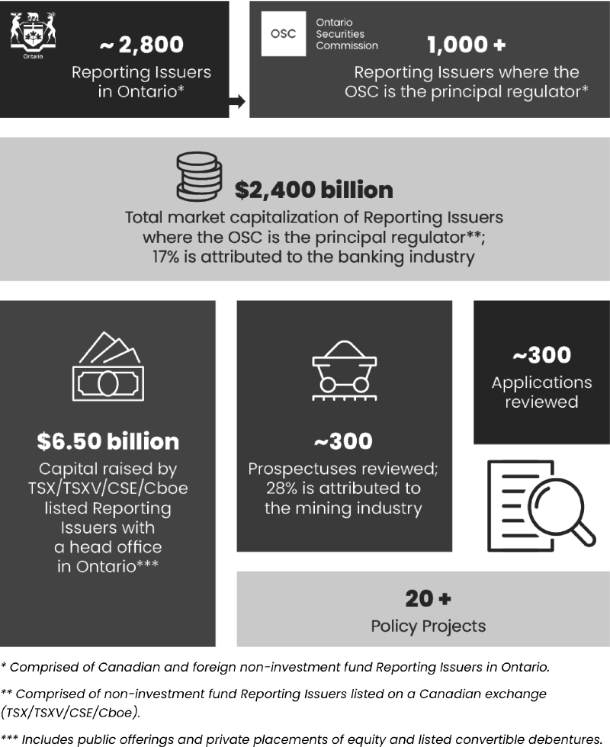
Reviewed approximately 300 prospectuses and 300 exemptive relief applications.
•
With the Economic Market and Analysis group, launched a dashboard that provides an overview of prospectus-exempt distributions by corporate issuers headquartered in Canada that raised capital from Ontario investors (the Dashboard).
•
Supported compliance with ongoing reporting obligations by completing over 350 continuous disclosure (CD) reviews.
•
Contributed to national harmonization efforts through various CSA committees.
•
Enhanced transparency regarding the use of the offering memorandum exemption by introducing the Annual Financial Statements Non-Delivery List.
•
Engaged with investors and market participants through educational and outreach programs through SME seminars and OSC Innovation Office.
•
Engaged with external stakeholders and other regulatory agencies on emerging, novel, or complex accounting, auditing, and related financial reporting issues.
* Comprised of Canadian and foreign non-investment fund Reporting Issuers in Ontario.
** Comprised of non-investment fund Reporting Issuers listed on a Canadian exchange (TSX/TSXV/CSE/Cboe).
*** Includes public offerings and private placements of equity and listed convertible debentures.
This Report provides an overview of the Division's operational and policy work during Fiscal 2025, including a summary of key findings and outcomes from our regulatory oversight programs and a status report of ongoing Issuer-related policy initiatives. The Report is intended for entities and individuals we regulate, their advisors, as well as investors and other market participants.
Through this Report, we aim to:
• REINFORCE the importance of complying with regulatory obligations;
• PROVIDE GUIDANCE to support improved disclosure and compliance practices;
• HIGHLIGHT key trends in Ontario's capital markets; and
• INFORM AND UPDATE stakeholders on new and ongoing policy initiatives.
The Division supports the OSC's mandate and vision to make Ontario's capital markets inviting, thriving and secure. Through our oversight role, we support the OSC's goal to improve transparency, trustworthiness, and efficiency in Ontario's capital markets.
In addition to operational work, the Division is engaged in policymaking to update, enhance and streamline securities regulation in alignment with the OSC's mandate.
The Division's functions are organized among the following three departments:
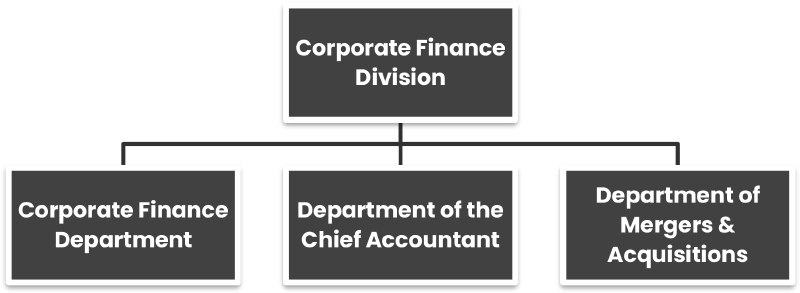
The Corporate Finance Department (CFD) focuses on the oversight of Issuers in Ontario.
The CFD's operational work includes:
Disclosure Oversight (CD, Public Offerings and Exempt Market)
• assessing, using risk-based criteria, whether Issuers in Ontario are providing the required level of disclosure of material information to investors so they can make informed investment decisions, including through the review of
• CD filed by Reporting Issuers;
• public offerings of securities by Reporting Issuers;
• capital raising activities in the exempt market;
Exemptive Relief Applications
• reviewing and considering applications for exemptive relief from regulatory requirements;
Other Regulatory Oversight
• reviewing credit rating agencies that are designated rating organizations;
• overseeing designated benchmarks and benchmark administrators;
• overseeing the listed Reporting Issuer function for OSC-recognized exchanges;
• reviewing insider reporting;
Stakeholder Engagement, Guidance and Education
• responding to inquiries and complaints;
• engaging with stakeholders, including external advisory committees;
• providing guidance to stakeholders through staff notices that communicate expectations and interpretations of regulatory requirements in certain areas; and
• delivering education and outreach programs.
The Department of the Chief Accountant (DCA) provides advisory services relating to accounting and assurance for all divisions in the OSC and is involved with policy initiatives focused on financial reporting. The DCA also engages with various external stakeholders that are involved with financial reporting, including standard setters, audit regulators, and professional accounting firms.
The DCA's operational work includes:
• overseeing securities rules and regulations related to financial reporting frameworks (e.g., IFRS Accounting Standards);
• providing advisory services to the OSC for complex accounting or assurance issues;
• advising the OSC on the impact of new financial reporting developments; and
• engaging with external stakeholders on significant financial reporting matters.
The Department of Mergers and Acquisitions (DM&A) is responsible for the regulation of mergers and acquisition (M&A) transactions and the unique risks faced by shareholders in evolving capital markets. The DM&A focuses on matters relating to take-over bids, issuer bids, business combinations, related party transactions, early warning requirements, conflict of interest transactions, defensive tactics and minority shareholder rights.
The DM&A's operational work includes:
• real-time monitoring and supervising of M&A transactions;
• responding to complaints;
• responding to inquiries;
• reviewing and considering exemptive relief applications;
• participating in M&A hearings, including making submissions and working with parties to narrow issues and navigate procedural matters; and
• engaging with stakeholders on emerging trends and policy issues.
The CFD continues to play a leading role in several significant policy initiatives with other securities regulators in the CSA in addition to policy initiatives that are applicable only in Ontario.
Policy initiatives that were implemented or achieved significant milestones over the last year to the date of this Report are outlined below. A complete list of our current policy projects can be found in Appendix B.
Access Model for Certain Continuous Disclosure Documents
On November 19, 2024, the CSA published for a 90-day comment period revised proposals to introduce an access model for annual financial statements, interim financial reports and related management's discussion & analysis (collectively, CD documents) for non-investment fund Reporting Issuers. Implementing an access model for CD documents will modernize the way CD documents are made available to investors and provide a more timely and environmentally friendly way of communicating to investors than paper delivery. Generally, access will be provided once the CD document is filed on SEDAR+ and a news release is issued to advise that the CD document is accessible on SEDAR+, the SEDAR+ notification functionality is available, how to obtain an electronic or paper copy of the document and that standing instructions can be provided.
On April 17, 2025, the CSA introduced three blanket orders aimed at supporting the competitiveness of Canada's capital markets.
CBO 41-930 supports the competitiveness of Canada's public markets by making it more cost-effective for Issuers to go public in Canada through an initial public offering (IPO) prospectus and by streamlining other disclosure requirements. Key relief includes:
• allowing Issuers to exclude audited annual financial statements and operating statements for the third most recently completed financial year in their IPO prospectuses and, circulars or material change reports that are filed in relation to a restructuring transaction;
• allowing Issuers to include, subject to certain conditions, specified pricing information in marketing materials and standard term sheets distributed during the waiting period without first disclosing the information in a preliminary prospectus or an amendment to a preliminary prospectus; and
• allowing Issuers, in Ontario and certain other jurisdictions, to exclude promoter certificates from a prospectus where the promoter signs a certificate in the prospectus in another capacity, subject to the satisfaction of specified conditions.
CBO 45-930 provides a prospectus exemption for companies that will be going or have recently gone public in Canada through an underwritten IPO, giving them greater flexibility to raise additional capital following the IPO, provided certain conditions are met.
The key relief provides that, subject to certain conditions, within the 12-month period after a receipt is issued for a final long form IPO prospectus for an underwritten offering, a Reporting Issuer may, in total, distribute up to the lesser of $100,000,000 or 20% of the aggregate market value of the Reporting Issuer's listed equity securities on a specified date.
CBO 45-933 provides Issuers greater access to capital by providing an exemption from the $100,000 investment limit in NI 45-106, such that a re-investment of proceeds of disposition of an investment in the same Issuer does not count towards the investment limit, provided that the investor receives advice from a registered dealer or registered adviser that the re-investment of proceeds and any new investment under the offering memorandum exemption continues to be suitable for the investor.
In Ontario, all three blanket orders will expire on October 16, 2026, unless extended.
On May 14, 2025, the CSA published CBO 45-935, which increased the capital raising limit under the listed issuer financing exemption. Pursuant to CBO 45-935, listed Reporting Issuers can raise the greater of $25 million and 20% of the aggregate market value of their listed securities, up to a maximum of $50 million in a 12-month period, subject to certain conditions.
In Ontario, CBO 45-935 will expire on November 15, 2026, unless extended.
In response to increased uncertainty and rising competitiveness concerns for Issuers, on April 23, 2025, the CSA announced that it had paused its work on the development of a new mandatory climate-related disclosure rule.
We remind Issuers that existing securities legislation requires disclosure of material climate-related risks and related matters in an Issuer's regulatory filings. We also remind Issuers that misleading climate-related disclosures (often referred to as greenwashing) are not permitted under securities law. We refer Issuers to the following staff guidance, previously issued by the CSA, that may assist Issuers with climate-related disclosure:
• CSA Staff Notice 51-333 Environmental Reporting Guidance (2010) provides guidance on reporting of material environmental risks, including climate- related risks, and related matters.
• CSA Staff Notice 51-358 Reporting of Climate Change-rated Risks (2019) provides guidance on how Issuers might approach preparing disclosures about material climate-related risks.
• CSA Staff Notice 51-365 (2024) provides guidance on avoiding overly promotional claims by Issuers that could potentially be considered "greenwashing".
We continue to review disclosure of climate-related matters as part of our ongoing CD review program.
Following the CSA's publication of Consultation Paper 43-401 Consultation on National Instrument 43-101 Standards of Disclosure for Mineral Projects in 2022, on June 12, 2025, the CSA proposed amendments to NI 43-101, Form 43-101F1 and Companion Policy 43-101CP. The proposed amendments are intended to clarify, harmonize and streamline Canada's mining disclosure regime without introducing any new requirements. Specifically, the proposed amendments would update and enhance the standards for disclosing scientific and technical information about mineral projects to address evolving disclosure practices and policy considerations identified by CSA staff, and to reflect changing industry and investor expectations. The comment period for the proposed amendments ended on October 10, 2025.
On August 28, 2025, the CSA published final amendments to NI 44-102 to introduce a permanent expedited shelf prospectus regime for WKSIs in Canada. The amendments foster capital raising and support the competitiveness of Canadian markets by reducing regulatory burden for eligible WKSIs. The amendments came into force on November 28, 2025, and allow eligible WKSIs to:
• file a final base shelf prospectus and be deemed to receive a receipt for that prospectus without first filing a preliminary base shelf prospectus or undergoing any regulatory review;
• omit certain disclosure from the base shelf prospectus; and
• benefit from receipt effectiveness for a period of 37 months from the date of its deemed issuance, subject to the requirement for the Reporting Issuer to reassess its qualification to use the WKSI regime annually.
On September 25, 2025, the OSC published for comment new prospectus exemptions in CSA MI 45-111, which will provide new sources of capital for non-investment fund Issuers that have their head office in Canada and increased investment opportunities for investors who may not meet the financial thresholds or other criteria required to qualify as an accredited investor. In order to qualify, investors must meet other criteria intended to demonstrate financial knowledge, investment knowledge or relevant industry-specific experience, and acknowledge that they understand certain investment considerations and risks, among other conditions.
The OSC also published a new blanket order, OI 45-510, which came into effect on October 25, 2025, for an 18-month period. OI 45-510 provides time-limited prospectus exemptions, based on the self-certified investor prospectus exemptions in CSA MI 45-111 while the proposed multilateral instrument is being considered.
The OSC also published local amendments to section 2.4 of NI 45-106 to allow private issuers to distribute securities to self-certified investors under OI 45-510 and OI 45- 507 (collectively, the Class Orders) without losing their status as a private issuer and their ability to rely on the private issuer prospectus exemption in NI 45-106. The local amendments also amend section 2.4 of NI 45-106 to provide that the prohibition against paying a commission or finder's fee to any director, officer, founder or control person of an Issuer does not apply to a distribution to a self-certified investor in reliance on the Class Orders. The local amendments came into force on December 4, 2025.
On October 23, 2025, the CSA published for a 60-day comment period proposed CBO 51-933 to introduce a multi-year pilot project which would allow eligible Venture Issuers to voluntarily adopt semi-annual financial reporting, subject to certain terms and conditions. The SAR Pilot, which would include exemptions from certain CD requirements, aims to reduce administrative burden and costs associated with the preparation of the first and third quarter financial disclosures.
Upon adoption, Ontario's local blanket order will include an 18-month expiry date based on the statutory term limits for blanket orders. Therefore, the OSC concurrently published for a 60-day comment period proposed OSC Rule 51-507 to maintain the CD exemptions that will be in Ontario's local blanket order after its expiry.
The comment period for the SAR Pilot will end on December 22, 2025. The CSA anticipates the SAR Pilot will be in force prior to the end of March 2026.
This section provides an overview of the key findings and outcomes from our Fiscal 2025 CD review program (CDR Program). We highlight key or novel issues, discuss best practices, and reference relevant legislation and guidance to assist Issuers in addressing each topic.
Under Ontario securities law, a Reporting Issuer must provide timely and periodic CD about its business and affairs. The CDR Program seeks to assess whether Reporting Issuers are complying with disclosure obligations and to identify material deficiencies that may affect the reliability and accuracy of a Reporting Issuer's disclosure record. For further information about the CDR Program, refer to CSA Staff Notice 51-312, CSA Staff Notice 51-365 and our website.
The Division has primary responsibility as principal regulator{2} over 1,000 Reporting Issuers with an aggregate market capitalization of approximately $2,400 billion as of March 31, 2025. The three largest industries by market capitalization were banking, mining, and technology.
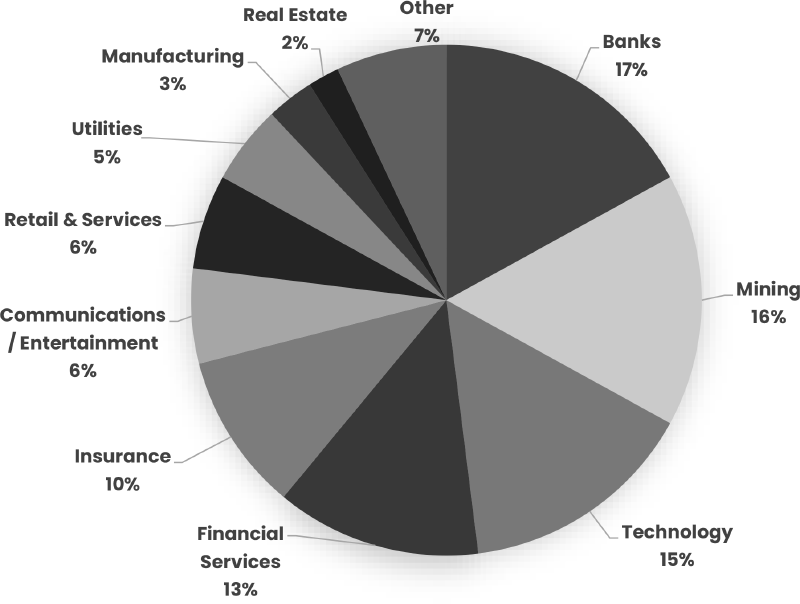
The CDR Program is conducted pursuant to the powers in subsection 20.1(1) of the Act and is part of a harmonized CDR Program across the CSA.{4} Our CDR Program is risk-based and outcome-focused. It includes planned full reviews and issue- oriented reviews (IORs) based on risk criteria as well as ongoing monitoring through news releases, media articles, complaints, and other sources.
As public markets evolve over time, we see different industries and/or issues gain public prominence and attract significant amounts of investor capital. We reassess our selection criteria to reflect emerging risks and trends, which impacts file selection accordingly.
We track several categories of outcomes for the CDR Program:
• Immediate corrective action is required: includes the refiling of a previously filed CD document or the filing of a document that should have been previously filed, a referral to the Enforcement division of the OSC, or the issuance of a cease trade order (CTO).
• Prospective enhancements are required: includes changes or enhancements required to be incorporated in the next filing as a result of deficiencies identified.
• No action is required: instances where no corrective changes or additional filings are required.
• Ongoing Oversight: applies specifically to IORs and involves an initial high- level review of disclosure to determine whether direct engagement is required or to conclude that no further action is required. These reviews include ongoing monitoring of Reporting Issuers, high-level reviews of Technical Reports, and reviews triggered by significant industry developments. If we determine that direct engagement is required with the Reporting Issuer to address potentially significant disclosure deficiencies, a formal IOR file will be opened.
A CD review may result in more than one outcome. For example, a Reporting Issuer may be required to refile certain CD documents while also committing to prospective disclosure enhancements. Tracking these outcomes assists us in planning the CDR Program, including the re-evaluation of our existing risk-based selection criteria.
The outcomes on a year-over-year basis should not be interpreted as trends since the nature of the reviews, issues identified, and number of Reporting Issuers reviewed each year are generally different.
The following summarizes CD review outcomes for Fiscal 2025, and for the fiscal year ended March 31, 2024 (Fiscal 2024).{5}
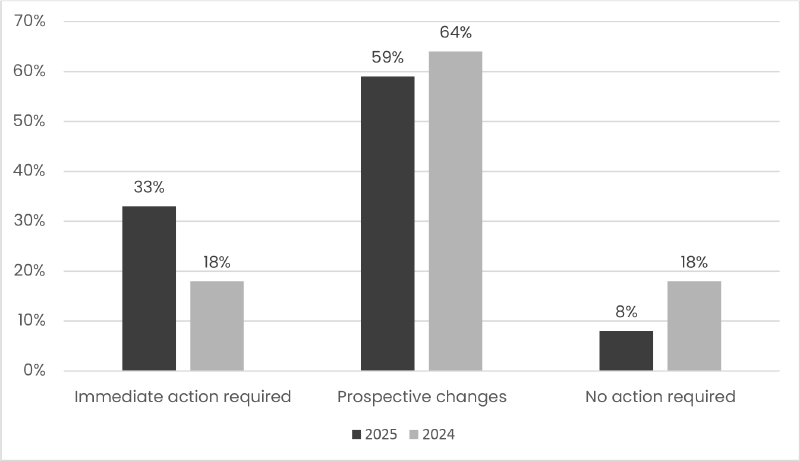
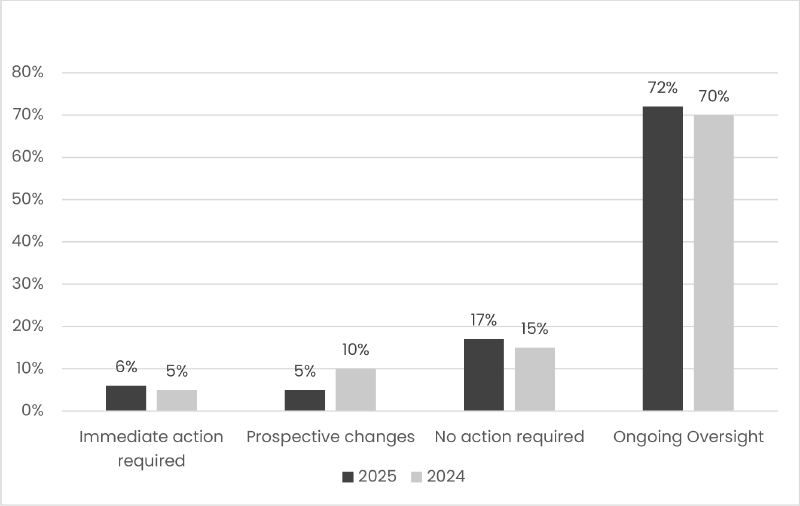
The most common types of immediate action required from Reporting Issuers were amendments made to their CD record, including the following:
• refiling of financial statements to correct material misstatements;
• refiling of management's discussion and analysis (MD&A), where the form was materially deficient and did not meet the form requirements of Form 51- 102F1;
• refiling or filing (in instances when documents were not filed in the first place) of material contracts and material change reports;
• filing of executive compensation and corporate governance disclosure that was required to be filed at an earlier date; and
• refiling of a Technical Report where the report filed was not in compliance with NI 43-101.
Reporting Issuers that refile CD documents during our review are placed on the Refilings and Errors List found on our website.
This section highlights some of the common deficiencies and areas for improvement that were observed during our CD reviews in Fiscal 2025. It includes best practices and guidance to assist Reporting Issuers in meeting their regulatory obligations.
We direct readers to previously published Corporate Finance Annual Reports for further guidance, and in particular, the following topics from the Corporate Finance 2024 Annual Report:
• boilerplate discussion of operations (page 14);
• additional disclosure for Venture Issuers without revenue (page 17); and
• problematic promotional disclosures (page 18).
The rapidly evolving global political and economic environment is contributing to significant market uncertainty for Issuers. As a result, Issuers must continually assess the impacts of ongoing developments to determine whether their existing disclosure is sufficient. Issuers should provide timely, meaningful, transparent, and balanced
disclosures about related impacts and uncertainties to help investors make informed investment decisions.
Issuers should consider the broader impact of tariff policies when evaluating the impact of these policies on their business and operations, including disruption to supply-chains and access to raw materials and prices paid for such raw materials.
While this list is not exhaustive, disclosures that may be relevant to understanding the impact of the tariffs include:
• key risks to the Issuer;
• known and expected trends, demands, events or uncertainties related to tariffs that management reasonably believes will materially affect the Issuer's future revenue, expenses or projects;
• whether the Issuer has been impacted by counter tariffs imposed by the Canadian Federal government, or by other jurisdictions;
• operational changes and other measures taken by management in response to tariffs, including any plans to reallocate assets to another country, or divest of certain investments;
• the current and expected impact on the Issuer's operations and financial condition, including liquidity and capital resources; and
• other financial reporting considerations.
Reporting Issuers should also assess whether the impact of tariffs triggers the requirement to file a material change report. While Reporting Issuers may have provided detailed operational updates via news releases, we remind Reporting Issuers that such disclosure should also be included and updated in prospectuses and CD documents, such as MD&A and AIFs.
Depending on specific facts and circumstances, there could be numerous accounting implications across multiple areas such as going concern assessments, judgements and estimates, impairment of non-financial assets, etc. We remind Issuers that they must consider:
• all relevant events and information up to the authorisation date of the financial statements, particularly in relation to the going concern assessment; and
• as new information becomes available, whether their judgements and estimates need to be updated and reflected in their interim financial reports.
Forward-looking information (FLI) is an area of interest to many investors and can provide valuable insight about a Reporting Issuer's business and how it intends to attain its corporate objectives and targets.
Some Reporting Issuers present FLI that span multiple years, without providing reasonable and sufficient quantitative and qualitative assumptions to support the FLI. FLI should be limited to a time period that can be reasonably estimated, which generally will not go beyond the end of the Reporting Issuer's next fiscal year, unless supported by robust, specific, and verifiable assumptions.
However, in some industries (e.g., mining) longer term forecasts may be more common owing to more predictable quantitative forecast inputs. There may also be other scenarios where long-term FLI is relevant and supportable. Where long-term FLI is presented:
• all multi-year projections must be based on assumptions that are reasonable and supportable in the circumstances (not simply best estimates which cannot be supported); and
• the assumptions for financial projections must be specific and comprehensive, particularly with respect to quantitative details, such that an investor is able to clearly understand how each assumption was used to develop the FLI.
Where FLI is presented for multiple years without adequate support, staff may ask Issuers to limit the disclosure to cover a shorter period that can be more clearly supported (for example, one or two years, depending on facts and circumstances).
For more information on FLI, including multi-year FLI, please refer to the Corporate Finance 2022 Annual Report. Below is an example of disclosure that would not meet our expectations, followed by enhanced disclosure.
Disclosure Type |
Example |
|
|
Unsupported Long-Term FLI Disclosure |
During fiscal 20X5, we began construction of a second manufacturing facility. Facility construction will be completed in 2 years and will allow us to increase revenues by 50% in year 3, 60% in year 4 and 70% in year 5. |
|
|
Enhanced Disclosure |
During fiscal 20X5, we began construction of a second manufacturing facility. Facility construction will be completed in 2 years. The new facility will be approximately 100,000 square feet, which is approximately 50% of the square footage of our current facility. Given that manufacturing output is highly correlated to square footage available and given that our existing customers have already expressed interest in purchasing this increased throughput, we expect this will allow us to increase revenues by 50% in year 3. |
|
|
|
We also expect that new manufacturing processes will allow us to further enhance output levels on a per square foot basis, beginning in year 4, however the potential effectiveness of these new processes is not yet known, as they remain in development at this time. |
Pursuant to NI 52-110, audit committee members must not have a direct or indirect material relationship with the Reporting Issuer.{6} Similarly, section 1.2 of NI 58-101 prescribes that a director is "independent" if he or she would be independent within the meaning of section 1.4 of NI 52-110. A material relationship is defined as a relationship which could, in the view of the Reporting Issuer's board of directors, be reasonably expected to interfere with the exercise of a member's independent judgement. The purpose of the independence requirement is to support board members exercising independent judgment in performing their independent director or audit committee member duties.
What are the material relationships in NI 52-110?
NI 52-110 defines certain relationships as material relationships and thereby precludes some individuals from being considered independent. These material relationships are set out as bright line tests in sections 1.4 and 1.5 of NI 52-110, and they apply regardless of any determination of independence made by the board of directors. To be considered an independent director, an individual must not have a relationship captured by the bright line tests that are set out in section 1.4 of NI 52-110. To be considered an independent audit committee member, an individual must not have a relationship captured by the bright line tests that are set out in sections 1.4 and 1.5 of NI 52-110.
What are the bright line material relationship triggers in paragraphs 1.4(3)(a) and (f) of NI 52-110?
Staff have received inquiries as to whether, in certain fact patterns, subsection 1.4(7) of NI 52-110 provides for the non-application of the bright line test in subsection 1.4(3) of NI 52-110. Staff's position is that the material relationship triggers in subsection 1.4(3) of NI 52-110 are bright line tests, and once triggered, the bright line tests apply regardless. Below we consider the bright line material relationship triggers in paragraphs 1.4(3)(a) and (f) of NI 52-110.
Paragraphs 1.4(3)(a) and (f){7} respectively prescribe that an individual is considered to have a material relationship with the Reporting Issuer if such individual:
• is, or has been within the last three years, an employee or executive officer of the Reporting Issuer; or
• received more than $75,000 in direct compensation from the Reporting Issuer during any 12-month period within the last three years.
Guidance on subsections 1.4(3) and 1.4(7) of NI 52-110
Subsection 1.4(7){8} of NI 52-110 operates as a carve-out in certain limited factual circumstances to the bright line material relationship triggers in subsection 1.4(3) of NI 52-110. However, in circumstances where an individual also has a relationship captured by any of the bright line material relationship triggers contained in subsection 1.4(3) of NI 52-110, (as an example, the individual has previously acted as an interim CEO and received more than $75,000 in direct compensation for that interim role), this individual would not be considered independent for the purposes of NI 52-110 as the bright line tests apply regardless.
Subsection 1.4(7) of NI 52-110 prescribes that a material relationship is not imputed on an individual solely because the individual:
• has previously acted as an interim chief executive officer of the Reporting Issuer, or
• acts, or has previously acted, as a chair or vice-chair of the board of directors or of any board committee of the Reporting Issuer on a part-time basis.
If Issuers are unsure of a director's independence status, they should consult with their legal counsel.
"Trade" is defined broadly in the Act and includes "any act, advertisement, solicitation, conduct or negotiation directly or indirectly in furtherance of" a trade. While the definition of "trade" includes a carve-out for "a transfer, pledge or encumbrance of securities for the purpose of giving collateral for a debt made in good faith", a recent decision by the Capital Markets Tribunal (the Tribunal) that was subsequently affirmed by the Ontario Superior Court of Justice (Divisional Court) serves as an important reminder that this is a narrow exception and covers only the transfer, pledge, or encumbrance itself.
As noted by the Tribunal, "[the carve-out] does not apply to the different ways in which a pledgee may deal with the pledged securities. Nor does it apply to the issuance of debt itself. Each of those dealings is a separate transaction which must be tested to determine if it is, itself, a trade within the Act's definition."
We recommend that market participants seeking to rely on this carve-out to transfer, pledge or otherwise encumber securities of an Issuer that is subject to a CTO proceed with caution and, where appropriate, seek professional advice. While the specific transfer, pledge, or encumbrance of securities by the borrower to secure a bona fide debt may not be impacted by the CTO, such securities would remain subject to the CTO.
Where there is evidence to suggest that the transfer, pledge or encumbrance is made as part of a pre-arranged scheme and a trade related to the securities is expected, involvement in the conveyance may constitute acts in furtherance of a trade. Such acts may breach the CTO and may warrant compliance and/or enforcement action.
The determination of whether acts are in furtherance of a trade is a factual consideration examining the totality of conduct including, but not limited to, consideration of the surrounding circumstances, proximity of the acts to the potential trades, and the impact of the conduct. A strong indicator that actions further a trade is when benefits are directly or indirectly acquired as a result of the trade. There need not be a completed sale or disposition of a security for acts to be in furtherance of a trade; all that is required is acting for the purpose of doing so.
Reporting Issuers are reminded that entering into bankruptcy, insolvency, restructuring or receivership proceedings (collectively, the proceedings) does not relieve or exempt them from their securities filing requirements. If a Reporting Issuer is in default under securities laws, the principal regulator for the Reporting Issuer will generally issue a failure-to-file cease trade order (FFCTO) requiring all trading in the securities of the Reporting Issuer to cease. Where the OSC is the principal regulator for a Reporting Issuer, the proper forum to seek an exemption from securities filing requirements is the OSC.
When Reporting Issuers become the subject of a proceeding, they are generally expected to issue and file a news release disclosing the nature and circumstances of the proceeding. Reporting Issuers should also consider whether such proceedings trigger the timely disclosure requirement under section 75 of the Act.
We expect and encourage Reporting Issuers undergoing a proceeding to consider the regulatory implications of such proceeding in their court orders. For example, where a Reporting Issuer is subject to an FFCTO, any proposed sale, restructuring or other transaction arising out of a proceeding may require exemptive relief from the OSC to revoke or vary the FFCTO, even if the transaction is conducted under a court- supervised process. We encourage Reporting Issuers to seek legal advice from a qualified securities lawyer to determine whether specific provisions of their court order or other related relief sought within a proceeding is compliant with securities law requirements and any outstanding orders against the Reporting Issuer.
For further information on the regulatory implications for a Reporting Issuer undergoing a proceeding, refer to our website.
We continue to observe instances where Reporting Issuers do not file amended versions of a previously filed material contract. Pursuant to Companion Policy 51- 102CP, an amendment to a material contract or an amended material contract is treated as a "material contract" and must be filed on SEDAR+. The required timelines for filing material contracts are set out in NI 51-102 and summarized below.
Description |
Timeline for Filing |
|
|
If the Issuer is required to file an AIF |
|
|
|
A material contract for which a material change report is filed |
The material contract must be filed no later than the material change report |
|
|
All other material contracts |
Material contracts made or adopted before the date of the AIF must be filed no later than the time of filing the AIF |
|
|
If the Issuer is not required to file an AIF |
|
|
|
A material contract for which a material change report is filed |
The material contract must be filed no later than the material change report |
|
|
All other material contracts |
Material contracts must be filed within 120 days after the end of the financial year in which they were made or adopted |
Under Ontario securities law, to distribute securities, an Issuer must file and obtain a receipt for a prospectus or rely upon a prospectus exemption. A key component of our oversight of Issuers in Ontario's capital markets is the review of prospectuses in connection with public offerings. This section outlines data and trends with respect to public offerings and provides guidance on common issues that arise during our prospectus reviews.
The economy and financial markets experienced significant challenges in Fiscal 2025, driven by economic instability, trade uncertainty, and geopolitical shifts.
Capital market activity remained relatively stable in Fiscal 2025, with approximately 300 prospectuses reviewed -- fairly consistent with Fiscal 2024. These filings covered a wide range of industries with mining, financial services and technology being the most active sectors{9} based on the number of offerings.
Prospectuses Reviewed by Industry{10}
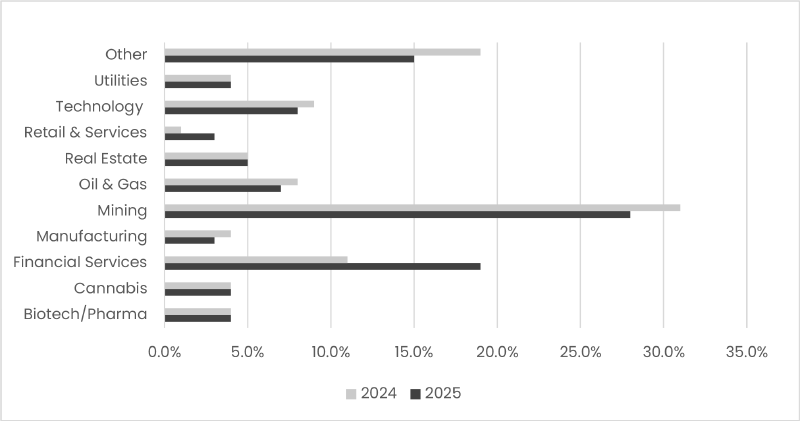
The table below highlights some of the common deficiencies and areas for improvement that were observed during our reviews of prospectus filings in Fiscal 2025.
Deficiency |
Guidance |
|
|
||
Description of the business |
Issuers in the early stages of development often lack sufficient detail about the nature of their business. This is often observed with Issuers filing a non-offering prospectus or completing a reverse takeover transaction. |
|
|
||
|
Prospectus disclosure about the business and/or business plan must be entity-specific. Issuers with preliminary business plans, no binding agreements, or unexecuted business plans or strategies, should include clear prospectus disclosure of these facts. |
|
|
||
|
In discussing future plans, Issuers should avoid using overly promotional language that overstates their current stage of development. |
|
|
||
|
For more information, please see pages 38-39 of the Corporate Finance 2022 Annual Report. |
|
|
||
Significant developments during the course of a review |
During a prospectus review, significant developments may arise that impact an Issuer's business or operations. For example, evolving market conditions, financings, new or amended material contracts, board or executive officer changes, commencing a strategic review process etc. In addition to complying with applicable securities law requirements (e.g., material change reporting, filing an amendment to a preliminary prospectus), Issuers should advise staff of relevant developments as soon as possible. |
|
|
||
Comfort letter requirements |
Pursuant to subparagraph 9.1(1)(b)(iii) of NI 41-101, Issuers filing a preliminary prospectus that is accompanied by an unsigned auditor's report must file a comfort letter (the Letter) signed by their auditors and addressed to the applicable securities regulatory authorities where the prospectus is being filed. |
|
|
||
|
This Letter informs the regulatory authorities that the auditor is in a position that it could sign the report of the auditors as at a date that is as close as is reasonable and practicable to the date of the preliminary prospectus. It is our expectation that this Letter should only be provided where the audit has been substantially completed, except for the four matters set out in paragraph A38 of Section 7150 Auditor's Consent to the Use of a Report of the Auditor Included in an Offering Document. |
|
|
||
|
The Letter provides comfort on the financial statements and informs the regulatory authorities that the audit has been substantially completed, except for: |
|
|
||
|
• |
consideration of events between the dates of the preliminary and final prospectuses; |
|
||
|
• |
review of comments issued by securities regulators; |
|
||
|
• |
authorization of the financial statements by those charged with governance; and |
|
||
|
• |
reading of the final prospectus. |
|
||
|
We remind Issuers that the Letter must be signed, dated and must not include other qualifications outside of the four specific items bulleted above. |
|
The discussion in the CD section of this Report is also applicable to prospectus filings. The following topics from the Corporate Finance 2024 Annual Report were also commonly observed this year:
• significant projects without revenue (page 15);
• confidential pre-file prospectuses (page 31);
• financial condition and sufficiency of proceeds (page 32);
• president's lists (pages 33-34); and
• conditional approval letters (page 35).
A special purpose acquisition corporation (SPAC) is a shell company that facilitates capital formation by permitting experienced management teams to raise funds from public investors to acquire a business that will become a listed Reporting Issuer on a non-venture exchange. The regulatory purpose and rationale underlying the SPAC regime is to provide an alternative listing mechanism to an IPO for non- reporting Issuers. Further to applicable rules, a prospectus must be filed with the relevant securities commission or authority at the time of the IPO, and a non-offering prospectus must be filed at the time of the qualifying acquisition (QA) or qualifying transaction (QT), as applicable.
Given that a SPAC may have up to 36 months to complete a QA or QT, it is important that investors receive clear and consistent disclosure at the time of the IPO regarding the SPAC, including the nature and scope of a potential QA or QT. Such disclosure assists investors in making an informed investment decision. Given that the purpose of a SPAC program is to provide an alternative listing mechanism for non-reporting Issuers, staff expect that this disclosure will include a statement in the IPO prospectus that the SPAC will not complete or propose to complete a QA or QT, as applicable, with or involving any Reporting Issuer.
We have recently observed a number of Issuers that have questioned whether the interpretation provisions respecting the terms "subsidiary", "affiliate", "control", and "beneficial ownership of securities" in subsections 1(2) to 1(6) of the Act lead to the conclusion that non-corporate entities or relationships (such as partnerships or trusts) are precluded from being subsidiaries under the Act. Specifically, since the interpretation provision in subsection 1(4) of the Act describes the circumstances in which "a company shall be deemed to be a subsidiary of another company", does this mean that a subsidiary relationship can only arise between two entities that are "companies"?
For clarity, staff are of the view that subsections 1(2) to 1(6) of the Act are non- exhaustive interpretation provisions rather than exhaustive definitions, and therefore, these provisions do not have the effect of excluding an unincorporated entity from being a subsidiary or an affiliate of another entity or from controlling or being controlled by another entity. Accordingly, staff take the position that the term "subsidiary" under securities legislation may include companies as well as other types of business organizations or relationships such as partnerships, trusts and other unincorporated business entities.
We note that if an Issuer were to take the position that a non-corporate entity that is directly or indirectly controlled by the Issuer is not a "subsidiary" for the purposes of Ontario securities law, this may raise important public interest concerns. For example, staff would likely have significant concerns with an Issuer asserting that an operating company (Opco) that was directly or indirectly controlled by a holding company (Holdco) was not a subsidiary of Holdco because of an intervening partnership or trust, and that as a result Holdco was not required to consolidate the financial information of Opco in its financial statements and directors and officers of Opco were not considered "insiders" of, or persons in a "special relationship" with, Holdco.
We also remind Issuers of the interpretive language in:
• subsections 1.1(2) and 1.1(3) of NI 51-102 regarding the meaning of affiliate and control, respectively; and
• instruction (17) of Form 44-101F1 regarding the meaning of subsidiary: "Wherever this Form uses the word "subsidiary", the term includes companies and other types of business organizations such as partnerships, trusts, and other unincorporated business entities."
We have seen renewed interest from Issuers in the crypto asset industry, which seems to be in part driven by regulatory developments in the U.S. We remind Issuers of our previous guidance listed at the end of this section.
We also remind Issuers with operations in Canada (whether providing products or services from a location in Canada or to residents of Canada) that there are potential public interest concerns if an Issuer that is not in compliance with securities laws were to become a Reporting Issuer.{11} For example, this would be the case if an Issuer that is conducting business that requires registration under securities legislation is not yet registered. It is also an exchange listing requirement that Issuers be in compliance with securities laws.
If an Issuer in the crypto asset industry intends to become a Reporting Issuer by way of a reverse takeover, change of business, or other means not requiring the filing of a prospectus, we expect the Issuer to contact staff to discuss its compliance with securities laws sufficiently in advance of any such transaction at cryptocompliance@osc.gov.on.ca.
If an Issuer engaged in crypto businesses intends to become a Reporting Issuer by filing a prospectus, we encourage the Issuer to consider submitting a confidential prospectus pre-filing, if eligible, to provide an opportunity to discuss the Issuer's compliance with securities laws.
We have recently seen several Reporting Issuers publicly announce that they intend to pursue a crypto asset "treasury" strategy whereby they propose to raise money from the public to purchase and hold (or lend, stake or otherwise seek to profit from) Bitcoin or other crypto assets (collectively, a crypto asset treasury strategy).
We have also seen several Reporting Issuers that are not in the crypto asset industry announce that they intend to hold a "treasury" of crypto assets, primarily Bitcoin, as a hedge against inflation or for other reasons. Where a Reporting Issuer is not pursuing a crypto asset treasury strategy but does intend to hold a certain amount of crypto assets, it should consider the materiality of the crypto asset holdings to its business and the guidance below.
We have included guidance below based on our observations of recent disclosure made by Reporting Issuers pursuing crypto asset treasury strategies. We will continue to monitor disclosure made by these types of Issuers through our review program activities. Issuers should also refer to our previous guidance at the end of this section. In general, we remind Issuers that disclosure must be specific to their business, including with respect to any objectives, products, services and risks.
Issuers whose primary business is a crypto asset treasury strategy share many similarities with investment funds. We may raise comments about whether the Issuer is an investment fund or whether the Issuer or any of its service providers are engaged in activities that require registration as a dealer, adviser or investment fund manager.
Pursuant to recent amendments to NI 81-102, investment funds that are Reporting Issuers are only permitted to purchase, sell, use or hold crypto assets that satisfy certain criteria. Where a Reporting Issuer is proposing to pursue a crypto asset treasury strategy using crypto assets that would not meet the criteria set out in NI 81- 102, this raises concerns about potential regulatory gaps.
Additionally, certain of the criteria in NI 81-102 are designed to promote accurate price discovery, given that some crypto assets may not be traded in "active markets". Where a Reporting Issuer pursues a crypto asset treasury strategy using crypto assets that would not meet the criteria set out in NI 81-102, we expect the Reporting Issuer to adequately demonstrate that it is able to satisfy its disclosure obligations such that investors would have full, true and plain disclosure of all material facts.
The features and characteristics, including risk profiles, of crypto assets vary significantly. If a Reporting Issuer were to change its fundamental investment strategy, including the features and characteristics of the crypto assets it holds, we would generally consider this to be a material change and a change of business. A change of business of this nature would generally require shareholder approval.
If the Reporting Issuer has a prospectus that is in effect, we would also expect it to file an amendment to its prospectus and have received a receipt for the amended prospectus before implementing the change in investment strategy. We encourage these Issuers to consider submitting a confidential prospectus pre-file if they are considering implementing a change in investment strategy.
For Reporting Issuers that are pursuing a crypto asset treasury strategy, their primary asset is a portfolio of one or more crypto assets. Where the Reporting Issuer retains a third-party to custody those crypto assets, we would generally consider any contracts with the custodian to be material contracts upon which the Reporting Issuer's business is substantially dependent. If a material contract is entered into in the ordinary course of business but the Reporting Issuer's business is substantially dependent upon the contract, the contract is required to be filed on SEDAR+ pursuant to paragraph 12.2(2)(f) of NI 51-102.
If an Issuer pursuing a crypto asset treasury strategy files a prospectus, we may raise comments about whether the Issuer reasonably expects to distribute securities of that amount. We expect that an Issuer would be able to provide a rationale for the size of the offering based on its planned crypto asset acquisition strategy, including specifics about the amount of crypto assets it intends to acquire and the frequency of planned acquisitions and the reasonableness of the planned acquisitions based on the market for the particular crypto asset. The size of the offering may also raise blind pool concerns.
- - - - - - - - - - - - - - - - - - - - - - - - - - - - - - - - - - - - - - - - - - - - - - - - - - - - - - - - - - - - - - - - - - - - - - - - - - - - - -
For more information and guidance on crypto assets, Issuers should also review:
• Corporate Finance 2022 Annual Report
• CSA Staff Notice 51-363 Observations on Disclosure by Crypto Assets Reporting Issuers
• Joint CSA/IIROC Staff Notice 21-330 Guidance for Crypto-Trading Platforms: Requirements relating to Advertising, Marketing and Social Media Use
• CSA Staff Notice 21-327 Guidance on the Application of Securities Legislation to Entities Facilitating the Trading of Crypto Assets
• CSA Staff Notice 51-356 Problematic promotional activities by issuers
• NP 51-201
• Multilateral Staff Notice 51-359 Corporate Governance Related Disclosure Expectations for Reporting Issuers in the Cannabis Industry
• CSA Staff Notice 81-336 Guidance on Crypto Asset Investment Funds That are Reporting Issuers
- - - - - - - - - - - - - - - - - - - - - - - - - - - - - - - - - - - - - - - - - - - - - - - - - - - - - - - - - - - - - - - - - - - - - - - - - - - - - -
During Fiscal 2025, we continued our oversight of capital-raising activities in the exempt market in Ontario, including by non-reporting Issuers. Our exempt market oversight program, like our CDR Program for Reporting Issuers, is risk-based and outcomes-focused.
The exempt market oversight program generally includes reviews of Issuers that have raised capital from Ontario investors in reliance on the prospectus exemptions in NI 45-106, or other securities legislation, with a particular focus on non-reporting Issuers that have relied on the offering memorandum prospectus exemption in subsection 2.9 of NI 45-106 (OM Exemption). Our reviews include consideration of offering memoranda, subscription agreements, risk acknowledgments and marketing materials, and reports of exempt distribution on Form 45-106F1.
Non-compliance with applicable provisions of NI 45-106 or other securities legislation may result in staff requesting that the Issuer take corrective action.
This section:
• highlights market trends in exempt market data;
• identifies common deficiencies and areas for improvement that were observed during our IORs of exempt market Issuers in Fiscal 2025; and
• provides guidance to assist Issuers in meeting their regulatory obligations.
We encourage exempt market Issuers to review the information set out below with a view to better understanding their obligations and improving the quality of their disclosure.
On December 24, 2024, the OSC published a Dashboard of capital raising activity by Canadian corporate (non-investment fund) Issuers in Ontario's exempt market. The Dashboard provides an overview of prospectus-exempt distributions by corporate Issuers headquartered in Canada that raised capital from Ontario investors between 2018 and 2024. The data covers exempt market or private market financing activity under prospectus exemptions that are required to be reported to the OSC on Form 45-106F1. The Dashboard represents data that was collected, processed and presented on a best-efforts basis and does not include information about prospectus-exempt distributions made by foreign Issuers in Ontario's exempt market.
In 2024, the most recent year for which the Dashboard provides information, approximately $58.4 billion of capital was raised in the exempt market by Canadian corporate issuers, with approximately $55.6 billion being invested by institutional investors and $2.8 billion invested by individual investors.
The Accredited Investor Exemption is the leading prospectus exemption, by capital raised, and represents approximately $52.7 billion in capital raised in 2024. The Minimum Amount Investment Exemption follows, representing $4.8 billion in capital raised.
We remind Issuers that any offering memorandum used under the OM Exemption must comply with the terms and conditions of that exemption. For example:
• subsection 2.9(19.6) of NI 45-106, if applicable, requires an "existing use" appraisal report; and
• section 6.4 of NI 45-106 prescribes additional disclosure in the offering memorandum if there is a distribution of a syndicated mortgage, the Issuer is engaged in real estate activities or the Issuer is a collective investment vehicle.
Additionally, if an Issuer intends to invest, lend or otherwise transfer a significant amount of the proceeds of an offering to another Issuer, and the Issuer views the other Issuer as a subsidiary (as defined in section 1.1 of NI 45-106), we expect the Issuer to treat the other Issuer as a subsidiary for all purposes of Ontario securities law, including for the purposes of the Issuer's financial statements disclosure. If the other Issuer is not a subsidiary, the Issuer should include the disclosure required by item 1.3 Proceeds Transferred to Other Issuers of Form 45-106F2.
The OM Exemption provides that an Issuer must not make a misrepresentation in an offering memorandum and must not deliver an offering memorandum unless the offering memorandum contains sufficient information to enable a reasonable purchaser to make an informed investment decision. We expect Issuers to prepare their offering memoranda and other offering documents in a manner consistent with this principle and in a way that prioritizes substance over form.
We remind Issuers conducting an ongoing distribution under the OM Exemption that NI 45-106 requires that the offering memorandum be periodically amended to include the Issuer's audited annual financial statements for its most recently completed financial year in accordance with the Instructions for Completing Form 45-106F2 Offering Memorandum for Non-Qualifying Issuers B. Financial Statements -- General.
Where staff become aware of an Issuer distributing securities in purported reliance on a prospectus exemption but without complying with the conditions of the prospectus exemption, staff may recommend enforcement action against the Issuer, its principals, and any intermediaries involved in the transaction. We also remind Issuers and other market participants that, where a distribution of securities is made in breach of the prospectus requirements of Ontario securities law, this may provide investors with a civil right of action for rescission or damages against the Issuer, its principals and any intermediaries involved in the transaction.
Issuers, promoters and other market participants involved in the marketing of tax shelter schemes and schemes that purport to allow investors to withdraw funds from registered plans on a tax-free basis (RRSP strip schemes) should carefully consider the securities law implications of such schemes and ensure that any marketing materials or offering documents used in connection with such schemes are fair, balanced and not misleading.
Where a tax shelter scheme or RRSP strip scheme involves a series of transactions that includes an issuance of securities, it is not sufficient to prepare an offering document that focuses only on that intermediate step without also providing meaningful disclosure about the scheme as a whole. We also note that, in addition to the issuance of securities as a step in the scheme, the entire scheme may itself be considered a form of security. See, for example, the Tribunal decision in Re Furtak et al dated November 24, 2016 as subsequently upheld by the Ontario Superior Court of Justice (Divisional Court) in Furtak v. Ontario (Securities Commission), 2018 ONSC 6616 and the recent decision of a Director in the Registration, Inspections and Examinations Division (the RIE Division) of the OSC.
In preparing marketing materials and offering documents, market participants should consider, among other things, the following:
• Do the materials contain a misrepresentation, including by omitting material facts about the scheme necessary to make the disclosure not misleading?
• Do the materials provide sufficient information about the entire scheme to enable investors to make an informed decision on whether to participate in the scheme?
• If the Issuer is making representations relating to the alleged availability of tax credits or deductions or other advantageous tax treatment, what is the basis for these representations? For example, has the Issuer obtained a legal opinion relating to the entire scheme and, if so, is it addressed to the investor or to the Issuer or promoter of the scheme?
• Do the materials include adequate disclosure of the risks of the scheme to an investor, including the risk that the Canada Revenue Agency may challenge the claims or deductions of the investor?
We will continue to conduct reviews of Issuers, promoters and other market participants promoting tax shelter products and RRSP strip schemes and take action as appropriate.
On October 8, 2025, the OSC introduced the AFS non-delivery list, a list of non- reporting Issuers that have relied on the OM Exemption in Ontario but have not delivered annual financial statements to the OSC.
Staff remind Issuers that companies that sell their securities using the OM Exemption are subject to the following ongoing obligations:
• Annual Financial Statements -- Under subsection 2.9(17.5) of NI 45-106, an Issuer must, within 120 days after the end of each of its financial years, deliver annual financial statements to the securities regulatory authority, and make them available to purchasers under the OM Exemption. The financial statements must be audited and prepared in accordance with IFRS Accounting Standards.
• Notice of Use of Proceeds -- Under subsection 2.9(17.19) of NI 45-106, the financial statements must be accompanied by a notice disclosing the Issuer's use of the proceeds raised under the OM Exemption in accordance with Form 45-106F16.
These disclosure requirements continue to apply each year after the initial sale of securities under the OM Exemption until the earlier of (i) the date the Issuer becomes a Reporting Issuer in any jurisdiction of Canada; and (ii) the date the Issuer ceases to carry on business.
These disclosure requirements provide Ontario investors that have purchased securities under the OM Exemption with important information about the business activities of the companies they have invested in. Publishing the AFS non-delivery list on the OSC website provides greater transparency about the exempt market by notifying investors and other market participants of companies that have not delivered their annual financial statements to the OSC.
Generally, a non-reporting Issuer that has relied on the OM Exemption in Ontario and that has not delivered to the OSC annual financial statements for one or both of its two most recently completed financial years will be considered by staff to be in default of its securities law obligations unless it had ceased to carry on business. Any such Issuer will be placed on the AFS non-delivery list no earlier than 30 days after the prescribed delivery deadline under subsection 2.9(17.5) of NI 45-106.
Prior to adding an Issuer on the AFS non-delivery list, staff will notify the Issuer that our records indicate that it has not delivered annual financial statements to the OSC for the applicable financial years. If an Issuer is notified by staff, it may either remedy the default(s) within the time specified by staff or provide information to staff explaining why the Issuer is not in default of its disclosure requirements (e.g., because it ceased to carry on business for the applicable period). If an Issuer remedies the default and remits the applicable fee within the time period specified by staff or satisfies staff that it is not in default, staff will not identify the Issuer on the AFS non-delivery list. If the Issuer fails to respond to staff, it will be included on the list.
An Issuer will be removed from the AFS non-delivery list as soon as practicable after delivering to the OSC annual financial statements for its two most recently completed financial years in accordance with section 2.9 of NI 45-106 and remitting the applicable fee, or after providing staff with information that demonstrates how it has complied with the requirement under subsection 2.9(17.5) of NI 45-106.
As part of our oversight function for financial benchmarks and designated rating organizations (DROs), we conduct risk-based compliance reviews of benchmark administrators and DROs.
On July 13, 2021, MI 25-102 came into force in Ontario. It established a comprehensive regime for the designation and regulation of financial benchmarks and those that administer them.
In Canada, the OSC and the Autorité des marchés financiers have designated Term CORRA as a designated interest rate benchmark and CanDeal Benchmark Administration Services Inc. as its designated benchmark administrator. No other benchmarks or benchmark administrators are currently designated.
In April 2012, the CSA implemented a regulatory oversight regime for credit rating agencies (CRAs) through NI 25-101.
The five CRAs that are currently designated as DROs in Canada are:
• DBRS Limited
• Fitch Ratings Canada, Inc. (Fitch Canada)
• Kroll Bond Rating Agency, LLC (Kroll)
• Moody's Canada Inc.
• S&P Global Ratings Canada
Fitch Canada was designated as a DRO in May 2025. Previously, its affiliate Fitch Ratings, Inc. had been designated as a DRO.
Kroll has only been designated as a DRO for the purposes of the alternative eligibility criteria in prospectus rules for Reporting Issuers of asset-backed securities to file a short-form prospectus or a shelf prospectus.
We review and make recommendations to appropriate decision makers on applications for exemptive relief. The review standard for granting relief varies, but it generally requires a decision maker to determine that granting the requested relief would not be prejudicial to the public interest. For further information about the process for exemptive relief applications, refer to NP 11-203.
In Fiscal 2025, we reviewed approximately 300 applications for exemptive relief from various Ontario securities law requirements, approximately 25% more than Fiscal 2024.
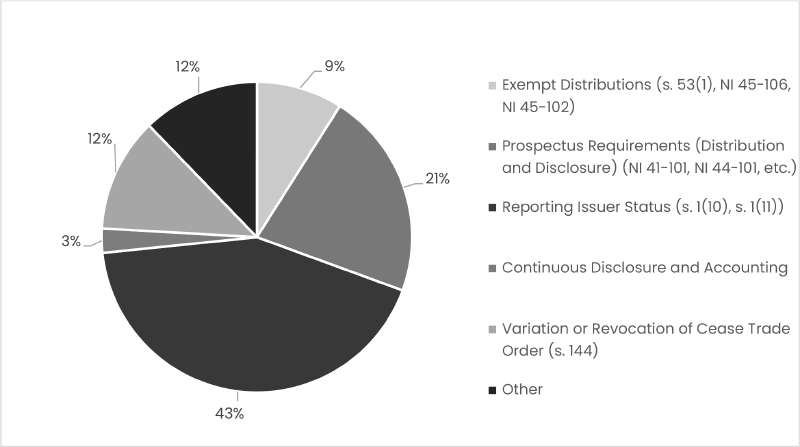
Similar to Fiscal 2024, the majority of applications related to relief from certain prospectus requirements and Reporting Issuer status. We continue to monitor the types of applications received and the exemptive relief granted to assess whether we should consider changes to our rules or policies. Key takeaways from our exemptive relief work in Fiscal 2025 are set out below. For additional tips and guidance on submitting an exemptive relief application, refer to prior years' Corporate Finance Annual Reports.
We note that Issuers subject to a CTO for failing to file financial statements and related documents may apply for a partial revocation of the CTO in order to conduct a private placement to raise funds to pay all amounts necessary to bring the Issuer's CD record up to date (including paying applicable fees to the auditor of the Issuer's financial statements) and to later file an application for a full revocation of the CTO (the Use of Proceeds).
When preparing a draft partial revocation order for such an application, we note that the draft order should contain:
• a representation specifying the aggregate dollar amount, or the range of the aggregate amount, expected to be raised from the private placement;
• a representation with a table noting how that amount will be allocated to each item in the Use of Proceeds;
• a representation setting out the parameters of the proposed private placement (e.g., one or more options for the private placement, whether the private placement will be an offering of equity securities, debt securities or a combination of both) and any expected terms of the securities (e.g., the range of any percentage of interest payable in connection with debt securities); and
• a condition that the proposed private placement must be completed within 60 or 90 days after the date of the order.
We note that the use of alternative parameters and ranges in the order may provide flexibility to the Issuer in completing the private placement after the order is issued. The application should include a letter from the auditor of the Issuer's financial statements confirming that the items listed in the Use of Proceeds as being payable to the auditor are sufficient.
- - - - - - - - - - - - - - - - - - - - - - - - - - - - - - - - - - - - - - - - - - - - - - - - - - - - - - - - - - - - - - - - - - - - - - - - - - - - - -
Reminder: Statutory Reciprocal Orders
We remind issuers that on December 4, 2023, section 127.0.1 of the Act and section 60.0.1 of the Commodity Futures Act (Ontario) came into force. These provisions provide for the immediate reciprocation in Ontario for a CTO issued by another Canadian securities regulator against an Issuer for failing to comply with their CD obligations.
Therefore, if a FFCTO was issued by another Canadian securities regulator on or after December 4, 2023, and the order does not name Ontario, it is unnecessary for the Issuer to apply to Ontario for any amendment, variation or revocation of the FFCTO, and the Issuer need only apply to the securities regulator that issued the FFCTO using the passport procedures in NP 11-203. Please refer to our website for more information.
- - - - - - - - - - - - - - - - - - - - - - - - - - - - - - - - - - - - - - - - - - - - - - - - - - - - - - - - - - - - - - - - - - - - - - - - - - - - - -
For information about the insider reporting compliance program and frequently asked questions, refer to our website as well as prior years' Corporate Finance Annual Reports, including:
• pages 51-52 in the Corporate Finance 2023 Annual Report; and
• pages 48-50 in the Corporate Finance 2022 Annual Report.
The DCA advises the OSC on emerging, novel, or complex accounting, auditing, and related financial reporting issues. The following are notable topics the DCA has recently been involved with that impact market participants.
The Corporate Finance 2024 Annual Report highlighted some of our initial observations and expectations regarding the implementation of IFRS 18 Presentation and Disclosure in Financial Statements (IFRS 18). Considering the relevance of IFRS 18 to all Reporting Issuers, we share below the following additional observations and expectations on the topic.
We remind Reporting Issuers of the importance of disclosing entity-specific information to help investors understand both the anticipated and initial application of IFRS 18.
Before Adoption |
When an entity has not applied a new IFRS Accounting Standard that has been issued but is not yet effective, International Accounting Standard (IAS) 8 Accounting Policies, Changes in Accounting Estimates and Errors requires disclosure of known or reasonably estimable information relevant to assessing the possible impact that application of the new IFRS Accounting Standard will have on the entity's financial statements in the period of initial application. |
|
|
|
As the effective date of IFRS 18 approaches, we expect Reporting Issuers to disclose progressively more entity-specific information about the anticipated impact, particularly as it relates to the Statement of Profit or Loss, including effects on relevant totals and subtotals, such as operating income (to the extent such a subtotal is currently presented but its composition will change on adoption of IFRS 18) and/or existing subtotals that are not expected to be presented under IFRS 18. |
|
|
On Adoption: |
For Reporting Issuers with calendar year ends, adoption of IFRS 18 would initially be required for the interim financial statements for the period ended March 31, 2027, with retrospective application -- i.e., comparative interim period (e.g., March 31, 2026) presented to comply with the requirements of IFRS 18. |
|
|
Interim Financial Statements |
Disclosure of reconciliation information is required by IFRS 18.C5. Among other things, this information will help investors understand how line items presented in the statement of profit or loss have changed in the comparative periods as a result of applying IFRS 18. |
IFRS 18 introduces the concept of "management-defined performance measures" (MPMs) and requires such financial measures to be disclosed in a note to the financial statements. MPMs are subtotals of income and expenses that meet specific criteria outlined in IFRS 18. Prior to the introduction of MPMs, such measures have traditionally been considered non-GAAP financial measures (e.g., adjusted net income), which historically have only been disclosed outside the financial statements in disclosure documents such as MD&A, earnings releases, and investor presentations.
As the effective date of IFRS 18 approaches, Reporting Issuers are encouraged to reflect on the nature, extent, and manner of non-GAAP financial measures they disclose outside the financial statements as these measures may be MPMs that will be required to be disclosed inside the financial statements under IFRS 18, and thus subject to any financial statements audit.
Among other things, the mandatory disclosure of MPMs inside a note to the financial statements will require effective systems and processes in place to allow management to capture relevant information to satisfy disclosure requirements and enable their external auditor to effectively audit such information.
We recently published proposed amendments to NI 52-112 that address, in a targeted manner, the consequences arising from IFRS 18 requiring disclosure of MPMs in a note to the financial statements. The proposed amendments are focused on disclosures outside the financial statements and nothing in the proposed amendments changes or overrides the requirements of IFRS Accounting Standards. To learn more about the proposed amendments visit our website.
During CD reviews, staff objected to the disclosure of particular non-GAAP financial measures on the basis that they were misleading, notwithstanding that each non- GAAP financial measure contained the required disclosures in NI 52-112.
Most recently, staff have questioned whether adjustments that have the effect of changing the recognition and measurement principles required to be applied in accordance with IFRS Accounting Standards are misleading (e.g., changing the basis of accounting for expected credit losses -- such as when expected credit losses are excluded and only realized write-offs are included, or changing the basis of accounting for revenue or expenses from an accrual basis in accordance with IFRS Accounting Standards to a cash basis).
- - - - - - - - - - - - - - - - - - - - - - - - - - - - - - - - - - - - - - - - - - - - - - - - - - - - - - - - - - - - - - - - - - - - - - - - - - - - - -
We remind Issuers that compliance with NI 52-112 does not relieve an Issuer from presenting or disclosing a non-GAAP financial measure in a way that would not be misleading.
- - - - - - - - - - - - - - - - - - - - - - - - - - - - - - - - - - - - - - - - - - - - - - - - - - - - - - - - - - - - - - - - - - - - - - - - - - - - - -
As discussed above, with the adoption of IFRS 18 certain non-GAAP financial measures will be disclosed in a note to the financial statements when specific criteria in IFRS 18 are met (e.g., if an entity uses such measures in public communications outside financial statements -- such as MD&A, earnings release, investor presentations).
Accordingly, before a non-GAAP financial measure can be disclosed inside the financial statements, an Issuer must first ensure it has appropriately disclosed, in accordance with securities legislation, the non-GAAP financial measures outside the financial statements.
We remind Issuers that compliance with NI 52-112 does not relieve them from other obligations under securities legislation. Specifically, an Issuer may not present or disclose a non-GAAP financial measure in a way that would be misleading. Whether a non-GAAP financial measure is misleading will depend on entity-specific facts and circumstances.
As articulated in the Companion Policy 52-112CP:
• Issuers should avoid making inappropriate or potentially misleading statements about the usefulness of a measure. NI 52-112 does not explicitly prohibit certain adjustments. However, if adjustments are not consistent with the usefulness explanation provided to address clauses 6(1)(e)(ii)(B), 8(c)(iii)(B) and 10(1)(b)(ii)(B) of NI 52-112 this may result in a non-GAAP financial measure that is inappropriate or misleading.
• A non-GAAP financial measure may be misleading if it
• includes positive components of the most directly comparable financial measure but omits negative components (e.g., presenting a non-GAAP financial measure that excludes unrealized losses on financial instruments but includes unrealized gains); or
• excludes from an operating performance measure those operating expenses necessary to operate an Issuer's business.
Financial statements prepared under accounting frameworks such as IFRS Accounting Standards require certain assets and liabilities to be recognized and measured, or assessed for impairment, using fair value-based approaches. As a result, it is important for Issuers to ensure they have appropriate processes and practices in place to support the development of high-quality valuation information in financial reporting.
On November 3, 2025, the International Organization of Securities Commissions{12} (IOSCO) issued a Statement on the Importance of High-Quality Valuation Information in Financial Reporting. The statement highlights the need for high- quality, consistent valuation information in financial reports and stresses that valuations play a critical role in the reliability of Issuer financial statements. The statement outlines several areas where practices could be improved and lead to higher quality valuation information, such as ensuring adequate valuation knowledge or expertise is utilized for fair value determinations and ensuring inputs and assumptions are reasonable and supportable, among other areas. We encourage Issuers to consider this statement and its contents when preparing financial statements to be filed with the OSC.
We have identified that certain information required to be disclosed by IFRS Accounting Standards is occasionally being inappropriately labelled as "unaudited" in the audited annual financial statements accompanied by an unqualified auditor's report. Examples include:
• Certain business combination disclosure -- the revenue and profit or loss of the combined entity for the current reporting period as though the acquisition date for all business combinations that occurred during the year had been as of the beginning of the annual reporting period (paragraph B64(q)(ii) of IFRS 3 Business Combinations).
• Certain investment disclosure -- summarised financial information for joint ventures and associates (e.g., paragraphs B12(b)- B13 of IFRS 12 Disclosure of Interests in Other Entities).
- - - - - - - - - - - - - - - - - - - - - - - - - - - - - - - - - - - - - - - - - - - - - - - - - - - - - - - - - - - - - - - - - - - - - - - - - - - - - -
We remind Issuers and their auditors that no information in the audited annual financial statements should be labelled as unaudited.
- - - - - - - - - - - - - - - - - - - - - - - - - - - - - - - - - - - - - - - - - - - - - - - - - - - - - - - - - - - - - - - - - - - - - - - - - - - - - -
We remind Issuers and their auditors that all information in the annual financial statements, accompanied by an unqualified auditor's report, must be audited. No information presented in such financial statements should be labelled as "unaudited".
We conducted an IOR of certain Reporting Issuers whose primary operations involve providing alternative financing services to individuals and businesses. The objective of this review was to better understand how these Reporting Issuers present cash flow and liquidity information in their financial statements. In particular, we examined compliance with IAS 7 Statement of Cash Flows (IAS 7) requirements for the presentation of cash flows and the sufficiency of related liquidity disclosures, with a particular emphasis on areas such as loan advances and repayments, loan modifications and renewals, collateral, and interest collection.
The table below summarizes the key findings from this IOR, along with best practices for Issuers to enhance transparency and remain in compliance with IFRS Accounting Standards:
Findings |
Observations and Best Practices |
|
|
1. Cash flow and liquidity disclosures |
Investors and other stakeholders rely heavily on cash flow and entity-specific liquidity disclosures to assess financial condition and risk exposures associated with the collectability of financial assets. However, our review identified various findings with respect to cash flow presentation and lack of entity-specific disclosure. |
|
|
|
In certain Reporting Issuers disclosure, we identified deficiencies in the quality of information about portfolio liquidity. For example, certain Reporting Issuers did not adequately describe the nature and quality of collateral held, the maximum credit risk exposure before collateral, when expected cash flows from the realization of collateral -- rather than anticipated borrower repayments -- was central in determining the loss provision, or significant changes in collateral quality. These disclosures are essential to help users understand the entity-specific liquidity risks associated with the Reporting Issuer's portfolio and how they are being managed. In response to our comments, Reporting Issuers agreed to provide enhanced disclosure about portfolio liquidity, including collateral disclosure, on a prospective basis. |
|
|
2. Statement of Cash Flows |
We identified deficiencies in the classification of cash flows on the statement of cash flows. We observed instances where Reporting Issuers classified loan advances and repayments as investing activities rather than operating activities. Consistent with IAS 7.11, it is our view that these cash flows represent operating activities, as they are core to the Reporting Issuers' operations of providing financing and generating returns from such activities. This classification issue is significant because proper presentation of operating cash flows is central to conveying how these entities generate and use cash. As a result of our review, several Reporting Issuers restated their financial statements to correct this misclassification and were placed on the OSC's Refilings and Errors List. |
|
|
3. Loan modifications and renewals |
We reviewed information about loan modifications and renewals to assess whether Reporting Issuers were incorrectly presenting non-cash transactions (such as modifications, renewals, or paid-in-kind interest) as cash flows since we have identified issues in this area in past reviews. Reporting Issuers engaged in such activities provided detailed reconciliations of loan-related inflows and outflows, and we observed that they were classifying them appropriately as non-cash transactions, rather than recording them as cash inflows or outflows. For other Reporting Issuers in our sample, we observed that either these activities were not undertaken as a matter of internal policy or were not material. |
Overall, our review highlighted the need for proper classification of cash flows and robust, entity-specific liquidity disclosures to support transparent financial reporting. While corrective actions were taken, this area will continue to be a focus of regulatory oversight. In particular, we will continue to examine whether Reporting Issuers with similar business models provide sufficient disclosure about their loan portfolios, staging, and expected credit loss assessment processes, recognizing that these factors have a significant impact on reported financial position and performance.
The DM&A provides robust oversight of M&A transactions, a dynamic and evolving area of our capital markets and one which brings unique risks for securityholders. Transactional matters are often time-sensitive, complex and subject to competing interests. Moreover, transactional matters typically involve both corporate and securities law obligations and have the potential to engage the OSC's public interest jurisdiction. We strive to oversee M&A transactions in a manner that is responsive to, and mindful of, all of these various considerations when advancing the OSC's mandate.
The DM&A's main oversight role is achieved through real-time reviews of transaction circulars and material change reports, assessments of complaints, consideration of substantive inquiries, active participation in M&A hearings before the Tribunal, and reviews of exemptive relief applications. The quality of our oversight is enhanced by a continuous assessment of emerging trends and through open communication with market participants.
The DM&A conducts real-time reviews of circulars for various transactions, including business combinations and related party transactions regulated by MI 61-101, as well as take-over bids, issuer bids, and dissident proxy solicitations. We also review material change reports in respect of transactions subject to the enhanced disclosure requirements of MI 61-101. Further information on the policy considerations underlying our real-time review program can be found in CSA Staff Notice 61-302.
The purpose of the real-time review program is to identify and resolve securities regulatory issues in real-time, before a transaction is put before securityholders or closed, so as to reduce the risk of harm to minority securityholders. To this end, we screen and selectively review circulars and material change reports promptly after they have been filed to assess, as applicable, compliance with disclosure requirements (including concerning the board's review and approval process), the availability and satisfaction of conditions to exemptions being relied upon, accurate delineation of minority securityholder vote composition, and potential public interest concerns. In Fiscal 2025, the DM&A conducted substantive reviews of approximately 120 circulars and over 50 material change reports.
If we identify concerns with a circular or material change report, we will engage in a timely way to resolve any issues promptly, pragmatically, and, if possible, without impacting expected transaction timing. Disclosure deficiencies can generally be addressed through remedial supplemental disclosure by news release sufficiently in advance of the proxy cut-off for the applicable securityholder meeting; however, more significant or pervasive deficiencies may result in staff requesting a delay of the meeting and potentially the remailing and filing of an amended information circular. In instances of inappropriate purported reliance on exemptions from the requirements of MI 61-101 or other serious non-compliance, we expect prompt remedial action to address those issues without compromising securityholder rights. Where satisfactory remedial action is not possible to address serious compliance or public interest concerns, we will consider enforcement action.
This section highlights some of the common deficiencies that we observed during our real-time reviews of information circulars in Fiscal 2025, and includes best practices and guidance to assist Reporting Issuers in meeting their regulatory obligations.
Issue |
Best Practice |
|
|
||
Insufficient disclosure |
We have observed instances where Reporting Issuers do not provide sufficient disclosure in material change reports filed in connection with a related party transaction for which the Reporting Issuer is purporting to rely on the financial hardship exemption in subsection 5.5(g) and/or paragraph 5.7(1)(e) of MI 61-101. |
|
|
||
|
Among other things, Reporting Issuers are required to include in the material change report: |
|
|
||
|
• |
the purpose and business reasons for the transaction, |
|
||
|
• |
the anticipated effect of the transaction on the Reporting Issuer's business and affairs; |
|
||
|
• |
a discussion of the review and approval process adopted by the board of directors and special committee for the transaction; and |
|
||
|
• |
the facts supporting the Reporting Issuer's reliance on the formal valuation and minority approval exemptions. |
|
||
|
This disclosure should be thorough and, taken together, provide securityholders with a meaningful understanding of what led to the Reporting Issuer being in serious financial difficulty, the alternatives considered by management and the board to address it, how the transaction is designed to improve the financial position of the Reporting Issuer, and why the Reporting Issuer is not able to seek shareholder approval for the transaction. |
|
|
||
Proximity to shareholder meeting |
We have observed instances where Reporting Issuers complete a related party transaction in reliance on the financial hardship exemption from the minority approval requirement shortly before, or following, a meeting of securityholders. |
|
|
||
|
The financial hardship exemption from the minority approval requirement provides an accommodation to Reporting Issuers so that they are not obliged to incur the expense of holding a meeting at a time when the Reporting Issuer is acutely in need of funds due to insolvency or being in serious financial difficulty. |
|
|
||
|
In order to rely on the exemption, there must be no other requirement, corporate or otherwise, to hold a meeting to obtain any approval of the holders of any class of affected securities. We remind Reporting Issuers that this condition is not narrowly limited to a requirement to hold a meeting for approval in relation to the subject matter of the related party transaction. If a Reporting Issuer is required to hold a meeting for any reason, then reliance on the financial hardship exemption proximate to that meeting is not appropriate as the Reporting Issuer is obliged to hold and bear the expense of the meeting irrespective of the minority approval requirement under MI 61-101. |
|
|
||
|
There may be acute circumstances where a Reporting Issuer has called a meeting unrelated to a related party transaction but needs to complete the related party transaction in reliance on the financial hardship exemption in advance of that meeting in order, in part, to fund the expense of the required meeting. In that circumstance, the fact that the purpose of the related party transaction was to fund the costs of the meeting should be explicitly disclosed in the material change report for the related party transaction so that securityholders can understand why the Reporting Issuer determined that it was critical to complete the transaction without waiting to obtain minority approval at the upcoming meeting. |
|
Subsection 5.1(h) of MI 61-101 provides a carve-out to the application of Part 5 of MI 61-101 if the Reporting Issuer is obligated to and carries out the transaction substantially under terms (i) that were agreed to and generally disclosed before the Reporting Issuer become a Reporting Issuer; or (ii) of a previous transaction the terms of which were generally disclosed, if the previous transaction was carried out in compliance with MI 61-101, including in reliance on any applicable exemption or exclusion, or was not subject to MI 61-101.
We remind Reporting Issuers that the carve-outs in subsection 5.1(h) of MI 61-101 require that the Reporting Issuer be obligated to carry out the transaction in question. If the Reporting Issuer is not obligated to carry out the transaction but determines to do so, the carve-outs would not apply, and the Reporting Issuer must determine if another exemption or exclusion is available for that transaction. For example, if a Reporting Issuer enters into an agreement with a related party pursuant to which the related party obtains the option to acquire an asset from the Reporting Issuer in the future at the related party's discretion, the exercise of the option by the related party generally would be carved out under subsection 5.1(h) as long as the Reporting Issuer complied with, or was exempt from, MI 61-101 when it entered into the agreement and the terms of the transaction were generally disclosed. Conversely, if a Reporting Issuer enters into an agreement with a related party pursuant to which the Reporting Issuer obtains the option to acquire an asset from a related party in the future at the Reporting Issuer's discretion the exercise of that option by the Reporting Issuer would not have the benefit of the carve-outs in subsection 5.1(h) because the Reporting Issuer is not obligated to carry out the transaction.
We also remind Reporting Issuers that the carve-outs in subsection 5.1(h) of MI 61-101 may not apply if a Reporting Issuer amends the terms of a previous transaction, as the amendments may constitute a new related party transaction for which the Reporting Issuer will need to determine whether formal valuation and minority approval requirements of MI 61-101 apply and, if so, whether exemptions are available. For example, an amendment to a security of a Reporting Issuer held by a related party is itself a related party transaction. If the amendment constitutes a material amendment to the terms of the security, the fair market value tests relating to certain exemptions are to be applied to the whole transaction as amended, and not just to the amendment.
If a Reporting Issuer is required to obtain minority approval for a transaction under MI 61-101, it must obtain it at a meeting of holders of affected securities called to consider the transaction.
Section 3.1 of Companion Policy 61-101CP notes that the regulator or securities regulatory authority may consider granting an exemption from this requirement where the Reporting Issuer is able to demonstrate that holders of a majority of the securities eligible to be voted at a meeting would vote in favour of the transaction, conditional on security holders being provided with disclosure similar to what would be available to them if a meeting were held.
In making a recommendation to the decision maker to grant this relief, we expect that the disclosure document provided in lieu of an information circular will be filed and made available to all securityholders at least 14 days before consents are obtained from consenting securityholders. In addition to the disclosure required by MI 61-101, we also expect that the disclosure document will include the disclosure required in an information circular sent to securityholders to approve the transaction. For example, if the information circular would need to include prospectus level disclosure with respect to a significant acquisition or restructuring transaction, this disclosure would need to be included in the disclosure document provided to securityholders in lieu of an information circular.
Finally, we consider relief to obtain minority approval by written consent to be exceptional and sought by Reporting Issuers that are closely held or have some familiarity with the securityholders that would constitute the majority vote that could be obtained at a meeting of securityholders. Reporting Issuers should not view the possibility of obtaining this exceptional relief as a pretext to broadly solicit support for a transaction by means of written consent.
The DM&A will be involved in any M&A transactional matter brought before the Tribunal, typically with litigation support from our General Counsel's Department. Our role in M&A hearings can involve:
• working with parties to focus issues/scope of the matters;
• working with parties on procedural matters relating to the hearing
• negotiating resolutions with parties; and
• advising the Tribunal by providing the OSC's views as a party in the hearing.
In Fiscal 2025 there was one transactional matter that proceeded to a Tribunal hearing.
In July 2024 the Tribunal heard an application by RIOT Platforms, Inc. (RIOT) to cease trade any securities to be issued under a shareholder rights plan (also known as a "poison pill") that was adopted by Bitfarms Ltd. (Bitfarms) in the face of RIOT's acquisition overtures and activist engagement. Bitfarms' poison pill included a highly unusual 15% trigger that effectively precluded RIOT from acquiring shares of Bitfarms in the ordinary course up to the statutory 20% take-over bid threshold.
DM&A staff, supported by the General Counsel's Department, were significantly involved in the hearing, including by making written and oral submissions to the Tribunal on behalf of the OSC. The OSC opposed the 15% threshold rights plan on the basis that it undermined the established securities regulatory framework applicable to the market for control and influence as set out in NI 62-104 and related rules and policies. The Tribunal agreed with RIOT and the OSC and granted an order cease- trading any securities that could be issued under Bitfarms' poison pill.
The Tribunal's decision upheld the integrity of the take-over bid regime and ability of shareholders to acquire shares up to the take-over bid threshold subject only to early warning obligations. More broadly, in its reasons, the Tribunal also established a legal test for public interest intervention in respect of a shareholder rights plan based on whether (i) the plan undermines one or more clearly discernible animating principles underlying securities law in a real and substantial way, and (ii) there is a public dimension to the effect caused by the rights plan.
The DM&A has a prominent role within the CSA in advancing regulatory initiatives to promote high regulatory standards and respond to market developments. We also strive to facilitate dialogue with market participants on M&A regulatory policy issues. Refer to Appendix B: Responsive Regulation for an update on our policy projects.
The CSA previously conducted extensive research and stakeholder consultations on a review of MI 61-101. Following that work, and considering other emerging policy priorities, the CSA decided no changes to the existing regime will be made at this time. The CSA intend to revisit the review of MI 61-101 in the future.
DM&A staff encourage Issuers to consult Companion Policy 61-101CP, CSA Staff Notice 61-302, and periodic commentary in prior Corporate Finance Annual Reports for guidance on the application, interpretation, and best practices for compliance with MI 61-101. Issuers and their counsel are also welcome to contact DM&A staff with specific inquiries.
The DM&A has been involved in considering regulatory policy issues associated with the adoption of virtual shareholder meetings. In 2024, the CSA issued a news release providing Reporting Issuers with updated guidance on virtual shareholder meetings. The news release sets out guidance to assist Reporting Issuers in fulfilling their obligations under securities legislation and to encourage the adoption of practices that facilitate shareholder participation. As advised in the news release, we recommend that Reporting Issuers consult and follow accepted best practices relating to the conduct of shareholder meetings. We will continue to monitor the practice of virtual shareholder meetings and may issue further guidance and updates as required.
The Corporate Finance section of our website provides an outline for Issuers on how to comply with Ontario securities law and file certain documents with the OSC. We have updated our website to include further information and resources on topics typically discussed in our annual reports. In particular, we provide resources for selling securities in Ontario, CD, industry-specific disclosure requirements, insider reporting, etc. It also provides a number of resources available to Issuers, including links to prior years' Corporate Finance Annual Reports, staff notices, etc.
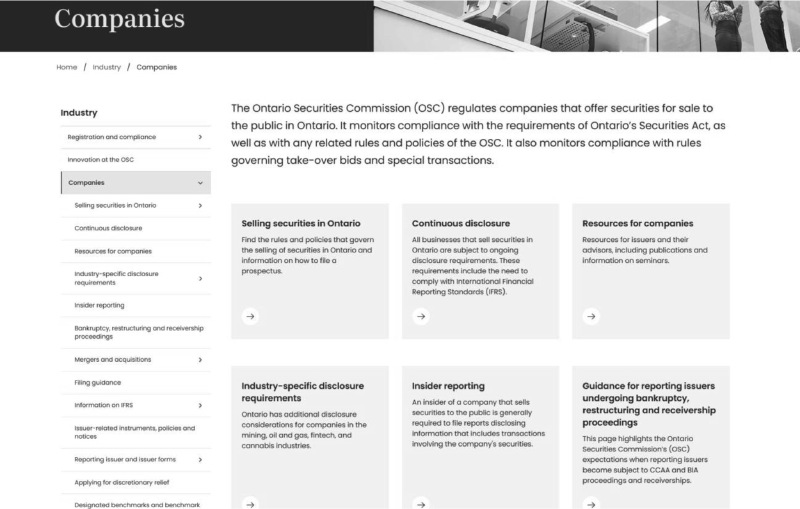
For Issuers filing a confidential pre-file prospectus, preliminary prospectus or exemptive relief application, refer to our service commitments on our website for information on our timeframes to respond to inquiries, issue comment letters and complete our reviews.
The OSC website includes guidance on a number of administrative matters that will be useful for Issuers, including tips on filing on SEDAR+ and other filing guidance for applications, prospectuses and CD documents.
The OSC SME Institute was established to provide free educational seminars to help small and medium enterprises (SMEs) understand securities regulatory requirements for being or becoming a Reporting Issuer in Ontario and participating in the exempt market. For more than 10 years, we have provided SMEs with various seminars ranging from raising money in the public markets and the exempt market, CD considerations, industry-specific sessions and other seminars to assist them in meeting regulatory requirements. Refer to Resources for Companies on our website for further information.
Video replays of these past seminars are available on OSC's YouTube channel.
The following terms are used widely throughout the Report and have the meanings set forth below unless otherwise indicated. Words importing the singular number include the plural, and vice versa.
Accredited Investor Exemption means the prospectus exemption under subsection 73.3(2) of the Act.
Act means the Securities Act (Ontario) R.S.O. 1990, chapter s.5.
Companion Policy 43-101CP means Companion Policy 43-101CP to NI 43-101.
Companion Policy 52-112CP means Companion Policy 52-112 to NI 52-112.
Companion Policy 61-101CP means Companion Policy 61-101CP to MI 61-101.
CBO 13-933 means Coordinated Blanket Order 13-933 Temporary exemption from the requirement to transmit a report of exempt distribution through SEDAR+ in connection with distributions of eligible foreign securities to permitted clients.
CBO 41-930 means Coordinated Blanket Order 41-930 Exemptions from Certain Prospectus and Disclosure Requirements.
CBO 45-930 means Coordinated Blanket Order 45-930 Prospectus Exemption for New Reporting Issuers.
CBO 45-933 means Coordinated Blanket Order 45-933 Exemption from the Investment Limit under the Offering Memorandum Prospectus Exemption to Exclude Reinvestment Amounts.
CBO 45-935 means Coordinated Blanket Order 45-935 Exemptions from Certain Conditions of the Listed Issuer Financing Exemption.
CBO 51-933 means proposed Coordinated Blanket Order 51-933 Exemptions to Permit Semi-Annual Reporting for Certain Venture Issuers.
Corporate Finance Annual Reports means Corporate Finance annual reports that have been published in previous years.
Corporate Finance 2021 Annual Report means OSC Staff Notice 51-732 Corporate Finance Branch 2021 Annual Report.
Corporate Finance 2022 Annual Report means OSC Staff Notice 51-734 Corporate Finance Branch 2022 Annual Report.
Corporate Finance 2023 Annual Report means OSC Staff Notice 51-735 Corporate Finance Branch 2023 Annual Report.
Corporate Finance 2024 Annual Report means OSC Staff Notice 51-736 Corporate Finance Division 2024 Annual Report.
CSA MI 45-111 means CSA Multilateral Notice and Request for Comment Proposed Multilateral Instrument 45-111 Self-Certified Investor Prospectus Exemption.
CSA Staff Notice 11-348 means CSA Staff Notice and Consultation 11-348 Applicability of Canadian Securities Laws and the Use of Artificial Intelligence Systems in Capital Markets.
CSA Staff Notice 51-312 means CSA Staff Notice 51-312 (Revised) Harmonized Continuous Disclosure Review Program.
CSA Staff Notice 51-365 means CSA Staff Notice 51-365 Continuous Disclosure Review Program Activities for the Fiscal Years Ended March 31, 2024 and March 31, 2023.
CSA Staff Notice 51-366 means CSA Staff Notice 51-366 Regulatory Concerns with Certain Asset or Business Acquisitions.
CSA Staff Notice 61-302 means CSA Staff Notice 61-302 Staff Review and Commentary on Multilateral Instrument 61-101 Protection of Minority Security Holders in Special Transactions.
Form 43-101F1 means Form 43-101F1 Technical Report.
Form 44-101F1 means Form 44-101F1 Short Form Prospectus.
Form 45-106F1 means Form 45-106F1 Report of Exempt Distribution.
Form 45-106F2 means Form 45-106F2 Offering Memorandum for Non-Qualifying Issuers.
Form 51-102F1 means Form 51-102F1 Management's Discussion & Analysis.
Form 58-101F1 means Form 58-101F1 Corporate Governance Disclosure.
Issuer has the meaning ascribed to that term in subsection 1(1) of the Act.
MI 25-102 means Multilateral Instrument 25-102 Designated Benchmarks and Benchmark Administrators.
MI 61-101 means Multilateral Instrument 61-101 Protection of Minority Security Holders in Special Transactions.
Minimum Amount Investment Exemption means the prospectus exemption in subsection 2.10(1) of NI 45-106.
NI 25-101 means National Instrument 25-101 Designated Rating Organizations.
NI 41-101 means National Instrument 41-101 General Prospectus Requirements.
NI 43-101 means National Instrument 43-101 Standards of Disclosure for Mineral Projects.
NI 44-101 means National Instrument 44-101 Short Form Prospectus Distributions.
NI 44-102 means National Instrument 44-102 Shelf Distributions.
NI 45-106 means National Instrument 45-106 Prospectus Exemptions.
NI 51-102 means National Instrument 51-102 Continuous Disclosure Obligations.
NI 51-107 means proposed National Instrument 51-107 Disclosure of Climate-related Matters.
NI 52-112 means National Instrument 52-112 Non-GAAP and Other Financial Measures Disclosure.
NI 58-101 means National Instrument 58-101 Disclosure of Corporate Governance Practices.
NI 62-104 means National Instrument 62-104 Take-Over Bids and Issuer Bids.
NI 81-102 means National Instrument 81-102 Investment Funds.
NP 11-202 means National Policy 11-202 Process for Prospectus Reviews in Multiple Jurisdictions.
NP 11-203 means National Policy 11-203 Process for Exemptive Relief Applications in Multiple Jurisdictions.
NP 11-207 means National Policy 11-207 Failure-to-File Cease Trade Orders and Revocations in Multiple Jurisdictions.
NP 12-202 means National Policy 12-202 Revocation of Certain Cease Trade Orders.
NP 41-201 means National Policy 41-201 Income Trusts and other Indirect Offerings.
NP 51-201 means National Policy 51-201 Disclosure Standards.
NP 58-201 means National Policy 58-201 Corporate Governance Guidelines.
OI 13-512 means Ontario Instrument 13-512 Temporary Exemption from the Requirement to Transmit a Report of Exempt Distribution through SEDAR+ in connection with Distributions of Eligible Foreign Securities to Permitted Clients (Interim Class Order).
OI 45-507 means Ontario Instrument 45-507 Self-Certified Investor Prospectus Exemption (Interim Class Order).
OI 45-510 means Ontario Instrument 45-510 Self-Certified Investor Prospectus Exemption (Interim Class Order).
OSC Rule 51-507 means proposed Ontario Securities Commission Rule 51-507 Exemptions to Permit Semi-Annual Reporting for Certain Venture Issuers.
OSC Staff Notice 33-752 means OSC Staff Notice 33-752 Summary Report for Dealers, Advisers and Investment Fund Managers.
Reporting Issuer has the meaning ascribed to that term in subsection 1(1) of the Act.
SEDAR+ has the meaning ascribed to that term in subsection 1(1) of National Instrument 13-103 System for Electronic Data Analysis and Retrieval+ (SEDAR+).
Technical Report means a report prepared in accordance with NI 43-101 and Form 43-101F1.
Venture Issuer has the meaning ascribed to that term in subsection 1.1(1) of NI 51-102.
{1} Note: all figures are as at / for Fiscal 2025 and are approximate or rounded.
{2} For a prospectus filing, pursuant to NP 11-202, an Issuer's principal regulator is the regulator of the jurisdiction in which the Issuer's head office is located. If the regulator identified is not in a specified jurisdiction, the principal regulator is the regulator in the specified jurisdiction with which the Issuer has the most significant connection. See subsections 3.4(4) -- 3.4(8) of NP 11-202.
{3} Comprised of non-investment fund Reporting Issuers listed on a Canadian exchange (TSX/TSXV/CSE/Cboe).
{4} For more information see CSA Staff Notice 51-312.
{5} Comparative figures for outcomes of full CD reviews have been revised to conform with the current year presentation.
{6} Venture Issuers are exempt from the requirements of Part 3 (Composition of the Audit Committee) and Part 5 (Reporting Obligations) of NI 52-110.
{7} Subsection 1.4(3)(f) also applies to an individual's immediate family member (defined in NI 52-110).
{8} Subsection 1.4(7) also applies to an individual's immediate family member (defined in NI 52-110).
{9} "Other" includes sectors such as communications, crypto assets, environmental, gaming, hospitality, SPACs, CPCs and transportation.
{10} Comparative figures for Fiscal 2024 have been revised to conform with the current year presentation. "Other" includes Capital Pool Companies, Communications/Entertainment and Transportation.
{11} See OSC news release dated March 29, 2021. See also CSA news release dated March 29, 2021.
{12} IOSCO is the international body that brings together the world's securities regulators and is recognized as the global standard setter for financial markets regulation. The OSC is an active member of the IOSCO Board and participates on all major IOSCO committees.
The following summary provides a description and status of our current policy projects, all of which are aimed at making Ontario's capital markets inviting, thriving and secure.
Policy Project |
Brief Description |
Status |
|
||
Access model for CD documents |
Implementing an access model for CD documents will modernize the way CD documents are made available to investors and provide a more timely and environmentally friendly way of communicating to investors than paper delivery. Generally, access will be provided once the CD document is filed on SEDAR+ and a news release is issued to alert investors that the CD document is accessible on SEDAR+ and how to obtain an electronic or paper copy of the document. |
On November 19, 2024, the CSA published revised proposals to introduce an access model for CD documents. The comment period ended on February 17, 2025. The CSA is considering stakeholder feedback on the revised proposals. |
|
||
AFS non-delivery list |
On October 8, 2025, the Corporate Finance Division introduced the AFS non-delivery list of non-reporting Issuers that have relied on the OM exemption in Ontario but have not delivered annual financial statements to the OSC. |
The AFS non-delivery list is currently live on the OSC website and is aimed at advancing investor protection for investors by increasing transparency about the business activities of non-reporting Issuers raising capital in the exempt market under the OM Exemption. |
|
||
Climate-related disclosures |
On October 18, 2021, the CSA published for comment NI 51-107 to address the need for more consistent and comparable climate-related information to help inform investment decisions. Climate-related disclosures continue to be an evolving area, with several developments both domestically and internationally. |
On April 23, 2025, the CSA announced a pause in its work on the development of a new climate-related disclosure rule. |
|
||
Continuous disclosure requirements |
On May 20, 2021, the CSA proposed changes to modernize the CD requirements for non-investment fund Reporting Issuers. The proposed changes are to streamline and clarify certain disclosure requirements in the MD&A and AIF, eliminate certain requirements that are redundant or no longer applicable, combine the financial statements, MD&A and, where applicable, AIF into one reporting document and to introduce a small number of new requirements to address gaps in disclosure. Although the feedback was generally supportive, we believe that the objectives of these proposed changes would be best achieved when combined with a model for electronic access to information. |
On October 3, 2023, the CSA provided an update noting that until work on the access model advances, the CSA does not anticipate implementing the amendments that would introduce the annual and interim disclosure statements. The CSA plans to provide a market update on the proposed CD amendments in the coming months. |
|
||
Definition of Venture Issuer |
On August 1, 2024, the CSA published for comment proposed amendments and changes to certain National Instruments and Policies to address a number of matters, including matters related to: (i) the name changes of Aequitas NEO exchange and the PLUS Markets; and (ii) the creation of a Senior Tier by the Canadian Securities Exchange (CSE). The amendments were published in final form on June 19, 2025. |
On September 19, 2025, the CSA adopted amendments and changes to certain National Instruments and Policies that, among other things, revised the definition of Venture Issuer to exclude Issuers on the Senior Tier of the CSE and allow them to be treated the same way under securities legislation as Issuers listed on other non-venture exchanges. |
|
||
Distributions of eligible foreign securities to permitted clients |
On July 21, 2023, CBO 13-933 came into effect. CBO 13-933 provides an exemption from the requirement to transmit a Form 45-106F1 and offering memorandum through SEDAR+ in connection with distributions of eligible foreign securities to permitted clients. CBO 13-933 expired in Ontario on January 21, 2025. |
On January 21, 2025, OI 13-512 came into effect. OI 13-512 generally extended the exemption provided in CBO 13-933, subject to certain conditions. OI 13-512 will expire on July 21, 2026, unless extended. |
|
||
Diversity on boards and in executive officer positions |
On April 13, 2023, the CSA published a notice and request for comment regarding proposed amendments and changes to Form 58-101F1 and NP 58-201 seeking to introduce disclosure requirements on aspects of diversity beyond the representation of women. |
On April 23, 2025, the CSA announced that it had paused its work on proposed amendments and changes to existing diversity-related disclosure requirements. |
|
||
|
On October 30, 2024, the findings from our tenth annual review of disclosure related to women on boards and in executive officer positions were published in CSA Multilateral Staff Notice 58-317 Review of Disclosure Regarding Women on Boards and in Executive Officer Positions -- Year 10 Report. |
|
|
||
Early Warning and NI 62-104 |
The CSA is considering, among other things, the appropriate current scope of disclosure requirements concerning equity derivatives, the sufficiency of the current disclosure and timing requirements concerning acquirers' "plans and future intentions", and other targeted and house-keeping amendments. Also, as part of the broader efforts to ensure a competitive capital market, the CSA is considering a selective repurchase issuer bid exemption. |
The CSA anticipates publishing proposed amendments and guidance, as applicable, in early 2026. |
|
||
Exempt market activity dashboard |
On November 18, 2025, the OSC published an update to the exempt market activity dashboard to include 2024 data. The dashboard provides an overview of prospectus-exempt distributions by corporate Issuers headquartered in Canada that raised capital from Ontario investors between 2018 and 2024. The data covers exempt or private market financing activity under prospectus exemptions that are required to be reported to the OSC on Form 45-106F1. |
The Dashboard data was collected from Form 45-106F1s and the accompanying Schedule 1s filed with the OSC. The dashboard represents data that was collected, processed, and presented on a best-efforts basis. |
|
||
|
|
The OSC will continue to collect and process data for future updates to the dashboard. |
|
||
Financial Benchmarks |
On July 13, 2021, MI 25-102, which established a comprehensive regime for the designation and regulation of financial benchmarks and those that administer them, came into force in Ontario. In Canada, the OSC and the Autorité des marchés financiers designated Term CORRA as a designated interest rate benchmark and CanDeal Benchmark Administration Services Inc. as its designated benchmark administrator. No other benchmarks or benchmark administrators are currently designated. |
On May 30, 2024, proposed amendments to the assurance report provisions in MI 25-102 were published for a 90-day comment period. The comment period ended on August 28, 2024. We are considering the comments provided. |
|
||
Listed Issuer Financing Exemption |
The listed issuer financing exemption was introduced in November 2022 to provide a more efficient method of capital raising for Reporting Issuers that have securities listed on a recognized exchange and have filed all timely and periodic disclosure documents required under Canadian securities legislation. The exemption allows eligible Reporting Issuers, subject to certain conditions, to raise the greater of C$5 million and 10% of the Issuer's market capitalization, up to an aggregate maximum of C$10 million in a 12-month period without the use of a prospectus. |
Since its adoption, market participants have provided positive feedback on the exemption but noted that the original capital raising limits have been restricting the use of the exemption. On May 14, 2025, the CSA published CBO 45-935, which increased the capital raising limit under the exemption, subject to certain conditions. Pursuant to CBO 45-935, eligible Reporting Issuers can raise the greater of C$25 million and 20% of the Issuer's market capitalization, up to an aggregate maximum of C$50 million in a 12-month period without the use of a prospectus. |
|
||
|
|
In Ontario, CBO 45-935 will expire on November 15, 2026, unless extended. We anticipate publishing a proposed harmonized rule for comment to determine whether rule amendments are required to codify the relief provided in CBO 45-935. |
|
||
Majority voting |
On August 1, 2024, the CSA published for comment proposed amendments and changes to certain National Instruments and Policies to address, among other things, the uncertainty about the form of proxy required under NI 51-102 to be provided to securityholders of CBCA-incorporated Reporting Issuers as a result of amendments to the CBCA regarding "majority voting" requirements. |
The amendments were published in final form on June 19, 2025. |
|
||
|
|
On September 19, 2025, the CSA adopted amendments to NI 51-102 to address the uncertainty about the form of proxy required under NI 51-102 to be provided to securityholders of CBCA-incorporated Reporting Issuers as a result of amendments to the CBCA regarding "majority voting" requirements. |
|
||
|
The amendments in effect codify the exemptions granted to CBCA-incorporated Reporting Issuers through CSA blanket orders in 2023. |
|
|
||
Mineral project disclosure |
On June 12, 2025, the CSA proposed amendments to NI 43-101, Form 43-101F1 and Companion Policy 43-101CP. The proposed amendments are intended to clarify, harmonize and streamline Canada's mining disclosure regime without introducing any new requirements. |
The comment period for the proposed amendments ended on October 10, 2025. The CSA is reviewing comments provided. |
|
||
Modernization of escrow agreement |
On August 1, 2024, the CSA published for comment proposed amendments and changes to certain National Instruments and Policies to address, among other things, the need to modernize the form of escrow agreement so it no longer has to be signed, sealed and delivered by securityholders in the presence of a witness. This is a requirement that is outdated and not compatible with electronic signing. |
On September 19, 2025, the CSA adopted changes to modernize the form of escrow agreement under National Policy 46-201 Escrow for Initial Public Offerings by removing the requirement for the agreement to be signed, sealed and delivered by securityholders in the presence of a witness. |
|
||
New Reporting Issuer Blanket Order |
On April 17, 2025, the CSA published CBO 45-930. CBO 45-930 provides a prospectus exemption for companies that will be going or have recently gone public in Canada through an underwritten IPO, giving them greater flexibility to raise additional capital following the IPO, provided certain conditions are met. |
In Ontario, CBO 45-930 will expire on October 16, 2026, unless extended. We anticipate publishing proposed harmonized rules for comment to determine whether rule amendments are required to codify the relief provided in CBO 45-930. |
|
||
NI 52-112 Non-GAAP and Other Financial Measures Disclosure |
Proposed amendments to NI 52-112, and proposed consequential changes and amendments (together, the Proposed Amendments) primarily seek to ensure that measures that have historically been subject to the requirements of NI 52-112 remain subject to its requirements following the adoption of a new IFRS Accounting Standard, IFRS 18. |
On November 13, 2025, the CSA published, for a 90-day comment period, a Notice and Request for Comment for the Proposed Amendments. |
|
||
|
|
Comments are requested in writing on or before February 11, 2026. |
|
||
Offering Memorandum Blanket Order |
On April 17, 2025, Alberta, New Brunswick, Nova Scotia, Ontario, Québec and Saskatchewan published CBO 45-933. |
In Ontario, CBO 45-933 will expire on October 16, 2026, unless extended. We anticipate publishing a proposed harmonized rule for comment to determine whether rule amendments are required to codify the relief provided in CBO 45-933. |
|
||
|
CBO 45-933 provides greater access to capital by providing an exemption from the $100,000 investment limit in NI 45-106, such that a re-investment of proceeds of disposition of an investment in the same Issuer does not count towards the investment limit, provided that the investor receives advice from a registered dealer or registered adviser that the re-investment of proceeds and any new investment under the offering memorandum exemption continues to be suitable for the investor. |
|
|
||
Prospectus and Disclosure Blanket Order |
On April 17, 2025, the CSA published CBO 41-930. CBO 41-930 supports the competitiveness of Canada's public markets by making it more cost-effective for Issuers to go public in Canada through an IPO prospectus and by streamlining other disclosure requirements. CBO 41-930 includes relief, subject to certain conditions, from requirements in respect of third-year historical financial statement disclosure, marketing during the waiting period and promoter certificates. |
In Ontario, CBO 41-930 will expire on October 16, 2026, unless extended. We anticipate publishing proposed harmonized rules for comment to determine whether rule amendments are required to codify the relief provided in CBO 41-930. |
|
||
Regulatory concerns with certain asset or business acquisitions |
July 3, 2025, the CSA published CSA Staff Notice 51-366 which outlines the regulatory concerns associated with Reporting Issuers distributing numerous securities to acquire assets or businesses that appear to possess little or no actual value or operating history and pay notably inflated prices. |
Staff will continue to apply additional regulatory scrutiny to Reporting Issuers involved in acquisitions that appear to raise the concerns set out in CSA Staff Notice 51-366. |
|
||
Review of Normal Course Issuer Bid Regime |
The CSA has initiated a review of the normal course issuer bid regime to consider modernizing enhancements responsive to the multiple marketplace environment and evolving market practices while ensuring appropriate regulatory oversight. |
The CSA is conducting research and internal consultations to develop recommendations. |
|
||
SAR Pilot |
On October 23, 2025, the CSA published for a 60-day comment CBO 51-933 to introduce a multi-year pilot project to allow eligible Venture Issuers to voluntarily adopt semi-annual financial reporting, subject to certain terms and conditions. |
The public comment period for CBO 51-933 and OSC Rule 51-507 closes on December 22, 2025. |
|
||
|
The OSC concurrently published for a 60-day comment period OSC Rule 51-507 to maintain the CD exemptions that will be in Ontario's local Blanket Order after its expiry. |
The CSA anticipates the SAR Pilot will be in force prior to the end of March 2026. |
|
||
|
Once in force, the SAR Pilot will include exemptions from certain CD requirements and will reduce administrative burden and costs associated with the preparation of the first and third quarter financial disclosures. |
The CSA also intends to engage in a broader rule-making project related to voluntary semi-annual reporting and will use learnings from the SAR Pilot to inform this initiative. In the interim, the CSA will continue to monitor international developments relating to semi-annual reporting. |
|
||
Self-certified investor prospectus exemption |
On September 25, 2025, the CSA published for a 90-day comment period proposed CSA MI 45-111 (SCIPE), which introduces a harmonized self-certified investor prospectus exemption in certain jurisdictions across Canada, including Ontario. If adopted, SCIPE will provide access to new sources of capital for non-investment fund Issuers that have their head office in Canada and increase investment opportunities for investors who may not meet the financial thresholds or other criteria required to qualify as an accredited investor. The CSA has also proposed consequential amendments to NI 45-106 to include self-certified investors under the proposed instrument in the list of purchasers that can purchase under the private issuer exemption. |
The comment period for SCIPE ends on January 5, 2026. |
|
||
|
|
The OSC published a new blanket order, OI 45-510, which came into effect on October 25, 2025 for an 18-month period, unless extended by the OSC. OI 45-510 provides time-limited prospectus exemptions, based on SCIPE, to facilitate additional capital raising for Canadian Issuers and investment opportunities for investors in Ontario while SCIPE is being considered. |
|
||
|
|
The OSC also published local amendments to section 2.4 of NI 45-106, as proposed by the CSA under SCIPE, to allow private issuers to distribute securities to self-certified investors under OI 45-510 and OI 45- 507 (which expired on October 25, 2025), without losing their status as a private issuer and their ability to rely on the private issuer prospectus exemption in NI 45-106. The local amendments also amend section 2.4 of NI 45-106 to provide that the prohibition against a commission or finder's fee for any director, officer, founder or control person of an Issuer does not apply to a distribution to a self-certified investor in reliance on the Class Orders. The local amendments came into force on December 4, 2025. |
|
||
Use of artificial intelligence systems in capital markets |
On December 5, 2024, the CSA published CSA Staff Notice 11-348 to provide clarity and guidance on how securities legislation applies to the use of AI systems by market participants that are not investment fund Reporting Issuers. CSA Staff Notice 11-348 includes guidance for Reporting Issuers related to disclosure obligations, including the disclosure of current AI systems business use, AI-related risk factors, promotional statements about AI-related use and FLI about AI-related use. |
CSA Staff Notice 11-348 also included consultation questions to seek feedback from stakeholders on the use of AI systems in capital markets. The comment period ended on March 31, 2025. We are considering the feedback provided. |
Contact Information
Corporate Finance Department
Prospectus Receipts
Mining Disclosure
Administrative Matters (including insider reporting and cease trade orders)
Department of Mergers & Acquisitions
Department of the Chief Accountant
Promino Nutritional Sciences Inc.
National Policy 11-207 Failure-to-File Cease Trade Orders and Revocations in Multiple Jurisdictions -- Application by an issuer for a revocation of a cease trade order issued by the Commission -- cease trade order issued because the issuer failed to file certain continuous disclosure materials required by Ontario securities law -- defaults subsequently remedied by bringing continuous disclosure filings up to date -- cease trade order revoked.
Securities Act, R.S.O. 1990, c. S.5, as am., s. 144.
National Policy 11-207 Failure-to-File Cease Trade Orders and Revocations in Multiple Jurisdictions.
November 26, 2025
1. Promino Nutritional Sciences Inc. (the Issuer) is subject to a failure-to-file cease trade order (the FFCTO) issued by the Ontario Securities Commission (the Principal Regulator) on May 7, 2025.
2. The Issuer has applied to the Principal Regulator under National Policy 11-207 Failure-to-File Cease Trade Orders and Revocations in Multiple Jurisdictions (NP 11-207) for an order revoking the FFCTO.
3. The Issuer has filed the continuous disclosure documents required under the Legislation.
4. Terms defined in National Instrument 14-101 Definitions or in NP 11-207 have the same meaning if used in this order, unless otherwise defined.
5. This decision is based on the following facts represented by the Issuer:
(a) The Issuer was incorporated under and is governed by the Business Corporations Act (British Columbia).
(b) The Issuer's head office is located at 4145 North Service Road, 2nd Floor, Burlington, Ontario, L7L 6A3.
(c) The Issuer is a reporting issuer in all of the provinces and territories of Canada (the Reporting Jurisdictions), and Ontario is the Principal Regulator.
(d) The Issuer's authorized capital consists of an unlimited number of common shares. As of October 17, 2025, 136,307,170 common shares are issued and outstanding.
(e) The Issuer's common shares are listed for trading on the Canadian Securities Exchange (the CSE) under the symbol "MUSL", as well as on the OTC Markets under the symbol "MUSLF" and on the Frankfurt Stock Exchange under the symbol "93X". The common shares remain suspended on the CSE and Frankfurt Stock Exchange, as of the date hereof. The common shares are not listed, quoted or traded on any other exchange, marketplace or other facility for bringing together buyers and sellers in Canada or elsewhere.
(f) The Issuer intends to apply to the CSE to lift the suspension of its common shares as soon as the FFCTO is revoked.
(g) The FFCTO was issued by the Principal Regulator as a result of the Issuer's failure to file the following continuous disclosure materials within the required timeframe (collectively, the Annual Filings):
i. annual audited financial statements for the year ended December 31, 2024, as required under National Instrument 51-102 Continuous Disclosure Obligations (NI 51-102);
ii. management's discussion and analysis (MD&A) related to the financial statements for the year ended December 31, 2024, as required under NI 51-102; and
iii. certification of the foregoing filings as required by National Instrument 52-109 Certification of Disclosure in Issuer's Annual and Interim Filings (NI 52-109).
(h) Since the issuance of the FFCTO, the Issuer has also failed to file the following documents within the required timeframe (collectively, the Additional Required Filings):
i. interim financial statements and related MD&A for the periods ended March 31, 2025 and June 30, 2025, as required under NI 51-102;
ii. certifications of the interim financial statements and MD&A noted above as required by NI 52-109; and
iii. statement of executive compensation for the year ended December 31, 2024 as required under NI 51-102.
(i) Subsequent to the FFCTO, the Issuer restated and refiled the following continuous disclosure documents (collectively, the Refilings):
i. annual MD&A for the year ended December 31, 2024;
ii. certifications of the refiled annual MD&A noted above as required by NI 52-109.
(j) The Refilings were required to be made to provide audit committee disclosure required by Form 52-110F2 Disclosure by Venture Issuers, corporate governance disclosure required by Form 58-101F2 Corporate Governance Disclosure (Venture Issuers), and to enhance disclosure regarding the Issuer's related party transactions and explanations of period-over-period financial variances. In connection with the Refilings, the Issuer will be placed on the Errors and Refilings List in accordance with OSC Staff Notice 51-711 (Revised) Refilings and Corrections of Errors.
(k) The Issuer has now filed all outstanding continuous disclosure documents with the Principal Regulator, including the Annual Filings and the Additional Required Filings.
(l) The Issuer is: (i) up to date with all of its continuous disclosure obligations; (ii) not in default of any requirements under applicable securities legislation or the rules and regulations made pursuant thereto in any of the Reporting Jurisdictions, except for the existence of the FFCTO; and (iii) not in default of any of its obligations under the FFCTO.
(m) The Issuer's profiles on the System for Electronic Document Analysis and Retrieval+ (SEDAR+) and the System for Electronic Disclosure by Insiders (SEDI) are up to date and accurate.
(n) The Issuer has paid all outstanding activity, participating and late filing fees that are required to be paid and has filed all forms associated with such payments.
(o) The Issuer is not considering, nor is it involved in any discussions relating to a reverse take-over, merger, amalgamation or other form of combination or transaction similar to any of the foregoing.
(p) The Issuer has provided a written undertaking to hold an annual meeting within three months after the date on which the FFCTO is revoked and will prepare a management information circular in accordance with Form 51-102F5 Information Circular, which will be sent to shareholders and filed on SEDAR+ in accordance with NI 51-102.
(q) Since the issuance of the FFCTO, there have not been any material changes in the business, operations or affairs of the Issuer that have not been disclosed by news release and/or material change report filed on SEDAR+.
(r) Upon the issuance of this revocation order, the Issuer will issue a news release and concurrently file a material change report on SEDAR+ announcing the revocation of the FFCTO.
6. The Principal Regulator is satisfied that the order to revoke the FFCTO meets the test set out in the Legislation for the Principal Regulator to make the decision.
7. The decision of the Principal Regulator under the Legislation is that the FFCTO is revoked.
DATED in Toronto on this 26th day of November, 2025.
OSC File #: 2025/0570
Nodal Exchange, LLC -- s. 144 of the OSA; ss. 38, 78 of the CFA
Section 78 of the Commodity Futures Act (Ontario) and section 147 of the Securities Act (Ontario) -- Application for an order varying an existing order exempting ICE NGX Canada Inc. from the requirement to be recognized as a commodity futures exchange and an exchange to allow it to allow access to participants (i) trading through a U.S. futures commission merchant or (ii) who are exempted from the requirement to be registered under the Commodity Futures Act -- requested order granted.
Commodity Futures Act, R.S.O. 1990, c. C.20, as am., s. 78.
Securities Act, R.S.O. 1990, c. S.5, as am., ss. 21, 147.
(Section 144 of the OSA and sections 38 and 78 of the CFA)
WHEREAS the Ontario Securities Commission (Commission) issued an order (Exemption Order) dated October 7, 2014, and varied on August 5, 2016, September 29, March 11, 2021, February 18, 2022, and May 2, 2025 exempting Nodal Exchange, LLC (Nodal Exchange) from the requirement to be recognized as an exchange under subsection 21(1) of the OSA and the requirement to be registered as a commodity futures exchange under subsection 15(1) of the CFA (Exchange Relief);
AND WHEREAS the Exemption Order also exempts trades in Nodal Contracts (as defined below) by a "hedger" as defined in subsection 1(1) of the CFA from the registration requirement under section 22 of the CFA (Hedger Relief);
AND WHEREAS the variation order dated August 5, 2016, exempted trades in Nodal Contracts by a bank listed in Schedule I to the Bank Act (Canada) (Bank) entering orders as principal and only for its own account from the registration requirement under section 22 of the CFA (Bank Relief);
AND WHEREAS Nodal Exchange has applied for a variation of the Exemption Order, which permits Ontario Participants only to access Nodal Exchange directly on a principal-to-principal basis for their proprietary accounts, to allow Ontario Participants to access the Exchange on an intermediated basis through order routing provided by a registered Futures Commission Merchant as defined in the United States Commodity Exchange Act and registered with the United States Commodity Futures Trading Commission (FCM) (Intermediation Relief);
AND WHEREAS Nodal Exchange has applied for an order pursuant to section 38 of the CFA exempting trades on Nodal Exchange by an Ontario Participant (as defined in the Exemption Order) that is not a dealer, a Hedger, or a Bank, but has obtained an exemption from the requirement to be registered under the CFA from the registration requirement under section 22 of the CFA (Participant Relief and, together with the Hedger Relief and the Bank Relief, Registration Relief);
AND WHEREAS Nodal Exchange has filed an application under section 144 of the OSA and under sections 38 and 78 of the CFA requesting that the Commission vary its existing order to provide for the Participant Relief and Intermediation Relief;
AND WHEREAS, based on the application and the representations made to the Commission by Nodal Exchange, the Commission has determined that it is not prejudicial to the public interest to vary the Exemption Order and to grant the Participant Relief and Intermediation Relief;
IT IS ORDERED, pursuant to section 144 of the Act and sections 38 and 78 of the CFA, that the Exemption Order is varied and restated as follows:
(Section 147 of the OSA and sections 38 and 80 of the CFA)
WHEREAS the Ontario Securities Commission (Commission) issued an order (Exemption Order) dated October 7, 2014, and varied on August 5, 2016, September 29, 2017, March 11, 2021, February 18, 2022 and May 2, 2025, exempting Nodal Exchange, LLC (Nodal Exchange) from the requirement to be recognized as an exchange under subsection 21(1) of the OSA and the requirement to be registered as a commodity futures exchange under subsection 15(1) of the CFA (Exchange Relief);
AND WHEREAS the Exemption Order also exempts trades in Nodal Contracts (as defined below) by a "hedger" as defined in subsection 1(1) of the CFA (Hedger) from the registration requirement under section 22 of the CFA (Hedger Relief);
AND WHEREAS the variation order dated August 5, 2016 exempted trades in Nodal Contracts by a bank listed in Schedule I to the Bank Act (Canada) (Bank) entering orders as principal and only for its own account from the registration requirement under section 22 of the CFA (Bank Relief), effective for five years;
AND WHEREAS the variation order dated February 18, 2022, extended the Bank Relief beyond the five-year period;
AND WHEREAS Nodal Exchange has applied for a variation of the Exemption Order, which permits Ontario Participants only to access Nodal Exchange directly on a principal-to-principal basis for their proprietary accounts, to allow Ontario Participants to access the Exchange on an intermediated basis through order routing provided by a registered Futures Commission Merchant as defined in the CEA and registered with the CFTC (both as defined below) (FCM) (Intermediation Relief);
AND WHEREAS Nodal Exchange has applied for an order pursuant to section 38 of the CFA exempting trades on Nodal Exchange by an Ontario Participant (as defined in the Exemption Order) that is not a dealer, a Hedger, or a Bank, but has obtained an exemption from the requirement to be registered under the CFA from the registration requirement under section 22 of the CFA (Participant Relief and, together with the Hedger Relief and the Bank Relief, Registration Relief);
AND WHEREAS Nodal Exchange has filed an application under section 144 of the OSA and under sections 38 and 78 of the CFA requesting that the Commission vary its existing order to provide for the Participant Relief and Intermediation Relief;
AND WHEREAS OSC Rule 91-503 Trades in Commodity Futures Contracts and Commodity Futures Options Entered into on Commodity Futures Exchanges Situate Outside of Ontario (Rule 91-503) exempts trades of commodity futures contracts or commodity futures options made on commodity futures exchanges not registered with or recognized by the Commission under the CFA from sections 25 and 53 of the OSA;
AND WHEREAS the deemed rule titled In the Matter of Trading in Commodity Futures Contracts and Commodity Futures Options Entered into on Commodity Futures Exchanges in the United States of America provides that section 33 of the CFA does not apply to trades entered into on a commodity futures exchange designated by the United States (U.S.) Commodity Futures Trading Commission (CFTC) under the U.S. Commodity Exchange Act (CEA);
AND WHEREAS Nodal Exchange has represented to the Commission that:
1. Nodal Exchange is a limited liability company organized under the laws of the State of Delaware in the U.S. and is a wholly owned subsidiary of Nodal Exchange Holdings, LLC, a privately held limited liability company organized under the laws of the State of Delaware;
2. Nodal Exchange receives a majority of its revenue from transaction fees, which include electronic trading fees, surcharges for privately-negotiated transactions and other volume-related charges for contracts executed through the Nodal Exchange trading venue;
3. Nodal Exchange Holdings, LLC, as the holding company for Nodal Exchange, does not have operations of its own, does not have employees, relies upon the profits paid by its subsidiary and has limited contractual arrangements. Nodal Exchange is the primary employer and retains operational control;
4. Nodal Exchange is a designated contract market (DCM) by the CFTC, within the meaning of that term under the CEA. Nodal Exchange is subject to regulatory supervision by the CFTC, a U.S. federal regulatory agency. Nodal Exchange is obligated under the CEA to give the CFTC access to all records unless prohibited by law or such records are subject to solicitor-client privilege. The CFTC reviews, assesses and enforces Nodal Exchange's adherence to the CEA and regulations thereunder on an ongoing basis, including DCM core principles (DCM Core Principles) relating to the operation and oversight of Nodal Exchange's markets, including financial resources, systems and controls, maintenance of an orderly market, execution and settlement of transactions, rule-making and investor protection;
5. The CFTC's Division of Market Oversight, Market Compliance Section conducts regular in-depth reviews of each DCM's ongoing compliance with CFTC regulations in order to enforce its rules, prevent market manipulation and customer and market abuses, and to ensure the recording and safe storage of trade information. The results of these rule enforcement reviews are in most cases summarized in reports by the CFTC that are provided to the DCMs;
6. Nodal Exchange provides trading services primarily for sophisticated commercial entities transacting in cash and physically settled commodity futures contracts offered by Nodal Exchange that are based on electric power, natural gas, and environmental products (Nodal Contracts). Nodal Exchange offers over 1,000 power contracts settling to monthly peak or off-peak hours for hub, zone, or node locations within the organized power markets in the U.S. Nodal Exchange's commercial customers are comprised of both buy and sell side investors, including commercial and investment banks, corporations, money managers, proprietary trading firms, hedge funds, and other institutional customers. Until October 19, 2015, all Nodal Contracts were cleared through LCH.Clearnet Ltd. (LCH.Clearnet), which is recognized by the Commission as a clearing agency under section 21.2 of the OSA, by LCH.Clearnet clearing members. Since October 19, 2015, all Nodal Contracts are cleared through Nodal Clear, LLC (Nodal Clear), a wholly-owned subsidiary of Nodal Exchange, by Nodal Clear clearing members (Nodal Clear Clearing Member). Nodal Clear is carrying on business pursuant to an order of the Commission dated September 29, 2017, exempting it from the requirement to be recognized as a clearing agency under section 21.2 of the OSA;
7. Nodal Exchange maintains and operates two electronic trading systems known as Nodal T7 and Nodal LiveTrade, that function as electronic central limit order books (Trading System) where entities trade Nodal Contracts on a principal-to-principal basis for their proprietary accounts;
8. As of November 1, 2023, Nodal Exchange also provides the capability to trade through an intermediary in a fiduciary capacity. Such an intermediary must be a Nodal Participant who is registered as a futures commission merchant (FCM) with the CFTC and is a Nodal Clear Clearing Member (referred to herein as an FCM Participant);
9. Nodal Exchange also performs clearing support services that are administrative processes that enable participants to access Nodal Clear in order to clear Nodal Contracts that were executed off-exchange (Block Trades) and on the Trading System. These clearing support services are administrative roles that consist of two primary functions: 1) verifying that each account holder's trading activity does not cause their account to exceed the trade risk limit (TRL) provided by the Nodal Clear Clearing Member and 2) systems support for position keeping and clearinghouse administration;
10. Neither Nodal Exchange nor Nodal Clear have any offices or maintain other physical installations in Ontario or any other Canadian province or territory;
11. Nodal Exchange offers direct access in Ontario to its Trading System and facilities to participants in Ontario (Ontario Participants) and proposes to offer intermediated access (i.e., order routing) to Ontario Participants through FCM Participants.
12. To obtain direct access to the Trading System and facilities of Nodal Exchange, an Ontario Participant must execute (i) a participant agreement with Nodal Exchange that requires, among other things, compliance with the rules of Nodal Exchange and all applicable laws relating to the use of Nodal Exchange, and (ii) a clearing agreement with a Nodal Clear Clearing Member unless the Ontario Participant is itself a Nodal Clear Clearing Member clearing for their own proprietary account (such participants on Nodal Exchange shall herein be referred to as Nodal Exchange Participants). Nodal Exchange Participants can transmit orders and trades directly into Nodal Exchange with the guarantee of a Nodal Clear Clearing Member;
13. Ontario Participants may include certain Canadian financial institutions (within the meaning of such term in subsection 1.1(3) of National Instrument 14-101 Definitions) and certain other market participants that have a head office or principal place of business in Ontario, such as (i) dealers that are engaged in the business of trading commodity futures contracts in Ontario; (ii) utilities and other commercial enterprises that are exposed to risks attendant upon fluctuations in the price of a commodity; and (iii) institutional investors and proprietary trading firms. In each case, Ontario Participants will be (i) dealers that are engaged in the business of trading commodity futures contracts and commodity futures options in Ontario for their proprietary accounts, (ii) Hedgers, or (iii) Banks;
14. Ontario Participants who elect to access the Exchange as customers (such participants on Nodal Exchange shall herein be referred to as Nodal Exchange Customers) will not have Direct Access, as defined in Exchange Rules, to the Exchange's System; however, they will be afforded access to trade on Nodal Exchange via their FCM Participant (i.e., Order Routing). Nodal Exchange will require FCM Participants to identify all Nodal Exchange Customers in accordance with its Rules. Accordingly, the Exchange will be able to determine whether Nodal Exchange Customers are Ontario Participants.
15. Nodal Exchange Customers, like any other person entering an order or executing a transaction in Nodal Contracts, consent and become subject to the Exchange's jurisdiction and Rules by virtue of accessing, initiating, entering any Order or executing a Transaction on or subject to the Rules of the Exchange via an FCM Participant. Ontario Participants who elect to become Nodal Exchange Customers will thus be subject to Nodal Exchange's jurisdiction.
16. Nodal Contracts fall within the definition of "commodity futures contract" as defined in section 1 of the CFA. As a result, Nodal Exchange is considered a "commodity futures exchange" as defined in section 1 of the CFA. Therefore, Nodal Exchange is prohibited from carrying on business in Ontario unless it is registered or exempt from registration as a commodity futures exchange under subsection 15(1) of the CFA;
17. As Nodal Exchange intends to provide Ontario Participants with access in Ontario to its Trading System and facilities to trade Nodal Contracts, Nodal Exchange is considered to be "carrying on business as a commodity futures exchange in Ontario";
18. Nodal Exchange is not registered with or recognized by the Commission as a commodity futures exchange under the CFA and none of the Nodal Contracts have been accepted by the Director (as defined in the OSA) under the CFA. As a result, Nodal Contracts are also considered "securities" under paragraph (p) of the definition of "security" in section 1 of the OSA, and Nodal Exchange is considered to be an "exchange" under the OSA. Therefore, Nodal Exchange is prohibited from carrying on business in Ontario unless it is recognized or exempt from recognition under subsection 21(1) of the OSA;
19. Further, while Nodal Contracts are also considered "securities" under paragraph (p) of the definition of "security" in section 1 of the OSA for the reasons outlined in the preceding paragraph, Nodal Contracts would not be considered "securities" under any other paragraph contained in that definition, nor would any Nodal Contract be considered a "derivative" as defined in section 1(1) of the OSA;
20. Similar to paragraphs 12 and 14 above, since Nodal Exchange seeks to provide Ontario Participants with access in Ontario to trade Nodal Contracts, Nodal Exchange is considered to be "carrying on business as an exchange in Ontario";
21. Additionally, the exemption from registration in subsection 32(a) of the CFA applies for trades "by a hedger through a dealer". This exemption will be available for trades in Nodal Exchange Contracts by Ontario-Participant Hedgers that route orders to Nodal Exchange through Nodal Clear Clearing Members acting as dealers (i.e., Hedgers that access Nodal Exchange as Nodal Exchange Customers). This exemption is not available for trades in Nodal Contracts by Ontario Participant Hedgers that become Nodal Exchange Participants since they will have direct access to Nodal Exchange but will not be considered to be executing "through a dealer". For this reason, Nodal Exchange is seeking continued Commission approval for the Hedger Relief;
22. Section 35.1 of the OSA provides that certain financial institutions are exempt from the requirement to be registered under the OSA to act as dealers provided that the conditions of the exemption are met. However, there is no corresponding exemption from registration for trades by these types of financial institutions in the CFA. For this reason, Nodal Exchange is seeking continued Commission approval of the Bank Relief.
23. Nodal Exchange requests the Participant Relief for the purpose of offering trading access to those market participants that have obtained an order from the Commission exempting them from the requirement to be registered under section 22 the CFA. Given these represent exempted market participants, Nodal Exchange seeks Commission approval allowing these participants to trade on Nodal Exchange.
24. Nodal Exchange requests the Intermediation Relief because the relief previously granted by the Commission was solely for direct access by Ontario Participants as Nodal Exchange Participants. Nodal Exchange did not offer order routing access through an FCM Participant at that time. The Commission has granted relief to other U.S. exchanges providing order routing access in Ontario.
25. To become Nodal Exchange Participants, Nodal Exchange ensures that all applicants must satisfy certain criteria, including, among other things: (i) being validly organized and in good standing, good reputation, and business integrity and (ii) having adequate financial resources to assume the responsibilities and privileges of being a Nodal Exchange Participant;
26. Nodal Clear Clearing Members holding customer accounts to guarantee the trades of Nodal Exchange Participants or provide order routing access to Nodal Exchange Customers as FCM Participants, are registered FCMs with the CFTC. Such Nodal Clear Clearing Members are subject to the compliance requirements of the CEA, the CFTC, and the National Futures Association as they relate to customer accounts, including various know-your-client, suitability, risk disclosure, anti-money laundering and anti-fraud requirements. These requirements, in conjunction with the margin requirements for Nodal Contracts applicable to Nodal Clear Clearing Members, and subsequently to their clients whose trades they guarantee, ensure that Ontario Participants seeking to become Nodal Exchange Participants or gain order routing access through an FCM Participant, are subjected to appropriate due diligence procedures and fitness criteria. In addition, Nodal Exchange Participants are responsible for, among other things, compliance with the rules of Nodal Exchange, as those rules relate to the entering and executing of transactions, and to comply with all applicable laws pertaining to the use of Nodal Exchange;
27. Based on the facts set out in the Application, Nodal Exchange satisfies the criteria for exemption set out in Schedule A to this Order;
AND WHEREAS the Commission will monitor developments in international and domestic capital markets and Nodal Exchange's activities on an ongoing basis to determine whether it is appropriate for the Commission to continue to grant the Exchange Relief, Intermediation Relief or Registration Relief and, if so, whether it is appropriate for the Exchange Relief, Intermediation Relief and Registration Relief to continue to be granted subject to the terms and conditions set out in Schedule A to this Order;
AND WHEREAS Nodal Exchange has acknowledged to the Commission that the scope of the Exchange Relief, Intermediation Relief or Registration Relief and the terms and conditions imposed by the Commission set out in Schedule A to this Order may change as a result of its monitoring of developments in international and domestic capital markets or Nodal Exchange's activities, or as a result of any changes to the laws in Ontario affecting trading in derivatives, commodity futures contracts, commodity futures options or securities;
AND WHEREAS based on the Application, together with the representations made by and acknowledgements of Nodal Exchange to the Commission, the Commission has determined that:
a. Nodal Exchange satisfies the criteria for exemption set out in Appendix 1 of Schedule A;
b. The granting of the Exchange Relief and Intermediation Relief would not be prejudicial to the public interest; and
c. The granting of the Registration Relief would not be prejudicial to the public interest;
IT IS HEREBY ORDERED by the Commission that:
a. Pursuant to section 147 of the OSA, Nodal Exchange continues to be exempt from recognition as an exchange under subsection 21(1) of the OSA;
b. Pursuant to section 80 of the CFA, Nodal Exchange continues to be exempt from registration as a commodity futures exchange under subsection 15(1) of the CFA;
c. Pursuant to section 38 of the CFA, trades in Nodal Contracts by Hedgers who are Ontario Participants continue to be exempt from the registration requirement under section 22 of the CFA;
d. Pursuant to section 38 of the CFA, trades in Nodal Contracts by Banks who are Ontario Participants entering orders only for their own accounts are exempt from the registration requirement under section 22 of the CFA; and
e. Pursuant to section 38 of the CFA, trades in Nodal Contracts by Ontario Participants (as defined in the Exemption Order) that are not dealers, Hedgers, or banks, but have obtained an exemption from the requirement to be registered under the CFA, are exempt from the registration requirement under section 22 of the CFA.
PROVIDED THAT
a. Nodal Exchange complies with the terms and conditions attached hereto as Schedule A.
b. The Bank Relief and the Participant Relief shall expire upon the coming into force of legislation or a rule by the Commission regarding the imposition of business conduct obligations on market participants in connection with the trading of exchange-traded derivatives with investors in Ontario.
c. This order shall terminate upon Nodal Exchange providing notice to the Commission that it has ceased carrying on business in Ontario.
DATED October 7, 2014, as varied and restated on August 5, 2016 and September 29, 2017, varied on March 11, 2021 and varied and restated on February 18, 2022, varied on May 2, 2025 and varied and restated on December 4, 2025.
Meeting Criteria for Exemption
1. Nodal Exchange will continue to meet the criteria for exemption included in Appendix 1 to this schedule.
Regulation and Oversight of Nodal Exchange
2. Nodal Exchange will maintain its registration as a DCM with the CFTC and will continue to be subject to the regulatory oversight of the CFTC.
3. Nodal Exchange will continue to comply with the ongoing requirements applicable to it as a DCM registered with the CFTC.
4. Nodal Exchange must do everything within its control, which would include cooperating with the Commission as needed, to carry out its activities as an exchange exempted from recognition under subsection 21(1) of the OSA, as a commodity futures exchange exempted from registration under subsection 15(1) of the CFA, and in compliance with Ontario securities law and Ontario commodity futures law.
Access
5. Nodal Exchange will not provide direct access to an Ontario Participant unless the Ontario Participant is appropriately registered to trade in Nodal Contracts, has obtained an exemption from registration, is a Hedger, or is a Bank; in making this determination, Nodal Exchange may reasonably rely on a written representation from the Ontario Participant that specifies either that it is appropriately registered to trade in Nodal Contracts, has obtained an exemption from registration, is a Hedger, or is a Bank, and Nodal Exchange will notify such Ontario Participant that this representation is deemed to be repeated each time it enters an order for a Nodal Contract.
6. Each Ontario Participant that intends to rely on the Hedger Relief will be required to, as part of its application documentation or continued access to trading in Nodal Contracts:
(a) represent that it is a Hedger;
(b) acknowledge that Nodal Exchange deems the Hedger representation to be repeated by the Ontario Participant each time it enters an order for a Nodal Contract and that the Ontario Participant must be a Hedger for the purposes of each trade resulting from such an order;
(c) agree to notify Nodal Exchange if it ceases to be a Hedger;
(d) represent that it will only enter orders for its own account;
(e) acknowledge that it is a market participant under the CFA and is subject to applicable requirements; and
(f) acknowledge that its ability to continue to rely on the Hedger Relief in accessing trading on Nodal Exchange will be dependent on the Commission continuing to grant the relief and may be affected by changes to the terms and conditions imposed in connection with the Hedger Relief or by changes to Ontario securities laws or Ontario commodity futures laws pertaining to derivatives, commodity futures contracts, commodity futures options or securities.
7. Each Ontario Participant that intends to rely on the Bank Relief will be required to, as part of its application documentation or continued access to trading in Nodal Contracts:
(a) represent that it will only enter orders as principal and for its own account only;
(b) represent that it is a Bank;
(c) acknowledge that the Bank Relief may be affected by changes to the terms and conditions imposed in connection with the Bank Relief or by changes to Ontario securities laws or Ontario commodity futures laws pertaining to derivatives, commodity futures contracts, commodity futures options or securities; and
(d) represent that it is not engaging in activities prohibited by its governing legislation.
8. Each Ontario Participant that intends to rely on the Participant Relief will be required to, as part of its application documentation or continued access to trading in Nodal Contracts:
(a) represent that it is exempted from the registration requirement under section 22 of the CFA;
(b) acknowledge that Nodal Exchange deems the exemption representation to be repeated by the Ontario Participant each time it enters an order for a Nodal Contract and that the Ontario Participant must be exempted from the registration requirement for the purposes of each trade resulting from such an order;
(c) agree to notify the Applicant if it ceases to be exempted from registration under the CFA;
(d) represent that it will only enter orders for its own account;
(e) acknowledge that it is a market participant under the CFA and is subject to applicable requirements; and
(f) acknowledge that its ability to continue to rely on the Participant Relief in accessing trading on Nodal Exchange will be dependent on the Commission continuing to grant the relief and may be affected by changes to the terms and conditions imposed in connection with the Participant Relief or by changes to Ontario securities laws or Ontario commodity futures laws pertaining to derivatives, Commodity Futures, or securities.
9. Nodal Exchange will require Ontario Participants to notify Nodal Exchange if their applicable registration or exemption from registration has been revoked, suspended or amended by the Commission or if they have ceased to be eligible for the Registration Relief and, following notice from the Ontario Participant or the Commission and subject to applicable laws, Nodal Exchange will promptly restrict the Ontario Participant's access to Nodal Exchange if the Ontario Participant is no longer appropriately registered with the Commission, or is no longer eligible for the Registration Relief.
10. Nodal Exchange must provide guidance to all FCM Participants that provide access to trading for order-routing clients that are Ontario Participants that indicates that the FCM Participant is permitted to grant such access provided that (i) the order-routing client is a registered futures commission merchant under the CFA; (ii) the FCM Participant is a registered FCM under the CFA or (iii) the FCM Participant is regulated as a "dealer" (as that term is defined in subsection 1(1) of the CFA) in its home jurisdiction and the order-routing client is a Hedger or is able to rely on another exemption from registration under the CFA.
Trading by Ontario Participants
11. Nodal Exchange will not provide access to an Ontario Participant to trading in exchange-traded products of an exchange other than those of Nodal Exchange, unless such other exchange has sought and received appropriate regulatory standing in Ontario.
12. Nodal Exchange will not provide access to an Ontario Participant to trading in Nodal Contracts other than those that meet the definition of "commodity futures contract" or "commodity futures option" as defined in subsection 1(1) of the CFA, and which also fall under paragraph (p) of the definition of "security" in subsection 1(1) of the OSA, without prior Commission approval.
Submission to Jurisdiction and Agent for Service
12. With respect to a proceeding brought by the Commission arising out of, related to, concerning or in any other manner connected with the Commission's regulation and oversight of the activities of Nodal Exchange in Ontario, Nodal Exchange will submit to the non-exclusive jurisdiction of (i) the courts and administrative tribunals of Ontario and (ii) an administrative proceeding in Ontario.
13. Nodal Exchange will submit to the Commission a valid and binding appointment of an agent for service in Ontario upon whom the Commission may serve a notice, pleading, subpoena, summons or other process in any action, investigation or administrative, criminal, quasi-criminal, penal or other proceeding arising out of or relating to or concerning the Commission's regulation and oversight of Nodal Exchange's activities in Ontario.
Prompt Reporting
14. Nodal Exchange will notify staff of the Commission promptly of:
(a) Any authorization to carry on business granted by the CFTC to Nodal Exchange is revoked or suspended or made subject to terms or conditions on Nodal Exchange's operations;
(b) Nodal Exchange institutes a petition for a judgment of bankruptcy or insolvency or similar relief, or to wind up or liquidate Nodal Exchange or has a proceeding for any such petition instituted against it;
(c) A receiver is appointed for Nodal Exchange or Nodal Exchange makes any voluntary arrangement with creditors;
(d) Nodal Exchange is not in compliance with this Order or with any applicable requirements, laws or regulations of the CFTC where it is required to report such non-compliance to the CFTC;
(e) Any known investigations of, or disciplinary action against, Nodal Exchange by the CFTC or any other regulatory authority to which it is subject; and
(f) Nodal Exchange makes any material change to the eligibility criteria for Ontario Participants.
Semi-Annual Reporting
15. Nodal Exchange will maintain the following updated information and submit such information in a manner and form acceptable to the Commission on a semi-annual basis (by July 31 for the first half of the calendar year and by January 31 of the following year for the second half), and at any time promptly upon the request of staff of the Commission:
(a) a current list of all Ontario Participants and whether the Ontario Participant is registered under Ontario securities laws or is exempt from or not subject to registration, and, to the extent known by Nodal Exchange, other persons or companies located in Ontario trading as customers of participants (Other Ontario Participants);
(b) to the extent provided to Nodal Exchange, the legal entity identifier assigned to each Ontario Participant and to Other Ontario Participants in accordance with the standards set by the Global Legal Entity Identifier System;
(c) a list of all Ontario Participants against whom disciplinary action has been taken since the previous report by Nodal Exchange, or, to the best of Nodal Exchange's knowledge, by the CFTC with respect to such Ontario Participants' activities on Nodal Exchange and the aggregate number of disciplinary actions taken against all participants since the previous report by Nodal Exchange;
(d) a list of all active investigations since the previous report by Nodal Exchange relating to Ontario Participants and the aggregate number of active investigations since the previous report relating to all participants undertaken by Nodal Exchange;
(e) a list of all Ontario applicants for status as a Nodal Exchange Participant who were denied such status or access to Nodal Exchange since the previous report, together with the reasons for each such denial; and
(f) for each product,
(i) the total trading volume and value originating from Ontario Participants, and, to the extent known by Nodal Exchange, from Other Ontario Participants, presented on a per Ontario Participant or per Other Ontario Participant basis; and
(ii) the proportion of worldwide trading volume and value on Nodal Exchange conducted by Ontario Participants, and, to the extent known by Nodal Exchange, by Other Ontario Participants, presented in the aggregate for such Ontario Participants and Other Ontario Participants;
provided in the required format.
Information Sharing
16. Nodal Exchange will provide information (including additional periodic reporting) as may be requested from time to time by, and otherwise cooperate with, the Commission or its staff, subject to any applicable privacy or other laws (including solicitor-client).
1.1 Regulation of the Exchange
The exchange is regulated in an appropriate manner in another jurisdiction by a foreign regulator (Foreign Regulator).
1.2 Authority of the Foreign Regulator
The Foreign Regulator has the appropriate authority and procedures for oversight of the exchange. This includes regular, periodic oversight reviews of the exchange by the Foreign Regulator.
2.1 Governance
The governance structure and governance arrangements of the exchange ensure:
(a) effective oversight of the exchange,
(b) that business and regulatory decisions are in keeping with its public interest mandate,
(c) fair, meaningful and diverse representation on the board of directors (Board) and any committees of the Board, including:
i. appropriate representation of independent directors, and
ii. a proper balance among the interests of the different persons or companies using the services and facilities of the exchange,
(d) the exchange has policies and procedures to appropriately identify and manage conflicts of interest, and
(e) there are appropriate qualifications, remuneration, limitation of liability and indemnity provisions for directors, officers and employees of the exchange.
2.2 Fitness
The exchange has policies and procedures under which it will take reasonable steps, and has taken such reasonable steps, to ensure that each director and officer is a fit and proper person.
3.1 Review and Approval of Products
The products traded on the exchange and any changes thereto are reviewed by the Foreign Regulator, and are either approved by the Foreign Regulator or are subject to requirements established by the Foreign Regulator that must be met before implementation of a product or changes to a product.
3.2 Product Specifications
The terms and conditions of trading the products are in conformity with the usual commercial customs and practices for the trading of such products.
3.3 Risks Associated with Trading Products
The exchange maintains adequate provisions to measure, manage and mitigate the risks associated with trading products on the exchange including, but not limited to, margin requirements, intra-day margin calls, daily trading limits, price limits, position limits, and internal controls.
4.1 Fair Access
(a) The exchange has established appropriate written standards for access to its services including requirements to ensure
i. participants are appropriately registered as applicable under Ontario securities laws or Ontario commodity futures laws, or exempted from these requirements,
ii. the competence, integrity and authority of systems users, and
iii. systems users are adequately supervised.
(b) The access standards and the process for obtaining, limiting and denying access are fair, transparent and applied reasonably.
(c) The exchange does not unreasonably prohibit, condition or limit access by a person or company to services offered by it.
(d) The exchange does not
i. permit unreasonable discrimination among participants, or
ii. impose any burden on competition that is not reasonably necessary and appropriate.
5.1 Regulation
The exchange has the authority, resources, capabilities, systems and processes to allow it to perform its regulation functions, whether directly or indirectly through a regulation services provider, including setting requirements governing the conduct of its participants, monitoring their conduct, and appropriately disciplining them for violations of exchange requirements.
6.1 Purpose of Rules
(a) The exchange has rules, policies and other similar instruments (Rules) that are designed to appropriately govern the operations and activities of participants.
(b) The Rules are not contrary to the public interest and are designed to
i. ensure compliance with applicable legislation,
ii. prevent fraudulent and manipulative acts and practices,
iii. promote just and equitable principles of trade,
iv. foster co-operation and co-ordination with persons or companies engaged in regulating, clearing, settling, processing information with respect to, and facilitating transactions in the products traded on the exchange,
v. provide a framework for disciplinary and enforcement actions, and
vi. ensure a fair and orderly market.
7.1 Due Process
For any decision made by the exchange that affects a participant, or an applicant to be a participant, including a decision in relation to access, exemptions, or discipline, the exchange ensures that:
(a) parties are given an opportunity to be heard or make representations, and
(b) it keeps a record of, gives reasons for, and provides for appeals or reviews of its decisions.
8.1 Clearing Arrangements
The exchange has appropriate arrangements for the clearing and settlement of transactions through a clearing house.
8.2 Regulation of the Clearing House
The clearing house is subject to acceptable regulation.
8.3 Authority of Regulator
A foreign regulator has the appropriate authority and procedures for oversight of the clearing house. This includes regular, periodic regulatory examinations of the clearing house by the foreign regulator.
8.4 Access to the Clearing House
(a) The clearing house has established appropriate written standards for access to its services.
(b) The access standards for clearing members and the process for obtaining, limiting and denying access are fair, transparent and applied reasonably.
8.5 Sophistication of Technology of Clearing House
The exchange has assured itself that the information technology used by the clearing house has been adequately reviewed and tested and provides at least the same level of safeguards as required of the exchange.
8.6 Risk Management of Clearing House
The exchange has assured itself that the clearing house has established appropriate risk management policies and procedures, contingency plans, default procedures and internal controls.
9.1 Systems and Technology
Each of the exchange's critical systems has appropriate internal controls to ensure completeness, accuracy, integrity and security of information, and, in addition, has sufficient capacity and business continuity plans to enable the exchange to properly carry on its business. Critical systems are those that support the following functions:
(a) order entry,
(b) order routing,
(c) execution,
(d) trade reporting,
(e) trade comparison,
(f) data feeds,
(g) market surveillance,
(h) trade clearing, and
(i) financial reporting.
9.2 Information Technology Risk Management Procedures
The exchange has appropriate risk management procedures in place including those that handle trading errors, trading halts and circuit breakers.
10.1 Financial Viability
The exchange has sufficient financial resources for the proper performance of its functions and to meet its responsibilities.
11.1 Transparency
The exchange has adequate arrangements to record and publish accurate and timely trade and order information. This information is provided to all participants on an equitable basis.
12.1 Record Keeping
The exchange has and maintains adequate systems in place for the keeping of books and records, including, but not limited to, those concerning the operations of the exchange, audit trail information on all trades, and compliance with, and/or violations of exchange requirements.
13.1 Outsourcing
Where the exchange has outsourced any of its key services or systems to a service provider, it has appropriate and formal arrangements and processes in place that permit it to meet its obligations and that are in accordance with industry best practices.
14.1 Fees
(a) All fees imposed by the exchange are reasonable and equitably allocated and do not have the effect of creating an unreasonable condition or limit on access by participants to the services offered by the exchange.
(b) The process for setting fees is fair and appropriate, and the fee model is transparent.
15.1 Information Sharing and Regulatory Cooperation
The exchange has mechanisms in place to enable it to share information and otherwise co-operate with the Commission, self-regulatory organizations, other exchanges, clearing agencies, investor protection funds, and other appropriate regulatory bodies.
15.2 Oversight Arrangements
Satisfactory information sharing and oversight agreements exist between the Ontario Securities Commission and the Foreign Regulator.
16.1 IOSCO Principles
To the extent it is consistent with the laws of the foreign jurisdiction, the exchange adheres to the standards of the International Organisation of Securities Commissions (IOSCO) including those set out in the "Principles for the Regulation and Supervision of Commodity Derivative Markets" (2011).
Multilateral Instrument 11-102 Passport System and National Policy 11-206 Process for Cease to be a Reporting Issuer Applications -- Securities Act s. 88 Cease to be a reporting issuer in BC -- The securities of the issuer are beneficially owned by not more than 50 persons and are not traded through any exchange or market -- The issuer is not an OTC reporting issuer; the securities of the issuer are beneficially owned by fewer than 15 securityholders in each of the jurisdictions of Canada and fewer than 51 securityholders worldwide; no securities of the issuer are traded on a market in Canada or another country; the issuer is not in default of securities legislation.
National Policy 11-206 Process for Cease to be a Reporting Issuer Applications -- The issuer ceased to be a reporting issuer under securities legislation.
Securities Act, R.S.B.C. 1996, c. 418, s. 88.
Securities Act, R.S.O. 1990, c. S.5, as am., s. 1(10)(a)(ii).
Citation: 2025 BCSECCOM 526
December 5, 2025
¶ 1 The securities regulatory authority in each of the Jurisdictions (Decision Maker) has received an application from the Filer for an order under the securities legislation of the Jurisdictions (the Legislation) that the Filer has ceased to be a reporting issuer in all jurisdictions of Canada in which it is a reporting issuer (the Order Sought).
Under the Process for Cease to be a Reporting Issuer Applications (for a dual application):
(a) the British Columbia Securities Commission is the principal regulator for this application,
(b) the Filer has provided notice that subsection 4C.5(1) of Multilateral Instrument 11-102 Passport System (MI 11-102) is intended to be relied upon in Alberta, and
(c) this order is the order of the principal regulator and evidences the decision of the securities regulatory authority or regulator in Ontario.
¶ 2 Terms defined in National Instrument 14-101 Definitions and MI 11-102 have the same meaning if used in this order, unless otherwise defined.
¶ 3 This order is based on the following facts represented by the Filer:
1. the Filer is not an OTC reporting issuer under Multilateral Instrument 51-105 Issuers Quoted in the U.S. Over-the-Counter Markets;
2. the outstanding securities of the Filer, including debt securities, are beneficially owned, directly or indirectly, by fewer than 15 securityholders in each of the jurisdictions of Canada and fewer than 51 securityholders in total worldwide;
3. no securities of the Filer, including debt securities, are traded in Canada or another country on a marketplace as defined in National Instrument 21-101 Marketplace Operation or any other facility for bringing together buyers and sellers of securities where trading data is publicly reported;
4. the Filer is applying for an order that the Filer has ceased to be a reporting issuer in all of the jurisdictions of Canada in which it is a reporting issuer; and
5. the Filer is not in default of securities legislation in any jurisdiction.
¶ 4 Each of the Decision Makers is satisfied that the order meets the test set out in the Legislation for the Decision Maker to make the order.
The decision of the Decision Makers under the Legislation is that the Order Sought is granted.
National Policy 11-206 Process for Cease to be a Reporting Issuer Applications -- The issuer ceased to be a reporting issuer under securities legislation.
Securities Act, R.S.O. 1990, c. S.5, as am., s. 1(10)(a)(ii).
Citation: Re MEG Energy Corp., 2025 ABASC 159
December 9, 2025
The securities regulatory authority in each of the Jurisdictions (the Decision Maker) has received an application from the Filer for an order under the securities legislation of the Jurisdictions (the Legislation) that the Filer has ceased to be a reporting issuer in all jurisdictions of Canada in which it is a reporting issuer (the Order Sought).
Under the Process for Cease to be a Reporting Issuer Applications (for a dual application):
(a) the Alberta Securities Commission is the principal regulator for this application;
(b) the Filer has provided notice that subsection 4C.5(1) of Multilateral Instrument 11-102 Passport System (MI 11-102) is intended to be relied upon in British Columbia, Saskatchewan, Manitoba, Québec, New Brunswick, Prince Edward Island, Nova Scotia, Newfoundland and Labrador, Yukon, Northwest Territories, and Nunavut; and
(c) this order is the order of the principal regulator and evidences the decision of the securities regulatory authority or regulator in Ontario.
Terms defined in National Instrument 14-101 Definitions and MI 11-102 have the same meaning if used in this order, unless otherwise defined.
This order is based on the following facts represented by the Filer:
1. the Filer is not an OTC reporting issuer under Multilateral Instrument 51-105 Issuers Quoted in the U.S. Over-the-Counter Markets;
2. the outstanding securities of the Filer, including debt securities, are beneficially owned, directly or indirectly, by fewer than 15 securityholders in each of the jurisdictions of Canada and fewer than 51 securityholders in total worldwide;
3. no securities of the Filer, including debt securities, are traded in Canada or another country on a marketplace as defined in National Instrument 21-101 Marketplace Operation or any other facility for bringing together buyers and sellers of securities where trading data is publicly reported;
4. the Filer is applying for an order that the Filer has ceased to be a reporting issuer in all of the jurisdictions of Canada in which it is a reporting issuer; and
5. the Filer is not in default of securities legislation in any jurisdiction.
Each of the Decision Makers is satisfied that the order meets the test set out in the Legislation for the Decision Maker to make the order.
The decision of the Decision Makers under the Legislation is that the Order Sought is granted.
OSC File #: 2025-0689
Starlight Western Canada Multi-Family (No. 2) Fund
National Policy 11-203 Process for Exemptive Relief Applications in Multiple Jurisdictions -- Multilateral Instrument 61-101 Protection of Minority Security Holders in Special Transactions -- application for relief from requirement to obtain separate minority approval for each class of units -- no difference of interest between holders of each class of units in connection with the proposed related party transaction -- safeguards include board comprised of independent trustees and fairness opinion -- declaration of trust provides that unitholders will vote as a single class unless the nature of the business affects holders of one class of units in a manner materially different from another class -- requiring a class-by-class vote could give a de facto veto right to a small group of unitholders.
Multilateral Instrument 61-101 Protection of Minority Security Holders in Special Transactions, ss. 8.1(1) and 9.1(2).
December 3, 2025
The principal regulator in the Jurisdiction has received an application from the Fund for a decision under the securities legislation of the Jurisdiction of the principal regulator (the "Legislation") exempting the Fund, pursuant to section 9.1 of Multilateral Instrument 61-101 Protection of Minority Security Holders in Special Transactions ("MI 61-101"), from the requirement in subsection 8.1(1) of MI 61-101 to obtain minority approval from the holders of every class of affected securities of the Fund, each voting separately as a class in connection with a proposed related party transaction pursuant to which, among other things, the Fund will combine its business with that of Starlight Western Canada Multi-Family Limited Partnership ("SW LP"), and requiring instead that minority approval be obtained from all Disinterested Unitholders (as defined below) voting together as a single class (the "Exemption Sought").
Under the Process for Exemptive Relief Applications in Multiple Jurisdictions (for a passport application):
(a) the Ontario Securities Commission is the principal regulator for this application, and
(b) the Fund has provided notice that section 4.7(1) of Multilateral Instrument 11-102 Passport System ("MI 11-102") is intended to be relied upon in Alberta, Saskatchewan, Manitoba and New Brunswick.
Terms defined in National Instrument 14-101 Definitions, MI 11-102 and MI 61-101 have the same meaning if used in this decision, unless otherwise defined.
This decision is based on the following facts represented by the Fund:
Overview of the Fund
1. The Fund is an unincorporated, open-ended real estate investment trust established in accordance with the laws of the Province of Ontario pursuant to a declaration of trust dated November 12, 2021, as amended and restated on January 27, 2022 (the "DOT").
2. The Fund's head office is located at 3280 Bloor Street West, Suite 1400, Centre Tower, Toronto, Ontario, M8X 2X3.
3. The Fund is a reporting issuer in each province of Canada other than Québec and is not in default of any applicable requirements of the securities legislation of such provinces.
4. None of the securities of the Fund are listed on a stock exchange.
5. The Fund's investment objectives are to: (a) directly or indirectly acquire, own, operate and stabilize a portfolio of newer vintage and newly constructed income-producing, multi-family real estate properties in British Columbia; (b) make stable monthly cash distributions; and (c) enhance earnings from its properties through active asset management, which may include leasing non-stabilized properties, increasing in-place rents to market rents, revenue enhancement through ancillary income opportunities and operating expense reductions, best-in-class property management and economies of scale.
6. The Fund completed its initial public offering on February 22, 2022.
7. The Fund had an initial term expiring on February 22, 2025, which has since been extended at the option of the Manager (as defined below) to February 22, 2026. The Manager may further extend the term of the Fund by an additional one-year period, after which the term of the Fund may not be extended further without a two-thirds vote of Unitholders (as defined below). Pursuant to the DOT Amendments (as defined below), the DOT will be amended to extend the term of the Fund by two years, with two one-year extensions at the discretion of the board of trustees of the Fund (the "Board"), starting as of the closing date of the Proposed Transaction (as defined below).
8. The Fund currently owns nine properties comprising 944 multi-family suites located in British Columbia.
9. The manager of the Fund is Starlight Investments CDN AM Group LP (the "Manager"), a wholly-owned subsidiary of Starlight Group Property Holdings Inc. ("Starlight Group"), a corporation which is wholly-owned by Daniel Drimmer, who is the Chief Executive Officer of the Fund.
10. The beneficial interests in the Fund are divided into three classes of units (collectively, the "Units"): Class A units ("Class A Units"), Class B units ("Class B Units") and Class C units ("Class C Units").
11. As at the record date for the Meeting (as defined below), being November 7, 2025 (the "Record Date"), there were 12,916,604 Units issued and outstanding, comprised of approximately 4,155,477 Class A Units, 5,373,577 Class B Units and 3,387,550 Class C Units.
12. Accordingly, as at the Record Date, the Class A Units represented approximately 32.17% of the issued and outstanding Units, the Class B Units represented approximately 41.60% of the issued and outstanding Units and the Class C Units represented approximately 26.23% of the issued and outstanding Units.
13. The holders of the Class A Units, Class B Units and Class C Units have the same rights and obligations and no holder of Units is entitled to any privilege, priority or preference in relation to any other such holder, subject to the following:
(a) The proportionate entitlement of the holders of Class A Units, Class B Units and Class C Units to participate in distributions made by the Fund and to receive proceeds upon termination or dissolution of the Fund is determined based on the net proceeds received or deemed to have been received by the Fund in respect of such class of Units at the time of the Fund's initial public offering.
(b) The proportionate allocation of income or loss of the Fund is determined in accordance with the DOT.
14. No class of Units is convertible into any other class of Units.
15. The DOT provides that the current holders of Units in the Fund ("Unitholders") vote as a single class in respect of any matter to be voted upon unless the nature of the business to be transacted at the meeting affects holders of one class of Units in a manner materially different from its effect on holders of another class of Units, in which case the Units of the affected class will vote separately as a class.
Proposed Transaction
16. The Fund and SW LP have entered into a business combination agreement pursuant to which, among other things, the Fund will sell its limited partnership interests in Starlight Western Canada Multi-Family (No. 2) Holding LP ("Holding LP"), the owner of the properties indirectly held by the Fund, to SW LP, in return for limited partnership units of SW LP (the "SW LP Units"), thereby combining ownership of the interests in the multi-family real estate properties currently owned by SW LP with the ownership of the interests in the multi-family real estate properties currently indirectly owned by the Fund (the "Proposed Transaction").
17. Pursuant to the Proposed Transaction, the existing carried interest in each of the Fund and SW LP will be settled in additional units of SW LP, the general partner of SW LP will be transferred by Starlight Group to the Fund, and the Fund will transfer the general partner of Holding LP to SW LP. As a result of the foregoing, the Fund will own an approximately 60.3% interest in SW LP and control its general partner, while SW LP's existing limited partners will own 39.7% of the limited partnership interests in SW LP.
18. SW LP is a private Ontario limited partnership managed and operated by an entity owned by Daniel Drimmer, the Chief Executive Officer of the Fund, and Mr. Drimmer is the sole director of the general partner of SW LP. As a result, SW LP is a "related party" of the Fund. SW LP currently owns six properties comprising 469 multi-family suites located in British Columbia.
19. As part of the Proposed Transaction, the carried interest will be reset and an affiliate of Starlight Group will be entitled to a new carried interest, which will provide for a payment of 20% (after a 50/50 catch-up) of all amounts distributed to holders of interests in the Fund and SW LP after a return of their invested capital (equal to the net asset value of the applicable interests pursuant to the Proposed Transaction) and an 8.0% per annum compounded internal rate of return to on such interests, with holders of interests in the Fund and SW LP receiving 80% of all such further distributions.
20. In connection with the Proposed Transaction, the DOT will be amended (collectively, the "DOT Amendments") to (a) permit and facilitate each of the transactions contemplated in the Proposed Transaction, (b) extend the term of the Fund by two years, with two one year extensions at the discretion of the Board, starting as of the closing date of the Proposed Transaction, (c) permit the Board of the Fund to offer for sale on a one-time basis additional Units on a public offering and/or private placement basis within 18 months of the closing date of the Proposed Transaction to raise proceeds not exceeding 25% of the market capitalization of the Fund (including the value of the SW LP Units not held by the Fund at such time), and permit the Board to further amend the DOT to facilitate such offering of Units, and (d) consequential and housekeeping amendments relating to the foregoing matters.
21. As a result of the foregoing, Unitholders will, through the Fund, continue to own indirect interests in the multi-family properties currently indirectly held by the Fund, as well as interests in the multi-family properties currently held by SW LP.
22. In connection with the Proposed Transaction, the management agreement of the Fund will be amended and restated to ensure the properties of SW LP are captured, with consequential amendments.
23. The Board determined that each of the members of the Board is "independent" of the Fund, the Manager and SW LP for purposes of MI 61-101, and negotiation of the Proposed Transaction between the Fund and SW LP has been overseen by the Board. The Proposed Transaction was informed by financial advice from CIBC World Markets Inc. ("CIBC") and the Fairness Opinion (as defined below).
24. Mr. Drimmer, as the indirect, sole beneficial owner of the Holding LP Class B limited partnership units, has an indirect interest in the carried interest that provides for 25% of an amount related to the Fund's distributable cash to be paid to the holders of interests in the carried interest and the remaining percentage (75%) is distributed to the Unitholders, provided that the carried interest is paid only if the Fund has sufficient distributable cash to provide Unitholders with a return on their invested capital in excess of a minimum reference internal rate of return (7.0% per annum). The existing carried interest will be settled as noted above.
25. The Proposed Transaction is a "related party transaction" as such term is defined in MI 61-101 as a result of the Fund selling its limited partnership interests in Holding LP to a related party of the Fund, and therefore is subject to the applicable requirements of MI 61-101. The Proposed Transaction is not a "business combination" as no interest of a holder of an equity security of the Fund may be terminated without the holder's consent.
26. The requirements of MI 61-101 include, among other things, obtaining approval for the Proposed Transaction by a majority of votes cast by the holders of each class of Units, excluding the votes attached to Units beneficially owned, or over which control or direction is exercised, by any party specified in subsection 8.1(2) of MI 61-101 (the "Disinterested Unitholders") at the Meeting. The Disinterested Unitholders in respect of the Proposed Transaction include all of the Unitholders with the exception of Mr. Drimmer, Martin Liddell, Glen Hirsh, and the directors and senior officers of Starlight Group.
27. The Fund has called a special meeting of Unitholders to be held on December 12, 2025 to consider the Proposed Transaction (the "Meeting").
28. The Fund is exempt from the formal valuation requirement in MI 61-101 in respect of the Proposed Transaction on the basis of paragraph 5.5(b) of MI 61-101 as no securities of the Fund are listed on a specified market.
29. As at the Record Date, Mr. Drimmer, Chief Executive Officer of the Fund and principal of the Manager, beneficially owned, or exercised control or direction over: 15,000 Class B Units and 700,000 Class C Units, representing a voting interest in the Fund of approximately 5.54%.
30. As at the Record Date, Mr. Liddell, Chief Financial Officer of the Fund, beneficially owned, or exercised control or direction over: 30,000 Class C Units, representing a voting interest in the Fund of approximately 0.23%.
31. As at the Record Date, Mr. Hirsh, Chief Operating Officer of the Fund, beneficially owned, or exercised control or direction over: 20,000 Class C Units, representing a voting interest in the Fund of approximately 0.15%.
32. As at the Record Date, the senior officers of Starlight Group beneficially owned, or exercised control or direction over: 318,500 Class C Units representing a voting interest in the Fund of approximately 2.47%.
33. As at the Record Date, to the knowledge of the Fund, the Disinterested Unitholders held:
(a) 4,155,477 Class A Units (or 100% of the Class A Units);
(b) 5,358,577 Class B Units (or approximately 99.7% of the Class B Units); and
(c) 2,319,050 Class C Units (or approximately 68.5% of the Class C Units).
34. The Proposed Transaction is subject to the following procedural mechanisms to ensure the collective interests of the Unitholders are protected:
(a) Negotiation of the Proposed Transaction has been overseen by the Board, which is comprised solely of trustees who are independent of the Fund, the Manager and SW LP for purposes of MI 61-101.
(b) The Board retained CIBC as financial advisor in respect of the Proposed Transaction.
(c) In addition, the Board retained Blair Franklin Capital Partners Inc. ("Blair Franklin") as independent financial advisor to the Board. Blair Franklin provided the Board with a fairness opinion (the "Fairness Opinion") concluding that the consideration to be received by the Fund pursuant to the Proposed Transaction is fair, from a financial point of view, to the Fund, which is included in the management information circular (the "Information Circular") concerning the Proposed Transaction. Such opinion and associated disclosure complies with the provisions of CSA Multilateral Staff Notice 61-302 -- Staff Review and Commentary on Multilateral Instrument 61-101 Protection of Minority Security Holders in Special Transactions.
(d) The Board exercised the requisite standard of care in accordance with the terms of the DOT with respect to the Proposed Transaction.
(e) The Board determined that the Proposed Transaction was in the best interests of the Fund and approved the Proposed Transaction.
(f) The Fund will hold the Meeting in order for the Unitholders to consider and, if deemed advisable, approve the Proposed Transaction by a majority of votes cast by the Disinterested Unitholders, voting together as a single class of the Fund.
(g) The Information Circular was prepared in accordance with the applicable securities regulations in order to provide sufficient information to allow the Unitholders to make an informed decision in respect of the Proposed Transaction.
(h) The Information Circular included disclosure that the Fund has applied for the Exemption Sought and described the implications of the Exemption Sought, if granted.
35. The DOT provides that Unitholders vote as a single class in respect of any matter to be voted upon unless the nature of the business to be transacted at the meeting affects holders of one class of units in a manner materially different from its effect on holders of another class of Units, in which case the Units of the affected class will vote separately as a class.
36. The DOT also provides that, in the event that the Fund enters into a transaction that, pursuant to MI 61-101, requires approval from each class of Units, in each case voting separately as a class, the Fund intends to apply to applicable securities regulatory authorities for discretionary relief from such obligation given that (a) the DOT provides that Unitholders will vote as a single class unless the nature of the business to be transacted at the meeting of Unitholders affects holders of one class of Units in a manner materially different from its effect on holders of another class of Units, (b) the relative returns of any proposed transaction to each class of Units are fixed pursuant to the formula set out in the DOT, and (c) providing a class vote could grant disproportionate power to a potentially small number of Unitholders.
37. The division of the Fund's Units into various classes was to accommodate a number of investment account differences, the establishment of differing economic entitlements to participate in distributions made by the Fund and to receive proceeds upon termination or dissolution of the Fund, in each case, strictly pursuant to formulas determined at the time of the initial issuance of the Units and provided for in the DOT.
38. Each Unit entitles the holder to the same rights and obligations and no Unitholder is entitled to any privilege, priority or preference in relation to any other holder of Units, subject to (a) the proportionate entitlement of each holder to participate in distributions made by the Fund and to receive proceeds upon termination of the Fund is based on such holder's share of the "Proportionate Class Interest", and (a) a proportionate allocation of income or loss of the Fund in accordance with the terms of the DOT. The Proportionate Class Interest is essentially the proportion of (a) the aggregate subscription amount deemed to have been received by the Fund for the issuance of such class of Units at the time of the initial public offering, and (b) the aggregate net proceeds of the initial public offering (being the gross proceeds less the agents' fee) for all classes of Units. A specific class's proportionate interest would be greater than another class's if Units of that first class had a lower applicable agents' fee in the initial public offering.
39. The relative interests as between classes within the Fund are fixed pursuant to a formula for the Fund that was determined at the time of the Fund's initial public offering when investors selected their preferred class (if applicable) and purchased or acquired their Units. The Proposed Transaction (inclusive of the DOT Amendments) will not alter such entitlements or otherwise provide for the payment of cash or assets to Unitholders in a manner that differs from the pre-established entitlements in the DOT, as each holder of a class of Units will continue to receive distribution proceeds representative of its proportionate interest.
40. Separate class votes by the Unitholders of the Fund would have the effect of granting disproportionate importance to a small group of Disinterested Unitholders of each of the Class A Units (32.2% of issued and outstanding Units), Class B Units (26.0% of issued and outstanding Units) and Class C Units (18.0% of issued and outstanding Units). Despite their relative holdings in regard to one another, Disinterested Unitholders in each of these groups would be afforded a de facto veto right in respect of the Proposed Transaction that could be exercised against all other Unitholders of the Fund. Because quorum for a meeting of a class of Unitholders is only 10% for each class, it is not inconceivable that a holder of less than 2% of the Units could veto the Proposed Transaction. Such an outcome would not be in accordance with the reasonable expectations of Unitholders.
41. To the best of the knowledge of the Manager and the Fund, there is no reason to believe that the Unitholders of any particular class would not approve the Proposed Transaction.
42. As of December 1, 2025, neither the Fund nor the Manager have received any complaints or expressions of concern about the Proposed Transaction or the Exemption Sought.
The principal regulator is satisfied that the decision meets the test set out in the Legislation for the principal regulator to make the decision.
The decision of the principal regulator under the Legislation is that the Exemption Sought is granted provided that:
(a) a special meeting of the Unitholders is held in order for the Disinterested Unitholders to consider and, if deemed advisable, approve the Proposed Transaction, such approval to be obtained with the Disinterested Unitholders voting together as a single class; and
(b) the Fund issues and files a press release announcing receipt of the Exemption Sought prior to the Meeting and describes the implications of same.
National Policy 11-203 Process for Exemptive Relief Application in Multiple Jurisdictions -- application from a UK-listed company (the Issuer) for relief equivalent to the exemption for "designated foreign issuers" in Part 5 of National Instrument 71-102 Continuous Disclosure and Other Exemptions Relating to Foreign Issuers and other CSA rules (the Designated Foreign Issuer Exemption). The Issuer is unable to rely on the Designated Foreign Issuer Exemption since the total number of equity securities owned, directly or indirectly, by residents of Canada is not less than 10 per cent, on a fully-diluted basis, of the total number of equity securities of the Filer, calculated in accordance with sections 1.2 and 1.3 of NI 71-102. The relief would exempt (i) the Issuer from certain continuous disclosure and other requirements, (ii) insiders of the Issuer from certain insider reporting requirements, and (iii) any person or company acquiring voting or equity securities of the Issuer from certain early warning requirements. Relief granted on conditions substantially analogous to the conditions in the Designated Foreign Issuer Exemption.
Securities Act, R.S.O. 1990, c. S.5, as am., s. 121(2)(a)(ii).
National Instrument 51-102 Continuous Disclosure Obligations, s. 13.1.
National Instrument 52-109 Certification of Disclosure in Issuers' Annual and Interim Filings, s. 8.6.
National Instrument 52-110 Audit Committees, s. 8.1.
National Instrument 52-112 Non-GAAP and Other Financial Measures Disclosure, s. 12.
National Instrument 54-101Communication with Beneficial Owners of Securities of a Reporting Issuer, s. 9.2.
National Instrument 55-102 System for Electronic Disclosure by Insiders, s. 6.1.
National Instrument 55-104 Insider Reporting Requirements and Exemptions, s. 10.1.
National Instrument 58-101 Corporate Governance Practices, s. 3.1.
Multilateral Instrument 61-101 Protection of Minority Security Holders in Special Transactions, s. 9.1(2).
National Instrument 62-103 The Early Warning System and Related Take-Over Bid and Insider Reporting Issues, s. 11.1.
National Instrument 62-104 Take-Over Bids and Issuer Bids, s. 6.1.
December 3, 2025
The principal regulator in the Jurisdiction has received an application from the Filer for a decision under the securities legislation of the Jurisdiction of the principal regulator (the Legislation) exempting:
(a) the Filer from the requirements of Parts 4 through 12 of National Instrument 51-102 Continuous Disclosure Obligations (NI 51-102), pursuant to section 13.1 of NI 51-102;
(b) the Filer from the requirements of National Instrument 52-109 Certification of Disclosure in Issuers' Annual and Interim Filings (NI 52-109), pursuant to section 8.6 of NI 52-109;
(c) the Filer from the requirements of National Instrument 52-110 Audit Committees (NI 52-110), pursuant to section 8.1 of NI 52-110;
(d) the Filer from the requirements of National Instrument 54-101 Communications with Beneficial Owners of Securities of a Reporting Issuer (NI 54-101), other than the requirements of NI 54-101 with respect to fees payable to intermediaries, for any depositary and any intermediary whose last address as shown on the books of the Filer is in Canada, pursuant to section 9.2 of NI 54-101;
(e) insiders of the Filer from insider reporting requirements and the requirement to file an insider profile under National Instrument 55-102 System for Electronic Disclosure by Insiders (NI 55-102), National Instrument 55-104 Insider Reporting Requirements and Exemptions (NI 55-104) and section 107 of theSecurities Act (Ontario) (the OSA), pursuant to section 6.1 of NI 55-102, section 10.1 of NI 55-104, and section 121(2)(a)(ii) of the OSA, respectively;
(f) the Filer from the requirements of NI 58-101 Disclosure of Corporate Governance Practices (NI 58-101), pursuant to section 3.1 of NI 58-101;
(g) the Filer from the requirements relating to business combinations and related party transactions in Multilateral Instrument 61-101 Protection of Minority Security Holders in Special Transactions (MI 61-101), pursuant to section 9.1(2) of MI 61-101;
(h) any person or company acquiring voting or equity securities of the Filer from the early warning requirements and acquisition announcement provisions of National Instrument 62-103 The Early Warning System and Related Take-Over Bid and Insider Reporting Issues (NI 62-103) and National Instrument 62-104 Take-Over Bids and Issuer Bids (NI 62-104), pursuant to section 11.1 of NI 62-103 and section 6.1 of NI 62-104, respectively; and
(i) the Filer from the requirements related to non-GAAP financial measures in National Instrument 52-112 Non GAAP and Other Financial Measures Disclosure (NI 52-112), pursuant to section 12 of NI 52-112
(collectively, the Exemption Sought).
Under the Process for Exemptive Relief Applications in Multiple Jurisdictions (for a passport application):
(a) the Ontario Securities Commission is the principal regulator for the application; and
(b) the Filer has provided notice that subsection 4.7(1) of Multilateral Instrument 11-102 Passport System (MI 11-102) is intended to be relied upon in the Provinces of Alberta, British Columbia, Newfoundland and Labrador, and Nova Scotia (together with the Jurisdiction, the Jurisdictions).
Terms defined in National Instrument 14-101 Definitions and MI 11-102 have the same meaning if used in this decision, unless otherwise defined. In addition, for purposes of this decision, the terms designated foreign issuer, foreign disclosure requirements and designated foreign jurisdiction have the respective meanings ascribed to them in National Instrument 71-102 Continuous Disclosure and Other Exemptions Relating to Foreign Issuers (NI 71-102).
This decision is based on the following facts represented by the Filer:
1. The Filer is incorporated under the laws of England and Wales, with its registered office located in London, United Kingdom.
2. The Filer is a mineral resources company focused primarily on the exploration and development of copper and gold deposits in Ecuador (where its 100% owned flagship Cascabel project is located).
3. The Filer's share capital consists of ordinary shares (Ordinary Shares) with a nominal par value of GBP0.01 each. As of September 1, 2025, the Filer had 3,001,106,975 issued and outstanding Ordinary Shares and 103,100,000 options (Options) entitling the holders thereof to acquire in aggregate an additional 103,100,000 Ordinary Shares, and no other equity securities outstanding.
4. The Ordinary Shares have been admitted to trading on the Main Market of the London Stock Exchange (the LSE) since October 6, 2017, and trade under the symbol "SOLG". Prior to this, the Ordinary Shares were listed on the AIM Market of the London Stock Exchange since February 2006.
5. The Ordinary Shares were listed on the Toronto Stock Exchange (the TSX) from July 14, 2017 until June 18, 2025, when they were voluntarily delisted from the TSX at the request of the Filer. As a result, the Ordinary Shares are no longer listed on any Canadian stock exchange or market.
6. The Filer is a reporting issuer in each of the Jurisdictions and is not in default of securities legislation in the Jurisdictions.
7. On February 24, 2023, the Filer acquired all of the issued and outstanding common shares of Cornerstone Capital Resources Inc. (Cornerstone), a corporation organized under the laws of Alberta, pursuant to statutory plan of arrangement under the Business Corporations Act (Alberta) (the Cornerstone Arrangement). At the time of the Cornerstone Arrangement, Cornerstone was a reporting issuer in certain of the Jurisdictions, and its common shares were listed on the TSX Venture Exchange as well as certain non-Canadian stock exchanges. In connection with the Cornerstone Arrangement: (i) the shareholders of Cornerstone received Ordinary Shares of the Filer for their common shares of Cornerstone, and each stock option of Cornerstone outstanding immediately prior to such time was exchanged for replacement stock options of the Filer; (ii) Cornerstone became a wholly-owned subsidiary of the Filer; (iii) the common shares of Cornerstone were delisted from each stock exchange on which they were previously listed; and (iv) Cornerstone ceased to be a reporting issuer. On closing of the Cornerstone Arrangement, the Filer issued a total of 525,954,360 Ordinary Shares, resulting in the former shareholders of Cornerstone holding approximately 17.1% of the then-outstanding Ordinary Shares following the Cornerstone Arrangement on a fully-diluted basis. The Filer's current equity securityholdings held by Canadian residents are predominantly as a result of Ordinary Shares issued under the Cornerstone Arrangement.
8. The Filer has made diligent and reasonable inquiries for the purpose of ascertaining the percentage of its Ordinary Shares held directly or indirectly, on a fully-diluted basis, by residents of Canada. These inquiries have included requesting and reviewing (i) a comprehensive third party analysis of its shareholder register to assess the geographic breakdown of the residence of beneficial owners of the Ordinary Shares; (ii) copies of insider reports and early warning reports filed with Canadian securities regulators regarding the ownership of its securities; and (iii) its internal Option holder register.
9. Based on these inquiries, on or about August 7, 2025 (being the date of the third party beneficial shareholder analysis), the Filer had 1,056 registered shareholders, and based on the diligent and reasonable inquiries described above, to the best of the Filer's knowledge and belief:
(a) 334,578,266 of the 3,001,106,975 issued and outstanding Ordinary Shares of the Filer were believed to be beneficially owned by Canadian residents or persons who could be deemed to be Canadian residents, representing 11.15% of the issued and outstanding Ordinary Shares of the Filer;
(b) in addition, 28,475,000 of the 103,100,000 outstanding Options of the Filer were held by Canadian residents; and
(c) as a result, 11.70% of the total issued and outstanding Ordinary Shares of the Filer (on a fully diluted basis) were held by Canadian residents or persons who could be deemed to be Canadian residents.
10. The largest shareholding which is beneficially owned or controlled by a Canadian resident is that of Mr. Dymant Sangha (the Significant Shareholder), who directly or indirectly owns or exercises control or direction over in aggregate 153,366,663 Ordinary Shares, representing 4.94% of the total issued and outstanding Ordinary Shares (on a fully diluted basis). As publicly disclosed in filings made under United Kingdom securities laws, these Ordinary Shares are beneficially owned by the Significant Shareholder or by Maxit Capital LP, a privately-held Canadian investment and merchant bank of which the Significant Shareholder is the Chief Executive Officer. Maxit Capital LP currently serves as a financial advisor to the Filer.
11. Excluding the Ordinary Shares owned, directly or indirectly, or over which control or direction is exercised, by the Significant Shareholder, the percentage of the issued and outstanding Ordinary Shares of the Filer held by other Canadian residents is only 6.76% (on a fully diluted basis).
12. The Significant Shareholder has confirmed in writing to the Filer that (i) he and Maxit Capital LP receive disclosure from the Filer under the UK Reporting Requirements (as defined below), and (ii) he and Maxit Capital LP do not object to the Filer's request for the Exemption Sought.
13. The Filer is a "foreign reporting issuer" for purposes of NI 71-102 and a "foreign issuer" for purposes of National Instrument 52-107 Acceptable Accounting Principles and Auditing Standards (NI 52-107) since: (i) it is a reporting issuer that is incorporated under the laws of a foreign jurisdiction; (ii) outstanding voting securities carrying more than 50% of the votes for the election of directors of the Filer are not owned, directly or indirectly, by residents of Canada; (iii) less than a majority of the executive officers and directors of the Filer are residents of Canada; (iv) less than 50% of the consolidated assets of the Filer are located in Canada; and (v) the business of the Filer is not administered principally in Canada.
14. The Filer does not have a class of securities registered under section 12 of the United States Securities Exchange Act of 1934 (the 1934 Act) and is not be required to file reports under section 15(d) of the 1934 Act.
15. The Filer is subject to foreign disclosure requirements in a designated foreign jurisdiction on the basis that: (i) it is subject to public disclosure requirements in the United Kingdom under the UK Market Abuse Regulation (for which the Financial Conduct Authority is the competent authority) and the rules of the LSE, which is currently its principal trading market (collectively, the UK Reporting Requirements), and (ii) the United Kingdom is specified under NI 71-102 as a designated foreign jurisdiction. The Filer is not in default of the UK Reporting Requirements.
16. The Filer's annual comparative consolidated financial statements for the years ended June 30, 2025 and 2024 were (i) prepared in accordance with International Financial Reporting Standards (IFRS) as adopted by the International Accounting Standards Board (IASB) and (ii) audited by the Filer's auditors in accordance with International Standards on Auditing (ISA). The Filer expects that its annual consolidated financial statements will continue to be prepared in accordance with IFRS as adopted by the IASB and audited in accordance with ISA.
17. Following its delisting from the TSX, none of the Filer's securities are currently listed, traded or quoted on a marketplace in Canada (as that term is defined in National Instrument 21-101 -- Marketplace Operation) and the Filer does not intend to have its securities listed, traded or quoted on any marketplace in Canada.
18. Since February 27, 2023, the Filer has not conducted any offerings, whether by way of a prospectus offering or a private placement, of its securities in Canada, nor does the Filer currently intend to conduct any offerings, whether by way of a prospectus offering or a private placement, of its securities in Canada.
19. From the time the Filer obtained its listing on the TSX in July 2017 until its voluntary delisting of the shares in June 2025, the daily average volume of trading of the Ordinary Shares on the TSX only accounted for less than 3% of the Filer's worldwide daily trading volumes. Since its Ordinary Shares were delisted from the TSX, the Filer has not taken any steps to create or maintain a market for its securities in Canada.
20. The Filer's principal reason for seeking the Exemption Sought is that its burden and cost in complying with NI 51-102 and other Canadian continuous disclosure requirements is disproportionate to the benefit it and its security holders derive from such compliance.
21. But for the Significant Shareholder, who beneficially owns or exercises control or direction over 4.94% of the Ordinary Shares (on a fully diluted basis) and without whom the Filer's aggregate fully-diluted Canadian resident shareholding would be less than 10%, the Filer would satisfy all of the criteria to be a designated foreign issuer.
22. The Significant Shareholder is a sophisticated investor with extensive knowledge of Canadian and international financial markets, who has determined that he does not require the incremental disclosure required by Canadian securities laws, and has therefore consented to the Filer bringing this Application and to the Exemption Sought. As a result, the Filer submits any Ordinary Shares beneficially owned or over which control or direction is exercised by the Significant Shareholder should be excluded in determining whether to apply the regime applicable to designated foreign issuers under NI 71-102 to the Filer.
Decision
The principal regulator is satisfied that the decision meets the test set out in the Legislation for the principal regulator to make the decision.
The decision of the principal regulator under the Legislation is that the Exemption Sought is granted provided that and for so long as:
(a) the Filer continues to be a "foreign reporting issuer" for purposes of NI 71-102 in that: (i) it is incorporated under the laws of England and Wales; (ii) Canadian residents own, directly or indirectly, outstanding voting securities carrying no more than 50% of the votes for the election of directors of the Filer; (iii) less than a majority of the executive officers or directors of the Filer are residents of Canada; (iv) less than 50% of the consolidated assets of the Filer are located in Canada; and (v) the business of the Filer is not administered principally in Canada;
(b) the Filer does not have a class of securities registered under section 12 of the 1934 Act and is not required to file reports under section 15(d) of the 1934 Act;
(c) the Filer is subject to and complies with the foreign disclosure requirements of the United Kingdom;
(d) excluding any equity securities owned, directly or indirectly, or over which control or direction is exercised, by the Significant Shareholder, the total number of equity securities of the Filer owned, directly or indirectly, by residents of Canada does not exceed 10%, on a fully-diluted basis, of the total number of equity securities of the Filer, calculated in accordance with sections 1.2 and 1.3 of NI 71-102;
(e) the Filer files on SEDAR+ all documents relating to the Filer, including amendments and supplements thereto, that it would be required to file under applicable current and future requirements of the Legislation as if it were a designated foreign issuer;
(f) the Filer complies with current and future requirements of the Legislation applicable to designated foreign issuers as if it were a designated foreign issuer;
(g) the Filer's disclosure documents required to be filed on SEDAR+ pursuant to paragraph (e) above comply with the requirements of NI 52-107 applicable to foreign issuers;
(h) the financial statements of the Filer that are required to be filed, or included in any documents required to be filed, on SEDAR+ pursuant to paragraph (e) above are prepared in accordance with IFRS standards as adopted by the IASB;
(i) the audited financial statements of the Filer that are required to be filed, or included in any documents required to be filed, on SEDAR+ pursuant to paragraph (e) above are audited in accordance with ISA and the financial statements are accompanied by:
(i) an auditor's report that
(A) expresses an unmodified opinion,
(B) identifies all financial periods presented for which the auditor has issued the auditor's report,
(C) identifies the auditing standards used to conduct the audit and the accounting principles used to prepare the financial statements,
(D) is prepared in accordance with the same auditing standards used to conduct the audit, and
(ii) the predecessor auditor's reports on the comparative periods, if the Filer has changed its auditor and one or more of the comparative periods presented in the financial statements were audited by the predecessor auditor;
(j) the Filer must, at least once a year, disclose in, or as an appendix to, a document that the Filer is required to file under the UK Reporting Requirements and that the Filer files on SEDAR+ that:
(i) the Filer is subject to public disclosure requirements in the United Kingdom under the applicable UK Reporting Requirements; and
(ii) pursuant to the terms of this decision, the principal regulator has provided the Filer with exemptive relief from certain continuous disclosure requirements under the Legislation provided that, among other things, the Filer files on SEDAR+, makes publicly available or provides to its securityholders in Canada the disclosure documents filed, made publicly available or provided to its securityholders by the Filer pursuant to the UK Reporting Requirements;
(k) if the Filer sends a document to holders of securities of any class under the foreign disclosure requirements of the United Kingdom and that document is required to be filed on SEDAR+ under this decision, the Filer sends the document in the same manner and at the same time to registered holders of securities of that class in the Jurisdictions;
(l) insiders of the Filer comply with the foreign disclosure requirements of the United Kingdom regarding insider reporting;
(m) any person or company acquiring voting or equity securities of the Filer:
(i) complies with the foreign disclosure requirements of the United Kingdom relating to reporting of beneficial ownership of voting or equity securities of the Filer; and
(ii) files with the applicable Canadian securities regulatory authority or regulator each report of beneficial ownership that is filed with or furnished to the foreign regulatory authority; and
(n) the grant of the Exemption Sought will expire on the date that is five years after the date of this decision.
OSC File #: 2025/0558
Goodwood Inc. and Goodwood Capital Fund
National Policy 11-203 Process for Exemptive Relief Applications in Multiple Jurisdictions -- Relief granted revoking and replacing existing relief -- Approval granted under paragraph 5.5(1)(d) of NI 81-102 to maintain suspension of redemptions until following the completion of a cash subscription for units of the Fund by the CEO of the incoming sole shareholder of the Filer -- Relief granted to suspend calculation of the Fund's NAV during the period of redemption rights suspension for the purposes of processing subscriptions and redemptions -- Relief to suspend redemptions and NAV calculations expires on December 31, 2025 or such earlier date as the cash subscription is completed -- Relief granted to permit the Fund to continue to hold greater than 15% of its NAV in illiquid assets until immediately following the completion of investment of NPWI clients' managed account assets in the Fund -- Relief from the illiquid asset restriction expires on December 31, 2025 or such earlier date as the subscription by NPWI clients is completed -- Relief subject to conditions.
National Instrument 81-102 Investment Funds, ss. 2.4(2), 5.5(1)(d) and 19.1.
National Instrument 81-106 Investment Funds Continuous Disclosure, ss. 14.2(3)(a) and 17.1.
Securities Act, R.S.O. 1990, c. S.5, as am., s. 144.
December 4, 2025
The principal regulator in the Jurisdiction has received an application from the Filer for a decision under the securities legislation of the Jurisdiction of the principal regulator (the Legislation):
(a) revoking and replacing the Previous Decision (as defined below);
(b) for approval pursuant to paragraph 5.5(1)(d) of National Instrument 81-102 Investment Funds (NI 81-102) to permit the Fund to maintain the suspension of the right of its unitholders to request that the Fund redeem their units of the Fund until the earlier of (i) the issuance of a press release confirming the Nour Subscription (as defined below) is completed, and (ii) December 31, 2025 (the Redemption Suspension Relief);
(c) for an exemption from the requirement in paragraph 14.2(3)(a) of National Instrument 81-106 Investment Funds Continuous Disclosure (NI 81-106) for the Fund to calculate its net asset value once a week during the period of suspension for the purposes of processing subscriptions and redemptions until the earlier of (i) the issuance of a press release confirming the Nour Subscription is completed, and (ii) December 31, 2025 (the NAV Suspension Relief); and
(d) for an exemption from the requirement in subsection 2.4(2) of NI 81-102 to permit the Fund to hold illiquid assets making up more than 15% of its net asset value (the Illiquid Asset Restriction) of the Fund (the Illiquid Asset Relief) until the earlier of (i) immediately following the closing of the Nour Client Subscription (as defined below), and (ii) December 31, 2025
(collectively, the Requested Relief).
Under the Process for Exemptive Relief Applications in Multiple Jurisdictions (for a passport application):
(a) the Ontario Securities Commission is the principal regulator for this application; and
(b) the Filer has provided notice that subsection 4.7(1) of Multilateral Instrument 11-102 Passport System (MI 11-102) is intended to be relied upon in each of the other provinces and territories of Canada other than the Jurisdiction (together with the Jurisdiction, the Jurisdictions).
Terms defined in MI 11-102, National Instrument 14-101 Definitions and NI 81-102 have the same meaning if used in this decision, unless otherwise defined.
This decision is based on the following facts represented by the Filer:
The Filer
1. The Filer is a corporation incorporated under the laws of the Province of Ontario. The Filer's head office is located in Oakville, Ontario.
2. The Filer is registered as an investment fund manager in Ontario, Quebec and Newfoundland and Labrador and as an investment dealer in Ontario, Quebec, British Columbia, Alberta and Nova Scotia.
3. The Filer is not in default of securities legislation in any of the Jurisdictions.
4. The Filer is the investment fund manager and portfolio adviser of the Fund.
The Fund
5. The Fund is an open-end mutual fund trust established under the laws of Ontario. The Fund was created pursuant to the provisions of a declaration of trust dated December 23, 1999. This declaration of trust was amended and restated as a trust agreement on January 27, 2006, and was further amended and restated on March 9, 2010 and June 11, 2014 (as amended from time to time, the Trust Agreement). Computershare Trust Company of Canada Inc. acts as trustee to the Fund pursuant to the terms of the Trust Agreement.
6. The investment objective of the Fund is to achieve capital appreciation by investing primarily in equity securities of North American companies over a broad range of industry sectors.
7. The Fund is a reporting issuer in each of the Jurisdictions.
8. The Fund does not currently distribute units to the public pursuant to a prospectus. However, following the Nour Subscription, the Filer intends to prospectus qualify the Fund to permit it to open for new subscriptions.
9. Other than during the period in which redemptions and the calculation of the Fund's net asset value have been suspended pursuant to the Previous Decision, the Fund has calculated its net asset value on a weekly basis in accordance with paragraph 14.2(3)(a) of NI 81-106 and has been redeemable on a weekly and monthly basis.
10. The Fund is not in default of securities legislation in any of the Jurisdictions.
Termination of the Fund
11. The Filer originally obtained a decision dated January 30, 2025 to permit the Fund to suspend the redemption of units of the Fund and the calculation of the net asset value of the Fund for a period of 90 days until April 30, 2025 (the January Decision).
12. On April 16, 2025, the Filer convened a special meeting of unitholders of the Fund at which the unitholders voted to approve the termination of the Fund (the Unitholder Approval). Notwithstanding this approval, the resolution passed by the unitholders of the Fund also authorized the manager to delay or terminate the termination of the Fund if the Filer determined in its sole discretionary that it was necessary or desirable to do so.
13. Following obtaining the Unitholder Approval, the Filer commenced the liquidation of the assets of the Fund and distributed cash to unitholders of the Fund equal to approximately 82% of the net asset value of the Fund on April 25, 2025. The remaining assets of the Fund (other than cash retained for payment of expenses) are investments that constitute illiquid assets as such term is defined in NI 81-102 (the Illiquid Positions).
14. Despite actively working to liquidate or otherwise monetize the Illiquid Positions after obtaining the Unitholder Approval, the Filer was unable to do so prior to the expiry of the January Decision. Prior to the expiry of the January Decision, the Filer obtained another decision dated April 29, 2025 which revoked the January Decision, extended the Fund's suspension of redemptions and net asset value calculations, and granted relief from the illiquid asset restriction in subsection 2.4(2) of NI 81-102, until December 31, 2025 or such earlier date as the Fund is terminated and liquidated (the Previous Decision).
15. Since obtaining the Previous Decision, the Filer has been actively working to liquidate or otherwise monetize the Illiquid Positions, and will continue to do so. However, it is expected that it will not be able to do so in respect of the Illiquid Positions, approximately $250,000 or 67% of the remaining net assets of the Fund, , by the expiry of the Previous Decision.
16. Absent the Requested Relief, the Filer would be required to terminate the Fund on or before December 31, 2025, which would require the Filer to dispose of the Illiquid Position at a materially discounted value or write down the value of the Illiquid Positions to zero in order to terminate the Fund. This means that the Fund would not be able to distribute any meaningful proceeds in respect of the Illiquid Positions.
Nour Private Management Inc. and Nour Private Wealth Inc.
17. Nour Private Management Inc. (NPMI) is a corporation incorporated under the laws of Canada. NPMI's head office is located in Oakville, Ontario.
18. Nour Private Wealth Inc. (NPWI), an affiliate of NPMI, is registered as a mutual fund dealer and an investment dealer in each of the provinces of Canada.
19. The sole shareholder of the Filer, 1354037 Ontario Inc. (the Shareholder), intends to enter into an agreement (the Purchase Agreement) pursuant to which NPMI will acquire all of the issued and outstanding shares of the Filer from the Shareholder (the Transaction).
20. Upon obtaining the Requested Relief, Mr. Elie Nour, the Chief Executive Officer and sole director of NPMI, has agreed to complete a cash subscription for units of the Fund in an amount of at least $250,000 CAD (the Nour Subscription).
21. The Nour Subscription is intended to permit all existing unitholders in the Fund to redeem their units should they elect to redeem.
22. Upon obtaining the Requested Relief, the Filer intends to prospectus qualify the Fund to permit it to open for new subscriptions. NPWI will then invest client assets in the Fund, to the extent that doing so is in the best interests of its clients. Once these investments are completed, the Fund's portfolio will be managed in accordance with the illiquid asset requirements set out in section 2.4 of NI 81-102, and such assets will be immediately deployed to allow the Fund to resume investing in line with its investment objectives.
23. Upon obtaining the Requested Relief, NPMI has agreed to complete the Nour Subscription in the Fund, on the conditions that:
(a) the Fund is not terminated,
(b) following the Nour Subscription, the Fund begins permitting redemptions and calculating its net asset value,
(c) on or about the time of the Nour Subscription, NPWI will be appointed to act as sub-adviser to the Filer in respect of the Fund; and
(d) following the Nour Subscription, the Fund is prospectus-qualified.
24. Upon obtaining the Requested Relief, the Filer intends to:
(a) shortly thereafter, provide notice to unitholders of the Fund advising them that the Fund will no longer terminate and that upon the completion of the anticipated Nour Subscription, unitholders will be permitted to redeem in the normal course, if desired. Unitholders will also be advised that the Fund will commence reinvesting its assets in accordance with its investment objectives;
(b) upon the completion of the Nour Subscription, issue a press release confirming the Nour Subscription has been completed and that redemptions and net asset valuation calculations have resumed. The Redemption Suspension Relief and the NAV Suspension Relief will expire upon the issuance of the press release;
(c) appoint NPWI to act as sub-adviser to the Filer in respect of the Fund;
(d) file a preliminary simplified prospectus for the Fund in accordance with the requirements of National Instrument 81-101 Mutual Fund Prospectus Disclosure and, immediately thereafter, file and obtain a receipt for a final simplified prospectus; and
(e) following the date on which a receipt for the final prospectus is issued and after NPWI invests certain managed account assets of its clients in the Fund (the Nour Client Subscription), invest the Fund's portfolio in accordance with the illiquid asset requirements set out in section 2.4 of NI 81-102. These assets will also be immediately deployed to permit the Fund to recommence investing in accordance with its investment objectives.
25. Section 13.4 of NI 31-103 imposes obligations on a registered firm to address all material conflicts of interest between the firm and its clients in the best interest of its clients. NPWI intends to only invest managed account assets in the Fund where it is in the best interest of the client to do so. NPWI believes that there are a significant portion of clients who will benefit from the investment strategy deployed by the Fund. NPWI currently offers a managed account strategy that has an investment strategy that is substantially similar to the Fund that has certain account size minimums. These account size minimums are required in order to make the implementation of the strategy for the client economical for both the client and NPWI. Clients that will be invested in the Fund are client accounts that NPWI has identified as suitable for the managed account strategy currently implemented by NPWI but that do not meet the asset threshold to participate in the managed account strategy. Clients who will be invested in the Fund, which would be invested in a manner to align with the NPWI managed account strategy, would benefit from obtaining access to this strategy, which would otherwise not be available to them without meeting the minimums for account requirements. It is expected that this will also benefit clients by allowing them to have account assets invested in one vehicle, which simplifies client holdings.
26. It is anticipated that the majority of the client assets that will be invested in the Fund will be made by smaller registered plans (such as TFSA and RESP accounts). For registered accounts, reallocation of assets to the Fund would not trigger a taxable event and for non-registered accounts, such changes are expected to have a minimal tax consequence. Additionally, there are tax loss carryforwards available in the Fund that could benefit the tax outcome for clients holding non-registered accounts.
27. NPWI will only invest managed account assets in the Fund to the extent it is suitable for the client based on NPWI's Know Your Client and Know Your Product processes. NPWI has conducted extensive due diligence on the Fund and alternative products in its assessment of client suitability and on an ongoing basis, NPWI will continue to maintain awareness of comparable non-proprietary products available in the market. To mitigate conflicts of interest, no compensation or incentive programs for NPWI employees or advisors will be tied to the sale or distribution of the Fund, and no sales charges, including front-end loads, will apply to NPWI's client investments in the Fund. NPWI will continue to monitor the Fund's strategy and assess suitability on an ongoing basis as required by applicable securities laws to ensure the investment remains suitable for such clients.
28. NPWI will provide prior notice to its clients regarding the conflict of interest in accordance with Section 13.4 of NI 31-103.
29. The independent review committee ("IRC") of the Fund has provided a recommendation to the Filer that, after reasonable inquiry into the perceived conflict of interest, the Filer's decision to abandon the termination and reopening the Fund achieves a fair and reasonable result for the Fund.
30. Other than as set out above, in the immediate term, the Fund will continue to be operated in accordance with historical practice. There are no proposed changes to the investment objectives or investment strategies. All existing service providers are expected to be maintained. There are no proposed changes to the IRC members. The policies and procedures applicable to the Fund are not expected to change other than in accordance with regular compliance updates in accordance with applicable law.
Requested Relief
31. The Trust Agreement requires the consent of the principal regulator to suspend the determination of the net asset value of the Fund. The Trust Agreement also provides that if the determination of the net asset value of the Fund is suspended, the right of a redeeming unitholder to have their units redeemed shall be similarly suspended. Accordingly, the Trust Agreement requires that the Requested Relief to suspend be obtained in order to suspend the determination of the net asset value of the Fund and redemptions from the Fund. The Filer intends to continue to determine the net asset value of the Fund for the purpose of processing distributions and otherwise on an as needed basis.
32. Section 10.6 of NI 81-102 only permits an investment fund subject to that instrument to suspend the right of securityholders to request that the investment fund redeem its securities for the whole or any part of a period during which normal trading is suspended on a stock exchange, options exchange or futures exchange within or outside Canada on which securities are listed and posted for trading, or on which specified derivatives are traded, if those securities or specified derivatives represent more than 50% by value, or underlying market exposure, of the total assets of the investment fund without allowance for liabilities and if those securities or specified derivatives are not traded on any other exchange that represents a reasonably practical alternative for the investment fund. The present facts do not permit the Filer to suspend redemptions on this basis.
33. Pursuant to paragraph 5.5(1)(d) of NI 81-102, the approval of the securities regulatory authority is required before an investment fund suspends, other than under section 10.6 of NI 81-102, the rights of securityholders to request that the investment fund redeem their securities.
34. The Previous Decision granted relief to permit the Fund to (i) suspend the redemption of units of the Fund and the calculation of the net asset value of the Fund until December 31, 2025 (or such earlier date as the Fund is terminated and liquidated), and (ii) to permit the Fund to hold illiquid assets making up more than 15% of its net asset value until December 31, 2025 (or such earlier date as the Fund is terminated and liquidated).
35. Absent the Requested Relief, the Filer would not be permitted to accept a subscription from Mr. Elie Nour, since it is a condition of the Previous Relief that the Fund will not distribute any further securities prior to its termination.
36. As the Fund will consist largely of Illiquid Positions until the Nour Client Subscription closes and the assets are reinvested in accordance with the Fund's investment objective, the Fund continues to require an exemption from the Illiquid Asset Restriction until immediately following the closing of the Nour Client Subscription.
37. The Filer submits that issuing the Requested Relief is in the best interest of the unitholders of the Fund as it will enable the Fund to accept the Nour Subscription, which will then give the existing unitholders the opportunity to redeem their units and for the Fund to pay such unitholders redemption proceeds equal to their proportionate share of the Fund's net asset value as at the applicable redemption date. This also provides the unitholders with the option of remaining in the Fund, if they desire.
The principal regulator is satisfied that the decision meets the test set out in the Legislation for the principal regulator to make the decision.
The decision of the principal regulator under the Legislation is that the Requested Relief is granted, provided that:
(a) the Redemption Suspension Relief and the NAV Suspension Relief shall expire upon the earlier of (i) the issuance of a press release confirming the Nour Subscription is completed, and (ii) December 31, 2025;
(b) the Illiquid Asset Relief shall expire upon the earlier of (i) immediately following the closing of the Nour Client Subscription, and (ii) December 31, 2025;
(c) the Fund will continue to meet its continuous disclosure obligations under NI 81-106 as well as all other applicable securities law obligations (as modified by the Requested Relief);
(d) the Filer will not earn and collect management fees from the Fund until following the expiry of the Redemption Suspension Relief and the NAV Suspension Relief;
(e) other than in connection with the Nour Subscription, the Fund will not distribute any further securities until following the expiry of the Redemption Suspension Relief and the NAV Suspension Relief;
(f) prior to the completion of the Nour Subscription, the Filer will provide notice to unitholders advising them that the Fund will no longer terminate, that a change of control in respect of the manager of the Fund is anticipated, and that the Nour Subscription will be completed on a specified date, following which unitholders will be permitted to redeem in the normal course, if desired;
(g) upon the closing of the Nour Subscription, the Filer will issue a press release confirming the Nour Subscription has been completed and that redemptions and net asset valuation calculations have resumed;
(h) prior to the expiration of the NAV Suspension Relief, the Filer will continue to determine the net asset value of the Fund for the purpose of processing the Nour Subscription and otherwise on an as needed basis; and
(i) the net asset value of the Fund will be provided on the Filer's designated website on a timely basis.
National Policy 11-203 Process for Exemptive Relief Applications in Multiple Jurisdictions -- Application for relief from the prospectus and registration requirements for certain trades made in connection with an employee share offering by a French issuer -- the issuer cannot rely on the employee exemption in section 2.24 of National Instrument 45-106 Prospectus Exemptions as the securities are not being offered to Canadian employees directly by the issuer but rather through special purpose entities -- Canadian participants will receive disclosure documents -- the special purpose entities are subject to the supervision of the local securities regulator -- Canadian employees will not be induced to participate in the offering by expectation of employment or continued employment -- there is no market for the securities of the issuer in Canada -- the number of Canadian participants and their share ownership are de minimis -- relief granted, subject to conditions.
Securities Act, R.S.O. 1990, c. S.5, as am., ss.25, 53 and 74(1).
National Instrument 45-106 Prospectus Exemptions.
National Instrument 45-102 Resale of Securities.
[Original text in French]
SEDAR+ filing No.: 06356995
November 26, 2025
The securities regulatory authority or regulator in each of the Jurisdictions (Decision Maker) has received an application from the Filer for a decision under the securities legislation of the Jurisdictions (the Legislation) for:
1. an exemption from the prospectus requirement (the Prospectus Relief) so that such requirement does not apply to trades of units (the Units) of a fund named "CARING GROUP" (the Fund), a fonds commun de placement d'entreprise (FCPE), a form of collective shareholding vehicle commonly used in France for the custody of securities held by employee-investors in employee share ownership plans, made pursuant to the Employee Offering (as defined below) to or with Qualifying Employees (as defined below) resident in the Jurisdictions (collectively, the Canadian Employees, and Canadian Employees who subscribe for Units, the Canadian Participants); and
2. an exemption from the dealer registration requirement (the Registration Relief, and together with the Prospectus Relief, the Exemption Sought) so that such requirement does not apply to the Filer, the Local Related Entities (as defined below), the Fund and Equalis Capital France (the Management Company) in respect of trades in Units made pursuant to the Employee Offering to or with Canadian Employees.
Under the Process for Exemptive Relief Applications in Multiple Jurisdictions (for a dual application):
(a) the Autorite des marches financiers is the principal regulator for this application; and
(b) the decision is the decision of the principal regulator and evidences the decision of the securities regulatory authority or regulator in Ontario.
Terms defined in Regulation 14-101 respecting Definitions, CQLR, c. V-1.1, r. 3, Regulation 11-102 respecting Passport System, CQLR, c. V-1.1, r. 1 (Regulation 11-102) and Regulation 45-106 respecting Prospectus Exemptions, CQLR, c. V-1.1, r. 21 have the same meaning if used in this decision, unless otherwise defined.
This decision is based on the following facts represented by the Filer:
1. The Filer is a corporation formed under the laws of France. It is not, and has no intention of becoming, a reporting issuer under the securities legislation of any jurisdiction of Canada and is not in default of securities legislation of any jurisdiction of Canada. The head office of the Filer is located in France and its Securities (as defined below) are not listed on a regulated market.
2. The Filer has established a global employee offering (the 2026 Employee Offering) and expects to establish subsequent global employee offerings following 2026 for the next four years that are substantially similar (the Subsequent Employee Offerings, and together with the 2026 Employee Offering, the Employee Offering) for Qualifying Employees of the Filer and its participating related entities, including related entities that employ Canadian Employees (Local Related Entities, and together with the Filer and other related entities of the Filer, the Group). Each Local Related Entity is a direct or indirect controlled subsidiary of the Filer and no Local Related Entity is a reporting issuer nor has any intention of becoming a reporting issuer under the securities legislation of any jurisdiction of Canada. The Canadian headquarter of the Group is in Quebec.
3. As of the date hereof, Hygie Canada Inc. is the only Local Related Entity. For any Subsequent Employee Offering, the list of Local Related Entities may change.
4. As of the date hereof and after giving effect to the Employee Offering, the Filer is and will be a "foreign issuer" as such term is defined in section 2.15(1) of Regulation 45-102 respecting Resale of Securities, CQLR, c. V-1.1, r. 20 (Regulation 45-102) and section 2.8(1) of Ontario Securities Commission Rule 72-503 -- Distributions Outside Canada (OSC Rule 72-503).
5. The Employee Offering involves an offering of ordinary shares (the Ordinary Shares), class A preferred shares (the Class A Preferred Shares, and together with the Ordinary Shares, the Shares) and of convertible bonds (the Bonds, and together with the Shares, the Securities) of the Filer to be subscribed through the Fund (the Plan), subject to the decision of the supervisory board of the Fund and the approval of the French Autorite des marches financiers (the French AMF).
6. Only persons who are employees of an entity forming part of the Group during the subscription period for an Employee Offering and who meet other employment criteria (the Qualifying Employees) will be authorized to participate in the Employee Offering.
7. The Fund was established for the purpose of implementing the Employee Offering generally. There is no intention for the Fund to become a reporting issuer under the securities legislation of any jurisdiction of Canada.
8. The Fund is a FCPE and is registered with and has been approved by the French AMF.
9. The total amount that may be invested by a Canadian Employee in an Employee Offering cannot exceed 25% of his or her gross annual compensation. Amounts contributed by a Canadian Employee's employer and/or the Filer through the employer Initial Contribution (as defined below) and Matching Contribution (as defined below) are not factored into the maximum amount that a Canadian Employee may contribute.
10. The maximum aggregate amount of subscriptions that may be made by the Qualifying Employees under the 2026 Employee Offering is €500,000 (the Maximum Offering Size). A different maximum offering size may apply to Subsequent Employee Offerings. If subscriptions received from Qualifying Employees under an Employee Offering would result in aggregate subscriptions in the Fund in excess of the Maximum Offering Size, a reduction will be applied to the subscriptions as follows:
(a) the largest individual subscription or subscriptions will be reduced to the value of the next largest subscription;
(b) if such reduction does not reduce the aggregate subscriptions under the Employee Offering below the Maximum Offering Size, the value of the largest subscriptions, including those reduced in value pursuant to step 10(a), will be reduced to the value of the next largest subscription;
(c) if the reduction of the subscriptions described at step 10(b) does not reduce the aggregate subscriptions under the Employee Offering below the Maximum Offering Size, step 10(b) will be repeated until the aggregate subscriptions under the Employee Offering is below the Maximum Offering Size.
11. Under the Plan, each Employee Offering will be made as follows:
(a) Canadian Participants will subscribe for the Units, and the Fund will then subscribe for Securities on behalf of Canadian Participants using Canadian Participants' contributions, the Initial Contribution and the Matching Contributions from the Local Related Entities that employ the Canadian Participants.
(b) The subscription price will consist of (i) a 30% discount to the fair market value of the Ordinary Shares; (ii) the fair market value of the Class A Preferred Shares; and (iii) the fair market value of the Bonds, as determined by ACA Nexia, an independent expert appointed by the Filer (the Subscription Price).
(c) The Securities subscribed for will be held in the Fund and the Canadian Participants will receive Units in exchange for their participation at an initial subscription price of €10 per Unit. The value of the Units depends on the value of the Securities and will be calculated twice a year (on March 15 and September 15), which value will than be communicated to Canadian Participants.
(d) Any income or net capital gains realized on the Securities held in the Fund will be contributed to the Fund and used to purchase additional Securities and if unavailable, other eligible investments of the Fund as described herein. To reflect this reinvestment, no new Units will be issued. Instead, the reinvestment will increase the asset base of the Fund as well as the value of the Units held by Canadian Participants.
(e) All Units acquired by Canadian Participants will be subject to a hold period of approximately five years (the Lock-Up Period), subject to certain exceptions provided for under French law and adopted for an Employee Offering (such as death, disability, or termination of employment).
(f) At the end of the relevant Lock-Up Period, a Canadian Participant may: (i) request the redemption of all or a part of his or her Units in consideration for a cash payment equal to the next value of the Units calculated by application of the valuation method determined by an independent expert; or (ii) continue to hold his or her Units in the Fund.
(g) In the event of an early exit resulting from a Canadian Participant exercising one of the exceptions to the Lock-Up Period and meeting the applicable criteria, the Canadian Participant may request the redemption of his or her Units in consideration for a cash payment equal to the next value of the Units calculated by application of the valuation method determined by an independent expert. Redemption fees of 1% will be charged to the Canadian Participant requesting early redemption.
12. For the 2026 Employee Offering, the Filer itself, and/or through the Local Related Entity that employs the Qualifying Employee, will contribute (i) an initial contribution of CA$558 to all the Qualifying Employees (the Initial Contribution), and (ii) a matching contribution (the Matching Contribution) for the benefit of, and at no cost to, the Canadian Participant, determined according to the personal contribution of the Canadian Participant (the Employee Contribution), according to the following terms, for a maximum Employee Contribution of CA$2,325:
Employee Contribution
Matching Contribution
Up to CA$775
200%
Between CA$776 and CA$1,550
100%
Between CA$1,551 and CA$2,325
50%
For each Subsequent Employee Offering, the Initial Contribution and Matching Contribution rules may change.
13. Under French law, an FCPE is a limited liability entity. The portfolio of the Fund will consist almost entirely of Securities, and shares in undertakings for collective investment in transferable securities (UCITS) and investment funds classified as standard or short-term "money market funds with variable net asset value" (the money market funds). The portfolio of the Fund may, from time to time, also include cash in respect of income or net capital gains realized on the Securities which will be reinvested in Securities and cash or cash equivalents pending investments in Securities and for the purposes of Unit redemptions.
14. The Fund is managed by the Management Company, which is a portfolio management company governed by the laws of France. The Management Company is registered with the French AMF as an investment manager and complies with the rules of the French AMF. The Management Company is not, and has no current intention of becoming, a reporting issuer under the securities legislation of any jurisdiction of Canada.
15. The Management Company's portfolio management activities in connection with the Employee Offering and the Fund are limited to purchasing Securities from the Filer, selling such Securities as necessary in order to fund redemption requests, and investing available cash in UCITS and money market funds and cash equivalents.
16. The Management Company is also responsible for publishing periodic informational documents as provided by the rules of the Fund. The Management Company delegates the accounting and administrative management function (including, in particular, the calculation of the net asset value) of the Fund to Credit Industriel et Commercial (CIC) in compliance with the French legislation. CIC is authorized to perform such delegated functions. The Management Company's activities do not affect the underlying value of the Securities.
17. None of the entities forming part of the Group, the Fund or the Management Company, or any of their directors, officers, employees, agents or representatives will provide investment advice to the Canadian Employees with respect to an investment in the Units.
18. None of the entities forming part of the Group, the Fund or the Management Company is in default of securities legislation of any jurisdiction of Canada.
19. Securities issued pursuant to an Employee Offering will be deposited in the Fund through Banque Federative du Credit Mutuel (the Depositary), a large French commercial bank subject to French banking legislation. For any Subsequent Employee Offering, the Depositary may change. In the event of such a change, the successor to the Depositary will remain a large French commercial bank subject to French banking legislation. The Depositary carries out orders to purchase, trade and sell securities in the portfolio and takes all necessary action to allow the Fund to exercise the rights relating to the securities held in its portfolio.
20. The Management Company and the Depositary are obliged to act exclusively in the best interests of the Unit holders (including Canadian Participants) and are jointly and severally liable to them under French legislation for any violation of the rules and regulations governing FCPEs, any violation of the rules of the Fund, or for any self-dealing or negligence.
21. Participation in the Employee Offering is voluntary, and Canadian Employees will not be induced to participate in the Employee Offering by expectation of employment or continued employment.
22. Units are not transferable by holders of such Units except upon redemption and other than as reflected in the decision document.
23. The Unit value of the Fund will be calculated and reported to the French AMF on a regular basis, based on the net assets of the Fund divided by the number of Units outstanding. The value of Units will be based on the fair market value of the underlying Securities as set by the independent expert, but the number of Units of the Fund will not correspond to the number of the underlying Securities.
24. The Securities and the Units are not currently listed for trading on any stock exchange in Canada and there is no intention to have the Securities or the Units so listed.
25. All management charges relating to the Fund will be paid from the assets of the Fund or by the Filer, as provided in the rules of the Fund.
26. Canadian Employees will receive an information package in the French or English language, according to their preference, which will include a summary of the terms of the Employee Offering and a description of Canadian income tax consequences of subscribing for and holding Units and requesting the redemption of such Units at the end of the applicable Lock-Up Period. Canadian Participants will have access to a copy of the rules of the Fund. Canadian Employees can have access, through their management or their human resources services, to a copy of the Filer's annual consolidated financial statements and audited, as well as a copy of the information documents of the Filer deposited with the French AMF relating to the Securities and the rules of the Fund. The new value of the Securities will be communicated annually to the Canadian Participants. Canadian Participants will receive an initial statement of their holdings under the Plan, together with an updated statement at least once per year.
27. As of November 7, 2025, there were approximately 32 Canadian Employees, of which 31 were in Quebec and 1 was in Ontario, representing, in the aggregate, less than 15% of the number of employees in the Group worldwide.
Each of the Decision Makers is satisfied that the decision meets the test set out in the Legislation for the Decision Maker to make the decision.
The decision of the Decision Makers under the Legislation is that the Exemption Sought is granted provided that:
1. with respect to the 2026 Employee Offering the prospectus requirement will apply to the first trade in any Units acquired by Canadian Participants pursuant to this decision unless the following conditions are met:
(a) the issuer of the security:
(i) was not a reporting issuer in any jurisdiction of Canada at the distribution date, or
(ii) is not a reporting issuer in any jurisdiction of Canada at the date of the trade;
(b) the issuer of the security was a foreign issuer on the distribution date, as such term is defined in section 2.15(1) of Regulation 45-102 and section 2.8(1) of OSC Rule 72-503; and
(c) the first trade is made:
(i) through an exchange, or a market, outside of Canada, or
(ii) to a person outside of Canada; and
2. for any Subsequent Employee Offering completed within five years from the date of this decision:
(a) the representations other than those in paragraphs 3, 10, 12 and 27 remain true and correct in respect of a Subsequent Employee Offering, and
(b) the conditions set out in paragraph 1 apply to any Subsequent Employee Offering (varied such that any references therein to the 2026 Employee Offering are read as references to the relevant Subsequent Employee Offering); and
3. in the Province of Ontario, the Prospectus Relief, for the first trade in any Units acquired by Canadian Participants pursuant to this decision, is not available with respect to any transaction or series of transactions that is part of a plan or scheme to avoid the prospectus requirements in connection with a trade to a person or company in Canada.
Edgware Re. Ltd. and Marsh Canada Limited
Application for relief from the dealer registration requirement -- relief sought for the distribution of common shares in connection with group captive insurance program -- clients are limited to permitted clients -- the filers are subject to comprehensive prudential and conduct oversight under Canadian and Bermuda insurance regulation -- relief subject to terms and conditions.
Securities Act, R.S.O. 1990, c. S.5, as am., ss. 25(1), 74(1).
Multilateral Instrument 11-102 Passport System, s. 4.7.
National Instrument 31-103 Registration Requirements, Exemptions and Ongoing Registrant Obligations, s. 1.1.
National Policy 11-203 Process for Exemptive Relief Applications in Multiple Jurisdictions.
December 9, 2025
The Principal Regulator (as defined below) in the Jurisdiction has received an application (the Application) from the Filers for a decision under the securities legislation of the Jurisdiction (the Legislation) that the Filers be exempt from the dealer registration requirement (the Dealer Registration Relief) with respect to sales of common shares of Edgware Re. Ltd. (Edgware) by Marsh Canada Limited (Marsh) in connection with the offering of captive insurance policies (the Requested Relief).
Under the Process for Exemptive Relief Applications in Multiple Jurisdictions (for a passport application):
1. the Ontario Securities Commission is the principal regulator for the Application (the Principal Regulator); and
2. the Filers have provided notice that, section 4.7(1) of Multilateral Instrument 11-102 Passport System (MI 11-102) is intended to be relied upon in every Canadian province other than Ontario (collectively, with Ontario, the Applicable Jurisdictions).
Terms defined in National Instrument 14-101 Definitions and MI 11-102 have the same definition if used in this decision, unless otherwise defined.
This decision is based on the following facts represented by the Filer:
Marsh:
1. Marsh is a corporation incorporated under the Canada Business Corporations Act with its head office in Toronto, Ontario. Marsh is part of Marsh & McLennan Companies, Inc. (MMCI) a corporation incorporated in Delaware, United States of America and listed on the New York Stock Exchange;
2. Marsh is not in default of securities legislation in any of the jurisdictions of Canada;
3. Marsh is not registered as a dealer under the securities, derivatives or commodity futures legislation in any of the jurisdictions of Canada;
4. Marsh is properly registered or licensed in each of the Applicable Jurisdictions to act as an insurance broker or agency with respect to insurance products other than life insurance including cyber coverage;
Edgware:
5. Edgware is currently licensed in Bermuda as a Class 3 insurer under Bermuda's Insurance Act of 1978 (the BIA);
6. As a licensed insurer, Edgware must:
7. meet minimum capital and solvency requirements, including maintaining relevant assets equal to at least 75 percent of its relevant liabilities and maintaining a minimum capital and surplus of US$1,000,000;
(a) appoint an auditor to report on the company's annual financial statements and statutory financial return; and
(b) prepare an annual financial return and file the same with the Bermuda Monetary Authority;
(c) Edgware is not in default of securities legislation in any of the jurisdictions of Canada;
Group Captive Insurance:
8. Captive insurance is a form of insurance that provides an alternative form of risk management to commercial insurance. A group captive insurer is an insurance company formed to insure the risk of its shareholders and their affiliated entities;
9. Edgware is a group captive insurance company providing cyber and related insurance policies to sophisticated clients (Clients) accepted by the board of directors of Edgware (the Board);
10. From time to time, Marsh may introduce prospective Clients, who are existing investment grade clients of Marsh (excluding clients in the healthcare industry, public entities, educational institutions, cloud service providers, companies with less than $1 billion in annual revenue, and technology companies with insurance policies that combine cyber and technology errors and omissions insurance coverages within a single policy), that, among other factors, achieve a strong cyber security assessment to the Board in order for such prospective Clients to obtain cyber and related insurance policies from Edgware (Edgware Insurance);
11. If the Board accepts a prospective Client to obtain Edgware Insurance, such prospective Client is required to purchase a single share from a new series of common shares of Edgware (Shares) for an amount of consideration to be determined by the Board;
12. One Share is issued to each Client by Edgware in connection with the provision of Edgware Insurance and Edgware does not trade in any other securities;
13. Marsh does not presently trade in any securities other than introducing prospective Clients to Edgware;
14. Each Client's Share is non-transferrable, whether or not for consideration, other than to an affiliate of such Client and with (a) the prior written consent of the Board or, (b) in the event of a change of 10% or more of the voting rights of Edgware, the Bermuda Monetary Authority;
15. In the event of non-renewal or lapse of a Client's Edgware Insurance, Edgware will repurchase such Client's Share pursuant to a methodology set out in Edgware's organizational documents;
16. It is expected that Edgware Insurance will be offered to each Client on a reinsurance basis. An insurance company with the required registration or licence in the Applicable Jurisdiction of each Client (the Canadian Insurer) will provide a cyber and related insurance policy to that Client and then reinsure (or cede the risk of) that insurance policy with Edgware. In Applicable Jurisdictions where Edgware can rely on licensing or registration exemptions, Edgware Insurance may be provided directly to Clients;
17. Marsh receives compensation from Clients relating to the services it provides as an agent or broker with respect to Edgware Insurance. Marsh does not receive, and Edgware does not offer, any direct or indirect compensation relating to the offering of the Shares; and
18. Clients will be provided with an offering document relating to the Shares which will describe the business and operations of Edgware and the terms of the offering of the Shares. Such offering document will constitute an offering memorandum and be filed with the regulator or securities regulatory authority in each Applicable Jurisdiction where such filing is required.
The Principal Regulator is satisfied that the decision meets the test set out in the Legislation for the principal regulator to make the decision. The decision of the Principal Regulator under the Legislation is that the Requested Relief is granted provided that:
(a) Marsh maintains its insurance broker or insurance agency licences and registrations in good standing in each of the Applicable Jurisdictions where it offers Edgware Insurance;
(b) Edgware maintains its licences as an insurer in good standing under the BIA;
(c) Edgware will deal honestly, fairly and in good faith with Clients;
(d) Marsh will deal with Clients according to the legal and ethical requirements of its insurance broker or insurance agency licensing or registration in each Applicable Jurisdiction including with respect to conflicts of interest, disclosure of fees and premiums, confidentiality, suitability and good faith;
(e) The Filers will not trade any securities other than Shares, and will trade Shares only to Clients who directly or indirectly obtain Edgware Insurance;
(f) The Filers will provide Clients with an offering document relating to the Shares which will describe the business and operations of Edgware and the terms of the offering of the Shares;
(g) Marsh will not receive, and Edgware will not offer, any direct or indirect compensation relating to the offering of the Shares;
(h) Marsh will introduce prospective Clients in order for such prospective Clients to obtain cyber and related insurance policies from Edgware only if those prospective Clients are permitted clients within the meaning of section 1.1 of National Instrument 31-103 Registration Requirements, Exemptions and Ongoing Registrant Obligations (Permitted Clients);
(i) Edgware will offer Edgware Insurance only to prospective Clients who are Permitted Clients; and
(j) The Shares shall not be sold, assigned, transferred, or otherwise disposed of, other than to a Permitted Client or an affiliate of the transferor of the Shares with the prior written consent of the Board, and, where applicable, the Bermuda Monetary Authority, and only in compliance with applicable securities laws.
Temporary, Permanent & Rescinding Issuer Cease Trading Orders
Company Name |
Date of Temporary Order |
Date of Hearing |
Date of Permanent Order |
Date of Lapse/Revoke |
|
||||
THERE IS NOTHING TO REPORT THIS WEEK. |
||||
Company Name |
Date of Order |
Date of Revocation |
|
||
E2Gold Inc. |
December 4, 2025 |
__________ |
|
||
PharmaCielo Ltd. |
December 5, 2025 |
December 8, 2025 |
Temporary, Permanent & Rescinding Management Cease Trading Orders
Company Name |
Date of Order |
Date of Lapse |
|
||
THERE IS NOTHING TO REPORT THIS WEEK. |
||
Outstanding Management & Insider Cease Trading Orders
Company Name |
Date of Order or Temporary Order |
Date of Hearing |
Date of Permanent Order |
Date of Lapse/Expire |
Date of Issuer Temporary Order |
|
|||||
Performance Sports Group Ltd. |
19 October 2016 |
31 October 2016 |
31 October 2016 |
__________ |
__________ |
Company Name |
Date of Order |
Date of Lapse |
|
||
Agrios Global Holdings Ltd. |
September 17, 2020 |
__________ |
|
||
Sproutly Canada, Inc. |
June 30, 2022 |
__________ |
|
||
iMining Technologies Inc. |
September 30, 2022 |
__________ |
|
||
Alkaline Fuel Cell Power Corp. |
April 4, 2023 |
__________ |
|
||
mCloud Technologies Corp. |
April 5, 2023 |
__________ |
|
||
FenixOro Gold Corp. |
July 5, 2023 |
__________ |
|
||
HAVN Life Sciences Inc. |
August 30, 2023 |
__________ |
|
||
Perk Labs Inc. |
April 4, 2024 |
__________ |
|
||
Dye & Durham Limited |
September 30, 2025 |
__________ |
Issuer Name:
Type and Date:
Offering Price and Description:
Underwriter(s) or Distributor(s):
Promoter(s):
Filing #06352331
- - - - - - - - - - - - - - - - - - - - - - - - - - - - - - - - - - - - - - - - - - - - - - - - - -
Issuer Name:
Type and Date:
Offering Price and Description:
Underwriter(s) or Distributor(s):
Promoter(s):
Filing #06348670
- - - - - - - - - - - - - - - - - - - - - - - - - - - - - - - - - - - - - - - - - - - - - - - - - -
Issuer Name:
Type and Date:
Offering Price and Description:
Underwriter(s) or Distributor(s):
Promoter(s):
Filing #06372503
- - - - - - - - - - - - - - - - - - - - - - - - - - - - - - - - - - - - - - - - - - - - - - - - - -
Issuer Name:
Type and Date:
Offering Price and Description:
Underwriter(s) or Distributor(s):
Promoter(s):
Filing #06344207
- - - - - - - - - - - - - - - - - - - - - - - - - - - - - - - - - - - - - - - - - - - - - - - - - -
Issuer Name:
Type and Date:
Offering Price and Description:
Underwriter(s) or Distributor(s):
Promoter(s):
Filing # 06371782
- - - - - - - - - - - - - - - - - - - - - - - - - - - - - - - - - - - - - - - - - - - - - - - - - -
Issuer Name:
Type and Date:
Offering Price and Description:
Underwriter(s) or Distributor(s):
Promoter(s):
Filing #06371751
- - - - - - - - - - - - - - - - - - - - - - - - - - - - - - - - - - - - - - - - - - - - - - - - - -
Issuer Name:
Type and Date:
Offering Price and Description:
Underwriter(s) or Distributor(s):
Promoter(s):
Filing #06372982
- - - - - - - - - - - - - - - - - - - - - - - - - - - - - - - - - - - - - - - - - - - - - - - - - -
Issuer Name:
Type and Date:
Offering Price and Description:
Underwriter(s) or Distributor(s):
Promoter(s):
Filing #06286774
- - - - - - - - - - - - - - - - - - - - - - - - - - - - - - - - - - - - - - - - - - - - - - - - - -
Issuer Name:
Type and Date:
Offering Price and Description:
Underwriter(s) or Distributor(s):
Promoter(s):
Filing #06372433
- - - - - - - - - - - - - - - - - - - - - - - - - - - - - - - - - - - - - - - - - - - - - - - - - -
Issuer Name:
Type and Date:
Offering Price and Description:
Underwriter(s) or Distributor(s):
Promoter(s):
Filing #06254539
- - - - - - - - - - - - - - - - - - - - - - - - - - - - - - - - - - - - - - - - - - - - - - - - - -
Issuer Name:
Type and Date:
Offering Price and Description:
Underwriter(s) or Distributor(s):
Promoter(s):
Filing #06283175
- - - - - - - - - - - - - - - - - - - - - - - - - - - - - - - - - - - - - - - - - - - - - - - - - -
Issuer Name:
Type and Date:
Offering Price and Description:
Underwriter(s) or Distributor(s):
Promoter(s):
Filing #06277544
- - - - - - - - - - - - - - - - - - - - - - - - - - - - - - - - - - - - - - - - - - - - - - - - - -
Issuer Name:
Type and Date:
Offering Price and Description:
Underwriter(s) or Distributor(s):
Promoter(s):
Filing #06222234
- - - - - - - - - - - - - - - - - - - - - - - - - - - - - - - - - - - - - - - - - - - - - - - - - -
Issuer Name:
Type and Date:
Offering Price and Description:
Underwriter(s) or Distributor(s):
Promoter(s):
Filing #06308910
- - - - - - - - - - - - - - - - - - - - - - - - - - - - - - - - - - - - - - - - - - - - - - - - - -
Issuer Name:
Principal Regulator -- Ontario
Type and Date:
Offering Price and Description:
Filing # 06368851
- - - - - - - - - - - - - - - - - - - - - - - - - - - - - - - - - - - - - - - - - - - - - - - - - -
Issuer Name:
Principal Regulator -- British Columbia
Type and Date:
Offering Price and Description:
Filing # 06371529
- - - - - - - - - - - - - - - - - - - - - - - - - - - - - - - - - - - - - - - - - - - - - - - - - -
Issuer Name:
Principal Regulator -- Ontario
Type and Date:
Offering Price and Description:
Filing # 06371921
- - - - - - - - - - - - - - - - - - - - - - - - - - - - - - - - - - - - - - - - - - - - - - - - - -
Issuer Name:
Principal Regulator -- British Columbia
Type and Date:
Offering Price and Description:
Filing # 06361742
- - - - - - - - - - - - - - - - - - - - - - - - - - - - - - - - - - - - - - - - - - - - - - - - - -
Issuer Name:
Principal Regulator -- British Columbia
Type and Date:
Offering Price and Description:
Filing # 06344990
- - - - - - - - - - - - - - - - - - - - - - - - - - - - - - - - - - - - - - - - - - - - - - - - - -
Issuer Name:
Principal Regulator -- Ontario
Type and Date:
Offering Price and Description:
Filing # 06370760
- - - - - - - - - - - - - - - - - - - - - - - - - - - - - - - - - - - - - - - - - - - - - - - - - -
Issuer Name:
Principal Regulator -- Alberta
Type and Date:
Offering Price and Description:
Filing # 06370768
- - - - - - - - - - - - - - - - - - - - - - - - - - - - - - - - - - - - - - - - - - - - - - - - - -
Issuer Name:
Principal Regulator -- British Columbia
Type and Date:
Offering Price and Description:
Filing # 06363999
- - - - - - - - - - - - - - - - - - - - - - - - - - - - - - - - - - - - - - - - - - - - - - - - - -
Issuer Name:
Principal Regulator -- Alberta
Type and Date:
Offering Price and Description:
Filing # 06361798
- - - - - - - - - - - - - - - - - - - - - - - - - - - - - - - - - - - - - - - - - - - - - - - - - -
Issuer Name:
Principal Regulator -- Quebec
Type and Date:
Offering Price and Description:
Filing # 06364372
- - - - - - - - - - - - - - - - - - - - - - - - - - - - - - - - - - - - - - - - - - - - - - - - - -
Type |
Company |
Category of Registration |
Effective Date |
|
|||
Voluntary Surrender |
HYPERION CAPITAL INC. |
Exempt Market Dealer |
November 27, 2025 |
|
|||
Amalgamation |
POLAR ASSET MANAGEMENT PARTNERS INC. and CASTLEFIELD ASSOCIATES INC. |
Portfolio Manager, Commodity Trading Manager, Investment Fund Manager, Exempt Market Dealer |
December 1, 2025 |
|
|||
|
To form: |
|
|
|
|||
|
POLAR ASSET MANAGEMENT PARTNERS INC. |
|
|
|
|||
Consent to Suspension (Pending Surrender) |
BRODERICK CAPITAL CORP. |
Exempt Market Dealer |
December 5, 2025 |
|
|||
Amalgamation |
Wickham Investment Counsel Inc. and Wellington-Altus USA Inc. |
Portfolio Manager |
December 2, 2025 |
|
|||
|
To form: |
|
|
|
|||
|
Wellington-Altus USA Inc. |
|
|
|
|||
Change of Registration Category |
RFO Capital Inc. |
From: Portfolio Manager and Exempt Market Dealer |
December 5, 2025 |
|
|||
|
|
To: Portfolio Manager, Exempt Market Dealer and Investment Fund Manager |
|
Nodal Exchange, LLC -- Application for Variation of Exemption Order -- Notice of Commission Order
On December 4, 2025, the Commission issued an order (the Order) varying the order exempting Nodal Exchange, LLC (Nodal) from the requirements to be registered as a commodity futures exchange under section 15 of the Commodity Futures Act (Ontario) (CFA) and recognized as an exchange under section 21 of the Securities Act (Ontario), originally dated October 7, 2014, as subsequently varied and restated (Former Exemption Order). The Order varies and restates the Former Exemption Order to allow Nodal to offer (i) Ontario Participants intermediated access to its trading facilities through order routing provided by a U.S.-registered futures commission merchant and (ii) direct trading access to participants located in Ontario that have obtained an exemption from the requirement to be registered under section 22 of the CFA.
A copy of the Order is published in Chapter B.2 of the OSC Bulletin published on December 11, 2025.
Cboe Canada Inc. -- Significant Change and Fee Change -- Dedicated Cores -- Notice of Approval
In accordance with the Process for the Review and Approval of Rules and the Information Contained in Form 21-101F1 and the Exhibits Thereto, the Ontario Securities Commission (the OSC) has approved a Significant Change subject to Public Comment and a Fee Change subject to Public Comment, whereby the Cboe Canada Inc. (the Exchange) Form 21-101F1 (the F1) is being amended to introduce a new optional connectivity service known as Dedicated Cores and to adopt the fee applicable to this new service.
On October 2, 2025, the Significant Change subject to Public Comment and the Fee Change subject to Public Comment were published for comment. For additional details, please refer to the Request for Comments published on the OSC website and in the OSC Bulletin on October 2, 2025. One comment letter was received; the comments made in that letter, along with the Exchange's response to each one, are set out in Appendix A.
A revised version of the Exchange's Trading Functionality Guide and a revised version of the Exchange's Connectivity Services Fee Schedule reflecting, respectively, the Significant Change subject to Public Comment and the Fee Change subject to Public Comment will be available in the "Document Library" section of the Exchange's website closer to the date of implementation.
The Exchange is planning to implement the Significant Change subject to Public Comment and the Fee Change subject to Public Comment on February 2, 2026.
The following is a summary of comments received in response to the Request for Comments published on October 2, 2025 regarding the Significant Change subject to Public Comment and the Fee Change subject to Public Comment in respect of Dedicated Cores, and the responses thereto. Capitalized terms used but not defined herein are as defined in the Trading Policies, the Request for Comments, and/or the Notice of Approval to which this Appendix A is attached.
One comment letter was received in response to the Request for Comments (from The Bank of Nova Scotia -- Global Equity, aka Scotiabank Global Banking and Markets).
Comment |
Exchange Response |
|
|
The commenter does not support this proposal in its current form. The commenter believes it raises significant concerns regarding fair access and introduces a pay-to-play dynamic that could undermine the principles of a level playing field in Canadian markets. While the commenter recognizes the intent to improve performance, these benefits would be concentrated among firms with the resources to purchase dedicated infrastructure, creating a tiered market structure. |
The Exchange fundamentally disagrees with the commenter's characterization of Dedicated Cores and their impact. Notably, we disagree with the claim that Dedicated Cores raise "significant concerns regarding fair access" and that they will only benefit "firms with the resources to purchase" the new service. In fact, as specifically explained in the Request for Comments: |
|
|
|
1. All Members that wish to use a Dedicated Core will receive one free of charge. |
|
|
|
2. All Members will ultimately benefit from the new service, even if they choose not to take any Dedicated Cores, "insofar as those opting to use Dedicated Cores will receive the benefits of Dedicated Cores [...] (reduced latency, enhanced throughput, and improved performance), while those opting to continue using the shared CPU Cores will also experience benefits of reduced latency, enhanced throughput, and improved performance relative to today, given the diversion of some order message traffic from the shared CPU Cores to the Dedicated Cores." |
|
|
|
Request for Comments, page 2 of 5. For these reasons, the Exchange submits that the new service is not only consistent with the principle of fair access, it actually represents an improvement on the status quo-namely, insofar as it is expected to result in reduced latency, enhanced throughput, and improved performance for all firms-even those that choose not to take any Dedicated Cores, including the smallest firms-by reallocating the message traffic of the largest firms to Dedicated Cores, as noted above. In doing so, Dedicated Cores will reduce the likelihood that smaller firms could end up being disadvantaged by the larger message traffic of larger firms that can (randomly) occur today, especially during times of market volatility and high message traffic. In other words, Dedicated Cores will actually democratize connectivity and improve fair access. |
|
|
The commenter asserted that by offering "materially better performance to those who pay for dedicated cores," the new service conflicts with the principle of fair access that is set out in Part 5 of NI 21-101. The commenter further stated that: "The inclusion of one free dedicated core per dealer does not resolve this issue; it simply masks the underlying inequity while incentivizing further paid adoption." |
For the reasons noted above, the Exchange views Dedicated Cores as consistent with the principle of fair access. In fact, as further explained above, we believe Dedicated Cores will democratize connectivity to the Exchange and improve fair access as compared to the status quo by incentivizing Members responsible for the largest message volumes to pay a larger fee for those message volumes (through the optional Dedicated Cores service), while alleviating any potential burden on smaller firms that choose to continue to use the shared CPU Cores available today. |
|
|
The commenter stated that Dedicated Cores would Introduce "infrastructure tiers based on payment," which the commenter viewed as introducing "systemic inequity." The comment asserted that "[m]arket quality should not hinge on a participant's ability to purchase premium connectivity." |
Contrary to the commenter's assertion, Dedicated Cores will not cause "market quality" to "hinge on a participant's ability to purchase premium connectivity." Members that choose not to take any Dedicated Cores, including the one free Dedicated Core that will be offered to all Members, will not only be no worse off than today, but they will actually enjoy reduced latency, enhanced throughput, and improved performance as compared to today. In this sense, Dedicated Cores will improve "market quality" for all marketplace participants, regardless of whether they choose to pay for the new service. And as proven by the existence of various levels of connectivity services already available on the market today-including, for example, 10 Gb physical ports, which are available on Cboe Canada and other marketplaces, and co-location services (which are offered by other marketplaces, see, e.g., TMX | Market Insights -- Co-Location Services)-it is simply not accurate to claim that "fair access" means that marketplaces can never offer clients that consume greater resources and/or have greater latency sensitivity any service that addresses those greater needs at an incrementally higher price point. See TSX Inc. and TSX Venture Exchange Inc. -- Proposed Amendments -- Joint Notice and Request for Comments (describing new "TMX Ultra 10Gb Connectivity" service to be offered by TSX and TSX-V), approved Nov. 27, 2025, per Notice of Approval -- Proposed Amendments -- TSX Inc. | OSC (noting, as part of exchanges' response to public comments, that "[o]ffering premium, optional [connectivity] services such as this is essential [...] to drive innovation and ensure that Canadian capital markets remain globally competitive" and that "[t]he decision to pursue a latency-sensitive strategy is a commercial one that already involves substantial investments in talent, research, proprietary hardware, and software [...] [which] are the primary barrier to entry in this specialized field, not the incremental cost of a connectivity upgrade"). Fair access should mean fairness of opportunity and the prevention of discrimination against any subset of marketplace participants. For the reasons noted in the Request for Comments and summarized above, Dedicated Cores certainly meet that standard. |
|
|
The commenter stated that: "Segmentation of order flow across dedicated and shared cores could distort price discovery and exacerbate latency-driven strategies, particularly during volatile periods." |
As noted above, the Exchange views Dedicated Cores as consistent with the principle of fair access. In fact, as further explained above, we believe Dedicated Cores will democratize connectivity to the Exchange and improve fair access as compared to the status quo by incentivizing Members responsible for the largest message volumes to pay a larger fee for those message volumes (through the optional Dedicated Cores service), while alleviating any potential burden on smaller firms that choose to continue to use the shared CPU Cores available today. |
|
|
The commenter noted that similar offerings have been introduced by the U.S. affiliates of the Exchange, and that these offerings were "marketed as premium connectivity options." According to the commenter, these services have "drawn scrutiny from the SEC and market participants for creating latency advantages tied to payment, raising questions about fair access and competitive equity." |
We believe this comment may mischaracterize the actions or views of the U.S. Securities and Exchange Commission (the "SEC") and/or of U.S. marketplace participants as regards the adoption of Dedicated Cores by the Exchange's U.S. affiliates that operate exchanges in the United States-namely, the BYX, BZX, EDGA, and EDGX exchanges (collectively, the "Cboe US Exchanges"). In fact, each of the Cboe US Exchanges submitted rule filings-including both a "product" rule filing and a "fee" rule filing-for public comment in the US (as is common practice in that jurisdiction) in support of Dedicated Cores, and all of the rule filings were published with "immediate effectiveness." While the "fee" rule filings were republished multiple times to address various comments received on a piecemeal basis from the SEC (see SR-CboeBYX-2025-020, available at https://cdn.cboe.com/resources/regulation/rule_filings/approved/2025/?SR-CboeBYX-2025-020.pdf, n. 1-which was the last and final "fee" filing submitted by any of the Cboe US Exchanges), Dedicated Cores have been in continuous operation for the Cboe US Exchanges since, respectively, the dates of the relevant initial "product" and "fee" rule filings (filed between April and June 2024), with the exception of the EDGX exchange (which chose to delay implementation to July 2024-see SR-CboeEDGX-2024-031, available at https://cdn.cboe.com/resources/regulation/rule_filings/?approved/2024/SR-CboeEDGX-2024-031.pdf). Not a single public comment was received by the Cboe US Exchanges in response to any of the Dedicated Cores-related rule filings published in the US. We can also confirm that the statutory time limit for the SEC to request any further re-filings has now passed and, therefore, the fees applicable to Dedicated Cores in the US are now final. Moreover, there is nothing in the public record in the United States to suggest that the adoption of Dedicated Cores by the Cboe US Exchanges is in any way at odds with "fair access and competitive equity." Notably, the SEC never suspended any of the "product" or "fee" rule filings of the Cboe US Exchanges at any time, even though that was an option for the SEC (and, hypothetically, would have indicated a fundamental concern). |
|
|
The commenter claimed that introducing Dedicated Cores in Canada would "set a significant precedent" that would "normalize tiered infrastructure access based on fees, potentially shifting our market structure toward a pay-to-play environment that disadvantages participants who do not engage in latency-sensitive strategies." The commenter expressed a concern that this precedent could "pressure other Canadian marketplaces to follow suit, escalating costs for dealers and fragmenting performance tiers." In the commenter's view, NI 21-101 set outs rules that are "historically committed to fairness and transparency" and that Dedicated Cores under NI 21-101 would represent a "fundamental shift away from equal access principles." The commenter therefore urged regulators to "consider whether this proposal aligns with the long-standing Canadian approach to marketplace neutrality and investor confidence." |
As explained in greater detail in our responses above, Dedicated Cores are not only consistent with the principle of fair access, they represent an improvement on the status quo because they are expected to result in reduced latency, enhanced throughput, and improved performance for all firms, including smaller firms and/or those that choose not to take any Dedicated Cores, by reallocating the message traffic from shared CPU Cores to Dedicated Cores. In doing so, Dedicated Cores will reduce the likelihood that smaller firms could end up being disadvantaged by the larger message traffic of larger firms that can (randomly) occur today, especially during times of market volatility and high message traffic. In other words, Dedicated Cores actually democratize connectivity and improve fair access. For these reasons, the "slippery slope" argument made in this comment should be viewed with skepticism, particularly since each individual rule or F1 amendment must be evaluated on its own merits. |
|
|
The commenter noted the proposal includes one free Dedicated Core per Member, which the commenter stated "appears designed to mitigate fairness concerns." However, according to the commenter, the free Dedicated Core would be insufficient "because meaningful performance benefits accrue only when multiple dedicated cores are purchased." The commenter asserted that the new service "effectively incentivizes firms to pay for additional cores to remain competitive, reinforcing a pay-to-play model." According to the commenter, smaller firms and those not engaged in latency-sensitive strategies will be disadvantaged, as these firms "cannot justify or absorb these incremental costs." The commenter further noted that "low latency participants will each require their own connectivity into the marketplace." |
The commenter's cavalier dismissal of the benefits of the one free Dedicated Core for those Members that choose to take advantage of it and the bald assertion that "meaningful performance benefits accrue only when multiple dedicated cores are purchased" are simply not supported by the factual record. We submit that the benefits of the one free Dedicated Core will be real and meaningful to smaller Member firms, as borne out by the experiences of members of the Cboe US Exchanges (and the clients of other marketplaces operated by the Exchange's affiliates in the UK, Europe, and Australia); as for the benefits accruing from multiple Dedicated Cores, they are relative, and the cost of this optional service offering will need to be weighed against the benefits for each Member, based on its own individual trading habits and business needs. Regardless, however, for the reasons explained in greater detail above, all Members will benefit-even those that choose not to take any Dedicated Cores-so stating that "meaningful performance benefits accrue only when multiple dedicated cores are purchased" is simply inaccurate. Much like 10 Gb physical ports, Members with larger message traffic will be more inclined to opt to pay for more than one Dedicated Core, while those with smaller message traffic will not. In that sense, there is nothing unusual or unprecedented about the new offering. |