
Ontario Securities Commission Bulletin
Issue 48/44 - November 06, 2025
Ont. Sec. Bull. Issue 48/44
• Ontario Securities Commission and Radhakrishna Namburi
• Ontario Securities Commission et al.
• Ontario Securities Commission and Andre Itwaru
• Ontario Securities Commission et al.
• Ontario Securities Commission and Radhakrishna Namburi
• Adam Joseph Arquette and Arquette Insurance and Wealth Management -- ss. 127(1), 127(5.1)
• Ontario Securities Commission and Andre Itwaru -- Rules 14, 14.1 of CMT Rules of Procedure
• OSC Staff Notice 81-739 -- Investment Management Division Annual Summary Report
• OSC Staff Notice 11-737 (Revised) -- Securities Advisory Committee -- Vacancies
• Russell Investments Canada Limited
• True Exposure Investments, Inc.
• True Exposure Investments, Inc. and TRU.X Exogenous Risk Pool
• CIBC Asset Management Inc. and Conservative Income Portfolio
• Temporary, Permanent & Rescinding Issuer Cease Trading Orders
• Temporary, Permanent & Rescinding Management Cease Trading Orders
• Mount Logan Capital Inc. -- s. 21(b) of Ont. Reg. 398/21 of the OBCA
• Global Copper Corp. -- s. 21(b) of Ont. Reg. 398/21 of the OBCA
- - - - - - - - - - - - - - - - - - - - - - - - - - - - - - - - - - - - - - - - - - - - - - - - - -
Ontario Securities Commission et al. -- s. 127(8)
FILE NO.: 2025-28
BETWEEN:
Subsection 127(8) of the Securities Act, RSO 1990, c S.5
PROCEEDING TYPE: Application for Extension of Temporary Order
HEARING DATE AND TIME: November 10, 2025 at 10:00 a.m.
LOCATION: By videoconference
The purpose of this proceeding is to consider whether the Capital Markets Tribunal should grant the application filed by the Commission to extend the temporary order issued by the Commission on October 27, 2025.
Any party to the proceeding may be represented by a representative at the hearing.
IF A PARTY DOES NOT ATTEND, THE HEARING MAY PROCEED IN THE PARTY'S ABSENCE AND THE PARTY WILL NOT BE ENTITLED TO ANY FURTHER NOTICE IN THE PROCEEDING.
This Notice of Hearing is also available in French on request of a party. Participation may be in either French or English. Participants must notify the Tribunal in writing as soon as possible if the participant is requesting a proceeding be conducted wholly or partly in French.
L'avis d'audience est disponible en français sur demande d'une partie, que la participation à l'audience peut se faire en français ou en anglais et que les participants doivent aviser le Tribunal par écrit dès que possible si le participant demande qu'une instance soit tenue entièrement ou partiellement en français.
Dated at Toronto this 30th day of October, 2025.
For more information
Please visit capitalmarketstribunal.ca or contact the Registrar at registrar@capitalmarketstribunal.ca.
BETWEEN:
(For Extension of a Temporary Order Under Subsections 127(1) and 127(7) of the Securities Act, RSO 1990 c S.5)
The Applicant, the Ontario Securities Commission (the Commission), requests that the Capital Markets Tribunal (the Tribunal) make the following orders:
1. An Order extending the Temporary Order of the Commission dated October 27, 2024 (Temporary Order) made with respect to Adam Joseph Arquette (Arquette) and Arquette Insurance and Wealth Management (AIWM) for six months, until April 27, 2025, or for such other period as the Tribunal considers necessary if satisfactory information is not provided to the Tribunal within the fifteen-day period pursuant to s. 127(8) of the Securities Act, RSO 1990, c S.5 (the Act); and
2. Such other Order as the Tribunal considers appropriate in the public interest.
The grounds for the request are:
1. The Commission's Enforcement Division (Enforcement) is investigating Arquette and AIWM for possible breaches of Ontario securities law.
2. In the course of the investigation, Enforcement has found evidence that:
(a) Arquette is an Ontario resident, and the principal of AIWM, a company incorporated under the laws of Canada and resident in Ontario;
(b) Neither Arquette nor AIWM has ever been registered with the Commission in any capacity;
(c) Arquette and AIWM have been soliciting investments from third parties (Clients) to be managed and invested by Arquette and AWIM, in exchange for a fee of approximately 2.5% of the Clients' investment;
(d) Arquette and AIWM may have executed direct or indirect control of more than 300 Client investment accounts, belonging to more than 100 unique Clients;
(e) Arquette and AIWM may have co-mingled funds received from Clients with Arquette's personal funds, including funds deposited into Arquette's personal trading accounts;
(f) Arquette and AIWM may have obscured their conduct, including trading losses in Client investment accounts, by ensuring that brokerage statements were not sent directly to Clients, and misrepresenting the value of Client investment accounts and losses;
(g) Arquette and AIWM may be continuing to receive fees from Clients for trading in securities on behalf of the Clients;
(h) Arquette and AIWM may be continuing to solicit persons for the purpose of trading in securities on their behalf for a fee;
3. It therefore appears to the Commission that Arquette and AIWM may be :
(a) engaging or participating in an act, practice or course of conduct relating to securities that the person or company knows or reasonably ought to know perpetrates a fraud on any person or company, contrary to section 126.1(1)(b) of the Act;
(b) engaging in or holding themselves out as engaging in the business of trading in securities without being registered and without an applicable exemption from the registration requirements, contrary to section 25 of the Act; and
(c) engaging in or holding themselves out as engaging in the business of advising in securities without being registered and without an applicable exemption from the registration requirements, contrary to section 25 of the Act;
4. On October 27, 2025, the Commission issued the Temporary Order.
5. The Temporary Order provided that:
(a) pursuant to clause 2 of subsection 127(1), trading in any securities by Arquette, AIWM, or by any person on their behalf, including but not limited to any act, advertisement, solicitation, conduct, or negotiation, directly or indirectly in furtherance of a trade, shall cease;
(b) pursuant to clause 3 of subsection 127(1), any exemptions contained in Ontario securities law do not apply to Arquette or AIWM; and
(c) pursuant to subsection 127(6) of the Act, this order shall take effect immediately and shall expire on the 15th day after its making unless extended by order of the Capital Markets Tribunal.
6. The investigation into the conduct described in the Temporary Order and this Application is continuing, and the time required to conclude a hearing could be prejudicial to the public interest;
7. The Order sought by the Commission is necessary to protect investors from serious and ongoing harm and is in the public interest;
8. Subsections 127(1) and 127(8) of the Act; and
9. Such further grounds as counsel may advise and the Tribunal may permit.
The Applicant intends to rely on the following evidence at the hearing:
1. The Temporary Cease Trade Order of the Commission signed October 27, 2025;
2. Affidavit of Jody Sikora, to be filed;
3. Such further evidence as counsel may advise and the Tribunal may permit.
Date: October 29, 2025
ONTARIO SECURITIES COMMISSION |
|
|
|
Johanna Braden |
|
Senior Litigation Counsel |
|
Tel: (416) 263-3763 |
|
Email: jbraden@osc.gov.on.ca |
|
Ontario Securities Commission and Radhakrishna Namburi
FOR IMMEDIATE RELEASE
October 29, 2025
TORONTO -- The Tribunal issued an Order in the above-named matter.
A copy of the Order dated October 29, 2025, is available at capitalmarketstribunal.ca.
Subscribe to notices and other alerts from the Capital Markets Tribunal:
For Media Inquiries:
For General Inquiries:
Ontario Securities Commission et al.
FOR IMMEDIATE RELEASE
October 30, 2025
TORONTO -- The Tribunal issued a Notice of Hearing on October 30, 2025 setting the matter down to be heard on November 10, 2025 at 10:00 a.m. to consider whether the Capital Markets Tribunal should grant the application filed by the Commission to extend the temporary order issued by the Commission on October 27, 2025.
A copy of the Notice of Hearing dated October 30, 2025, Application dated October 29, 2025 and Temporary Order dated October 27, 2025 are available at capitalmarketstribunal.ca.
Subscribe to notices and other alerts from the Capital Markets Tribunal:
For Media Inquiries:
For General Inquiries:
Ontario Securities Commission and Andre Itwaru
FOR IMMEDIATE RELEASE
October 30, 2025
TORONTO -- The Tribunal issued an Order in the above-named matter.
A copy of the Order dated October 30, 2025 is available at capitalmarketstribunal.ca.
Subscribe to notices and other alerts from the Capital Markets Tribunal:
For Media Inquiries:
For General Inquiries:
Ontario Securities Commission et al.
FOR IMMEDIATE RELEASE
October 31, 2025
TORONTO -- A case management hearing in the above-named matter is scheduled to be heard on November 6, 2025 at 9:00 a.m. by videoconference.
Members of the public may observe the hearing by videoconference, by selecting the "View by Zoom" link on the Tribunal's hearing schedule, at capitalmarketstribunal.ca/en/hearing-schedule.
Subscribe to notices and other alerts from the Capital Markets Tribunal:
For Media Inquiries:
For General Inquiries:
FOR IMMEDIATE RELEASE
November 4, 2025
TORONTO -- The Tribunal issued its Reasons for Decision in the above-named matter.
A copy of the Reasons for Decision dated November 3, 2025 is available at capitalmarketstribunal.ca.
Subscribe to notices and other alerts from the Capital Markets Tribunal:
For Media Inquiries:
For General Inquiries:
Ontario Securities Commission and Benjamin Ward
FOR IMMEDIATE RELEASE
November 4, 2025
TORONTO -- A case management hearing in the above-named matter is scheduled to be heard on November 14, 2025, at 10:00 a.m. by videoconference.
Members of the public may observe the hearing by videoconference, by selecting the "View by Zoom" link on the Tribunal's hearing schedule, at capitalmarketstribunal.ca/en/hearing-schedule.
Subscribe to notices and other alerts from the Capital Markets Tribunal:
For Media Inquiries:
For General Inquiries:
Ontario Securities Commission and Nayeem Alli
FOR IMMEDIATE RELEASE
November 4, 2025
TORONTO -- A case management hearing in the above-named matter is scheduled to be heard on November 18, 2025, at 10:00 a.m. by videoconference.
Members of the public may observe the hearing by videoconference, by selecting the "View by Zoom" link on the Tribunal's hearing schedule, at capitalmarketstribunal.ca/en/hearing-schedule.
Subscribe to notices and other alerts from the Capital Markets Tribunal:
For Media Inquiries:
For General Inquiries:
Ontario Securities Commission and Radhakrishna Namburi
BETWEEN:
File No. 2025-24
Adjudicator: |
Dale Ponder |
October 29, 2025
WHEREAS on October 29, 2025, the Capital Markets Tribunal held a hearing by videoconference;
ON READING the materials filed by the Ontario Securities Commission, and on hearing the submissions of the representative for the Commission, no one attending for the respondent, although properly served;
IT IS ORDERED THAT:
1. pursuant to rule 3 and subrule 14.1(1) of the Rules of Procedure (the Rules), the merits hearing and the sanctions and costs hearing in this proceeding shall be heard together;
2. pursuant to subrule 9(6) of the Rules, this proceeding shall be conducted in writing;
3. by 4:30 PM on December 4, 2025, the Commission shall serve and file its affidavit evidence, and written submissions on the merits, sanctions and costs;
4. by 4:30 PM on January 15, 2026, the respondent shall serve and file any affidavit evidence and written submissions on the merits, sanctions and costs; and
5. if applicable, by 4:30 PM on January 29, 2026, the Commission shall serve and file any reply affidavit evidence and any reply submissions on merits, sanctions and costs.
Adam Joseph Arquette and Arquette Insurance and Wealth Management -- ss. 127(1), 127(5.1)
(Subsections 127(1) and 127(5.1))
WHEREAS:
1. It appears to the Ontario Securities Commission (the Commission) that:
a. Adam Joseph Arquette (Arquette), an Ontario resident, is the principal of Arquette Insurance and Wealth Management (AIWM), a company incorporated under the laws of Canada and resident in Ontario; Neither Arquette nor AIWM has ever been registered with the Commission in any capacity;
b. Arquette and AIWM have been soliciting investments from third parties (Clients) to be managed and invested by Arquette and AWIM, in exchange for a fee of approximately 2.5% of the Clients' investment;
c. Arquette and AIWM may have executed direct or indirect control of more than 300 Client investment accounts, belonging to more than 100 unique Clients;
d. Arquette and AIWM may have co-mingled funds received from Clients with Arquette's personal funds, including funds deposited into Arquette's personal trading accounts;
e. Arquette and AIWM may have obscured their conduct, including trading losses in Client investment accounts, by ensuring that brokerage statements were not sent directly to Clients, and misrepresenting the value of Client investment accounts and losses;
f. Arquette and AIWM may be continuing to receive fees from Clients for trading in securities on behalf of the Clients;
g. Arquette and AIWM may be continuing to solicit persons for the purpose of trading in securities on their behalf for a fee;
h. Arquette and AIWM may have breached Ontario securities law and acted contrary to the public interest, including by:
i. engaging or participating in an act, practice or course of conduct relating to securities that the person or company knows or reasonably ought to know perpetrates a fraud on any person or company, contrary to section 126.1(1)(b) of the Securities Act, R.S.O. 1990, c. S.5, as amended (the Act);
ii. engaging in or holding themselves out as engaging in the business of trading in securities without being registered and without an applicable exemption from the registration requirements, contrary to section 25 of the Act; and
iii. engaging in or holding themselves out as engaging in the business of advising in securities without being registered and without an applicable exemption from the registration requirements, contrary to section 25 of the Act;
2. The Commission is conducting an investigation into the conduct described above;
3. The Commission is of the opinion that the time required to conclude a hearing could be prejudicial to the public interest; and
4. The Commission is of the opinion that it is in the public interest to make this Order.
IT IS ORDERED pursuant to section 127 of the Act that:
1. pursuant to clause 2 of subsection 127(1), trading in any securities by Arquette, AIWM, or by any person on their behalf, including but not limited to any act, advertisement, solicitation, conduct, or negotiation, directly or indirectly in furtherance of a trade, shall cease;
2. pursuant to clause 3 of subsection 127(1), any exemptions contained in Ontario securities law do not apply to Arquette or AIWM; and
3. pursuant to subsection 127(6) of the Act, this order shall take effect immediately and shall expire on the 15th day after its making unless extended by order of the Capital Markets Tribunal.
DATED at Toronto, this 27th day of October 2025.
Ontario Securities Commission and Andre Itwaru -- Rules 14, 14.1 of CMT Rules of Procedure
BETWEEN:
File No. 2025-22
Adjudicators: |
Jane Waechter |
October 30, 2025
(Rules 14 and 14.1 of the Capital Markets Tribunal Rules of Procedure)
WHEREAS on October 30, 2025, the Capital Markets Tribunal held a hearing by videoconference;
ON READING the materials filed by the Ontario Securities Commission, and on hearing the submissions of the representative for the Commission and Andre Itwaru for himself, and on being advised that all parties consent;
IT IS ORDERED THAT:
1. pursuant to rule 3 and subrule 14.1(1) of the Rules of Procedure the merits hearing and the sanctions and costs hearing in this proceeding shall be heard together;
2. by 4:30 PM on December 8, 2025, the Commission shall serve and file any affidavit evidence or witness summary, and written submissions on the merits, sanctions and costs;
3. by 4:30 p.m. on January 19, 2026, the respondent shall serve and file any affidavit evidence or witness summary, and written submissions on the merits, sanctions and costs;
4. if applicable, by 4:30 PM on February 2, 2026, the Commission shall serve and file any reply affidavit evidence and any reply submissions on merits, sanctions and costs; and
5. the hearing on the merits, sanctions and costs shall take place on March 26, 2026, at 10:00 AM, by videoconference, or on such other date and time as may be agreed to by the parties and set by the Governance & Tribunal Secretariat.
Harry Stinson et al. -- s. 144.1
Citation: Stinson v Ontario Securities Commission, 2025 ONCMT 14
Date: 2025-11-03
File No. 2025-13
BETWEEN:
(Section 144.1 of the Securities Act, RSO 1990, c S.5)
Adjudicators: |
Russell Juriansz (chair of the panel) |
|
Jane Waechter |
||
M. Cecilia Williams |
||
|
||
Hearing: |
In-person, October 21, 2025 |
|
|
||
Appearances: |
Kirsten Thoreson |
For the Ontario Securities Commission |
|
||
Richard A. Wellenreiter |
For Harry Stinson and Buffalo Grand Hotel |
|
|
||
No one appearing on behalf of Stinson Hospitality Management Inc., Stinson Hospitality Corp., Restoration Funding Corporation, Buffalo Central LLC, and Stephen Kelley |
||
|
||
Simon Parry |
For himself, as intervenor |
|
|
||
Henry Wemekamp |
For himself, as intervenor |
|
[1] Harry Stinson and Buffalo Grand Hotel Inc. (together, the Applicants) applied to vary an enforcement order made against them on December 15, 2023.{1} They asked the Tribunal to remove the following financial sanctions (the Financial Sanctions) that were ordered jointly and severally against them:
a. a disgorgement order for approximately $13.5 million;
b. a $600,000 administrative penalty; and
c. a $166,000 cost award.
[2] The Applicants presented a financing plan to renovate and refurbish the Buffalo Grand Hotel (the Hotel), which has been closed since December 30, 2021, after a fire caused extensive damage. The Applicants submitted that this financing plan is the only way that investors in the Hotel will recover any of their investments and that the Financial Sanctions are the only thing standing in the way of the financing plan. The Applicants presented a draft order that would reinstate the Financial Sanctions if several ongoing conditions were not satisfied relating to the financing.
[3] In its sanctions decision, the Tribunal stated:
We are sympathetic to the idea of investors obtaining redress through the sale of the assets. However, there is insufficient evidence in this case that such an outcome is on the horizon...{2}
[4] We came to the same conclusion about the Applicants' financing proposal. There was insufficient evidence that it was a real option for investor recovery. Moreover, the Applicants failed to meet the statutory requirement to show, on a balance of probabilities, that removing the Financial Sanctions would not be prejudicial to the public interest.
[5] On October 21, 2025, we dismissed the application, with reasons to follow.{3}
[6] In June 2023, the Tribunal found that the Applicants breached the Securities Act{4} by conducting an illegal distribution of securities and by breaching a cease trade order. The Tribunal ordered various sanctions against them on December 15, 2023, including the Financial Sanctions.
[7] By Notice of Application dated August 20, 2025, the Applicants applied to vary the Financial Sanctions on the ground that that the Financial Sanctions prevent the Applicants from getting financing to repair and reopen the Hotel. The Applicants said that this, in turn, prevents investors from recovering their investments in the Hotel.
[8] The Applicants submitted evidence including:
a. a Term Sheet dated May 23, 2025, from a lender which, if carried through to a binding lending agreement, would result in approximately US$19 million in funding;
b. an "as is" appraisal for the Hotel of US$3 million;
c. an "as complete" appraisal for the Hotel of US$31.7 million in 2028 and US$36.6 million in 2029, based on what it termed the "extraordinary assumption" that US$27 million will be spent to renovate, remediate and rebrand the Hotel;
d. a signed Franchise Agreement with a major hotel chain;
e. a Subordination Agreement between the Applicants and two trustees for the investors; and
f. an Investor Security Agreement.
[9] The Applicants also submitted evidence intended to demonstrate their impecuniosity.
[10] We permitted a redacted version of the exhibits to Stinson's September 16, 2025, affidavit to be filed and available to the public to protect the identity and personal information of individual investors and sensitive commercial information.
3.1 Intervenors
[11] Shortly before the commencement of the hearing, Simon Parry and Henry Wemekamp each applied to intervene in this application. They are trustees representing investors comprising 84 percent of the capital invested. They attended the hearing in person. They did not satisfy the procedural and substantive requirements to intervene and we were skeptical about whether they would make a unique contribution to our understanding of the issues. However, we exercised our discretion to permit Mr. Parry and Mr. Wemekamp to address the Tribunal for five minutes because of the unique nature of this variation request, the perspective they might bring as trustees for the investors, and because the parties consented. They offered some context and stated that approximately 80% of the investors were in favour of the Applicants' plan.
[12] Subsection 144.1(1) of the Act grants the Tribunal authority to vary its orders if satisfied that doing so would not be prejudicial to the public interest.
[13] The Tribunal's authority under s. 144.1 is an extraordinary remedy to be used only in the "rarest of circumstances."{5}The Tribunal has previously exercised its discretion to vary orders when:
a. new and material facts came to light after the initial order, or there were changes in the material circumstances underlying the order, including where terms of the initial order were duplicative or no longer necessary;{6}
b. the prior order was later found to be manifestly unfair to the respondent;{7} and
c. the Commission supported and consented to the requested relief.{8}
[14] In addition, the Tribunal has held that relief may be warranted where there has been a misrepresentation, where material facts were not disclosed during the original hearing, where new and previously undiscoverable facts came to light after the original hearing, where legislative changes made it appropriate to revisit the original decision, or where a binding authority was not brought to the attention of the Tribunal.{9}
[15] We focused our analysis on whether there were changes in the material circumstances underlying the Financial Sanctions, including whether the terms of the initial order are no longer necessary. None of the other circumstances that might justify revisiting an order were present in this application.
[16] The Applicants have the onus of proving on a balance of probabilities that the variation sought is justified and not prejudicial to the public interest.{10}
4.1 Material Change in Circumstances
[17] The Applicants submitted that circumstances have materially changed since the Tribunal imposed the Financial Sanctions in December 2023. The purported material change is that they now have a viable plan that would permit investors to recover their investments if the Financial Sanctions were removed.
[18] We were not persuaded. The evidence the Applicants filed was incomplete and largely speculative. They failed to provide sufficient specific and definitive information to meet their onus of proof. Their evidence indicated that a great deal of uncertainty remains. In particular:
a. The Term Sheet from the lender expired on May 23, 2025, and the Applicants did not provide a signed extension from the lender. Email evidence from the financial broker in March 2025, which could pertain to the same lender, said that "We do not have long to clear this issue as our current lender has us on a time frame in order to solve this with the OSC before our terms become void..."{11} This created uncertainty about whether the Term Sheet, which is not a binding loan commitment, will evolve into one.
b. The Term Sheet states: "There is currently an open matter with the Ontario Securities Commission which will be fully resolved prior to closing."{12} The Applicants submitted that this refers to this variation application, although this application was not an open matter when the Term Sheet was completed. We also did not know what "fully resolved" meant. This created uncertainty about the lender's requirements.
c. The financial broker wrote to the Applicants in March 2025 that:
It is imperative that we clear any clouds pertaining to the Ontario Securities Commission and any judgements against the Buffalo Grand Hotel and yourself for a lender to close on a loan to fund the re-opening of the hotel and convention center.{13}
There are US$3.5 million in liens and judgments registered against the Hotel. The Applicants said these amounts would be paid from the proceeds of the US$19 million loan (which was originally proposed to be a US$22 million in Term Sheet but was revised to US$19 million after a property appraisal was obtained). The documentation, however, did not clarify whether the lender would require the other judgments to be satisfied before advancing the loan. The March 2025 email from the broker suggested that prepayment may be required. This created further uncertainty about the lender's requirements and whether they can be satisfied by the Applicants.
d. The Term Sheet contemplated personal guarantees from Stinson and any investors holding more than a 10 percent interest in the Hotel. No investors hold more than 10 percent and, therefore, the only guarantor would be Stinson. In our view, a guarantee from Stinson would not be valuable to a lender, since the evidence filed showed that he is impecunious. This created uncertainty about whether the lender will proceed to a binding commitment when there are no guarantors.
e. The "as complete" appraisal for the Hotel relied on representations from management including the "extraordinary assumption" that US$27 million will be spent to remediate, renovate, rebrand and reposition the Hotel. The appraiser explained that if this assumption proves false, it would directly impact their value conclusions. We had no basis to regard the appraiser's "extraordinary assumption" to be reasonable. We note there was no evidence to show how the additional US$11.5 million contemplated by the appraisal would be raised (over and above the US$19 million covered by the Term Sheet and the US$3.5 million in judgments to be paid from the financing rather than spent on renovation).
f. The signed Franchise Agreement for the Hotel provided that renovations must begin no later than 30 days after the effective date of June 30, 2025. There was no evidence that renovations had begun; on the contrary, the Applicants' whole point was that the renovations could not begin until the Financial Sanctions are removed and the financing completed. This created uncertainty about whether the franchisor would be bound by the Franchise Agreement.
g. The City of Buffalo placed a certificate of abandonment on the property on June 19, 2025, and has threatened proceedings against the Hotel to seize it. There was no evidence that the City of Buffalo gave any assurance that it will change its position if the Financial Sanctions are removed. This created uncertainty as to whether the Hotel will be available to renovate and refurbish.
[19] There was also some evidence that weighs against the Financial Sanctions being an impediment to financing:
a. the Applicants said that the Franchise Agreement was contingent on the Financial Sanctions being lifted but we did not see that in any document or from the Franchisor; and
b. the OSC has not registered the order containing the Financial Sanctions against the Hotel and, as such, it is not a registered lien that directly impedes financing of the Hotel.
[20] In addition, there was no evidence about:
a. whether any further steps contemplated by the Term Sheet have been taken, other than payment of a due diligence deposit of $100,000; and
b. the substance of any communications between the Applicants and the proposed lender after July 7, 2025.
[21] The Applicants submitted that the Financial Sanctions are the primary remaining obstacle to developing the Hotel. We saw many more obstacles than the Financial Sanctions, as described above. Furthermore, the evidence did not suggest to us that the Financial Sanctions are no longer necessary. As such, we found that the Applicants have not demonstrated that a material change in circumstances has occurred to support varying the Financial Sanctions.
4.2 The Public Interest
[22] The Commission identified three precedent cases where an applicant sought to vary sanctions orders after contested sanctions and costs hearings, Freisen (Re),{14}Bergen (Re){15} and Spaetgens (Re),{16} and submitted that a common thread in these authorities is the requirement for substantial and satisfactory evidence, with adequate, specific and verifiable supporting information. For the purpose of our analysis, we focused on Spaetgens. Freisen and Bergen were less applicable to this case because they involved the need for current, corroborating evidence of character for individuals asking to be reinstated in a regulated industry.
[23] In Spaetgens (Re),{17} the Alberta Securities Commission refused to grant the requested order because the variation application was speculative, premature and unsupported by sufficient detail to permit any assessment of whether it would be prejudicial to the public interest to grant relief.
[24] Like in Spaetgens, the evidence filed by the Applicants was speculative, premature and unsupported by sufficient detail to permit an assessment of the public interest. We explained above that there are too many uncertainties, and we found that the evidence fell well short of "substantial and satisfactory."
[25] We would expect to, but did not, see evidence on the following topics relevant to the public interest:
a. whether the Applicants made any effort to pay the Financial Sanctions;
b. what was done with the funds initially raised from investors; and
c. whether other potentially viable options have been pursued, as the Commission referred to a few potentially viable options, including obtaining a forbearance agreement from the Commission on terms acceptable to the Commission, or obtaining a receivership order.
[26] In summary, other than a weakly supported assertion that their financing plan was the only viable option available to investors, the Applicants did not provide essential evidence to support a conclusion that removing the Financial Sanctions would not be prejudicial to the public interest.
[27] In addition, we were mindful of two of the important factors that assist the Tribunal in determining the appropriate sanctions in any case: specific and general deterrence. The order Stinson seeks to vary stems from the second instance where he has breached Ontario securities law. In the sanctions and costs decision in this matter, the Tribunal commented on Stinson's "failure to appreciate the importance of complying with Ontario securities law, especially in light of Stinson's previous settlement in 2006" with the Commission.{18} Exercising our discretion to grant the requested variation on the basis of such incomplete and speculative evidence would, in our view, undermine the specific deterrence intended by the Tribunal's sanctions order.
[28] We were also concerned that to grant the variation in this instance would send a message to like-minded individuals that financial sanctions from the Tribunal may be avoided on speculative, premature or unsupported evidence, thereby undermining the general deterrent effect of Tribunal sanctions decisions.
[29] While we understood and were sympathetic to the plight of the investors, we made two observations.
[30] First, the Tribunal's sanctions are protective and preventative, not compensatory. They have the purpose of protecting all investors by maintaining public confidence in the capital markets. The Tribunal has no jurisdiction to redress harm caused to private investors by making orders for restitution. The Tribunal's order of disgorgement is not the same as damages and is not intended to compensate individual investors.{19}
[31] Second, we did not accept the investors had no alternative but to rely on the Applicants to manage the refinancing, renovating and reopening the Hotel to attempt to recoup their investments as there was no evidence of any other options having been explored, as suggested by the Commission.
[32] For the above reasons, we found that the Applicants had not met their burden of demonstrating, on a balance of probabilities, that removing the Financial Sanctions was justified and would not be prejudicial to the public interest and we dismissed their application.
Dated at Toronto this 3rd day of November, 2025.
{1} Stinson (Re), 2023 ONCMT 50 (Stinson)
{2} Stinson at para 73
{3} (2025), 48 OSCB 8754
{4} RSO 1990, c S.5 (Act)
{5} X Inc. (Re), 2010 ONSEC 26 at para 35
{6} Cheng (Re), 2019 ONSEC 35; Macquarie Capital Markets Canada Ltd (Re), 2018 ONSEC 12 at paras 11-14; Friesen (Re), (1999) 22 OSCB 2427 (Friesen)
{7} AiT Advanced Information Technologies Corporation (Re), 2008 ONSEC 23
{8} Katanga Mining Limited (Re), 2021 ONSEC 11 at paras 5-9
{9} Pro-Financial Asset Management Inc (Re), 2017 ONSEC 39 at para 16
{10} Rankin (Re), 2011 ONSEC 32 at para 84, aff'd 2023 ONSC 112 (Div Ct)
{11} Exhibit 4, Email from Luke Thompson to Harry Stinson, dated March 23, 2025, Exhibit I to the Affidavit of Harry Stinson, sworn on October 7, 2025 (Thompson Email March 23, 2025)
{12} Exhibit 3, Lender Term Sheet, dated May 23, 2025 at p 3, Exhibit N to the Affidavit of Harry Stinson, sworn on September 16, 2025
{13} Exhibit 4, Thompson Email March 23, 2025
{14} Friesen (Re) (1999), 22 OSCB 2427
{15} 2021 CanLII 142789 (SK FCAA)
{16} 2017 ABASC 163
{17} 2017 ABASC 163
{18} Stinson at para 48
{19} Cartaway Resources Corp (Re), 2004 SCC 26 at paras 58-62, citing Committee for the Equal Treatment of Asbestos Minority Shareholders v Ontario (Securities Commission), 2001 SCC 37 at paras 41-45
OSC Staff Notice 81-739 -- Investment Management Division Annual Summary Report
OSC Staff Notice 81-739 Investment Management Division Annual Summary Report is reproduced on the following internally numbered pages. Bulletin pagination resumes at the end of the Staff Notice.
November 5, 2025
Contents
Senior Vice President's Message |
5 |
|||
Introduction |
7 |
|||
|
Responsibilities and structure of the IM division |
7 |
||
|
Types of investment funds |
10 |
||
|
Investment funds market landscape |
12 |
||
|
|
Investment fund population |
13 |
|
Part A: Operational highlights |
14 |
|||
|
I. |
Prospectus filings |
14 |
|
|
Pre-filing process for novel products |
15 |
||
|
Late changes to final prospectus document |
15 |
||
|
Data on prospectus reviews |
15 |
||
|
Noteworthy prospectus filings or trends |
17 |
||
|
|
Collateralized loan obligation ETFs |
17 |
|
|
|
Solana crypto funds |
18 |
|
|
|
High interest savings account (HISA) ETFs |
18 |
|
|
II. |
Exemptive relief applications |
19 |
|
|
Data on exemptive relief applications |
19 |
||
|
Noteworthy exemptive relief applications or trends |
20 |
||
|
|
Relief to borrow up to 10% of NAV on a short-term basis to facilitate purchases and redemptions on a T+1 settlement cycle |
20 |
|
|
|
Financial statements filing and delivery requirements for pooled funds |
21 |
|
|
|
Related party debt relief |
21 |
|
|
|
Lapse date extensions |
22 |
|
|
|
Underlying fund relief |
22 |
|
|
|
Bulk transfer applications |
23 |
|
|
III. |
Continuous disclosure reviews |
24 |
|
|
Summary of completed reviews |
24 |
||
|
Artificial intelligence washing |
24 |
||
|
Small issuer review |
25 |
||
|
Outlier analysis of investment fund survey data |
25 |
||
|
Fund risk rating |
26 |
||
|
Sales communications |
27 |
||
|
Monitoring of crypto asset funds |
28 |
||
|
Standard continuous disclosure reviews |
29 |
||
|
IV. |
Section 11.9 and 11.10 notices |
29 |
|
Part B: Regulatory policy |
31 |
|||
|
Completed policy initiatives |
31 |
||
|
|
Investment fund settlement cycle |
31 |
|
|
|
Modernization of the prospectus filing model for investment funds |
31 |
|
|
|
OSC Rule 81-510 Dealer Rebates of Trailing Commissions |
32 |
|
|
Ongoing policy initiatives |
33 |
||
|
|
Access based model for investment fund reporting issuers |
33 |
|
|
|
Modernization of continuous disclosure documents |
33 |
|
|
|
Review of principal distributor practices |
34 |
|
|
|
Use of chargeback model |
34 |
|
|
|
Investment funds investing in crypto assets |
35 |
|
|
|
Review of exchange traded funds |
35 |
|
Part C: Emerging issues and initiatives |
36 |
|||
|
Retail investor access to long-term assets through investment fund product structures |
36 |
||
|
Use of AI systems in capital markets |
36 |
||
|
Foreign issuer reports of exempt distribution |
38 |
||
|
Investment fund survey |
38 |
||
|
Financial sector assessment program |
39 |
||
Part D: Stakeholder outreach and resources |
40 |
|||
|
Landing page on OSC website |
40 |
||
|
Investment management brief |
40 |
||
|
SEDAR+ resources |
41 |
||
|
Publication of staff notices |
41 |
||
|
|
OSC Staff Notice 81-735 Cash Collateral Use for Delayed Basket Securities in ETF Subscriptions |
41 |
|
|
|
CSA Staff Notice 81-338 Guidance on the Use of Discretion Under the CSA Investment Risk Classification Methodology |
41 |
|
|
Investment Funds Technical Advisory Committee |
42 |
||
Appendix A -- Glossary and description of rules |
43 |
|||
I am pleased to share this annual Summary Report (Report) which provides an overview of the activities of the newly formed Investment Management division (IM division) for the fiscal year ended March 31, 2025 (Fiscal 2025).
Effective April 1, 2024, the Ontario Securities Commission (OSC) implemented changes to streamline its organizational structure to better deliver our six-year Strategic Plan and enable us to be responsive to market trends while continuing to provide balanced, flexible and responsive regulation. The scope of the IM division (previously the Investment Funds and Structured Products Branch) was broadened to include regulatory policy matters related to investment fund managers (IFMs) and portfolio advisers. This Report reflects the first operational year of the IM division, and I am proud of our efforts to move forward in a seamless manner.
Operationally, our Product Offerings team continued to improve efficiency by streamlining work processes and focusing on high-impact issues. These efforts helped to enhance the way we perform our regulatory functions. The Risk and Analytics team remained proactive in identifying emerging risks. Their outlier analysis using data from the Investment Fund Survey (IFS) has been especially useful in flagging unusual activities that may require further review.
On the policy side, the Regulatory Policy team undertook several key initiatives this year, with a strong emphasis on engaging stakeholders. We recognize the importance of thoughtful planning and careful consideration before publishing any proposed rules for public comment. Our newly formed Portfolio Advisers team brought valuable expertise in the regulation of IFMs and portfolio advisers. Their in- depth knowledge is instrumental in helping the IM division adapt our regulatory approach to reflect the evolving services offered by registrants.
Moving forward, we know the industry will continue to face changes and challenges that impact both investors and firms. We are committed to working closely with stakeholders and interested parties to ensure the IM division remains responsive and agile, to enhance the investor experience while keeping regulation aligned with shifting risks, needs and practices in Ontario and globally.
We hope this Report provides insight into our work and is useful to stakeholders. We welcome any questions or comments.
This Report provides an overview of the key operational and policy initiatives of the IM division that impact investment fund issuers and advisers during Fiscal 2025.
The Report can be used as a resource for IFMs and advisers, entities who perform services on their behalf and other stakeholders, including investors.
The Report is organized into four key areas:
Part A -- Operational highlights
• Summarizes our key activities, including
• prospectus reviews
• applications for exemptive relief,
• continuous disclosure reviews, and
• review notices relating to proposed ownership changes in, or asset acquisitions of, registered firms.
Part B -- Regulatory policy initiatives
• Identifies ongoing policy initiatives affecting investment funds and portfolio advisers with detail on their status.
Part C -- Emerging issues and initiatives
• Summarizes recent or upcoming changes in the industry that affect investment funds and portfolio advisers.
Part D -- Stakeholder outreach and resources
• Provides detail on our outreach initiatives and resources for issuers of investment funds and other stakeholders.
The OSC's mandate is to provide protection to investors from unfair, improper or fraudulent practices, to foster fair, efficient and competitive capital markets and confidence in the capital markets, to foster capital formation, and to contribute to the stability of the financial system and the reduction of systemic risk.
In May 2024, the OSC released its Strategic Plan detailing how it will approach its work over the next six years. The plan outlines six strategic goals aimed at making Ontario's capital markets inviting, thriving and secure, while aligning with the OSC's modernization efforts and supporting our mandate.
In support of the OSC's mandate and strategic plan, the IM division is responsible for administering the regulatory framework for investment funds, IFMs and portfolio management services that are offered to Ontario investors. The IM division is comprised of four teams, each with its own dedicated staff and key responsibilities.
Product Offerings Team
[x] reviews and assesses disclosure for all types of publicly offered investment funds, including prospectus filings and amendments,
[x] considers applications for discretionary relief from securities legislation, and
[x] engages with the Canadian Securities Administrators (CSA) on issues raised related to novel filings.
Regulatory Policy Team
[x] responsible for policy initiatives affecting investment funds and often collaborates with CSA counterparts to work on rule proposals and amendments aimed at adapting to changes in the capital markets,
[x] monitors, reviews and assesses regulatory proposals and product developments in Canada and abroad to determine possible impacts on our regulatory regime, and
[x] monitors and participates in investment fund regulatory developments globally, primarily through our work with the International Organization of Securities Commissions (IOSCO), and other financial regulators.
Risk and Analytics Team
[x] monitors the investment funds industry using risk and data analytics, using tools such as our continuous disclosure reviews, the IFS, and other resources,
[x] monitors and responds to emerging capital markets and investor protection risks more effectively, using a risk-based approach, and
[x] shares data with CSA and international regulators for systemic risk monitoring purposes.
Portfolio Advisers Team
[x] responsible for oversight of policy and operational matters, such as exemptive relief applications, relating to IFMs and portfolio management,
[x] reviews notices of proposed ownership changes in, or asset acquisitions of, registered firms, and
[x] liaises with the Registration, Inspection and Examination division (RIE) on novel and complex registration issues related to IFMs, portfolio management and advice.
In addition, staff across all teams in the IM division regularly
[x] engage with industry participants, including on advisory committees and consultation papers, and
[x] communicate our expectations on process or policy matters with stakeholders through regulatory updates in the Investment Management Brief (formerly known as eNews articles) and provide guidance in staff notices.
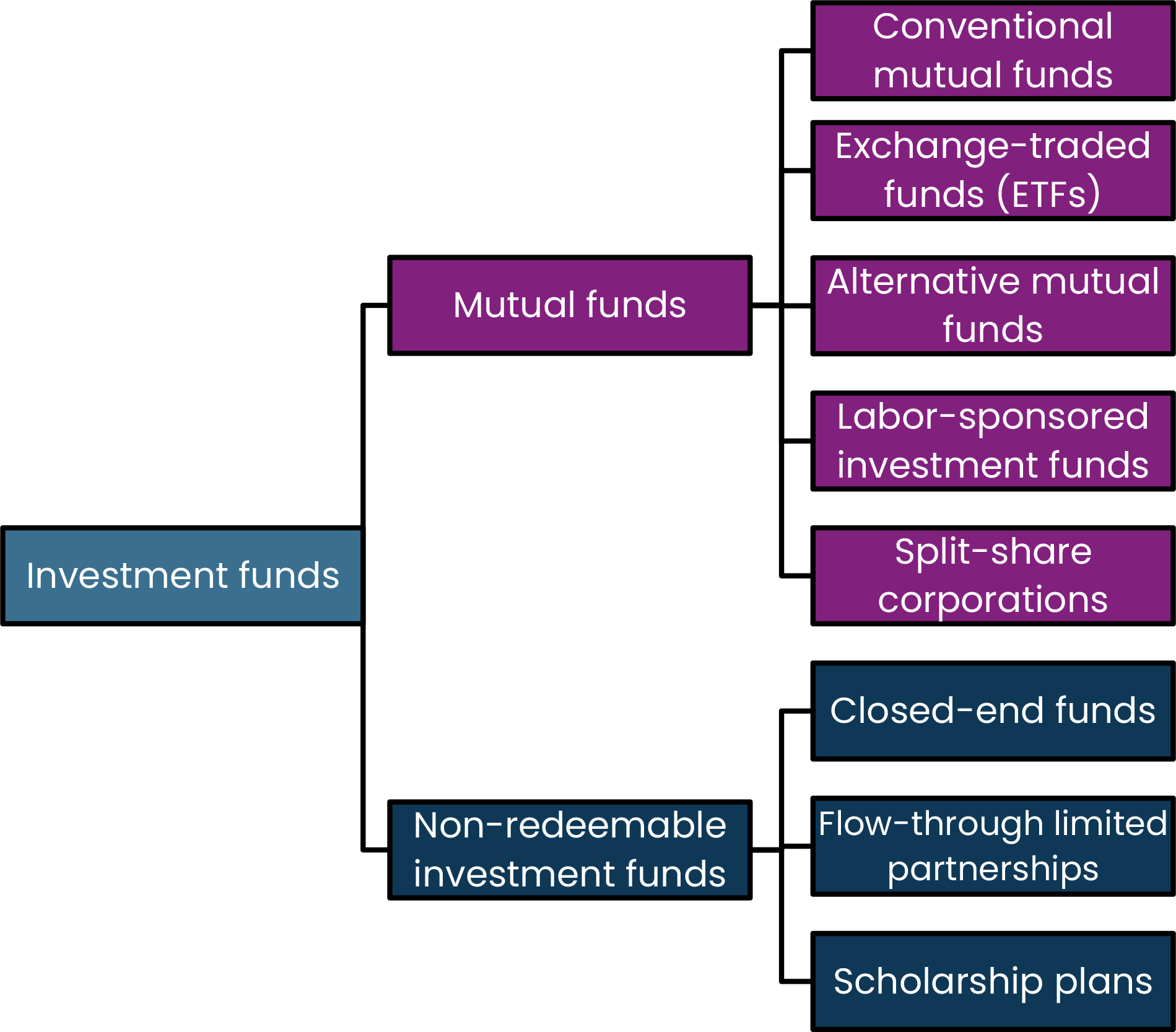
Guidance on whether an issuer is an investment fund was provided in the 2023 Report. Publicly offered investment fund assets in Canada are comprised broadly of mutual funds and non-redeemable investment funds:
Refer to Appendix A for a glossary and description of the rules that the IM division considers as part of its oversight of investment funds, IFMs and firms and individuals who are in the business of advising on securities in Ontario.
Canada's public investment funds have shown a slight growth since the prior year based on assets under management (AUM){1}:
Investment fund products |
AUM as of March 31, 2024 |
AUM as of March 31, 2025 |
% of Investment fund AUM as of March 31, 2025 |
|
|||
Conventional mutual funds |
$2.1 trillion |
$2.3 trillion |
79% |
|
|||
ETFs |
$417.1 billion |
$546.9 billion |
19% |
|
|||
Closed-end funds |
$41.6 billion |
$48.7 billion |
2% |
|
|||
TOTAL |
$2.6 trillion |
$2.9 trillion |
|
While conventional mutual funds still make up the bulk of the total investment fund AUM, ETF assets continue to grow at a faster rate than other investment fund products. Since the prior year, ETFs experienced the highest rate of growth in AUM (31%), as compared to conventional mutual funds (10%) and closed end funds (17%) and the value of ETF assets has almost doubled since fiscal 2021. The market share of ETFs also rose slightly to 19% from 16% in the prior year, with the shift coming entirely from conventional mutual funds which are at 79% as compared to 82% in the prior year. ETFs' continued popularity was evident with $95 billion of positive net sales during the period, which exceeds the combined total from the previous two periods. After two years of net redemptions, there were also positive net sales of $26 billion for conventional mutual funds during the period.
Globally, the Canadian investment funds industry remains significant and Canadian data on hedge funds, open-ended and closed-end funds can be compared to data from foreign jurisdictions on the IOSCO Investment Funds Statistics Dashboard. The IOSCO dashboard uses data from the IFS and aggregates public and private investment fund data from all its reporting jurisdictions, as well as showing information from individual jurisdictions.
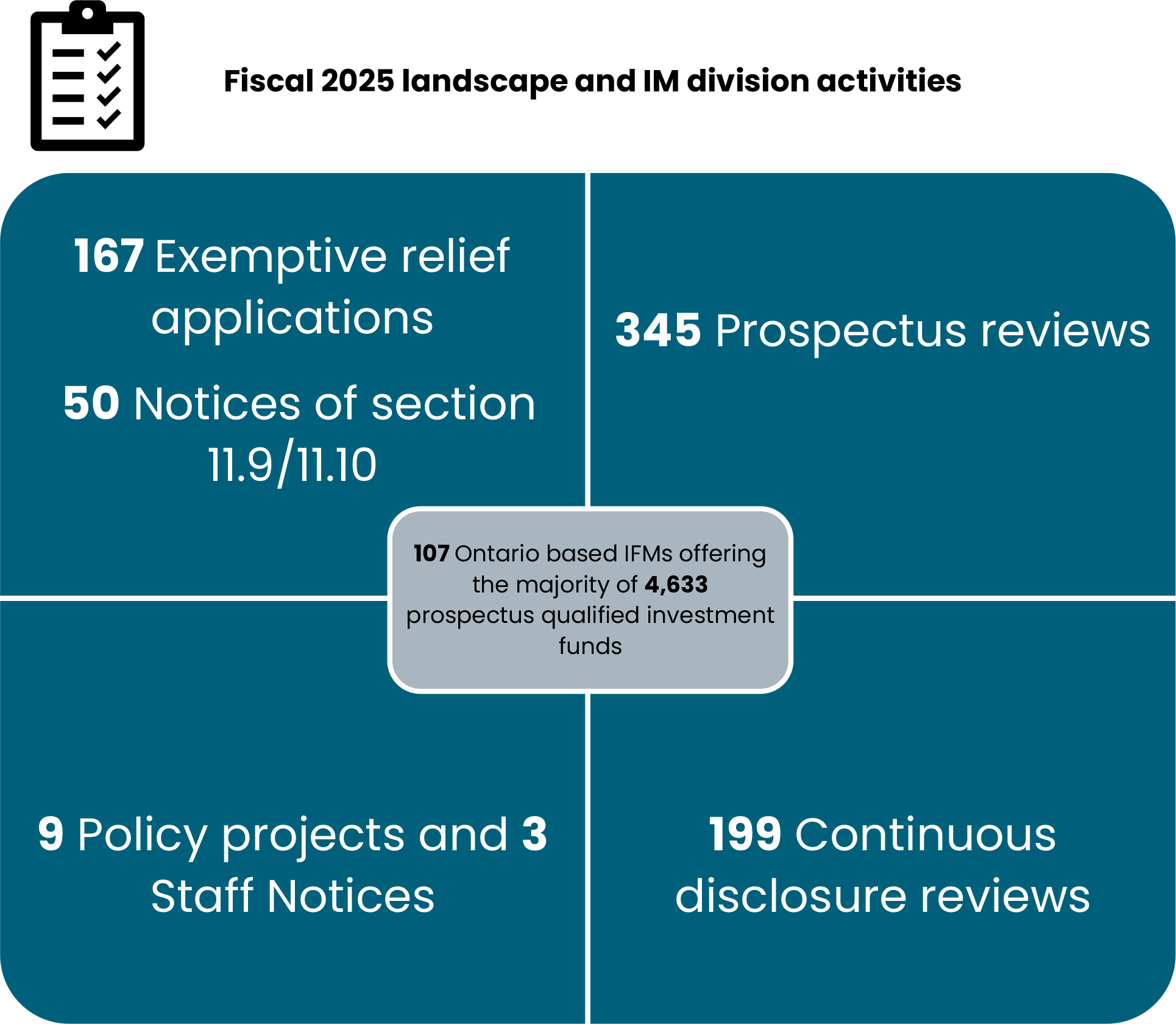
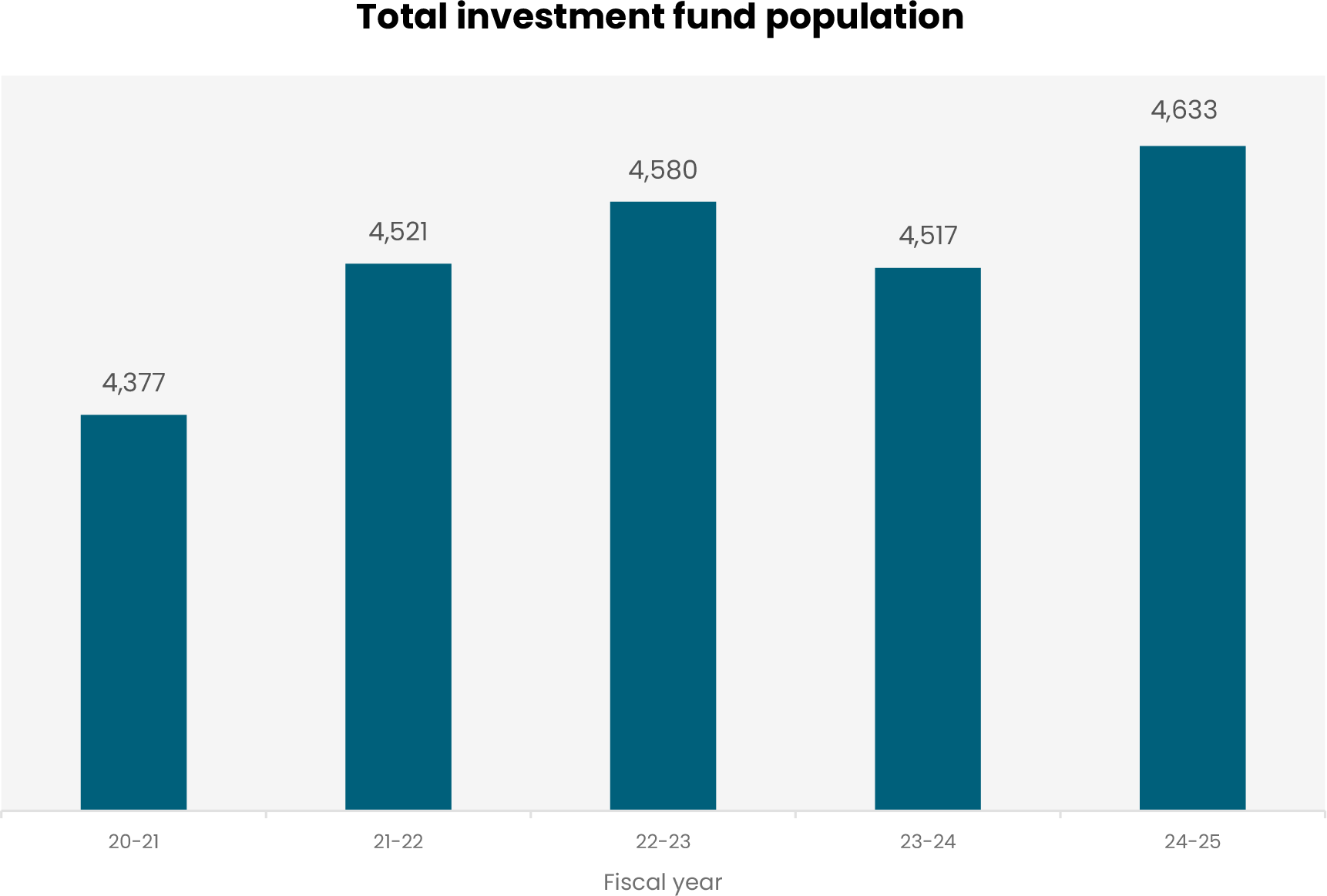
The OSC is the principal regulator to more than 80% of all Canadian investment funds, based on the head office location of the IFM. As of March 31, 2025, there were 107 Ontario-based IFMs offering the majority of the over 4,600 publicly offered investment funds, as compared to 119 IFMs in the prior year.{2} While the number of IFMs decreased during Fiscal 2025, there was a slight net increase of 116 funds in the total investment funds population.
The OSC is committed to transparency, accountability and timeliness in its regulatory functions and has set service standards and timelines which stakeholders can rely on when interacting with OSC staff. The OSC's most recent service commitment was published in March 31, 2025, and includes timelines for prospectus filings and amendments, review of exemptive relief applications, and continuous disclosure reviews. The IM division prides itself on ensuring that services are delivered efficiently and effectively. Sections I to IV below will highlight each of our main operational functions in more detail.
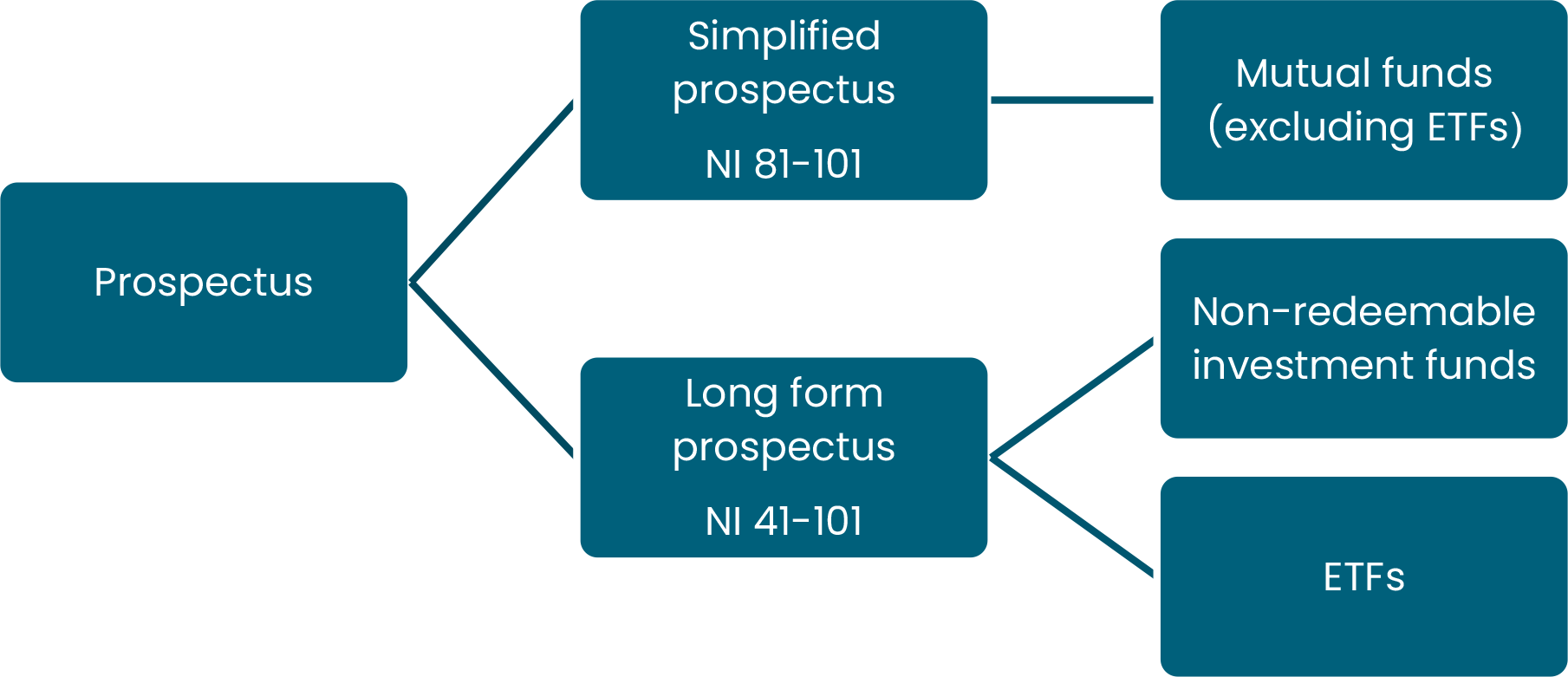
The review of preliminary and pro forma prospectuses is one of our key operational functions in regulating the sale of investment funds to retail investors. A preliminary prospectus is filed for new investment funds offerings, and a pro forma prospectus is filed to renew a prospectus that has lapsed (expired). Under Canadian securities law, an issuer must file a prospectus and obtain a receipt to "distribute" securities to the public. The type of prospectus required to be filed depends on the type of investment fund (e.g., conventional mutual fund or ETF) that is offering securities.{3}
For unique or novel products, we recommend that filers use the confidential pre-file process for prospectus and exemptive relief applications. Many filers who wish to launch a novel type of product in the market have used this process as it maintains the confidentiality of the product offering as the regulatory issues are resolved. While we understand the competitive aspect of being first to market with a novel product, we note that these types of files often require an in depth and thorough review as well as coordination with the other Canadian regulators in the CSA.
For more information on the pre-file process click here.
Staff remind IFMs that substantive changes to prospectus disclosure made after a preliminary or pro forma prospectus has been filed, or cleared for final, may cause delays in receiving a receipt for the final prospectus. More information on the review process when there have been substantive changes can be found here.
Prospectus filings are categorized by the IM division into one of three review types: standard, issue-oriented or full review. Most prospectus filings are subject to standard review, as these generally relate to investment funds that are already in distribution and have been previously reviewed. An issue-oriented review targets specific issues with the filing, while a full review is a more comprehensive and thorough review of the filing, which may occur when the prospectus is for a new manager, for a new type of fund or for a product that has features or characteristics that could raise novel issues. These filings are sometimes also accompanied by a related application for exemptive relief.
During Fiscal 2025, 86% of the prospectus reviews were standard, 12% were issue- oriented and 2% were full reviews.
For Fiscal 2025, the following trends were noted:
• There was a 4% increase in the total number of prospectus filings this fiscal year compared to last year. Over a third of the total filings were received in the first quarter (April 1 to June 30th) when markets were generally experiencing growth and IFMs may have seen this as an opportunity to launch new products. This large number of filings slowed down in the last three quarters when there was greater economic and political uncertainty in the markets.
• Total new funds receipted were relatively stable with 297 in Fiscal 2025, compared to 301 in the prior year.
• For the second consecutive year, newly launched ETFs exceeded those for conventional mutual funds at 49% vs 43%, respectively, compared to 48% vs 39% in the prior year. Factors contributing to this trend are the continued strength of ETF sales and its use to launch fund products, lower fees than conventional mutual funds and new managers (non-Canadian financial institutions) expanding into the Canadian ETF market.
• Of new funds receipted this year, new launches of alternative investment funds increased from 10% (31 funds) last year to 25% (76 funds) in Fiscal 2025, with most of the increase attributable to alternative ETFs. An "alternative mutual fund" is defined under NI 81-102 as a fund that can invest primarily in physical commodities, borrow cash or engage in short selling in a manner not permitted for other mutual funds under NI 81-102. Such funds can also create leverage through derivatives up to a maximum of 300% of net asset value. Within the alternative bucket, there are a variety of types of funds including crypto asset funds, leveraged strategies, long/short strategies and single U.S issuer ETFs, providing investors with more investment options and alternative strategies.
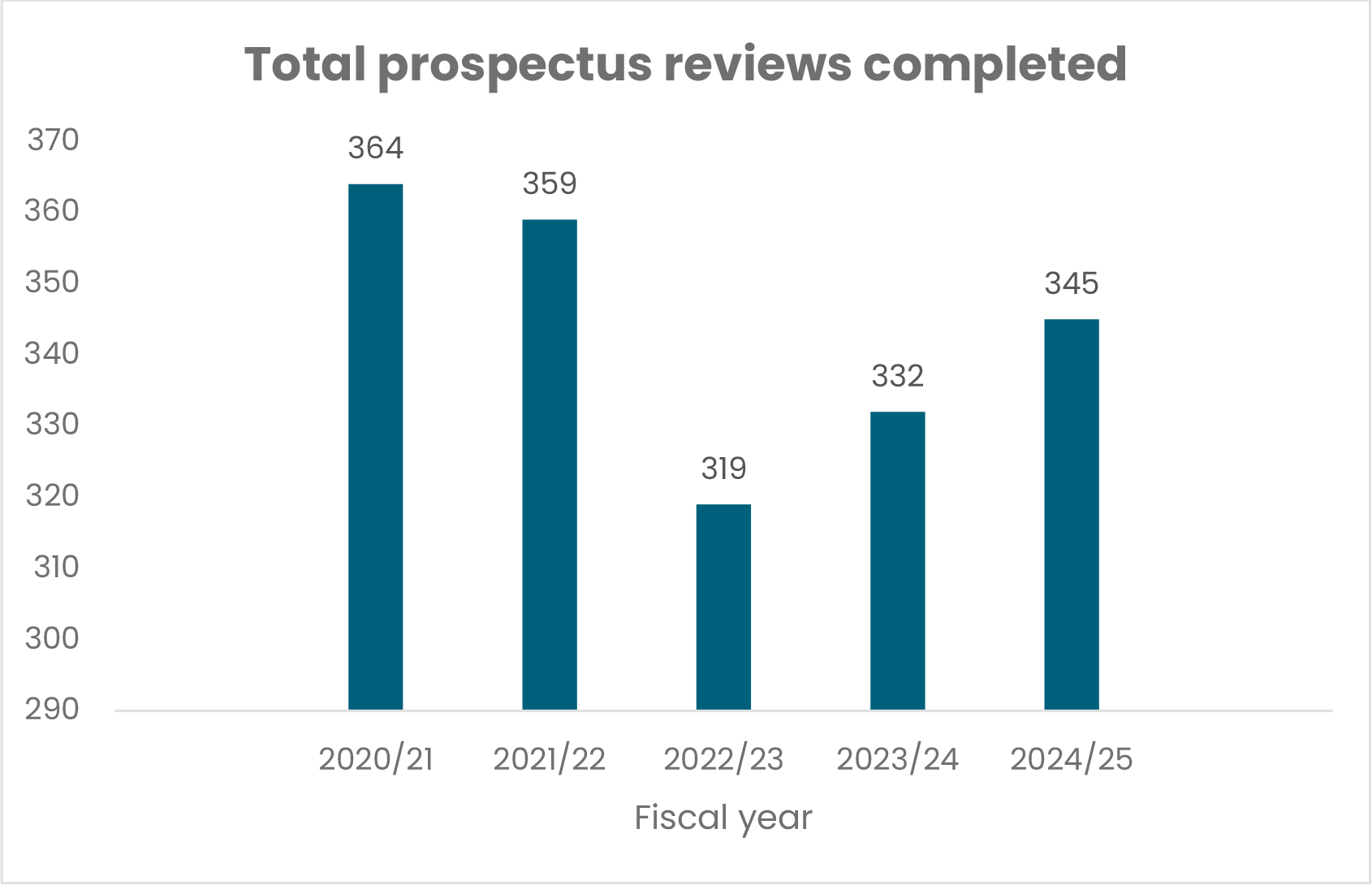
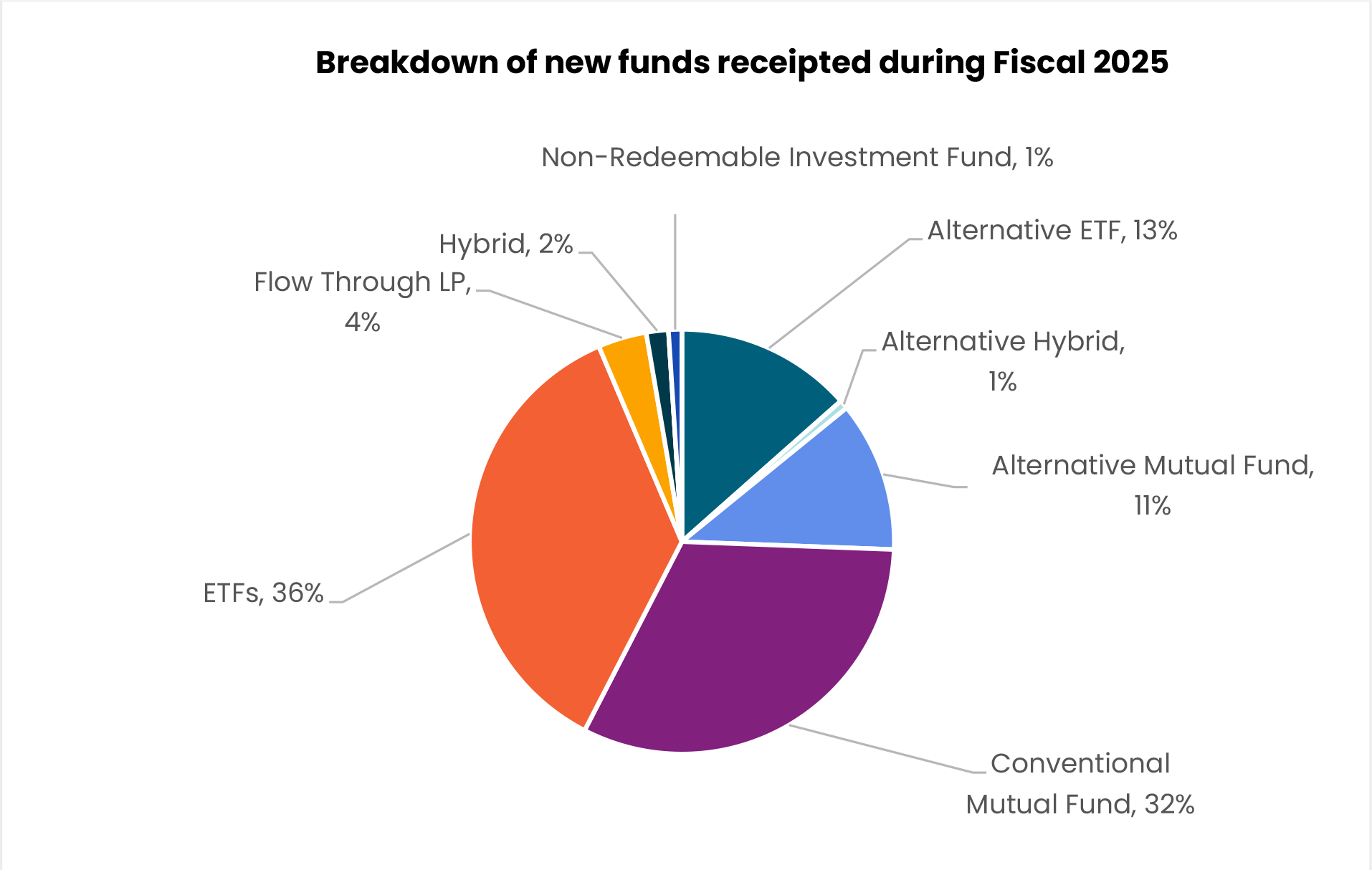
Some of the noteworthy prospectus filings that were receipted during the fiscal period (or shortly thereafter) are summarized below, along with details on any related exemptive relief.
An emerging trend this year was the launch of several ETFs that invest in collateralized loan obligations (CLOs), primarily rated AAA. During the last quarter of Fiscal 2025, five preliminary prospectuses were filed.
CLOs are investment vehicles that hold an underlying portfolio of corporate loans that are then put into a pool, securitized and managed like a fund. Each CLO is structured as a series of tranches that are interest-paying bonds, along with a small portion of equity. As the senior tranches have first claim on the cash flows produced by the loan pool, they are commonly granted AAA-ratings by credit rating agencies.
Institutional investors have been the traditional investor for CLOs. The CLO ETFs now provide a means for retail investors to obtain exposure to this asset class. CLOs are purported to provide higher yields than similarly rated corporate bonds, while having a lower correlation to equities and reduced correlation to traditional fixed income assets.
We note that CLO ETFs have been offered to U.S. investors for several years. OSC staff will continue to monitor this trend.
Shortly after the launch of Solana futures on the Chicago Mercantile Exchange in March 2025, we receipted the first Solana ETFs in North America that provide direct spot exposure to Solana. These ETFs began trading on the Toronto Stock Exchange on April 16, 2025. Four IFMs were issued final prospectus receipts for their respective Solana ETFs. The Solana ETFs, like the Ether ETFs, are also permitted to stake Solana held to earn staking rewards for the benefit of investors. Up to half of the fund's holding can be staked.
The launch of the Solana ETFs is consistent with the CSA's final rule amendments to NI 81-102 that provide for greater regulatory clarity for public investment funds investing in crypto assets and further the CSA's commitment to financial innovation and competition while maintaining investor protection.
On October 31, 2023, the Office of the Superintendent of Financial Institutions (OSFI) announced that it was raising liquidity requirements for HISA ETFs of deposit taking institutions, as these are considered unsecured wholesale funding and require a 100% run-off, compared to the previous rate of 40%. Banks that hold deposits for HISA funds must hold sufficient high-quality liquid assets, such as government bonds, to support all HISA ETF balances that can be withdrawn within 30 days. With the new stricter rules effective January 31, 2024, staff performed a review of HISA ETFs in the previous fiscal year to monitor their activities as part of the OSFI announcement, and to ensure the policy impact was managed. As part of that review, staff communicated expectations for disclosure in future renewal prospectuses.
Staff noted that HISA ETF renewal prospectuses filed in Fiscal 2025 have enhanced prospectus disclosure that describes the existence of terms in the ETF manager's contractual agreements with deposit taking institutions that may limit the ability of the ETF manager to make timely withdrawals without sufficient notice to the deposit taking institution, for example to reinvest assets of the ETF elsewhere. The ETFs are generally permitted to make withdrawals without prior notice to satisfy unitholder redemptions. There is no impact on retail investors to purchase/sell units in the secondary market.
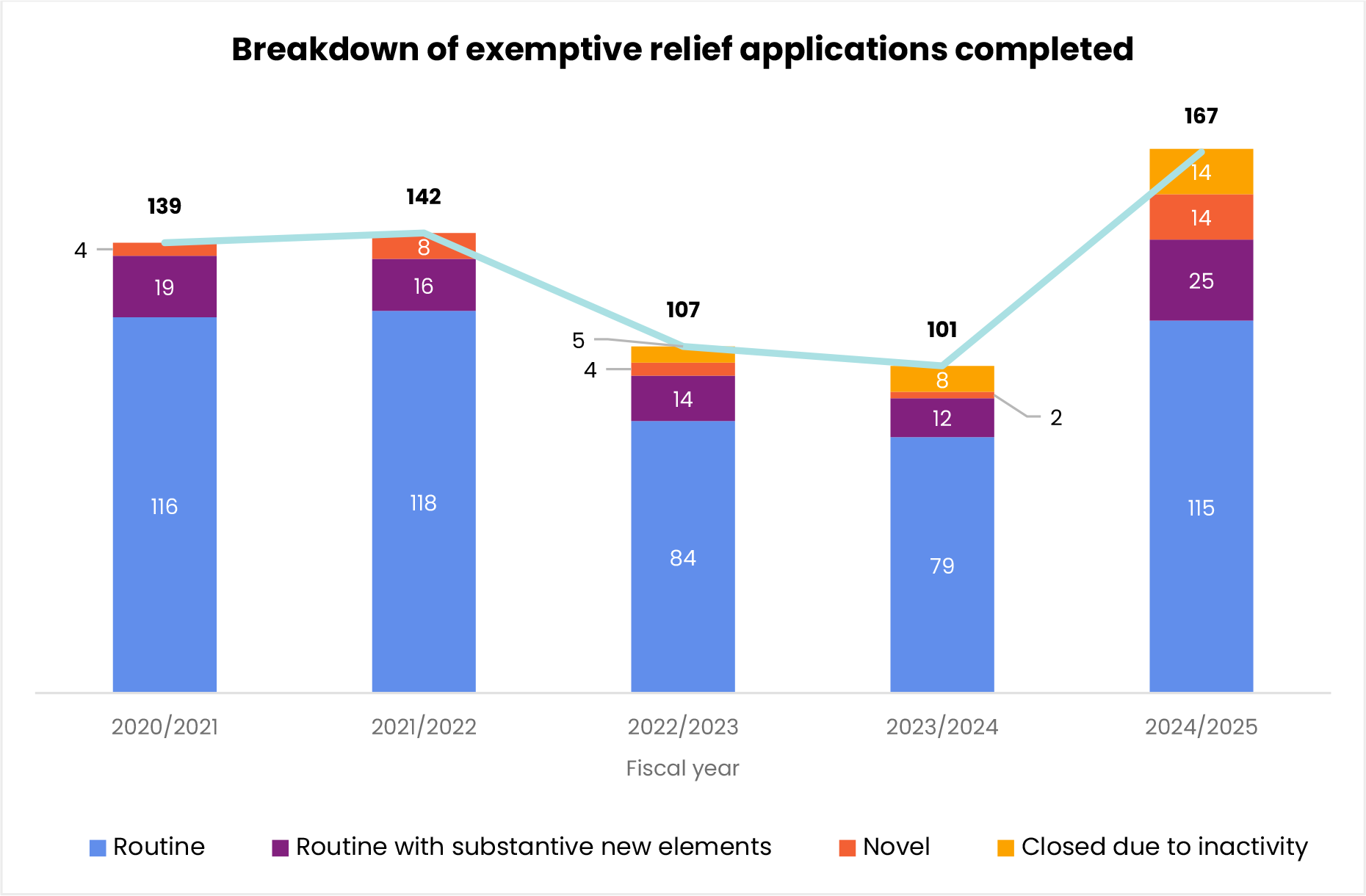
The IM division also reviews applications for exemptive relief, some of which are novel in nature. Novel applications generally consist of requests for relief that have not previously been granted or that deviate substantially from the fact patterns underlying any prior decisions. These applications generally take longer to review because of their nature and complexity, and we consult with the CSA on all novel applications. The test for granting the relief is whether the relief would not be prejudicial to the public interest.
The volume of exemptive relief applications received in Fiscal 2025 increased almost 30% from the prior year. Much of this increase is due to the addition of the Portfolio Advisers team and the accompanying applications related to relief from NI 31-103. While codifying routine relief as part of our burden reduction efforts led to a decline in the number of applications in the previous two years, many of the investment fund-related applications received in Fiscal 2025 have been more novel or have unique elements. Routine applications still made up the bulk of the exemptive relief applications completed. The general increase in the volume of filing submissions early in the fiscal year as compared to the latter half is consistent with favorable market conditions early in the year and more economic uncertainty towards the end of the fiscal period.
Relief was granted in May 2024 to allow certain mutual funds managed by 11 IFMs to borrow cash on a temporary basis in an amount that does not exceed 10% of the mutual fund's net asset value at the time of borrowing to (i) accommodate requests for redemption of securities of the fund while the fund settles portfolio transactions initiated to satisfy such redemption requests, and to (ii) permit the fund to settle a purchase of portfolio securities that is executed in anticipation of the settlement of an investor's purchase of securities of the fund. Subsequent to this relief, additional IFMs applied and received similar relief.
The relief is aimed at addressing operational hurdles for those funds with exposure to non-T+1 markets, because of the implementation of T+1 settlement for securities traded in North American markets as of May 27, 2024, while certain foreign markets will continue to maintain T+2 settlement. Such markets include, but are not limited to, the European Union, the United Kingdom, Japan, Brazil, Australia, and New Zealand. The relief expires in three years.
Staff have periodically received applications on behalf of investment funds that are not reporting issuers (Pooled Funds), seeking exemptive relief from the deadline for financial statement filing and delivery requirements. These applications are typically sought by Pooled Funds that invest a significant portion of their assets in other underlying investment funds (Underlying Funds), that are established or domiciled in a foreign jurisdiction.
Relief is granted primarily to account for the additional time needed to incorporate the financial statements of the Underlying Funds into the Pooled Funds' financial statements so that they may be properly audited by the Pooled Fund's auditor.
We are reminding filers seeking this relief to, at a minimum, address the following:
• A description of the Pooled Fund's investment objectives and strategies, and how those objectives are met by investing in the Underlying Funds.
• The proportion of the Pooled Fund's net assets invested in the Underlying Funds.
• Where the Underlying Funds are domiciled.
• Why the relief is being requested (e.g. confirmation from the auditor that the Pooled Fund is unable to complete the audit of the financial statements without Underlying Fund information).
• The basis for the specific amount of additional time requested.
• What alternatives were considered (such as, for example, altering its financial year-end) to address the timing issues and why those options are impractical or unfeasible such that seeking exemptive relief is the better option.
• How the filer will inform the Pooled Fund's securityholders of the relief and give securityholders the opportunity to exit the fund on reasonable terms, within a certain window of time after being informed of the relief.
We note that the need to provide submissions unique to the situation being considered makes it unlikely that staff would be prepared to recommend this relief on a future oriented basis.
OSC and Autorité des marchés financiers staff worked collaboratively on novel relief granted in February 2025 to permit dealer-managed investment funds managed by five bank-owned investment IFMs, to invest in offerings of non-reporting issuer debt securities underwritten by a related party or a syndicate including a related party. This relief: (i) revokes prior similar relief granted to the funds, (ii) establishes revised conditions requiring the IFM's consideration of three substantive key elements relevant to the mitigation of conflicts of interest inherent in transactions contemplated by the relief, and (iii) mandates increased interaction between the IFM and the funds' Independent Review Committee (IRC) where any exceptions to the three substantive key elements are pursued.
During the period, we worked with several IFMs to accommodate extensions to their prospectus filing timelines to facilitate the consolidation of fund prospectuses for funds under common management. The lapse date requirement ensures the currency and accuracy of a prospectus to protect investors from relying on out-of- date information when purchasing securities. The lapse date extension relief enables IFMs to:
• combine the renewal of different prospectuses under the same document to streamline fund disclosure across the IFM's fund platform, allowing investors to compare their features more easily, and
• save on additional costs and expenses associated with preparing two separate renewal prospectuses, given how close in proximity the lapse dates of the different funds are to one another.
Filers are still obligated to disclose material changes, and staff are satisfied that the conditions of the relief ensure that investors are receiving current information related to their investments.
In the past year, the OSC has granted a decision, and opted into a decision of the BCSC, that provide relief from the fund-of-fund restrictions in NI 81-102, to permit certain investment funds to invest all, or substantially all of their assets in securities of an underlying U.S.-listed ETF or exchange-traded product. Five decisions of this nature were issued in Fiscal 2025, with the relief being granted to four different IFMs on behalf of six investment funds.
While relief had been granted previously to permit an investment fund to invest substantially all of its assets in an underlying U.S.-listed ETF, some of the decisions granting this relief over the past year contained substantive new elements. The facts surrounding these applications differed from one another, as did certain conditions contained in the decisions. However, there were several common elements. In each case, the underlying U.S.-listed ETF or exchange-traded product was (i) listed and traded on a recognized exchange in the U.S., (ii) managed in a manner consistent with the investment restrictions in NI 81-102, (iii) subject to disclosure requirements which were substantially similar to the disclosure requirements under NI 41-101, Form 41-101F2, Form 41-101F4, and NI 81-106, (iv) in good standing with the U.S. Securities and Exchange Commission (SEC), and (v) either an investment company subject to the Investment Company Act of 1940 or regulated by the SEC as a reporting issuer under the Securities Act of 1933.
Staff were satisfied that permitting these investment funds to invest their assets in these underlying U.S. funds could increase diversification opportunities that are otherwise not available and represent an efficient and cost-effective alternative to obtaining exposure to securities held by or strategies of the U.S. fund, without causing prejudice to investors.
When a large number of registered individuals move from one firm to another as the result of a business transaction, the acquiring firm may file an application for exemptive relief with the regulator from the individual form filing requirements, so that the transfer of registered or permitted individuals and business locations can be done on a 'bulk transfer' basis instead of an individual basis. Appendix D of 33-109CP lists the circumstances in which regulators will consider granting this relief as well as the information generally required to be submitted with an application.
Prior bulk transfer applications have typically involved a minimum of 25 individuals who must transfer their registration. Where the number of individuals moving is lower than 25, we would be unlikely to consider an application for bulk transfer relief and may ask filers to withdraw an application.
Finally, another factor impacting bulk transfer applications is timing. Bulk transfers cannot be processed through NRD from December 15 to the third week of January and therefore, the transfer will only be processed through NRD once this blackout period has expired. It is recommended that firms seeking bulk transfer relief apply at least 30 days before the effective date and include all the information in their application as set out in Appendix D to 33-109CP.
The IM division conducts standard and targeted reviews of the continuous disclosure (CD) filings of Ontario-based investment funds. Risk-based criteria are used to select investment funds to ensure compliance with disclosure requirements and to identify trends. We may also choose to conduct targeted reviews of a particular segment, on a particular issue or based on complaints received.
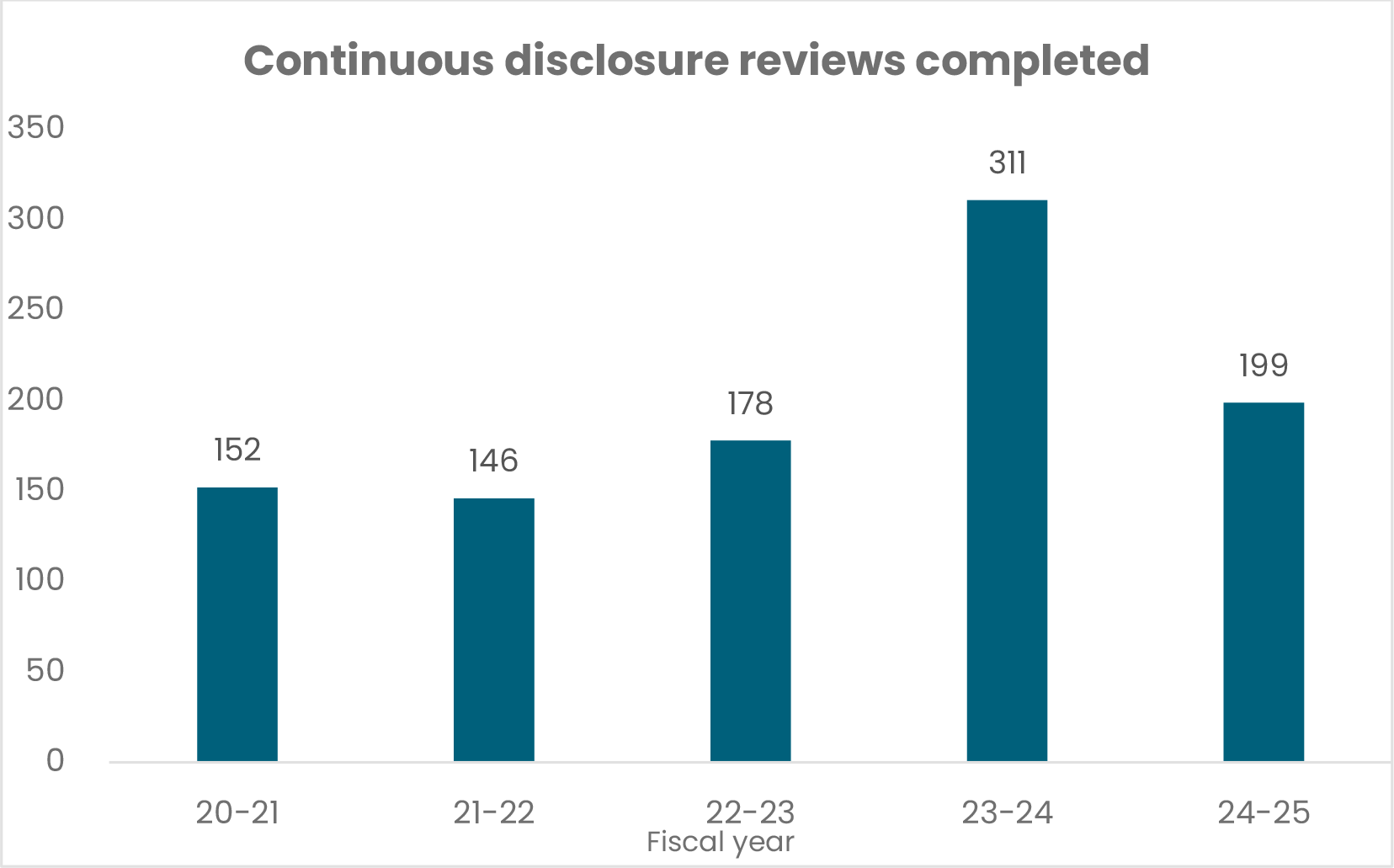
Although the overall number of completed CD reviews decreased in Fiscal 2025, there was a 58% increase in the number of targeted CD reviews performed compared to the prior year. These reviews take longer to complete and require more time and resources than standard reviews. The targeted reviews completed are described in more detail below.
Outlined below are the major reviews completed during the fiscal period:
We conducted an issue-oriented desk review of investment funds to determine if issuers were exaggerating their investment products' use of artificial intelligence (AI).
The review identified approximately 15 issuers that use the term AI or other related terminology (Generative AI, Large Language Model, Machine Learning, etc.) The vast majority of the 15 issuers use the term AI to indicate investments in large companies that are at the forefront of research and development of AI. There was no evidence noted of issuers using the term AI or related terminology in a misleading manner to attract investors, or of AI being used to perform portfolio management services.
Staff will continue to review the funds' disclosure around AI washing to ensure there are no misleading or inaccurate claims.
Staff conducted a review of small issuers with a focus on IFMs with total AUM of less than $100 million as well as small funds with less than $10 million in net assets. Staff reviewed documents for compliance with filing and disclosure requirements and clear presentation, such as the various compliance reports under NI 81-102, financial statements, the Management Report of Fund Performance (MRFP), prospectuses, and the IFM's website and other marketing materials for any misleading or egregious presentation. Staff noted that some smaller issuers have disclosure in the MRFP which is inconsistent with regulatory requirements or is not fulsome in nature, as well as other minor issues in the other disclosure documents or compliance reports. With regards to compliance reports that are required to be filed, issuers are reminded to submit the documents by the filing deadline in SEDAR+ under the appropriate SEDAR+ profile number. The review of small issuers is ongoing, and staff will determine whether guidance is needed in this area upon completion of the review and in conjunction with the ongoing policy initiative related to the modernization of continuous disclosure documents, including the MRFP, which is described in more detail in Part B.
Staff conducted detailed analysis on the data collected through the IFS for the year ended December 31, 2023, focusing on key risk areas including portfolio liquidity and financial leverage of investment funds.
Staff selected several key performance indicators (KPIs) or regulatory markers to compare and identify funds which were outliers compared to their peers or offside any regulatory restrictions for that particular type of investment fund. During Fiscal 2025, the analysis focused on the following areas:
• Portfolio liquidity -- the percentage of a fund's assets that require more than 365 days to liquidate.
• Cash borrowing -- the percentage of a fund's cash borrowing relative to its net asset value.
• Total borrowing and short sales -- the percentage of a fund's cash and securities borrowing relative to its net asset value.
• Aggregate exposure to borrowing, short selling and specified derivatives.
The majority of the funds complied with the applicable regulatory requirements for the KPIs selected based on the IFS data. Where outliers were identified, staff examined prospectuses, continuous disclosure documents and portfolio holdings to ensure that the funds were not offside regulatory requirements and to understand why the funds differed from their peers.
In some cases, the funds were outliers for valid reasons, for example due to receiving exemptive relief or erroneously identifying themselves as mutual funds in the IFS when they were in fact, alternative mutual funds and subject to different requirements. Some funds experienced transitory fluctuations in their borrowing or liquidity and staff will monitor these funds going forward using data from the most recent IFS.
Staff will continue to monitor outliers and incorporate data from the latest IFS to look for trends or issues that require further action.
Fund managers must use the CSA risk classification methodology to determine the investment risk level of conventional mutual funds and ETFs for use in the Fund Facts document and in the ETF Facts document, respectively. Under the CSA methodology, a mutual fund must calculate its standard deviation for the most recent 10 years to determine its investment risk level on the 5-category risk scale in the Fund Facts or ETF Facts, as applicable. IFMs are permitted to use discretion to classify a mutual fund at a higher investment risk level than that indicated by the standard deviation calculation, if it is reasonable to do so in the circumstances.
During the period, staff conducted a CD review to better understand the IFMs' use of discretion to increase the investment risk level of a mutual fund, including the circumstances under which discretion has or has not been used, and the related policies and procedures. CD review letters were sent to 45 IFMs of varying ranges of assets under management that manage mutual funds.
The review found that over 64% of IFMs have used discretion to increase a fund's risk rating. Among the reasons cited were the following:
• to avoid unnecessary disruption and confusion to investors by maintaining a previous risk rating,
• when a fund is on the cusp of two standard deviation ranges,
• to have the same investment risk level as comparable funds, and
• when higher volatility is anticipated.
Of note, in 2019, some IFMs reportedly used discretion to maintain a fund's investment risk level as disclosed in the most recently filed Fund Facts or ETF Facts when the 10-year standard deviation calculation under the CSA methodology no longer included the performance returns of the 2008 financial crisis.
The results of the review are summarized in OSC Staff Notice 81-338 Guidance on the Use of Discretion Under the CSA Investment Risk Classification Methodology. The staff notice also encourages all IFMs to adopt policies and procedures to determine the appropriateness of using discretion to increase a fund's investment risk level under the CSA methodology.
During the past fiscal year, staff continued to review sales communications of investment funds in accordance with the disclosure requirements in Part 15 of NI 81-102. Part 15 outlines how mutual funds can communicate and advertise their products to potential investors, including limitations on what information can be disclosed and what types of claims can be made in sales materials.
Through this review, staff noted that instances of non-compliance continue to occur in certain sales communications that are widely distributed through an IFM's website and social media (e.g., YouTube and LinkedIn). Instances of non-compliance through these sources included sales communications that:
• referred to a performance rating or ranking and included investment fund performance data without satisfying certain disclosure requirements,
• referenced non-compliant yield disclosure for certain investment funds that had not distributed securities under a prospectus for at least 12 consecutive months,
• included attention-grabbing high yield or high distribution rate information without also including standard performance data or ensuring that both data points were equally prominently displayed.
Where issues were identified that did not comply with the disclosure requirements, the sales communications were amended or removed as needed. Where there was continued non-compliance, staff referred the matter to the Registrant Conduct Team of the RIE division for further regulatory action.
To provide transparency to the market on amendments made to an investment fund's continuous disclosure record, website or social media during a staff review, staff may request the issuance of a news release by the IFM in relation to such corrections and place the affected investment fund issuers on the Refilings and Errors List for a period of three years.
We encourage IFMs to review the November 2023 article outlining staff's concerns around high yield figures being prominently displayed and emphasized over all other aspects of a fund's sales communication and marketing materials. Staff will continue to monitor investment fund sales communications to ensure compliance with disclosure requirements.
In Ontario, crypto asset funds are offered by seven IFMs and data on the crypto asset landscape is shown below:
Fiscal year |
# of Ontario public crypto asset funds |
AUM of crypto asset funds |
# crypto asset funds receipted |
# crypto asset funds terminated |
|
||||
2025 |
25 |
$7.35 billion |
44 |
0 |
|
||||
2024 |
21 |
$7.45 billion |
0 |
3 |
|
||||
2023 |
24 |
$2.85 billion |
2 |
1 |
|
||||
2022 |
23 |
$6.89 billion |
17 |
0 |
The IM division monitors crypto asset fund activity on a regular basis. Staff observed fluctuations in the monthly net inflows and outflows throughout the 12-month period ending March 31, 2025, with significant monthly outflows noted in December 2024 making up the majority of the $627 million in net redemptions during Fiscal 2025 (Fiscal 2024 -- net sales of $599 million). Despite the net redemptions, the total AUM of crypto asset funds remained relatively stable as the value of bitcoin increased in Fiscal 2025. The majority of the AUM (86%) is represented by 12 funds with exposure to bitcoin.
4 In addition to the four crypto asset funds receipted during the period, four additional ETFs were receipted shortly after the Fiscal 2025 year-end that provide direct spot exposure to Solana and three XRP ETFs were receipted in June 2025.
IM division staff conduct standard continuous disclosure reviews of a sample of filings including annual and interim financial statements, annual reports and annual and interim MRFPs filed on SEDAR+. The objective of these reviews is to ensure issuers are complying with their disclosure obligations under NI 81-106 and that the filings are made in a timely manner. The samples are selected based on risk areas which are comprised of material changes, change of auditor, new reporting issuers and issuers with a previous continuous disclosure review issue. During Fiscal 2025, 84 funds were selected for review across 47 IFMs.
The IM division is responsible for reviewing notices of proposed ownership changes in, or asset acquisitions of, registered firms as required under sections 11.9 or 11.10 of NI 31-103, as applicable (the Notice).{5}
Registrants are reminded to include the information in section 11.9 of Companion Policy 31-103 Registration Requirements, Exemptions and Ongoing Registrant Obligations under the heading Content of the notice to help the regulator assess the proposed transaction. Staff developed a voluntary form to assist filers in complying with their requirement to file the Notice.
We continue to see the following common issues with Notices that are filed for our review:
• registered firms or registered individuals acquiring 10% or more of the securities of another registered firm, or their sponsoring firm, without first providing the regulator with the required Notice;
• registered firms questioning whether a Notice is required where the percentage ownership change exceeds the 10% threshold by a small amount; we remind all filers that the 10% threshold is a bright line test and there is no "de minimus" concept that applies to this threshold and the corresponding requirement to file a Notice;
• registered firms not providing the regulator with the required Notice as soon as the registered firm knew, or had reason to believe, that 10% or more of its voting securities or other securities convertible into voting securities were going to be acquired;
• registrants filing Notices within a shorter time period than the minimum 30 days required before the closing of the proposed transaction and requesting an expedited non-objection; and
• registrants not including all relevant facts regarding the proposed transaction sufficient to enable the regulator to properly assess the proposed transaction (e.g., not adequately explaining how material conflicts of interest arising out of the proposed changes have been or will be addressed in the best interest of clients).
Where we identify missed Notices for completed transactions, we require the registered firm to file the Notice for review and pay the applicable filing fees. Failure to provide notice of ownership changes or asset acquisitions may also result in the issuance of a warning letter or, in limited cases, further regulatory action. We remind registered firms that they may use the voluntary form referenced in this section to prepare and file these Notices.
In addition to ongoing policy initiatives that focused on modernization of the investment funds' regulatory regime and burden reduction, the IM division's policy initiatives are evolving along with the OSC's new strategic plan which will include right-size regulation for investment funds which is informed by changing needs, risks and practices in Ontario and globally. As always, feedback from stakeholders, including investors, is a critical part of rule making. Unless an exception to the notice requirement applies, the OSC is required to publish proposed rules for public comment which is generally a 90-day period.
This section details the major policy initiatives that were completed or were ongoing during Fiscal 2025:

On May 23, 2024, the CSA published final amendments to NI 81-102 that would support mutual funds that voluntarily shorten their trade settlement cycles from two days after the trade date to one day (T+1), following the transition by North American securities markets to T+1 settlement. The amendments accommodate a range of settlement cycles for mutual funds, including those switching to T+1. The final amendments became effective on August 31, 2024.
On January 27, 2022, the CSA published for comment a proposal to modernize the prospectus filing model for investment funds. The final rules came into effect on March 3, 2025, and will reduce regulatory burden without affecting the quality or timeliness of information available to investors.
Under the new rules, investment funds in continuous distribution will now be able to file prospectuses every two years instead of annually. Investors will continue to have access to continuous disclosure documents, as well as the Fund Facts and the ETF Facts, which are updated annually, and will still be able to request the prospectus or access it online.
For all investment funds, the requirement to file a final prospectus no more than 90 days after the issuance of a receipt for a preliminary prospectus was also repealed.
With the publication of final rule amendments, SEDAR+ changes have also been implemented to support these amendments. Please also refer to the SEDAR+ Two- Year Lapse Date Frequently Asked Questions for more information.
Under the Order Execution Only (OEO) trailer ban, IFMs are prohibited from paying trailing commissions where the dealer is not required to make a suitability determination in connection with a client's purchase and ongoing ownership of prospectus qualified mutual fund securities, and dealers are prohibited from soliciting or accepting trailing commissions from an IFM, in connection with securities of the mutual fund held in an account of a client of the dealer, if the dealer is not required to make a suitability determination, including, among others, OEO dealers.
On April 3, 2025, the OSC published OSC Rule 81-510 Dealer Rebates of TrailingCommissions which codifies the temporary exemptive relief previously provided. The rule came into effect on May 31, 2025, and permits the continued payment of trailing commission rebates to investors in limited circumstances, where investors hold mutual fund securities that pay trailing commissions in accounts held at OEO dealers. It also permits the continued payment of trailing commission rebates in relation to the processing of client-initiated transfers of mutual fund securities with trailing commissions into OEO dealer accounts.

Access based model for investment fund reporting issuers
On September 27, 2022 the CSA published for comment CSA Notice and Request for Comment -- Proposed Amendments and Proposed Changes to Implement an Access-Based Model for Investment Fund Reporting Issuers. The proposed amendments will modernize existing delivery practices for investment fund continuous disclosure documents by increasing online availability and accessibility, which recognizes increased investor preference for accessing information electronically.
Comments on the proposed amendments were due December 26, 2022. We received 23 comments which are still being considered by the CSA.
On September 19, 2024, the CSA published proposed amendments to modernize the investment fund continuous disclosure requirements, with the aim of improving the quality of disclosure provided to investors and making the requirements less burdensome for investment funds. A key element of the CSA's proposals was to replace the existing annual and interim MRFP with a new annual and interim Fund Report that would improve disclosure. To ensure that the Fund Report would respond better to investor needs and preferences, the CSA engaged the services of a third- party consulting firm with expertise in behavioural insights to assist in the redesign efforts. The report of the behavioural insights consulting firm was published on the same date.
Another key element of the CSA's proposals was to provide exemptions from certain statutory requirements in a number of jurisdictions that impose an obligation on IFMs to file reports with respect to specified types of related party transactions. The third key element of the CSA's proposals was to remove the requirement to prepare certain class or series-level disclosures, that are not required under International Financial Reporting Standards, in the Statement of Comprehensive Income, the Statement of Changes in Financial Position, and the notes to the financial statements.
The CSA also made two additional proposals. The first was to reference the term Fund Expense Ratio, which combines the management expense ratio and the trading expense ratio of an investment fund, in the Fund Facts and the ETF Facts. The second was to make minor editorial and other revisions to the simplified prospectus form.
The comment period ended on January 31, 2025, and the Working Group is considering the comments received.
On November 28, 2024, the CSA published for comment proposed amendments to the principal distributor model in the distribution of mutual funds. The proposed amendments clarify that a principal distributor may only act for mutual funds in the same mutual fund family and require disclosure of principal distributor arrangements and compensation to investors purchasing mutual fund securities distributed by principal distributors. The aim of these amendments is to foster a fairer and more transparent marketplace for all market participants.
The CSA is also consulting on whether there are circumstances in which a principal distributor should be allowed to have multiple relationships. The deadline to submit comments on those proposals was April 28, 2025, and the comments are currently under review.
Chargebacks involve a compensation practice where a dealer or dealing representative is paid upfront commissions and/or fees when their client purchases securities. Chargebacks occur when investors redeem their securities before a fixed schedule as determined by the dealer firm, and the dealing representative is required to pay back all or part of the upfront commission/fees.
On June 26, 2025, the CSA published proposed amendments aimed at addressing the significant inherent conflict of interest arising from the use of chargebacks in the distribution of investment fund securities. The proposed amendments prohibit the use of chargebacks in the distribution of securities of investment funds that are reporting issuers.
On April 17, 2025, the CSA published amendments to NI 81-102 to provide greater regulatory clarity on certain key operational matters relating to public investment funds investing directly or indirectly in crypto assets. This represents a continuation of the CSA's efforts to enhance the regulatory framework for public crypto asset funds, following the publication of CSA Staff Notice 81-336 Guidance on Crypto Asset Investment Funds that are Reporting Issuers that was published July 2023.
The amendments tailor requirements for public investment funds investing in crypto assets to better protect investors and reduce risk. Requirements include crypto asset investment restrictions and custodial obligations. The CSA reminds Canadians that investing in crypto assets, even through public investment funds, is higher risk and may not be suitable for most retail investors.
The amendments came into effect on July 16, 2025, and are the second phase of a project to implement a Canadian regulatory framework for public investment funds holding crypto assets. In the project's third phase, the CSA will consult publicly on a broader framework.
In August 2023, the CSA commenced a review of ETF regulations to assess whether the current regulations applicable to ETFs remain appropriate. The review focused on the unique features of ETFs, such as secondary market trading, creation and redemption of ETF units by authorized dealers, and the underlying arbitrage mechanism of ETFs.
On June 19, 2025, the CSA published CSA Consultation Paper 81-409 Enhancing Exchange-Traded Fund Regulation: Proposed Approaches and Discussion (the ETF Consultation Paper), discussing potential enhancements for the ETF regulatory framework. The comment period ended in October 2025. Based on the feedback, if necessary, proposed rules or amendments will be published for comment. To inform the discussion, the OSC's Thought Leadership division conducted a study of the Canadian ETF market, analyzing its composition, secondary market activity, and factors affecting trading liquidity and arbitrage. The findings are detailed in the OSC ETF Study published concurrently with the ETF Consultation Paper.
There were several initiatives ongoing during the year which will affect investment funds on a go forward basis, as described below.
On October 10, 2024, the OSC published Consultation Paper 81-737 Opportunity to Improve Retail Investor Access to Long-Term Assets through Investment Fund Product Structures aimed at improving retail investor access to illiquid investments through a framework proposal for a long-term asset investment fund product structure.
The consultation proposed the creation of a new investment fund category, the Ontario Long-Term Asset Fund (OLTF), which would allow Ontarians to invest in assets they may not traditionally have exposure to. These assets include venture capital, private debt and equity, and infrastructure and natural resource projects. OLTFs could offer opportunities for more retail investors to participate in capital- intensive projects, while enabling businesses to lower funding costs and raise the capital necessary for growth.
The proposed new framework would allow retail investors to gain exposure to these long-term assets through the professional management of a registered IFM and registered portfolio manager.
Comments on the consultation paper were due on February 7, 2025, and the feedback received led to the next steps set out in OSC Staff Notice 81-738 Next Steps Following OSC Consultation Paper 81-737 Opportunity to Improve Retail Investor Access to Long-Term Assets through Investment Fund Product Structures, published on May 29, 2025.
On December 5, 2024, the CSA published a notice intended to provide clarity and guidance on how securities legislation applies to the use of AI systems by market participants. Staff Notice and Consultation 11-348 Applicability of Canadian Securities Laws and the Use of Artificial Intelligence Systems in Capital Markets also seeks stakeholder feedback through consultation questions on the evolving role of AI systems and the opportunities to tailor or modify current approaches to oversight and regulation.
The guidance in the notice addresses key considerations for registrants, reporting issuer investment funds, marketplaces and other market participants that may leverage AI systems. It highlights the importance of maintaining transparency, ensuring accountability and mitigating risks to foster a fair and efficient market environment. The guidance provided is based on existing securities laws and does not create new requirements.
Some highlights from the notice include the following:
• Registered firms should consider their use of AI systems and any associated risks when developing their policies and procedures. This would include the use of AI for functions that are outsourced to service providers.
• Advisors who use AI should disclose to clients in a clear and meaningful manner any use of AI systems that may directly affect the registerable services provided to them and any associated risks. While AI can be used by advisors to assist with trade execution, KYC and onboarding and support clients and investment research, the notice reiterates that an AI system cannot be used as a substitute for an advising representative acting as decision-maker for clients' investments and for making suitability determinations.
• IFMs using AI systems to assist in meeting a fund's investment objectives and strategies should consider the extent to which they should disclose this use in their fund's offering documents.
• Where the use of AI systems by an IFM raises an actual or perceived conflict of interest in respect of the investment fund, consideration should be given to whether an approval or recommendation must be obtained from the IRC prior to use of such system. Similarly, advisors must take reasonable steps to identify existing and reasonably foreseeable material conflicts of interest.
• Sales communications of a fund for AI-related disclosure must ensure that any claims about the use of AI systems are true, not misleading, do not exaggerate the extent of AI systems involvement, and lastly, do not conflict with a fund's regulatory documents.
The comment period on the consultation ended on March 31, 2025, and the responses will inform future initiatives related to the use of AI systems in capital markets.
IM division staff worked with the Corporate Finance division on Ontario Instrument 13- 512 Temporary Exemption from the Requirement to Transmit a Report of Exempt Distribution through SEDAR+ in connection with Distributions of Eligible Foreign Securities to Permitted Clients (Interim Class Order) (the Order) which provides an exemption in Ontario from the requirement to transmit a report of exempt distribution (RED) through SEDAR+ for a distribution of an "eligible foreign security" to a "permitted client", as such terms are defined in the RED, provided the distribution satisfies the conditions set out in the Order. A person or company eligible to rely on the Order must file the form of report in the manner set out in the appendices to the Order. The Order also provides an exemption from the requirement to transmit an offering memorandum through SEDAR+, if it is transmitted in the manner set out in Appendix A to the Order.
The exemption is intended to maintain the status quo while a permanent solution is developed to facilitate participation by Ontario-permitted clients in global offerings of foreign issuers. The Order came into effect on January 21, 2025, and remains in effect until July 21, 2026.
The Investment Fund Survey was initially launched on April 26, 2021, to seek key information about investment funds managed by IFMs registered in Ontario. The objective of the IFS is to collect comprehensive fund-level data that will enable us to generate insights into the Canadian investment fund industry. The data gathered is also shared with both domestic and international regulatory partners, such as the CSA, IOSCO and the Bank of Canada. IOSCO uses the data as part of its IOSCO Investment Funds Statistics Dashboard which aggregates public and private investment fund data from all its reporting jurisdictions.
The OSC also publishes historic survey results from previous IFSs via a Tableau public dashboard which can be found on the OSC Investment Fund Survey data landing page. The IFS results are updated annually as new data is collected from IFMs. In publishing the data in this manner, our intent is to promote greater transparency in a way that protects IFM confidentiality and greater usability of the aggregated data by stakeholders, while delivering on the OSC's mandate of contributing to financial stability.
On January 21, 2025, the OSC launched the 2025 IFS which seeks data points including, but not limited to, type of holdings (by geography and asset class), leverage, ownership, liquidity profiles and asset class exposure of investment funds. The deadline to submit this information was April 30, 2025, and data was collected from over 500 IFMs on approximately 7,000 prospectus-qualified and exempt market investment funds, regardless of fund size.
The Financial Sector Assessment Program (FSAP) is a comprehensive and in-depth assessment of a country's financial sector. The FSAP is conducted by the International Monetary Fund (IMF) with a focus on assessing the resilience of the financial sector, the quality of the regulatory and supervisory framework, and the capacity to manage and resolve financial crises.{6}
IM division staff participated extensively in the 2025 FSAP review for Canada. We provided in detail how our regulatory functions would monitor for key risks in the investment fund industry and how our regulatory framework would address these risks. Overall, the assessment went well, and some enhancements and recommendations were suggested. IM staff are taking steps to follow through on the recommendations, where appropriate, and are awaiting the IMF's final report.
The IM division supports and encourages regular engagement and communication with our stakeholders to provide education and make improvements on our regulatory processes. The following are key IM division outreach initiatives for our stakeholders:
The IM division landing page of the OSC website contains information relevant for investment fund issuers and their respective IFMs. This is a good resource to obtain information on the following areas:
• Types of investment funds
• Prospectus offerings for investment funds in Ontario
• Operating an investment fund in Ontario
• Ongoing disclosure requirements for investment funds in Ontario
• Marketing and sales of investment funds
• Investment Management Brief publications
• Applying for discretionary relief
• Investment fund survey
• Investment fund survey data
• Refiling and Errors List
• Latest policy developments affecting investment funds
• Latest orders, rulings and decisions involving investment funds
The IM Brief, which was previously known as IFSP eNews, is a web-based publication which aims to provide timely information about regulatory news and issues to investment fund issuers and their advisors in the form of articles published on a timely, as-needed basis. The IM Briefs are posted on a dedicated page on the OSC website, while IM division email list subscribers also receive each article via an e-mail blast. Registration for email subscription can be done here.
During the fiscal year, we published the following IM Brief:
May 22, 2024: Use of cash collateral for delayed basket securities in ETF subscriptions
We also published two IM Briefs shortly after the fiscal year end which pertain to initiatives that were largely completed in Fiscal 2025:
April 3, 2025: OSC publishes requirements for use of dealer rebates of mutual fund trailing commissions
April 16, 2025: CSA publishes guidance on the use of discretion under the CSA investment risk classification methodology
SEDAR+ Landing Page: https://www.sedarplus.ca/landingpage/
Training and Resources: SEDAR+ Training and Resources -- Canadian Securities Administrators
On May 22, 2024, we published OSC Staff Notice 81-735 to facilitate the use of cash collateral in ETF market-making activities. Specifically, this staff notice sets out our views regarding the use of cash collateral for ETF in-kind subscriptions where one or more securities from a basket of securities comprising payment cannot be delivered on the settlement date.
This issue was brought to our attention in a letter to staff from the Canadian Capital Markets Association and the Canadian ETF Association dated April 23, 2024. The staff notice is the result of our work with these industry associations to address the concerns expressed in their letter.
The guidance provides both ETFs and market makers with the flexibility to use cash collateral to prevent settlement failure due to the delayed delivery of basket securities. All investors in the ETFs will benefit from the use of cash collateral, as it will result in a market price that better reflects the underlying net asset value of the ETF.
On April 16, 2025, we published OSC Staff Notice 81-338 Guidance on the Use of Discretion Under the CSA Investment Risk Classification Methodology. Under the CSA
Methodology for conventional mutual funds, alternative mutual funds and ETFs, which is set out in Appendix F of NI 81-102, IFMs are required to use a standard deviation calculation of a fund's 10-year return history to determine its risk rating, which is disclosed in the Fund Facts or ETF Facts. The methodology also allows IFMs to use discretion to increase a fund's risk rating, if appropriate.
The staff notice provides an overview of the results of continuous disclosure review of 45 IFMs on their use of discretion under the CSA investment risk classification methodology. The staff notice also provides guidance to strongly encourage all IFMs to adopt policies and procedures to determine the appropriateness of using discretion to increase a fund's investment risk level under the CSA Methodology.
The Investment Funds Technical Advisory Committee (IFTAC) provides an opportunity for stakeholders to engage with the OSC to further effective regulation in the investment funds and structured products space. The IFTAC advises OSC staff on technical compliance challenges in the investment funds product regulatory regime and highlights opportunities for improving alignment between investor, industry, and regulatory goals.
IFTAC meets four times a year with members participating for two-year terms. Topics discussed by IFTAC over the past year included:
• Illiquid and private assets
• ETFs
• Investor perspectives in asset management
• AI and asset management
• Money market funds
• Sales practices
Legislation |
Description |
|
|
National Instrument 81-101 Mutual Fund Prospectus Disclosure |
Prospectus rule for all mutual funds other than ETFs. |
|
|
(NI 81-101) |
|
|
|
National Instrument 41-101 General Prospectus Requirements |
Prospectus rule for all other types of investment funds, including ETFs. |
|
|
(NI 41-101) |
|
|
|
National Instrument 81-102 Investment Funds |
Operational rule for all investment funds that are reporting issuers including requirements for such things as investment restrictions, fundamental changes, custody of assets, purchases and redemptions, and sales communications. |
|
|
(NI 81-102) |
|
|
|
National Instrument 81-105 Mutual Fund Sales Practices |
Sets out restrictions on sales practices and compensation arrangements of dealers that sell mutual funds that are reporting issuers. |
|
|
(NI 81-105) |
|
|
|
National Instrument 81-106 Investment Fund Continuous Disclosure |
Continuous disclosure requirements applicable to all investment funds and rules for calculating a fund's net asset value and management expense ratio. |
|
|
(NI 81-106) |
|
|
|
National Instrument 81-107 Independent Review Committee for Investment Funds |
Applies to all investment funds that are reporting issuers regarding the establishment and operation of the Independent Review Committee to oversee IFM conflicts of interest. |
|
|
(NI 81-107) |
|
|
|
National Instrument 31-103 Registration Requirements, Exemptions and Ongoing Registrant Obligations |
Rules that govern the registration and conduct of registered firms. Registration related issues are handled by RIE. |
|
|
(NI 31-103) |
|
Contact information
If you have any questions or comments about this Report, please contact:
You can also use our online form located on the Contact us webpage on the OSC website www.osc.ca to reach us.
{1} AUM of conventional mutual funds and ETFs obtained from SIMA (formerly IFIC) Monthly Investment Fund Statistics and closed end fund AUM from TSX
{2} Source -- Internal reporting issuer database.
{3} Certain funds that offer both mutual fund and ETF series within the same fund have obtained exemptive relief to use the simplified prospectus for the ETF series.
{5} As of April 1, 2025, the OSC delegated to the Canadian Investment Regulatory Organization the power to object to or approve acquisitions for which Notices have been provided by firms registered in the categories of investment dealer and mutual fund dealer and/or by their registered individuals.
{6} https://www.imf.org/en/Publications/fssa
OSC Staff Notice 11-737 (Revised) -- Securities Advisory Committee -- Vacancies
The Securities Advisory Committee ("SAC") is a committee of industry experts established by the Commission to advise it and its staff on a variety of matters including policy initiatives and capital markets trends. The Commission seeks four prospective candidates to serve on SAC beginning in January 2026 for a three-year term ending December 2028. There is typically a one-third turnover of SAC membership each calendar year.
SAC members generally meet every month and provide advice on a variety of matters, including legal and regulatory initiatives, as well as market implications of Commission rules, policies, operations, and administration. SAC members are also invited to provide their perspectives on emerging trends in the marketplace. Those who make a commitment to serve on SAC must be in a position to devote the time necessary to attend meetings and be an active participant at those meetings.
SAC members are expected to have excellent technical abilities and a strong interest in the development of securities regulatory policy. This includes having in-depth knowledge of the legislation, rules and policies for which the Commission is responsible, as well as a significant practice and experience in the securities field. Expertise in an area of special interest to the Commission at the time of an appointment will also be a factor in selection. Diversification of membership on SAC continues to be a Commission priority in order to promote a broad perspective on the development of securities regulatory policy. In addition to candidates engaged in private practice, we continue to welcome the submission of applications from in-house counsel practicing in the securities area at an exchange, institutional investor or dealer.
The OSC encourages applications from all qualified candidates who represent the full diversity of communities across Ontario.
Qualified individuals who have the support of their firms/employers for the commitment required to effectively participate on SAC, are invited to apply in writing for membership on SAC to the General Counsel's Department of the Commission, indicating areas of practice and relevant experience. Prospective candidates are encouraged to review OSC Policy 11-601 for further information about SAC.
SAC members whose terms continue past December 2025 are:
•
Gesta Abols
Fasken
•
Steve J. Cutler
Davies Ward Philips and Vineberg LLP
•
Matthew Merkley
Blake, Cassels & Graydon LLP
•
Howard Rusak
Canada Pension Plan Investment Board
•
Selma Thaver
Toronto Stock Exchange
•
Victoria Carrier
TD Wealth
•
Andrew Bozzato
Bennett Jones LLP
•
Catherine De Giusti
Wealthsimple
•
Luana DiCandia
Ontario Teacher's Pension Plan Board
The Commission wishes to thank the following members whose terms will expire at the end of December 2025:
•
Sandra Zhao
McMillan LLP
•
David A. Seville
Torys LLP
•
Robert Seager
Voorheis & Co. LLP
•
Rosalind Hunter
Osler, Hoskin & Harcourt LLP
The Commission is very grateful to outgoing members for their able assistance and valuable input.
Applications for SAC membership will be considered if received on or before November 30, 2025. Applications should be submitted by email to:
The OSC is committed to diversity, and it is our priority to provide an inclusive workplace, including on our advisory committees, where all individuals feel safe, valued, respected, and empowered.
We are committed to ensuring an inclusive, barrier-free, accessible recruitment process so that all individuals with disabilities, who are interested in pursuing and who apply for employment with the OSC, are made aware of the accommodation measures available to them throughout the recruitment and hiring process.
If you require an accommodation, please contact Paloma Ellard and we will work with you to meet your needs. For further information, please refer to accessibility at the OSC.
The OSC is a proud partner with the following organizations: BlackNorth Initiative, Canadian Centre for Diversity and Inclusion, and Pride at Work Canada, and is committed to our Accessibility and Reconciliation Action Plans.
National Policy 11-206 Process for Cease to be Reporting Issuer Applications -- Application by issuer for a decision that it is no longer a reporting issuer in the jurisdictions -- issuer has more than 15 securityholders in a jurisdiction and more than 51 securityholders worldwide that hold warrants exercisable into securities of the public acquirer -- holders of outstanding securities no longer require public disclosure in respect of the issuer -- relief granted.
Securities Act R.S.O. 1990, c. S.5, s. 1(10)(a)(ii).
Citation: Re American Creek Resources Ltd., 2025 ABASC 144
October 30, 2025
The securities regulatory authority or regulator in each of the Jurisdictions (Decision Maker) has received an application from the Filer for an order under the securities legislation of the Jurisdictions (the Legislation) that the Filer has ceased to be a reporting issuer in all jurisdictions of Canada in which it is a reporting issuer (the Order Sought).
Under the Process for Cease to be a Reporting Issuer Applications (for a dual application)
(a) the Alberta Securities Commission is the principal regulator for this application,
(b) the Filer has provided notice that subsection 4C.5(1) of Multilateral Instrument 11-102 Passport System (MI 11-102) is intended to be relied upon in British Columbia and Saskatchewan, and
(c) this order is the order of the principal regulator and evidences the decision of the securities regulatory authority or regulator in Ontario.
Terms defined in National Instrument 14-101 Definitions and MI 11-102 have the same meaning if used in this order, unless otherwise defined.
This order is based on the following facts represented by the Filer:
1. The Filer is a corporation in good standing under the Business Corporations Act (British Columbia) (BCBCA). The Filer's head office is located in Cardston, Alberta.
2. The Filer is a reporting issuer in British Columbia, Alberta, Saskatchewan and Ontario.
3. The Filer is not in default of securities legislation in any jurisdiction.
4. The common shares in the capital of the Filer (the AC Common Shares) were traded on the TSX Venture Exchange (the TSXV) under the symbol "AMK", and were quoted for trading on the OTCQB market facilitated by the OTC Markets Group, under the symbol "ACKRF". No other securities of the Filer were listed or quoted on any Marketplace (as defined below).
5. Under the terms of a plan of arrangement under the BCBCA (the Arrangement) between the Filer and Tudor Gold Corp. (Tudor), effective at 12:01 a.m. (Vancouver Time) on September 4, 2025 (the Effective Time), Tudor acquired all the outstanding AC Common Shares, and in return holders of AC Common Shares received 0.238 of a common share of Tudor (the Tudor Common Shares) for each AC Common Share held (the Exchange Ratio).
6. Immediately prior to the Effective Time, the Filer had the following outstanding securities:
(a) 475,018,299 AC Common Shares;
(b) options exercisable to purchase 47,495,000 Common Shares (the AC Options);
(c) 16,291,019 common share purchase warrants (the AC Warrants).
7. The Arrangement also provided that
(a) all AC Options outstanding immediately prior to the Effective Time, whether vested or unvested, were automatically exchanged for options of Tudor exercisable to acquire Tudor Common Shares based on the Exchange Ratio, and
(b) all AC Warrants were adjusted in accordance with their terms such that, after the Effective time, the holders became entitled to receive upon exercise of such AC Warrants, such number of Tudor Common Shares that the holders would have been otherwise been entitled to receive in AC Common Shares, if the holders had exercised their AC Warrants immediately prior to the Effective Time.
8. As at the date hereof, an aggregate of 16,047,346 AC Warrants remain outstanding (the Outstanding AC Warrants).
9. To the best of the Filer's knowledge and belief, upon review of the Filer's internal securities registers and reports of exempt distribution, the Filer believes that there are, in aggregate, greater than 15 holders of Outstanding AC Warrants in each of the jurisdictions of Canada.
10. The AC Common Shares were delisted from the TSXV effective at the close of business on September 5, 2025.
11. Tudor is a corporation existing under the BCBCA, and is a reporting issuer in each of the provinces and territories of Canada.
12. The Filer is not an OTC issuer as that term is defined under Multilateral Instrument 51-105 Issuers Quoted in the U.S. Over-the-Counter Markets.
13. The Filer has no intention to seek financing by way of a public offering of securities.
14. No securities of the Filer, including any debt securities, are traded in Canada or another country on a marketplace as defined in National Instrument 21-101 Marketplace Operation (Marketplace), or any other facility for bringing together buyers and sellers of securities where trading data is publicly reported.
15. The Filer is not eligible to use the simplified procedure under National Policy 11-206 Process for Cease to be a Reporting Issuer Applications because the securities of the Filer, namely the Outstanding AC Warrants, are not beneficially owned, directly or indirectly, by fewer than 15 securityholders in each of the jurisdictions of Canada.
Each of the Decision Makers is satisfied that the order meets the test set out in the Legislation for the Decision Maker to make the order.
The decision of the Decision Makers under the Legislation is that the Order Sought is granted.
Lorne Park Capital Partners Inc.
National Policy 11-206 Process for Cease to be a Reporting Issuer Applications -- The issuer ceased to be a reporting issuer under securities legislation.
Securities Act, R.S.O. 1990, c. S.5, as am., s. 1(10)(a)(ii).
October 31, 2025
The principal regulator in the Jurisdiction has received an application from the Filer for an order under the securities legislation of the Jurisdiction of the principal regulator (the Legislation) that the Filer has ceased to be a reporting issuer in all jurisdictions of Canada in which it is a reporting issuer (the Order Sought).
Under the Process for Cease to be a Reporting Issuer Applications (for a passport application):
a) the Ontario Securities Commission is the principal regulator for this application, and
b) the Filer has provided notice that subsection 4C.5(1) of Multilateral Instrument 11-102 Passport System (MI 11-102) is intended to be relied upon in British Columbia and Alberta.
Terms defined in National Instrument 14-101 Definitions and MI 11-102 have the same meaning if used in this order, unless otherwise defined.
This order is based on the following facts represented by the Filer:
1. the Filer is not an OTC reporting issuer under Multilateral Instrument 51-105 Issuers Quoted in the U.S. Over-the-Counter Markets;
2. the outstanding securities of the Filer, including debt securities, are beneficially owned, directly or indirectly, by fewer than 15 securityholders in each of the jurisdictions of Canada and fewer than 51 securityholders in total worldwide;
3. no securities of the Filer, including debt securities, are traded in Canada or another country on a marketplace as defined in National Instrument 21-101 Marketplace Operation or any other facility for bringing together buyers and sellers of securities where trading data is publicly reported;
4. the Filer is applying for an order that the Filer has ceased to be a reporting issuer in all of the jurisdictions of Canada in which it is a reporting issuer; and
5. the Filer is not in default of securities legislation in any jurisdiction.
The principal regulator is satisfied that the order meets the test set out in the Legislation for the principal regulator to make the order.
The decision of the principal regulator under the Legislation is that the Order Sought is granted.
OSC File #: 2025/0602
National Policy 11-203 Process for Exemptive Relief Applications in Multiple Jurisdictions -- Application for relief from the prospectus and registration requirements for certain trades made in connection with an employee share offering by a French issuer -- the issuer cannot rely on the employee exemption in section 2.24 of National Instrument 45-106 Prospectus Exemptions as the securities are not being offered to Canadian employees directly by the issuer but rather through a special purpose entity -- Canadian participants will receive disclosure documents -- the special purpose entity or FCPE is subject to the supervision of the local securities regulator -- Canadian employees will not be induced to participate in the offering by expectation of employment or continued employment -- there is no market for the securities of the issuer in Canada -- the number of Canadian participants and their share ownership are de minimis -- relief granted, subject to conditions.
Securities Act (Ontario), R.S.O. 1990, c. S.5, ss. 25(1), 53(1) and 74(1).
National Instrument 31-103 Registration Requirements, Exemptions and Ongoing Registrant Obligations.
National Instrument 45-106 Prospectus Exemptions.
National Instrument 45-102 Resale of Securities.
OSC Rule 72-503 Distributions Outside Canada.
[Original text in French]
SEDAR+ filing No.: 06335930
October 30, 2025
The securities regulatory authority or regulator in each of the Jurisdictions (the Decision Maker) has received an application from the Filer for a decision under the securities legislation of the Jurisdictions (the Legislation) for:
1. an exemption from the prospectus requirement of the Legislation (the Prospectus Relief) so that such requirement does not apply to:
a) trades in:
i) units (the Existing Principal Classic Units) of a fund named "OVHcloud Shares" (the Existing Principal Classic Fund), a fonds commun de placement d'entreprise or "FCPE", a form of collective shareholding vehicle commonly used in France for the custody of shares held by employee-investors in employee shareholding plans;
ii) units (the Future Principal Classic Units, and together with the Existing Principal Classic Units, thePrincipal Classic Units) of future funds organized in the same manner as the Existing Principal Classic Fund (the Future Principal Classic Funds, and together with the Existing Principal Classic Fund, thePrincipal Classic Funds), which may be used in connection with a Subsequent Employee Shareholding Plan (as defined below); and
iii) units (the Temporary Classic Units, and together with the Principal Classic Units, the Classic Units) of future temporary funds organized in the same manner as the Principal Classic Funds (the Temporary Classic Funds, and together with the Principal Classic Funds, the Funds), which will merge with a Principal Classic Fund pursuant to a Subsequent Employee Shareholding Plan;
made under the terms of the Employee Shareholding Plan (as defined below) to or with Qualifying Employees (as defined below) resident in the Jurisdictions (collectively, the Canadian Employees, and together with Canadian Employees who subscribe for Classic Units, the Canadian Participants);
b) trades of ordinary shares of the Filer (the Shares) by a Principal Classic Fund to or with Canadian Participants upon the redemption of the Principal Classic Units as requested by Canadian Participants; and
c) trades of the Shares by the relevant Temporary Classic Fund to or with Canadian Participants upon the redemption of the Temporary Classic Units as requested by Canadian Participants; and
2. an exemption from the dealer registration requirement (the Registration Relief, and together with the Prospectus Relief, the Exemption Sought) so that such requirement does not apply to the Filer and its Local Related Entities (as defined below), the Funds, and the Management Company (as defined below) in respect of the following:
a) trades in the Classic Units made pursuant to the Employee Shareholding Plan to or with Canadian Employees;
b) trades in Shares by a Principal Classic Fund to or with Canadian Participants upon the redemption of Classic Units as requested by Canadian Participants; and
c) trades in Shares by the relevant Temporary Classic Fund to or with Canadian Participants upon the redemption of the Temporary Classic Units as requested by Canadian Participants;
Under the Process for Exemptive Relief Applications in Multiple Jurisdictions (for a dual application):
a) the Autorité des marchés financiers is the principal regulator for this application; and
b) the decision is the decision of the principal regulator and evidences the decision of the securities regulatory authority or regulator in Ontario.
Terms defined in Regulation 14-101 respecting Definitions, CQLR, c. V-1.1, r. 3, Regulation 11-102 respecting Passport System, CQLR, c. V-1.1, r. 1 and Regulation 45-106 respecting Prospectus Exemptions, CQLR, c. V-1.1, r. 21 (Regulation 45-106) have the same meaning if used in this decision, unless otherwise defined. The term "related entity" has the meaning given to such term in Regulation 45-106.
This decision is based on the following facts represented by the Filer:
1. The Filer is a corporation formed under the laws of France. It is not, and has no intention of becoming, a reporting issuer under the securities legislation of any jurisdiction of Canada and is not in default of securities legislation of any jurisdiction of Canada. The head office of the Filer is located in France and the Shares are listed on Euronext Paris.
2. The Filer has established a global employee shareholding plan (the 2025 Employee Shareholding Plan), which is comprised of two subscription options:
a) the Open Market Plan (as defined below); and
b) an offering of Shares granted to eligible Qualifying Employees, at no cost to the Qualifying Employees, subscribed through the Existing Principal Classic Fund (the Kudos Plan).
3. The Filer expects to establish subsequent global employee shareholding plans for the next four years following 2025 (the Subsequent Employee Shareholding Plans, and together with the 2025 Employee Shareholding Plan, theEmployee Shareholding Plans) for employees of the Filer and its participating related entities, including related entities that employ Canadian Employees (the Local Related Entities, together with the Filer and its other related entities, the OVHcloud Group). Each Local Related Entity is controlled directly or indirectly by the Filer and no Local Related Entity is or has any intention of becoming, a reporting issuer under the securities legislation in any jurisdiction of Canada.
4. The Subsequent Employee Shareholding Plans will be substantially similar to the 2025 Employee Shareholding Plan and will be comprised of the Open Market Plan and the Kudos Plan, but may also involve an offering of Shares to be subscribed through a Future Principal Classic Fund or a Temporary Classic Fund (a Classic Plan).
5. As of the date hereof, the Local Related Entities include Hebergement OVH Inc., OVH Infrastructures Canada Inc. and OVH Serveurs Inc.
6. As of the date hereof and after giving effect to an Employee Shareholding Plan, the Filer is and will be a "foreign issuer" as such term is defined in section 2.15(1) of Regulation 45-102 respecting Resale of Securities, CQLR, c. V-1.1, r. 20 (Regulation 45-102) and section 2.8(1) of Ontario Securities Commission Rule 72-503 -- Distributions Outside Canada (OSC Rule 72-503).
7. Only persons who are employees of an entity forming part of the OVHcloud Group during the subscription period pursuant to the Employee Shareholding Plan and who meet other employment criteria (the Qualifying Employees) may participate in the relevant Employee Shareholding Plan.
8. The Existing Principal Classic Fund was established, and the Future Principal Classic Funds or Temporary Classic Funds may be established, in order to facilitate the participation of Qualifying Employees in the Employee Shareholding Plans. There is no intention for the Existing Principal Classic Fund, or the Future Principal Classic Funds and Temporary Classic Funds that will be established for the purpose of implementing Subsequent Employee Shareholding Plans to become reporting issuers under the securities legislation in any jurisdiction of Canada.
9. The Existing Principal Classic Fund is registered with, and approved by, the French AMF. It is expected that each Future Principal Classic Fund or Temporary Classic Fund established for a Subsequent Employee Shareholding Plan will be registered with, and approved by, the French AMF.
10. The total amount that may be invested by a Canadian Employee pursuant the Employee Shareholding Plans, including in connection with a Subsequent Employee Shareholding Plan (the Employee Contribution), cannot exceed 25% of their estimated gross annual remuneration for the relevant calendar year (for greater certainty, the estimated gross annual remuneration includes the Cash Bonus). The amount of the Cash Bonus invested under the Open Market Plan is included in calculating the investment limit, whereas the value of the Shares granted under the Kudos Plan and pursuant to the Matching Contribution is not.
11. Pursuant to the Employee Shareholding Plans, Qualifying Employees may acquire Shares at their market value through a Principal Classic Fund (the Open Market Plan). The Open Market Plan for the 2025 Employee Shareholding Plan will be subscribed through the Existing Principal Classic Fund, but Future Principal Classic Funds may be used in Subsequent Employee Shareholding Plans. Under the Open Market Plan, the grant of Shares to the Qualifying Employees will be made on substantially the following terms:
a) The total amount that may be invested by a Canadian Participant under the Open Market Plan is limited to the respective cash bonus amount such Canadian Participant is entitled to receive from the Filer during the relevant calendar year as part of the Filer's profit-sharing plan (the Cash Bonus).
b) Under the terms of the Open Market Plan, the Filer may also contribute additional Shares in accordance with predetermined matching contribution rules, for the benefit of, and at no cost to, eligible Canadian Participants (the Matching Contribution). The Shares granted under the Matching Contribution will be delivered at the same time as the Shares granted under the Open Market Plan.
c) For the 2025 Employee Shareholding Plan, the number of Shares which a Canadian Participant is eligible to receive under the Matching Contribution will be determined in accordance with a matching schedule and based on their aggregate subscription amount under the 2025 Employee Shareholding Plan and the ratio of the Matching Contribution. The anticipated Matching Contribution schedule for the 2025 Employee Shareholding Plan is set forth below, subject to negotiation between the Filer and certain representatives of the employees of the Filer:
Canadian Participant's Subscription
Matching Contribution Ratio
From €0 to €500
100%
From €501 to €1,000
75%
From €1,001 to €2,000
50%
d) Canadian Participants will receive one Principal Classic Unit in the Principal Classic Fund for each Share subscribed for under the Open Market Plan.
e) Any dividends paid on the Shares held in the Principal Classic Fund and subscribed for under the Open Market Plan will be contributed to the Principal Classic Fund and used to purchase additional Shares. Canadian Participants would be issued additional Principal Classic Units (or fractions thereof) to reflect this reinvestment.
f) At the end of the relevant Lock-Up Period (as defined below), or in the event of an early redemption (an Early Redemption) resulting from a Canadian Participant relying on one of the exceptions to the Lock-Up Period, the Canadian Participant may: (i) request the redemption of their Principal Classic Units in the Principal Classic Fund in consideration for the underlying Shares or a cash payment equal to the then market value of the Shares or (ii) continue to hold their Principal Classic Units in the Principal Classic Fund and request the redemption of those Principal Classic Units at a later date of the Canadian Participant's choice.
12. The Kudos Plan for the 2025 Employee Shareholding Plan will be subscribed through the Existing Principal Classic Fund, but Future Principal Classic Funds may be used in Subsequent Employee Shareholding Plans. Under the Kudos Plan, the grant of Shares to the Qualifying Employees will be made on substantially the following terms:
a) All Qualifying Employees who reach a continuous period of employment with the OVHcloud Group of 5, 10 or 15 years by a date determined by the Filer in the applicable year of the Employee Shareholding Plan will be eligible to participate in the Kudos Plan, subject to such Qualifying Employee being employed at the beginning of the option period in which such Qualifying Employee is eligible to participate in the Kudos Plan.
b) The value of the Shares that the Qualifying Employee is eligible to receive is variable depending on whether such Qualifying Employee has reached 5, 10 or 15 years of seniority.
c) The total amount that may be invested by a Canadian Participant under the Kudos Plan is limited to the respective value of Shares that such Canadian Participant is entitled to receive pursuant to the Kudos Plan during the relevant calendar year.
d) For each Qualifying Employee that elects to participate in the Kudos Plan, the Filer will make a contribution to the Principal Classic Fund which results in subscribing for Shares on behalf of the Canadian Participant at no cost to the Canadian Participant. The Qualifying Employees may elect to instead receive a cash payment or gift card or direct the Filer to make a charitable donation on their behalf, with the value of such payment, gift card or donation, as applicable, equal to the same value as the market value of the Shares that the Qualifying Employee would be otherwise entitled to receive under the Kudos Plan. Conversion of Euro value amounts to Canadian dollars, where applicable, will be made at the exchange rate published by the European Central Bank as at a date set in advance by the Filer.
e) The Shares will be held in the Principal Classic Fund and the Canadian Participant will receive one Principal Classic Unit in the Principal Classic Fund for each Share received under the Kudos Plan.
f) Any dividends paid on the Shares granted under the Kudos Plan that are held in the Principal Classic Fund will be contributed to the Principal Classic Fund and used to purchase additional Shares. Canadian Participants would be issued additional Principal Classic Units (or fractions thereof) to reflect this reinvestment.
g) All Principal Classic Units granted to Canadian Participants under the Kudos Plan will not be subject to the Lock-Up Period. Canadian Participants may, at any time following receipt of such Principal Classic Units: (i) request the redemption of their Principal Classic Units in the Principal Classic Fund in consideration for the underlying Shares or a cash payment equal to the then market value of the Shares or (ii) continue to hold their Principal Classic Units in the Principal Classic Fund and request the redemption of those Principal Classic Units at a later date of the Canadian Participant's choice.
13. All Classic Units acquired by Canadian Participants under the Open Market Plan or a Classic Plan will be subject to a hold period of approximately five years (the Lock-Up Period), subject to certain exceptions prescribed by French law and adopted under the offering in Canada (such as death, disability or termination of employment).
14. All Principal Classic Units granted to Canadian Participants under the Kudos Plan will not be subject to the Lock-Up Period.
15. Under a Subsequent Employee Shareholding Plan involving a Classic Plan, the Classic Plans will be made on substantially the following terms:
a) The relevant Future Principal Classic Fund or Temporary Classic Fund will subscribe for Shares on behalf of the Canadian Participants at a subscription price that is the price calculated as the arithmetical average of the prices of the Shares (expressed in euros) on Euronext Paris for the 20 consecutive trading days preceding the date of fixing of the subscription price (the Reference Price), less a specified discount to the Reference Price of no more than 30%.
b) The Filer may decide to grant a Matching Contribution to Canadian Participants, with the terms of such contribution to be determined at a later date. Shares granted under the Matching Contribution will be delivered concurrent with the delivery of the Shares pursuant to a Canadian Participant's Employee Contribution.
c) Following the completion of a Subsequent Employee Shareholding Plan, the relevant Temporary Classic Fund, if used, will be merged with the relevant Principal Classic Fund (subject to the decision of the supervisory boards of the respective Funds and to the French AMF's approval). The merger is made by the transfer of all assets held in the Temporary Classic Fund into the Principal Classic Fund and the liquidation of the Temporary Classic Fund after such transfer. The Temporary Classic Units held by Canadian Participants will be replaced with Principal Classic Units on a pro rata basis and the Shares subscribed for under a Subsequent Employee Shareholding Plan will be held in the Principal Classic Fund.
d) Any dividends paid on the Shares held in the relevant Funds will be contributed to the respective Fund and used to purchase additional Shares. To reflect this reinvestment, new Classic Units (or fractions thereof) will be issued to Canadian Participants.
e) At the end of the relevant Lock-Up Period or in the event of an Early Redemption, the Canadian Participant may: (i) request the redemption of their Principal Classic Units in the Principal Classic Fund in consideration for the underlying Shares or a cash payment equal to the then market value of the Shares or (ii) continue to hold their Principal Classic Units in the Principal Classic Fund and request the redemption of those Principal Classic Units at a later date of the Canadian Participant's choice.
16. Under the laws of France, an FCPE is a limited liability entity. The portfolio of the Funds will consist almost entirely of Shares. The Funds may also hold cash or cash equivalents pending investments in Shares and for the purposes of facilitating Classic Unit redemptions.
17. The manager of the Funds, Amundi Asset Management (the Management Company), is a portfolio management company governed by the laws of France. The Management Company is registered with the French AMF as an investment manager and complies with the rules of the French AMF and provisions of the French Monetary and Financial code. The Management Company is not, and has no intention of becoming, a reporting issuer under the securities legislation of any jurisdiction of Canada. For any Subsequent Employee Offering, the Management Company may change. In the event of such a change, the successor to the Management Company will comply with the terms and conditions described in this paragraph.
18. The Management Company's portfolio management activities in connection with the Employee Shareholding Plan and the Funds are limited to subscribing for Shares of the Filer, selling such Shares as necessary in order to fund redemption requests, investing available cash in cash equivalents.
19. The Management Company is also responsible for preparing accounting documents and publishing periodic informational documents. The Management Company's activities will not affect the underlying value of the Shares.
20. None of the Filer, its Local Related Entities, the Management Company or the Funds, nor any of their directors, officers, employees, agents or representatives will provide investment advice to the Canadian Participants with respect to an investment in Shares or the Classic Units.
21. Neither the Local Related Entities, the Management Company nor the Funds are currently in default of securities legislation of any jurisdiction of Canada.
22. Shares issued pursuant to the Employee Shareholding Plan will be deposited in the relevant Fund's account with CACEIS Bank (the Depositary), a large French commercial bank subject to French banking legislation. For any Subsequent Employee Shareholding Plan, the Depositary may change. In the event of such a change, the successor to the Depositary will remain a large French commercial bank subject to French banking legislation. The Depositary carries out orders to purchase, trade and sell securities in the portfolio and takes all necessary action to allow the Funds to exercise the rights relating to the securities held in their portfolio.
23. The Management Company and the Depositary are obliged to act exclusively in the best interests of the holder of the Classic Units (including Canadian Participants) and are liable to them under French legislation and regulations governing FCPEs, any of the rules of the Funds or for any self-dealing or negligence.
24. Participation in the Employee Shareholding Plan is voluntary, and Canadian Employees will not be induced to participate in the Employee Shareholding Plan by expectation of employment or continued employment.
25. The Classic Unit value of the Funds will be calculated and reported to the French AMF on a regular basis, based on the net assets of the Fund divided by the number of Classic Units outstanding. The value of the Classic Units will be correlated with the value of the underlying Shares.
26. The Shares and Classic Units are not currently listed for trading on any stock exchange in Canada and there is no intention to have them so listed.
27. All management charges relating to the Funds will be paid from the assets of the Fund or by the Filer, as provided in the rules of the Funds.
28. Canadian Participants will receive an information package in the French or English language (according to their preference) which will include a summary of the terms of the Employee Shareholding Plan, a description of Canadian income tax consequences relating to the subscription to and holding of Classic Units and the redemption thereof at the end of the applicable Lock-Up Period, a Key Information Document (KID) approved by the French AMF for each Fund describing its main characteristics and a subscription form. The information package will be made available through a link that will be emailed to each Canadian Employee.
29. Canadian Participants will have continuous access to information and relevant statements of their holdings online through an account created by the Canadian Participant with the account manager, Amundi ESR.
30. Canadian Participants may consult the Filer's Annual Report (Document d'Enregistrement Universel) filed with the French AMF in respect of the Shares, which is available on the Filer's website, as well as a copy of the relevant Fund's rules. They will also have access to the continuous disclosure materials relating to the Filer that are provided to its shareholders generally.
31. As at September 25, 2025, for the Employee Shareholding Plan, there are approximately 228 Canadian Employees of which the greatest number reside in the Province of Québec (223) and the remainder in the provinces of Ontario (5) and represent in the aggregate less than 8% of the number of Qualifying Employees of the OVHcloud Group worldwide.
32. Classic Units are not transferable by holders of such Classic Units except upon redemption and other than as reflected in the decision document.
Each of the Decision Makers is satisfied that the decision meets the test set out in the Legislation for the Decision Maker to make the decision.
The decision of the Decision Makers under the Legislation is that the Exemption Sought is granted provided that:
1. With respect to the Employee Shareholding Plan, the prospectus requirement will apply to the first trade in the Classic Units and Shares acquired by Canadian Participants pursuant to this decision, unless the following conditions are met:
a) the issuer of the security was a foreign issuer on the distribution date, as such term is defined in section 2.15 (1) of Regulation 45-102 and section 2.8(1) of OSC Rule 72-503;
b) the issuer of the security:
i) was not a reporting issuer in any jurisdiction of Canada at the distribution date, or
ii) is not a reporting issuer in any jurisdiction of Canada at the date of the trade; and
c) the first trade is made:
i) through an exchange, or a market, outside of Canada, or
ii) to a person or company outside of Canada.
2. for any Subsequent Employee Shareholding Plan made under this Decision within the period of five years following the date of this Decision:
a) the representations, other than those set out in paragraphs 5, 11(c) and 31, remain true and accurate with the necessary adaptations with respect to the Subsequent Employee Shareholding Plans; and
b) the conditions set out in paragraph 1 apply to the Subsequent Employee Shareholding Plans;
3. in the Province of Ontario, the prospectus exemption above, for the first trade in any Classic Units or Shares acquired by Canadian Participants pursuant to this decision, is not available with respect to any transaction or series of transactions that is part of a plan or scheme to avoid the prospectus requirements in connection with a trade to a person or company in Canada; and
4. in the Province of Québec, the required fees are paid in accordance with section 271.6(1.1) of the Securities Regulation (Québec), CQLR, c. V-1.1, r. 50 and any amendment thereto.
OSC File #: 2025/0535
Russell Investments Canada Limited
National Policy 11-203 Process for Exemptive Relief Applications in Multiple Jurisdictions -- relief granted to permit investment funds subject to National Instrument 81-102 Investment Funds that are "qualified institutional buyers" under the United States Securities Act of 1933 to invest in unregistered fixed income securities that are traded on mature and liquid markets purchased pursuant to Rule 144A of the United States Securities Act of 1933 in excess of the illiquid asset restrictions.
National Instrument 81-102 Investment Funds, ss. 1.1, 2.4(1), 2.4(2), 2.4(3), and 19.1.
October 16, 2025
The principal regulator in the Jurisdiction has received an application from the Filer, on behalf of the investment funds managed by the Filer that are subject to National Instrument 81-102 Investment Funds (NI 81-102) (the Existing Funds) and any future investment funds managed by the Filer or an affiliate of the Filer that are, or will be, subject to NI 81-102 (the Future Funds, and together with the Existing Funds, the Funds).
The Filer applies for a decision under the securities legislation of the Jurisdiction (the Legislation) that grants exemptive relief to the Funds that:
(a) the purchases by a Fund that is a Qualified Institutional Buyer (as defined in §230.144A of the Securities Act of 1933, as amended (the US Securities Act)) at the time of purchase, of those fixed income securities that qualify for, and may be traded pursuant to, the exemption from the registration requirements of the US Securities Act as set out in Rule 144A of the US Securities Act (Rule 144A) for resales of certain fixed income securities (144A Securities) to Qualified Institutional Buyers, are exempt from part (b) of the definition of an "illiquid asset" in section 1.1 of NI 81-102;
(b) the purchases by a Fund of those fixed income securities that qualify for, and may be traded pursuant to, the exemption from the registration requirements of the US Securities Act as set out in Rule 904 of Regulation S (Rule 904) of the US Securities Act for resales of certain fixed income securities (Regulation S Securities) to non-US persons, are exempt from part (b) of the definition of an "illiquid asset" in section 1.1 of NI 81-102; and
(c) a Fund's holdings of 144A Securities and Regulation S Securities (collectively, Privately Issued Fixed Income Securities) are excluded from consideration as an "illiquid asset" for the purposes of section 2.4 of NI 81-102
(collectively, the Exemption Sought).
Under the Process for Exemptive Relief Applications in Multiple Jurisdictions (for a passport application):
(a) the Ontario Securities Commission is the principal regulator for the Application; and
(b) the Filer has provided notice that subsection 4.7(1) of Multilateral Instrument 11-102 Passport System (MI 11-102) is intended to be relied upon in Alberta, British Columbia, Manitoba, New Brunswick, Newfoundland and Labrador, Northwest Territories, Nova Scotia, Nunavut, Québec, Prince Edward Island, Saskatchewan and Yukon (together with the Jurisdiction, the Canadian Jurisdictions).
Terms defined in Legislation, National Instrument 14-101 Definitions, and NI 81-102 have the same meaning if used in this decision, unless otherwise defined.
This decision is based on the following facts represented by the Filer:
The Filer
1. The Filer is a corporation incorporated under the federal laws of Canada with its head office located in Toronto, Ontario.
2. The Filer currently is registered under the securities legislation in:
(i) each Canadian Jurisdiction in the categories of investment fund manager, portfolio manager and exempt market dealer;
(ii) Ontario as a commodity trading manager and as a mutual fund dealer exempt from membership in the Mutual Fund Dealers Association of Canada (now the Canadian Investment Regulatory Organization); and
(iii) Manitoba as an advisor (commodities).
3. The Filer is not in default of securities legislation in any of the Canadian Jurisdictions.
The Funds
4. Each Fund is, or will be, an investment fund to which NI 81-102 applies, and will be organized and governed by the laws of a Canadian Jurisdiction.
5. The Filer is the manager of the Existing Funds and the Filer, or an affiliate of the Filer, will be the manager of any Future Funds.
6. The securities of the Funds are, or will be, qualified for distribution in one or more of the Canadian Jurisdictions and distributed to investors pursuant to a simplified prospectus and fund facts document(s), prepared in accordance with National Instrument 81-101 Mutual Fund Prospectus Disclosure, or as applicable, pursuant to a long-form prospectus and ETF facts document(s) prepared in accordance with National Instrument 41-101 General Prospectus Requirements.
7. Each Fund is, or will be, a reporting issuer under the securities legislation of one or more Canadian Jurisdictions.
8. The Existing Funds are not in default of the securities legislation of any of the Canadian Jurisdiction.
Definition of Illiquid Assets in NI 81-102
9. Pursuant to section 1.1 of NI 81-102, an "illiquid asset" is defined as:
(a) a portfolio asset that cannot be readily disposed of through market facilities on which public quotations in common use are widely available at an amount that at least approximates the amount at which the portfolio asset is valued in calculating the net asset value per security of the investment fund; or
(b) a restricted security held by an investment fund.
144A Securities
10. Rule 144A provides an exemption from the registration requirements of the US Securities Act for resales of unregistered securities by and to a Qualified Institutional Buyer. Rule 144A also requires that there must be adequate current public information about the issuing company before the sale can be made.
11. The definition of a Qualified Institutional Buyer under §230.144A of the US Securities Act includes several types of entities, but in general, such entities must, in the aggregate, own and invest on a discretionary basis at least USD$100 million in securities of issuers that are not affiliated with such entity.
12. While issuers themselves cannot rely on Rule 144A, as Rule 144A provides an exemption for resales of unregistered securities, the existence of Rule 144A allows financial intermediaries to purchase unregistered securities from issuers and resell them to Qualified Institutional Buyers in transactions that comply with Rule 144A without registering such securities.
13. Pursuant to the terms of the US Securities Act, public resales of 144A Securities to non-Qualified Institutional Buyers must be conducted in reliance upon other available exemptions, such as Rule 144. Rule 144 allows a seller to sell 144A Securities to a purchaser who does not qualify as a Qualified Institutional Buyer after a prescribed period of time (ranging from six months to one year after issuance), if certain other reporting requirements of the issuer are satisfied.
14. Despite the foregoing, 144A Securities are immediately freely tradable among Qualified Institutional Buyers in accordance with Rule 144A without regard to any holding periods. 144A Securities may also be sold to and purchased by non-Qualified Institutional Buyers after registration of the securities, or pursuant to another exemption from registration under the US Securities Act, if any exemption is available at that time.
15. Because public resales of 144A Securities are subject to certain holding periods notwithstanding that Qualified Institutional Buyers may purchase 144A Securities in accordance with Rule 144A which does not require a holding period, they may be considered restricted securities for the purposes of the part (b) definition of an "illiquid asset" under section 1.1 of NI 81-102, and each Fund's holdings of 144A Securities may be subject to the limits on holdings of illiquid assets in subsections 2.4(1), 2.4(2) and 2.4(3) of NI 81-102 (the Illiquid Asset Restrictions).
Regulation S Securities
16. Rule 904 provides an exemption from the registration requirements of the US Securities Act for resales of unregistered securities to non-US persons as defined under Regulation S. Among other conditions, Rule 904 requires that the offer or sale of such securities is made in an offshore transaction, and no directed selling efforts are made in the US by the seller, an affiliate, or any person acting on its behalf.
17. In conducting distributions of unregistered securities, financial intermediaries and other holders of the securities also routinely resell the unregistered securities to purchasers outside the US pursuant to Rule 904 without registering such Regulation S Securities to the extent the note indenture facilitates such Regulation S sales, which is typical in the market, except for some limited offerings.
18. Regulation S Securities are represented by a separate global note (the Reg S Global Note) from the global note representing securities sold under Rule 144A (the 144A Global Note), but the securities represented by the Reg S Global Note can be resold to Qualified Institutional Buyers in the same manner as the securities represented by the 144A Global Note, or resold to non-US person pursuant to Rule 904 provided the other conditions for the exemption are met. Regulation S Securities represented by the Reg S Global Note and the 144A Global Note are fungible and of equal value; at any time, any holder of such securities may transfer such securities to a US Qualified Institutional Buyer or to a non-US purchaser pursuant to Rule 904, and accordingly the securities have the same value and are fungible upon transfer. The liquidity and value of Regulation S Securities are the same in the hands of the Funds or of any other regardless of whether they are represented by the Reg S Global Note or the 144A Global Note.
19. Because Regulation S Securities may not be sold to the broader public notwithstanding that they are freely tradable with non-US persons that qualify under Rule 904, Regulation S Securities may be considered restricted securities for the purposes of the part (b) definition of an "illiquid asset" under section 1.1 of NI 81-102, and each Fund's holdings of Regulation S Securities may be subject to the Illiquid Asset Restrictions.
Reasons for the Exemption Sought
20. The Filer is of the view that certain Privately Issued Fixed Income Securities provide an attractive investment opportunity for the Funds. Due to the part (b) definition of an "illiquid asset" under section 1.1 of NI 81-102, the Funds may be unable to pursue these investment opportunities without risking a breach of the Illiquid Asset Restrictions.
21. The ability of Qualified Institutional Buyers to freely trade 144A Securities pursuant to Rule 144A has substantially reduced the discounts and illiquidity that were present in unregistered offerings historically. The market for Privately Issued Fixed Income Securities consists of a very deep pool of Qualified Institutional Buyers, as well as to non-US persons if the relevant note indenture permits sales under Regulation S.
22. The most liquid Privately Issued Fixed Income Securities have traded with comparable volumes to the most liquid corporate debt securities that are registered with the US Securities and Exchange Commission (Registered Securities) over the past few years. The segment of the US investment grade corporate bond market that is made up of Privately Issued Fixed Income Securities has grown substantially over the past 15 years. The segment of the US high-yield corporate bond market that is made up of Privately Issued Fixed Income Securities has also grown significantly over the past decade.
23. Daily market quotations are obtained in the same way through fixed income market platforms for Privately Issued Fixed Income Securities as they are for Registered Securities. Real-time price quotes and market trade data are available for Privately Issued Fixed Income Securities. Many fixed income trades including Privately Issued Fixed Income Securities, are reported within minutes into the Trade Reporting and Compliance Engine, a program initially developed by the National Association of Securities Dealers, Inc. (now the Financial Industry Regulatory Authority, Inc.) that provides for the reporting of over-the-counter transactions pertaining to eligible fixed income securities, including Privately Issued Fixed Income Securities, thus meeting market integrity requirements.
24. A Fund that qualifies as a Qualified Institutional Buyer at the time it purchases 144A Securities may trade those 144A Securities to another Qualified Institutional Buyer without further restriction (i.e. not subject to any holding period). Typically, a Fund would sell 144A Securities to other brokers or dealers that are Qualified Institutional Buyers themselves, who may then resell the securities to other Qualified Institutional Buyers. A Fund is not required to maintain its Qualified Institutional Buyer status in order to be able to resell its holdings of 144A Securities to another Qualified Institutional Buyer at any time.
25. A Fund that purchases Regulation S Securities may trade those Regulation S Securities to other non-US persons or, if the Fund is a Qualified Institutional Buyer at the time of the trade, to another Qualified Institutional Buyer without further restriction.
26. In the course of determining the potential liquidity of a security, the Filer uses a consistent list of factors. These factors may include, but would not be limited to, market volatility, trending credit quality, current valuation, maturity, size of the tranche or offering, the applicable underwriters, the status of well-covered credit or first-time issuer, index eligibility, and in the case of Privately Issued Fixed Income Securities, whether the security falls under "144A for life" status.
27. The Filer is of the view that it has the tools, resources and expertise necessary to assess issuances of Privately Issued Fixed Income Securities and to evaluate the creditworthiness of issuers on a per issuance basis. The Filer has the ability to conduct sufficient analysis and should have the opportunity to invest in Privately Issued Fixed Income Securities, and for the foregoing reasons, considers Privately Issued Fixed Income Securities to be liquid investments that are not "restricted securities" under part (b) of the section 1.1 definition of an "illiquid asset" in NI 81-102.
28. The purpose of the Illiquid Asset Restrictions is to govern a core investment fund principle: investors should be able to redeem mutual fund securities and, where applicable, non-redeemable investment fund securities on demand. Considering that Privately Issued Fixed Income Securities trade in an active institutional market, the Filer is of the view that Privately Issued Fixed Income Securities can be liquid relative to a Fund's need to satisfy redemptions. The result of the current part (b) definition of an "illiquid asset" in NI 81-102 is that all Privately Issued Fixed Income Securities may be rendered illiquid, whereas Privately Issued Fixed Income Securities may be more liquid than other types of securities that meet the liquidity criteria set out in NI 81-102.
29. Formally exempting Privately Issued Fixed Income Securities from the section 1.1, part (b) definition of an "illiquid asset" in NI 81-102 will not result in a Fund being unable to satisfy redemption requests. Investing in Privately Issued Fixed Income Securities may actually be more beneficial to the Funds than various other securities in which the Funds may invest, and the liquidity determination regarding any such Privately Issued Fixed Income Securities should be made on the actual trading liquidity of the security and not simply based on the manner in which the security was offered into the market.
30. The Filer maintains investor protection policies and procedures that address liquidity risk, and uses a combination of risk management tools, which may include (i) independent review committee approved governance policies that have been adopted to protect investors in the Funds, (ii) internal portfolio manager notification requirements of significant cash flows into the Funds, (iii) ongoing liquidity monitoring of each Fund's portfolio, (iv) real time cash projection reporting for the Funds, and (v) the consideration of factors set out in paragraph 26 above in order to assess the potential liquidity of a security.
31. If a Fund no longer meets the requirements for qualifying as a Qualified Institutional Buyer, then the Filer will arrange to immediately restrict any further purchases of 144A Securities until such time as the Fund regains its status as a Qualified Institutional Buyer.
32. The Filer is of the view that, if Privately Issued Fixed Income Securities were deemed to be illiquid assets, which may have the effect of prohibiting the Funds from accessing and investing in Privately Issued Fixed Income Securities, the Funds and their investors would lose out on potential investment opportunities in the fixed income space. The Filer is of the view that every basis point counts towards the total return opportunity of fixed income investors and investors would benefit from an expanded investment universe.
33. For the foregoing reasons, the Filer is of the view that it would not be prejudicial to the public interest to grant the Exemption Sought to the Funds.
The principal regulator is satisfied that the decision meets the test set out in the Legislation for the principal regulator to make the decision.
The decision of the principal regulator under the Legislation is that the Exemption Sought is granted, provided that:
(a) a Fund that purchases Privately Issued Fixed Income Securities is readily able to resell such securities to eligible purchasers without being subject to any holding period;
(b) the Privately Issued Fixed Income Securities purchased pursuant to the Exemption Sought are traded through market facilities on which public quotations in common use are widely available at an amount that at least approximates the amount at which the Privately Issued Fixed Income Securities are valued in calculating the net asset value per security of the Fund; and
(c) the prospectus of each Fund relying on the Exemption Sought discloses or will disclose in the next renewal of its prospectus following the date of this decision, the fact that the Fund has obtained the Exemption Sought.
Application File #: 2025/0439
SEDAR+ File #: 6310199
True Exposure Investments, Inc.
National Policy 11-203 Process for Exemptive Relief Applications in Multiple Jurisdictions -- Relief granted to facilitate the offering of exchange-traded mutual fund securities and conventional mutual fund securities under the same form of prospectus -- Relief granted from the requirement in NI 41-101 to file a long form prospectus for exchange-traded fund securities provided that a simplified prospectus is prepared and filed in accordance with NI 81-101 and the filer includes disclosure required pursuant to Form 41-101F2 that is not contemplated by Form 81-101F1 in respect of the exchange-traded fund securities -- Filer will file ETF Facts in the form prescribed by Form 41-101F4 in respect of exchange-traded fund securities of a fund and will file a Fund Facts document in the form prescribed by Form 81-101F3 in respect of conventional mutual fund securities of a fund -- Technical relief granted from Parts 9, 10, and 14 of NI 81-102 to permit each fund to treat its exchange-traded fund securities and conventional mutual fund securities as separate mutual funds for the purpose of compliance with Parts 9, 10, and 14 of NI 81-102.
National Instrument 41-101 General Prospectus Requirements, ss. 3.1(2) and 19.1.
National Instrument 81-102 Investment Funds, Parts 9, 10, and 14, and s. 19.1.
October 21, 2025
The principal regulator in the Jurisdiction has received an application from the Filer on behalf of the TRU.X Exogenous Risk Pool (the Existing Fund) and any other mutual funds that are or may be managed by the Filer now or in the future (the Future Funds, and together with the Existing Fund, the Funds, and each, a Fund) that offer ETF Securities (as defined below), either alone or along with Mutual Fund Securities (as defined below), for a decision under the securities legislation of the Jurisdiction of the principal regulator (the Legislation) that:
(a) exempts the Filer, any affiliate of the Filer, and each Fund from the requirement in subsection 3.1(2) of National Instrument 41-101 General Prospectus Requirements (NI 41-101) to prepare and file a long form prospectus for the ETF Securities in the form prescribed by Form 41-101F2 Information Required in an Investment Fund Prospectus (Form 41-101F2) provided that the Filer files: (i) a prospectus for the ETF Securities in accordance with the provisions of National Instrument 81-101 Mutual Fund Prospectus Disclosure (NI 81-101), other than the requirements pertaining to the filing of a fund facts document; and (ii) an exchange-traded fund (ETF) facts document in accordance with Part 3B of NI 41-101 (the ETF Prospectus Form Relief); and
(b) permits the Filer, any affiliate of the Filer and each Fund that offers both ETF Securities and Mutual Fund Securities to treat the ETF Securities and the Mutual Fund Securities as if such securities were separate funds in connection with their compliance with the provisions of Parts 9, 10 and 14 of National Instrument 81-102 Investment Funds (NI 81-102) (the Sales and Redemptions Relief)
(collectively, the Exemption Sought).
Under National Policy 11-203 Process for Exemptive Relief Applications in Multiple Jurisdictions (for a passport application):
(a) the Ontario Securities Commission is the principal regulator; and
(b) the Filer has provided notice that subsection 4.7(1) of Multilateral Instrument 11-102 Passport System (MI 11-102) is intended to be relied upon in all of the provinces and territories of Canada other than Ontario (together with Ontario, the Jurisdictions).
Capitalized terms used herein have the meaning ascribed thereto below (or in MI 11-102, National Instrument 14-101 Definitions and NI 81-102, as applicable) unless otherwise defined in this decision.
(a) Affiliate Dealer means a registered dealer that is an affiliate of an Authorized Dealer (as defined below) or the Designated Broker (as defined below) and that participates in the re-sale of Creation Units (as defined below) of a Fund from time to time.
(b) Authorized Dealer means a registered dealer that has entered, or intends to enter, into an agreement with the manager of a Fund authorizing the dealer to subscribe for, purchase and redeem Creation Units from the Fund on a continuous basis from time to time.
(c) Basket of Securities means, in relation to the ETF Securities (as defined below) of a Fund, a group of securities or assets representing the constituents of the Fund.
(d) Designated Broker means a registered dealer that has entered, or intends to enter, into an agreement with the Filer or an affiliate of the Filer on behalf of a Fund to perform certain duties in relation to the ETF Securities of the Fund, including the posting of a liquid two-way market for the trading of the Fund's ETF Securities on the TSX (as defined below) or another Marketplace (as defined below).
(e) ETF Facts means an ETF facts document prepared, filed and delivered in accordance with Part 3B of NI 41-101.
(f) ETF Securities means securities of an ETF series or class of a Fund that are listed or will be listed on the TSX or another Marketplace and that will be distributed pursuant to a simplified prospectus prepared in accordance with NI 81-101 and Form 81-101F1 (as defined below).
(g) Form 81-101F1 means Form 81-101F1 Contents of Simplified Prospectus.
(h) Fund Facts means a fund facts document prepared, filed and delivered in accordance with Form 81-101F3 Contents of Fund Facts Document (Form 81-101F3).
(i) Marketplace means a "marketplace" as defined in National Instrument 21-101 Marketplace Operation that is located in Canada.
(j) Market Price means the weighted average trading price of the ETF Securities of a Fund on the TSX or another Marketplace on which the ETF Securities of the Fund have traded on the effective date of a redemption.
(k) Mutual Fund Securities means securities of a non-exchange-traded class of a Fund that will be distributed pursuant to a simplified prospectus prepared in accordance with NI 81-101 and Form 81-101F1.
(l) Other Dealer means a registered dealer that is not an Authorized Dealer, the Designated Broker or an Affiliate Dealer.
(m) Prescribed Number of ETF Securities means, in relation to a Fund, the number of ETF Securities of the Fund determined by the Filer or an affiliate from time to time for the purpose of subscription orders, exchanges, redemptions or for other purposes.
(n) Prospectus Delivery Requirement means the requirement that a dealer, not acting as agent of the purchaser, who receives an order or subscription for a security offered in a distribution to which the prospectus requirement of the Legislation applies, send or deliver to the purchaser or its agent, unless the dealer has previously done so, the latest prospectus and any amendment either before entering into an agreement of purchase and sale resulting from the order or subscription, or not later than midnight on the second business day after entering into that agreement.
(o) Securityholders means beneficial or registered holders of Mutual Fund Securities or ETF Securities of a Fund, as applicable.
(p) TSX means the Toronto Stock Exchange.
This decision is based on the following facts represented by the Filer:
The Filer
1. The Filer is a corporation incorporated under the federal laws of Canada. The head office of the Filer is located at 130 King Street West, Suite 1900, Toronto, Canada, M5X 1E3.
2. The Filer is registered as an investment fund manager (IFM) in the Provinces of Ontario, Quebec and Newfoundland and Labrador.
3. The Filer is the IFM of the Existing Fund and the Filer will be the IFM of the Future Funds.
4. The Filer is not a reporting issuer in any Jurisdiction and is not in default of securities legislation of any of the Jurisdictions.
The Funds
5. Each Fund is, or will be, an open-ended mutual fund, established as either a trust or a class of shares of a mutual fund corporation governed by the laws of Ontario and is, or will be, a reporting issuer in the Jurisdictions in which its securities are distributed.
6. Each Fund that relies on the Exemption Sought will offer ETF Securities either alone or along with Mutual Fund Securities.
7. The Existing Fund is distributed pursuant to a simplified prospectus dated February 28, 2025, in the form prescribed by Form 81-101F1 (the Simplified Prospectus).
8. If the ETF Prospectus Form Relief is granted, it is expected that:
(a) the Filer will file an amended Simplified Prospectus in the form prescribed by Form 81-101F1 in respect of the Existing Fund, pursuant to which the Existing Fund will offer Mutual Fund Securities and ETF Securities, as a mutual fund that complies with the various requirements of NI 81-102. Fund Facts documents in the form prescribed by Form 81-101F3 for each series of Mutual Fund Securities of the Existing Fund, and an ETF Facts document in the form prescribed by Form 41-101F4 Information Required in an ETF Facts (Form 41-101F4) for the series of ETF Securities of the Existing Fund will also be filed, and
(b) if the Filer or an affiliate establishes any Future Fund that offers ETF Securities, the Filer may file a preliminary simplified prospectus in the form prescribed by Form 81-101F1, in respect of such Future Fund, pursuant to which the Future Fund will offer ETF Securities, and may also offer Mutual Fund Securities, if applicable, as a mutual fund that complies with the various requirements of NI 81-102. Fund Facts documents in the form prescribed by Form 81-101F3 for each class or series of Mutual Fund Securities and ETF Facts documents in the form prescribed by Form 41-101F4 for each class or series of ETF Securities will also be filed.
9. The Existing Fund and each Future Fund is, or will be, a reporting issuer in the Jurisdictions in which they offer their Mutual Fund Securities and/or ETF Securities. Each Fund that relies on the Exemption Sought may offer ETF Securities together with Mutual Fund Securities.
10. The Mutual Fund Securities of the Existing Fund consist of Series F, N and P units. The ETF Securities of the Existing Fund will be the Series E units of the Fund.
11. Subject to any exemptions that may be granted by the applicable securities regulatory authorities, each Fund will be subject to NI 81-102 and the Securityholders of each Fund will have the right to vote at a meeting of Securityholders in respect of any matter prescribed by NI 81-102.
12. The Filer, or an affiliate, has applied, or will apply, to list the ETF Securities of the Existing Fund or a Fund that relies on the Exemption Sought on the TSX or another Marketplace. In the case of a Future Fund, the Filer, or an affiliate will not file a final simplified prospectus for a Future Fund in respect of the ETF Securities of the Future Fund until the TSX or another Marketplace has conditionally approved the listing of the ETF Securities of the Future Fund.
13. The Existing Fund is not in default of securities legislation in any of the Jurisdictions.
ETF Prospectus Form and Sales and Redemptions Requirements
14. Mutual Fund Securities may be subscribed for or purchased directly from a Fund through mutual fund dealers, investment dealers and their representatives that are registered under applicable securities legislation in the Jurisdictions in which they are offered for sale.
15. ETF Securities will be distributed on a continuous basis in one or more of the Jurisdictions under a simplified prospectus in the form prescribed by Form 81-101F1. ETF Securities may generally only be subscribed for or purchased directly from the Funds (Creation Units) by Authorized Dealers or the Designated Broker. Generally, subscriptions or purchases may only be placed for a Prescribed Number of ETF Securities (or a multiple thereof) on any day when there is a trading session on the TSX or another Marketplace. Authorized Dealers and/or the Designated Broker subscribe for Creation Units for the purpose of facilitating investor purchases of ETF Securities on the TSX or another Marketplace.
16. In addition to subscribing for and re-selling their Creation Units, Authorized Dealers, the Designated Broker and Affiliate Dealers will also generally be engaged in purchasing and selling ETF Securities of the Fund as Creation Units in the secondary market. Other Dealers may also be engaged in purchasing and selling ETF Securities of the Fund as Creation Units in the secondary market despite not being an Authorized Dealer, the Designated Broker or an Affiliate Dealer that has entered in an agreement with the Filer.
17. The Designated Broker and each Authorized Dealer that subscribes for Creation Units must deliver, in respect of each Prescribed Number of ETF Securities to be issued, a Basket of Securities and/or cash in an amount sufficient so that the value of the Basket of Securities and/or cash delivered to the Fund is equal to the net asset value of the ETF Securities subscribed for, next determined following the receipt of the subscription order for Creation Units.
18. Upon notice given by the Filer from time to time and, in any event, not more than once quarterly, the Designated Broker may be contractually required to subscribe for Creation Units for cash in an amount not to exceed a specified percentage of the net asset value of the Fund or such other amount established by the Filer.
19. The Designated Broker and the Authorized Dealers will not receive any fees or commissions in connection with the issuance of Creation Units to them. On the issuance of Creation Units, the Filer or the Fund may, in the Filer's discretion, charge a fee to the Designated Broker or an Authorized Dealer to offset the expenses incurred in issuing the Creation Units.
20. The Designated Broker performs certain other functions, which include standing in the market with a bid and ask price for ETF Securities for the purpose of maintaining liquidity for the ETF Securities.
21. Except for Authorized Dealers and the Designated Broker subscriptions for Creation Units, as described above, and other distributions that are exempt from the Prospectus Delivery Requirement under the Legislation, ETF Securities generally will not be able to be purchased directly from the Fund. Investors are generally expected to purchase and sell ETF Securities, directly or indirectly, through dealers executing trades through the facilities of the TSX or another Marketplace in Canada. ETF Securities may also be issued directly to Securityholders upon a reinvestment of distributions of income or capital gains.
22. Securityholders that are not the Designated Broker or an Authorized Dealer that wish to dispose of their ETF Securities may generally do so by selling their ETF Securities on the TSX or another Marketplace, through a registered dealer, subject only to customary brokerage commissions. A Securityholder that holds a Prescribed Number of ETF Securities or a multiple thereof may exchange such ETF Securities for Baskets of Securities and/or cash in the discretion of the Filer or an affiliate. Securityholders may also redeem ETF Securities for cash at a redemption price equal to the lesser of 95% of the Market Price of the ETF Securities of the Fund on the TSX or another Marketplace on the date of redemption and the net asset value per ETF Security of the Fund.
ETF Prospectus Form Relief
23. The Filer believes it is more efficient and expedient to include all classes or series of Mutual Fund Securities and ETF Securities of a Fund in one prospectus form instead of two different prospectus forms and that this presentation will assist in providing full, true and plain disclosure of all material facts relating to the securities of the Fund by permitting disclosure relating to all classes or series of securities to be included in one prospectus.
24. The Filer or an affiliate will file ETF Facts in the form prescribed by Form 41-101F4 in respect of each class or series of ETF Securities and will file Fund Facts in the form prescribed by Form 81-101F3 in respect of each class or series of Mutual Fund Securities.
25. The Filer or an affiliate will ensure that any additional disclosure included in the simplified prospectus of the Fund relating to the ETF Securities will not interfere with an investor's ability to differentiate between the Mutual Fund Securities and the ETF Securities and their respective attributes.
26. The Fund will comply with the provisions of NI 81-101 when filing any prospectus or amendment thereto.
27. The Fund will comply with Part 3B of NI 41-101 when preparing, filing and delivering ETF Facts for the ETF Securities of the Fund.
Sales and Redemptions Relief
28. Parts 9, 10 and 14 of NI 81-102 do not contemplate both Mutual Fund Securities and ETF Securities being offered in a single fund structure. Accordingly, without the Exemption Sought, the Filer or an affiliate and the Fund, that offers both ETF Securities and Mutual Fund Securities, would not be able to technically comply with those parts of NI 81-102.
29. The Sales and Redemptions Relief will permit the Filer, or an affiliate and the Fund that offers both ETF Securities and Mutual Fund Securities to treat the ETF Securities and the Mutual Fund Securities as if such securities were separate funds in connection with their compliance with Parts 9, 10 and 14 of NI 81-102. The Exemption Sought will enable each class or series of the ETF Securities and the Mutual Fund Securities to comply with Parts 9, 10 and 14 of NI 81-102, as appropriate, for the type of security being offered.
The principal regulator is satisfied that the decision meets the test set out in the Legislation for the principal regulator to make the decision.
The decision of the principal regulator under the Legislation is that the Exemption Sought is granted provided that:
1. in respect of the ETF Prospectus Form Relief, the Filer or an affiliate complies with the following conditions:
(a) the Filer or an affiliate files a simplified prospectus in respect of the ETF Securities in accordance with the requirements of NI 81-101 and Form 81-101F1, other than the requirements pertaining to the filing of a fund facts document;
(b) the Filer or an affiliate includes disclosure required pursuant to Form 41-101F2 (that is not contemplated by Form 81-101F1) in respect of the ETF Securities in each Fund's simplified prospectus; and
(c) the Filer or an affiliate includes disclosure regarding this decision under the heading "Additional Information" in each Fund's simplified prospectus; and
2. in respect of the Sales and Redemptions Relief, the Filer or an affiliate and each Fund comply with the following conditions:
(a) with respect to its Mutual Fund Securities, each Fund complies with the provisions of Parts 9, 10 and 14 of NI 81-102 that apply to mutual funds that are not exchange-traded mutual funds; and
(b) with respect to its ETF Securities, each Fund complies with the provisions of Parts 9 and 10 of NI 81-102 that apply to exchange-traded mutual funds.
Application File #: 2025/0541
SEDAR+ File #: 6337394
National Policy 11-203 Process for Exemptive Relief Applications in Multiple Jurisdictions -- National Instrument 31-103 Registration Requirements, Exemptions and Ongoing Registrant Obligations (NI 31-103) -- relief from the requirement in section 11.3 of NI 31-103 to designate one individual as chief compliance officer (CCO) such that the Filer may instead be permitted to designate two individuals as CCO in respect of the Filer's two distinct divisions.
National Policy 11-203 Process for Exemptive Relief Applications in Multiple Jurisdictions, s. 5.4.
Multilateral Instrument 11-102 Passport System, s. 4.7(1).
National Instrument 31-103 Registration Requirements, Exemptions and Ongoing Registrant Obligations, ss. 11.3 and 15.1.
October 29, 2025
The principal regulator in the Jurisdiction has received an application from the Filer for a decision under the securities legislation of the Jurisdiction (the Legislation) for an exemption from the requirement contained in section 11.3 of National Instrument 31-103 Registration Requirements, Exemptions and Ongoing Registrant Obligations (NI 31-103) to permit the Filer to designate and register two individuals as the Chief Compliance Officer (CCO), resulting in a separate CCO in respect of each of the two distinct divisions of business carried on by the Filer (the Exemption Sought).
Under the Process for Exemptive Relief Applications in Multiple Jurisdictions (for a passport application):
(a) the Ontario Securities Commission is the principal regulator (the Principal Regulator) for this application; and
(b) the Filer has provided notice that subsection 4.7(1) of Multilateral Instrument 11-102 Passport System (MI 11-102) is intended to be relied upon by the Filer in each other Canadian province and territory (together with the Jurisdiction, the Jurisdictions) in respect of the Exemption Sought.
Terms defined in MI 11-102 and National Instrument 14-101 Definitions have the same meaning if used in this decision, unless otherwise defined.
This decision is based on the following facts represented by the Filer:
The Filer
1. The Filer is a corporation incorporated under the Business Corporations Act (Ontario) with its head office in Toronto, Ontario.
2. The Filer is a wholly-owned indirect subsidiary of The Toronto-Dominion Bank, a Schedule 1 Canadian chartered Bank.
3. The Filer is registered as an investment dealer in each of the Jurisdictions and is also registered as a derivatives dealer in Quebec. The Filer is a member of the Canadian Investment Regulatory Organization (CIRO).
4. The Filer is not in default of any requirements of securities legislation in the Jurisdictions.
The Business Lines
5. The Filer currently has three separate operating lines of business that engage in registrable activities. The Filer's business lines and strategy, and the client needs they service, for practical purposes, fall under two distinct divisions (each, a Division), each requiring a CCO:
(a) the DI Division provides order-execution-only services to retail clients through TD Direct Investing; and
(b) the Advisory Division provides advisory services through two separate business lines: Private Investment Advice (PIA) and Financial Planning (FP). PIA provides brokerage services, advice, and access to discretionary advice on a full range of investment products to high-net worth clients. FP provides financial planning services to individuals, which includes brokerage accounts and advice on investments.
6. Each Division generally functions independently, as a stand-alone operation within the Filer. The DI Division and the Advisory Division generally have separate and distinct operating models and management structures, with exceptions such as certain shared functional, operational and administrative support.
The CCOs
7. Currently, the Filer has one CCO responsible for both Divisions.
8. Upon the Exemption Sought being granted, the Filer intends to designate one individual as CCO of the DI Division and a different individual as CCO of the Advisory Division.
9. Each of the CCOs will meet the applicable proficiency requirements to act in the role, as provided for in NI 31-103 and CIRO's Investment Dealer Partially Consolidated Rules.
10. Each of the CCOs will oversee a compliance system that is reasonably designed to ensure that the Division for which they are the CCO, and each person acting on its behalf, comply with applicable securities legislation.
11. Upon the Exemption Sought being granted, each of the CCOs will have direct access to the ultimate designated person (UDP) and the Board of Directors of the Filer, will provide reports to the Board of Directors of the Filer, and will comply in all other respects with applicable securities law requirements, including the requirements set out in NI 31-103.
The CCO Requirement
12. Under section 11.3 of NI 31-103, a registered firm is required to designate and have registered an individual to be the CCO (the CCO Requirement).
13. In section 5.2 of Companion Policy 31-103CP Registration Requirements, Exemptions and Ongoing Registrant Obligations, the Canadian Securities Administrators (CSA) indicates that:
"Firms must designate one CCO. However, in large firms, the scale and kind of activities carried out by different operating divisions may warrant the designation of more than one CCO. We will consider applications, on a case-by-case basis, for different individuals to act as the CCO of a firm's operating divisions."
14. Additionally, CSA Staff Notice 31-358 Guidance on Registration Requirements for Chief Compliance Officers and Request for Comments indicates that the CSA may allow registered firms to implement their CCO responsibilities in a manner that better aligns with their operational needs and business models. It acknowledges that larger firms may benefit from implementing a multiple CCO model where they have distinct business lines or registration categories.
Reasons for Exemption Sought
15. Absent the Exemption Sought, the Filer would be required to designate one individual as CCO with compliance oversight responsibility for both distinct Divisions.
16. Given the material differences in the function and operation of each Division, including different registerable activities being undertaken by the DI Division and the Advisory Division, each Division requires different subject matter and business expertise and a different set of skills, experience and focus to most effectively discharge their respective responsibilities.
17. Allowing the Filer to designate and have registered a separate CCO for each Division will support an enhanced ability to:
(a) respond quickly to address each Division's compliance needs;
(b) provide a higher level of senior participation in compliance initiatives;
(c) undertake more comprehensive reviews of compliance monitoring programs; and
(d) assist each Division in ensuring an appropriate level of compliance oversight in future, especially as the Filer's businesses and regulatory expectations continue to evolve.
18. Accordingly, the Filer submits that permitting the designation of a separate CCO for the DI Division and the Advisory Division would be consistent with the policy objectives of the CCO Requirement.
19. As outlined above, each Division is generally subject to independent oversight, maintains separate and distinct compliance structures, and operates at a significant scale with generally separate and distinct management structures. In this context, each CCO would act as the most senior compliance officer within their respective Division. Aligning the CCO and the compliance structure with the distinct business models of each Division would effectively fulfil the policy objectives of the CCO Requirement and facilitate maintaining an effective compliance program.
The Principal Regulator is satisfied that the decision meets the test set out in the Legislation for the Principal Regulator to make the decision.
The decision of the Principal Regulator under the Legislation is that the Exemption Sought is granted provided that:
(i) each Division shall have its own CCO;
(ii) only one individual is the CCO of each Division;
(iii) each CCO reports to the UDP of the Filer;
(iv) each CCO fulfils the responsibilities set out in section 5.2 of NI 31-103 or any successor provision thereto, in respect of the Division for which they are the designated CCO; and
(v) each CCO has direct access to the Board of Directors of the Filer.
OSC File #: 2025/0520
National Policy 11-203 Process for Exemptive Relief Applications in Multiple Jurisdictions -- Investment funds that are fixed income funds granted relief from the concentration restriction in subsections 2.1(1) and 2.1(1.1) of National Instrument 81-102 Investment Funds to invest in debt securities issued by the Federal National Mortgage Association (Fannie Mae) and the Federal Home Loan Mortgage Corporation (Freddie Mac) beyond the limits permitted under NI 81-102 -- Debt securities of Fannie Mae and Freddie Mac are implicitly guaranteed by the U.S. government -- Fannie Mae and Freddie Mac are U.S. government sponsored entities and their securities are "government securities" under the U.S. Investment Company Act of 1940 -- Fannie Mae and Freddie Mac have a U.S. government equivalent credit rating -- Subject to conditions.
National Instrument 81-102 Investment Funds, ss. 2.1(1), 2.1(1.1), and 19.1.
October 23, 2025
The principal regulator in the Jurisdiction has received an application from the Filer on behalf of all existing and future investment funds managed by the Filer or an affiliate of the Filer (collectively, the Funds and individually, a Fund) that are subject to National Instrument 81-102 Investment Funds (NI 81-102), for a decision under the securities legislation of the Jurisdiction of the principal regulator (the Legislation) pursuant to section 19.1 of NI 81-102, exempting the Funds from:
(a) the restriction contained in subsection 2.1(1) of NI 81-102 to permit each Fund that is a mutual fund, other than an alternative mutual fund, to purchase a security of an issuer, enter into a specified derivative transaction or purchase index participation units (each a Purchase) when, immediately after the Purchase, more than 10% of the net asset value of the Fund would be invested in debt obligations issued or guaranteed by either the Federal National Mortgage Association (Fannie Mae) or the Federal Home Loan Mortgage Corporation (Freddie Mac); and
(b) the restriction contained in subsection 2.1(1.1) of NI 81-102 to permit each Fund that is an alternative mutual fund or a non-redeemable investment fund to make a Purchase when, immediately after the Purchase, more than 20% of the net asset value of the Fund would be invested in debt obligations issued or guaranteed by either Fannie Mae or Freddie Mac,
(together, the Exemption Sought).
Under the Process for Exemptive Relief Applications in Multiple Jurisdictions (for a passport application):
(a) the Ontario Securities Commission is the principal regulator for this application; and
(b) the Filer has provided notice that subsection 4.7(1) of Multilateral Instrument 11-102Passport System (MI 11-102) is intended to be relied upon in all of the provinces and territories of Canada other than Ontario (together with Ontario, the Jurisdictions).
Terms defined in National Instrument 14-101 Definitions, MI 11-102, and NI 81-102 have the same meaning if used in this decision, unless otherwise defined. In addition:
1940 Act means the U.S. Investment Company Act of 1940, as amended from time to time;
Fannie and Freddie Securities means debt obligations issued or guaranteed by either Fannie Mae or Freddie Mac including, without limitation, bonds, mortgage-backed securities, uniform mortgage-backed securities and Fannie or Freddie Security means any one such debt obligation;
Minimum Rating means a credit rating of BBB-- assigned by S&P Global Ratings Canada or an equivalent rating assigned by one or more other designated rating organizations;
U.S. means the United States of America; and
U.S. Government Equivalent Rating means a credit rating assigned by S&P Global Ratings Canada, or an equivalent rating assigned by one or more other designated rating organizations, to a Fannie or Freddie Security that is not less than the credit rating then assigned by such designated rating organization to the debt of the U.S. government of approximately the same term as the remaining term to maturity of, and denominated in the same currency as, the Fannie or Freddie Security.
This decision is based on the following facts represented by the Filer:
The Filer
1. The Filer:
(a) is a corporation amalgamated under the laws of Canada, with its registered head office located in Toronto, Ontario;
(b) is currently registered as:
(i) an adviser in the category of portfolio manager in each province of Canada;
(ii) an investment fund manager in Ontario, Québec and Newfoundland and Labrador;
(iii) a dealer in the category of: (1) mutual fund dealer in Alberta, British Columbia, Nova Scotia, Ontario, Prince Edward Island, and Québec; and (2) exempt market dealer in each province of Canada; and
(iv) a commodity trading manager in Ontario;
(c) is, or an affiliate of the Filer is or will be, the investment fund manager of each Fund; and
(d) or an affiliate may act as portfolio manager of the Funds or may appoint one or more portfolio managers or sub-advisors to a Fund who will provide the Filer with investment advice in respect of a Fund's investments.
The Funds
2. Each Fund is, or will be, an investment fund to which NI 81-102 applies, subject to any exemptions therefrom that have been, or may be, granted by the applicable securities regulatory authorities.
3. Securities of the Funds are, or will be, offered by a prospectus filed in the Jurisdictions and, accordingly, each Fund is, or will be, a reporting issuer in the Jurisdictions.
4. The investment objective of each Fund that will rely on the Exemption Sought permits, or will permit, the Fund to invest a majority of its assets in fixed income securities. The ability to invest in Fannie and Freddie Securities is, or will be, an important feature of each Fund due to the size and role of Fannie Mae and Freddie Mac in the U.S. mortgage industry.
5. Neither the Filer nor the Funds are in default of securities legislation in any Jurisdiction.
Fannie Mae and Freddie Mac
6. Fannie Mae is a financial services corporation originally established by the U.S. Congress in 1938 to provide U.S. federal government money to local banks to finance home mortgages during the Great Depression. Its business includes borrowing money in the debt markets by selling bonds and providing liquidity to mortgage originators by purchasing whole loans which it then securitizes by issuing mortgage-backed securities. Fannie Mae also earns guarantee fees for assuming the credit risk on mortgage loans.
7. Freddie Mac is a financial services corporation that was created by the U.S. Congress in 1970 to expand the secondary market for mortgages in the U.S. It was established to provide competition to Fannie Mae. Similar to Fannie Mae, the business of Freddie Mac includes buying mortgages in the secondary market, pooling them, and issuing mortgage-backed securities, as well as earning guarantee fees for assuming the credit risk on mortgage loans.
8. Fannie and Freddie Securities provide a substantial portion of the financing for residential mortgages in the U.S.
9. Originally, the obligations of Fannie Mae were explicitly guaranteed by the U.S. government. The explicit guarantee was removed as part of a reorganization of Fannie Mae in 1968. Like Fannie Mae, there is no explicit guarantee of the obligations of Freddie Mac by the U.S. government.
10. Notwithstanding the absence of an explicit guarantee, it is widely assumed that there is an implied guarantee of the obligations of both Fannie Mae and Freddie Mac by the U.S. government. This assumption is based on the view that Fannie Mae and Freddie Mac each are considered to be "too big to fail" due to the critical roles they play as instrumentalities of the U.S. government existing to support the liquidity of the residential real estate mortgage market. Accordingly, it is widely believed that the U.S. government implicitly guarantees the obligations of Fannie Mae and Freddie Mac. This is reflected in Fannie and Freddie Securities currently having a U.S. Government Equivalent Rating.
11. The implied guarantee was evidenced during the 2008 financial crisis. At that time, Fannie Mae and Freddie Mac together owned or guaranteed approximately half of the U.S.' US$12 trillion mortgage market and were at risk of defaulting on their obligations. Such a default would have increased the cost of obtaining mortgage financing from other sources, thereby exacerbating the decline in the U.S. residential real estate market, as well as negatively impacting investors (including retirement funds and money market funds) that held Fannie and Freddie Securities. As a result, on September 7, 2008, Fannie Mae and Freddie Mac were placed into conservatorship of the U.S. Federal Housing Financing Agency in order to stabilize them. The U.S. government avoided creating an explicit guarantee of the obligations of Fannie Mae and Freddie Mac due to the negative impact it would have had on the U.S. Treasury. Fannie Mae and Freddie Mac were expressly excluded from the bail-in regime created under Title II of the U.S. Dodd-Frank Wall Street Reform and Consumer Protection Act to preclude future U.S. government bailouts of large financial companies. It is expected that a further act of the U.S. Congress would be required to remove the implied guarantee of Fannie and Freddie Securities as part of a larger reform of the U.S. residential real estate market. No such initiative currently is a priority of the U.S. Congress.
12. Under the 1940 Act, an investment company registered with the U.S. Securities and Exchange Commission (the SEC) seeking to qualify as a "diversified company" (a 1940 Act Fund) is required, among other matters, to invest at least 75% of its total assets in a manner whereby not more than 5% of the value of its total assets is invested in the securities of any single issuer (U.S. 5% Restriction). This restriction is analogous to the diversification requirement imposed on public investment funds in Canada by subsections 2.1(1) and 2.1(1.1) of NI 81-102. Similar to paragraph 2.1(2)(a) of NI 81-102, the 1940 Act excludes a "government security" from the U.S. 5% Restriction.
13. The definition of "government security" in the 1940 Act differs from that contained in NI 81-102 by including any security issued by a person controlled or supervised by and acting as an instrumentality of the government of the U.S. pursuant to authority granted by the U.S. Congress (a U.S. Government Instrumentality). Each of Fannie Mae and Freddie Mac is considered to be a U.S. Government Instrumentality and Fannie and Freddie Securities therefore are "government securities" under the 1940 Act.
14. The definition of "government security" in NI 81-102 does not include U.S. government instrumentalities. Accordingly, the only U.S. securities which qualify as government securities are those directly issued by, or fully and unconditionally guaranteed by, the U.S. government. Fannie and Freddie Securities do not meet this definition since their obligations are not explicitly fully and unconditionally guaranteed by the U.S. government.
15. As a result, the restrictions in subsections 2.1(1) and 2.1(1.1) apply to each investment by a Fund in Fannie and Freddie Securities.
16. Fannie and Freddie Securities represent a large, attractive and unique category of investment that cannot be replicated by any other issuer. For this reason, it is important to the Funds that they be entitled to maximize their opportunity to invest in Fannie and Freddie Securities.
17. Investments in Fannie and Freddie Securities are considered to be more prudent than investments in equivalent bonds and mortgage-backed securities of other issuers due to the implied guarantee by the U.S. government. Accordingly, if the Exemption Sought is granted, each Fund will have the opportunity to maintain a more prudent portfolio through greater exposure to securities implicitly guaranteed by the U.S. government.
18. The current sub-advisor to the Funds seeking to rely on this decision manages 1940 Act Funds that currently hold significant amounts of Fannie and Freddie Securities, in many cases with individual 1940 Act Funds investing more than 10% of their net assets in the securities of either Fannie Mae or Freddie Mac. Granting the Exemption Sought will enable the Funds to invest in Fannie and Freddie Securities to the same degree and proportions as the 1940 Act Funds.
19. The Filer intends, either directly or through sub-advisors, to research and monitor the investment attributes and trading operations for Fannie and Freddie Securities. Such ongoing research and monitoring will include monitoring proposals to restructure the U.S. residential housing market that may impact the implied guarantee of Fannie and Freddie Securities by the U.S. government. If the U.S. Congress proposes legislation to change or remove the implied guarantee and the Filer determines in its judgment that, as a result of the announced proposed legislation, there is a significant risk that the Fannie and Freddie Securities held by the Funds could cease to have a U.S. Government Equivalent Rating or their credit ratings could decline below a Minimum Rating, the Funds will take steps that are reasonably required to dispose of their Fannie and Freddie Securities in an orderly and timely fashion such that the Fannie and Freddie Securities held by the Funds comply with subsections 2.1(1) and 2.1(1.1) of NI 81-102.
The principal regulator is satisfied that the decision meets the test set out in the Legislation for the principal regulator to make the decision.
The decision of the principal regulator is that the Exemption Sought is granted provided that:
(a) at the time of Purchase, the Fannie or Freddie Security has a U.S. Government Equivalent Rating and a rating not less than the Minimum Rating;
(b) the prospectus or simplified prospectus of each Fund that is a mutual fund distributing its securities, the prospectus of each Fund that is a non-redeemable investment fund distributing its securities, and the prospectus or annual information form of each Fund that is not distributing its securities:
(i) discloses that the Fund has received permission to invest more than 10% (or, in the case of an alternative mutual fund or a non-redeemable investment fund, 20%) of its net assets in each of Fannie Mae and Freddie Mac provided the Fannie and Freddie Securities maintain a U.S. Government Equivalent Rating and a rating not less than the Minimum Rating;
(ii) discloses (in the case of a prospectus or simplified prospectus, under the heading or sub-heading "Investment Strategies") the maximum amount the Fund may invest in Fannie and Freddie Securities; and
(iii) contains risk factors that:
(I) the U.S. government may not guarantee payment of Fannie and Freddie Securities; and
(II) describe the risks associated with the Fund investing more than 10% (or, in the case of an alternative mutual fund or a non-redeemable investment fund, 20%) of its net assets in each of Fannie or Freddie Securities,
provided that in the case of a Fund that is a mutual fund currently distributing its securities, the information required by this condition (b) may instead be included in the prospectus or simplified prospectus of the Fund when it is next renewed or amended;
(c) if the rating of a Fannie or Freddie Security held by a Fund ceases to have a U.S. Government Equivalent Rating or declines below the Minimum Rating, the Fund will take the steps that are reasonably required to dispose of such Fannie or Freddie Security in an orderly and timely fashion such that the Fannie and Freddie Securities held by the Fund comply with subsections 2.1(1) and 2.1(1.1) of NI 81-102; and
(d) if the U.S. Congress:
(i) proposes legislation intended to change or remove the implied guarantee by the U.S. government of Fannie Mae and/or Freddie Mac and the Filer determines in its judgment that, as a result of the announced proposed legislation, there is a significant risk that the Fannie and/or Freddie Securities held by the Funds could cease to have a U.S. Government Equivalent Rating or their credit ratings could decline below the Minimum Rating; or
(ii) enacts legislation that:
(I) removes the implied guarantee by the U.S. government of Fannie Mae and/or Freddie Mac; or
(II) specifies a future effective date on which the implied guarantee by the U.S. government of Fannie Mae and/or Freddie Mac will end,
the Funds will take the steps that are reasonably required to dispose of such Fannie and/or Freddie Securities in an orderly and timely fashion such that the Fannie and/or Freddie Securities held by the Funds comply with subsection 2.1(1) of NI 81-102 and/or 2.1(1.1) of NI 81-102, as applicable.
Application File #: 2025/0585
SEDAR+ File #: 6343960
True Exposure Investments, Inc. and TRU.X Exogenous Risk Pool
National Policy 11-203 Process for Exemptive Relief Applications in Multiple Jurisdictions -- Relief from requirement in section 59 of the Securities Act (Ontario) to include an underwriter's certificate in a prospectus of an exchange-traded mutual fund -- relief from take-over bid requirements of National Instrument 62-104 Take-Over Bids and Issuer Bids in respect of normal-course purchases of securities of an exchange-traded mutual fund.
Securities Act, R.S.O. 1990, c. S.5, as am., ss. 59(1) and 147.
National Instrument 62-104 Take-Over Bids and Issuer Bids, Part 2 and s. 6.1.
October 21, 2025
The principal regulator in the Jurisdiction has received an application from the Filer on behalf of the Existing Fund and any other mutual fund that is or may be managed by the Filer, or an affiliate of the Filer, in the future (the Future Funds, and together with the Existing Fund, the Funds, and each a Fund) that offer ETF Securities (as defined below), either alone or along with Mutual Fund Securities (as defined below), for a decision under the securities legislation of the Jurisdiction of the principal regulator (the Legislation) that exempts:
(a) the Filer, any affiliate of the Filer, and each Fund, from the requirement to include a certificate of the underwriter(s) in that Fund's prospectus in respect of each series or class of ETF Securities (the Underwriter's Certificate Relief); and
(b) a person or company purchasing ETF Securities in the normal course through the facilities of the Toronto Stock Exchange (the TSX) or another Marketplace (as defined below) from the Take-Over Bid Requirements (as defined below) (the Take-Over Bid Relief)
(collectively, the Exemption Sought).
Under National Policy 11-203 Process for Exemptive Relief Applications in Multiple Jurisdictions (for a passport application):
(a) the Ontario Securities Commission is the principal regulator for this application; and
(b) the Filer has provided notice that subsection 4.7(1) of Multilateral Instrument 11-102 Passport System (MI 11-102) is intended to be relied upon in all of the provinces and territories of Canada other than Québec and the Jurisdiction (together with the Jurisdiction, the Jurisdictions).
Capitalized terms used herein have the meaning ascribed thereto below (or in MI 11-102, National Instrument 14-101 Definitions, National Instrument 41-101 General Prospectus Requirements (NI 41-101) and National Instrument 81-102 Investment Funds (NI 81-102), as applicable) unless otherwise defined in this decision:
(a) Affiliate Dealer means a registered dealer that is an affiliate of an Authorized Dealer (as defined below) or the Designated Broker (as defined below) and that participates in the re-sale of Creation Units (as defined below) of a Fund from time to time.
(b) Authorized Dealer means a registered dealer that has entered, or intends to enter, into an agreement with the manager of a Fund authorizing the dealer to subscribe for, purchase and redeem Creation Units from the Fund on a continuous basis from time to time.
(c) Basket of Securities means, in relation to the ETF Securities (as defined below) of a Fund, a group of securities or assets representing the constituents of the Fund.
(d) Designated Broker means a registered dealer that has entered, or intends to enter, into an agreement with the Filer or an affiliate of the Filer on behalf of a Fund to perform certain duties in relation to the ETF Securities of the Fund, including the posting of a liquid two-way market for the trading of the Fund's ETF Securities on the TSX or another Marketplace.
(e) ETF means an exchange-traded fund.
(f) ETF Facts means an ETF facts document prepared, filed and delivered in accordance with Part 3B of NI 41-101 and Form 41-101F4 Information Required in an ETF Facts Document (Form 41-101F4).
(g) ETF Securities means securities of an ETF or of an exchange-traded series or class of a Fund that is listed or will be listed on the TSX or another Marketplace and that will be distributed pursuant to a:
(i) simplified prospectus prepared in accordance with NI 81-101 (as defined below) and Form 81-101F1 Contents of Simplified Prospectus (Form 81-101F1); or
(ii) long form prospectus prepared in accordance with NI 41-101 and Form 41-101F2 Information Required in an Investment Fund Prospectus (Form 41-101F2).
(h) Fund Facts means a fund facts document prepared, filed and delivered in accordance with Form 81-101F3 Contents of Fund Facts Document.
(i) Marketplace means a "marketplace" as defined in National Instrument 21-101 Marketplace Operation that is located in Canada.
(j) Market Price means the weighted average trading price of the ETF Securities of a Fund on the TSX or another Marketplace on which the ETF Securities of the Fund have traded on the effective date of a redemption.
(k) Mutual Fund Securities means securities of a non-exchange-traded class of a Fund that will be distributed pursuant to a simplified prospectus prepared in accordance with NI 81-101 (as defined below) and Form 81-101F1.
(l) NI 81-101 means National Instrument 81-101 Mutual Fund Prospectus Disclosure.
(m) Other Dealer means a registered dealer that is not an Authorized Dealer, the Designated Broker or an Affiliate Dealer.
(n) Prescribed Number of ETF Securities means, in relation to a Fund, the number of ETF Securities of the Fund determined by the Filer from time to time for the purpose of subscription orders, exchanges, redemptions or for other purposes.
(o) Prospectus Delivery Requirement means the requirement that a dealer, not acting as agent of the purchaser, who receives an order or subscription for a security offered in a distribution to which the prospectus requirement of the Legislation applies, send or deliver to the purchaser or its agent, unless the dealer has previously done so, the latest prospectus and any amendment either before entering into an agreement of purchase and sale resulting from the order or subscription, or not later than midnight on the second business day after entering into that agreement.
(p) Securityholders means beneficial or registered holders of Mutual Fund Securities or ETF Securities of a Fund, as applicable.
(q) Take-Over Bid Requirements means the requirements of National Instrument 62-104 Take-Over Bids and Issuer Bids relating to take-over bids, including the requirement to file a report of a take-over bid and to pay the accompanying fee, in each of the Jurisdictions.
(r) TSX means the Toronto Stock Exchange.
This decision is based on the following facts represented by the Filer:
The Filer
1. The Filer is a corporation incorporated under the federal laws of Canada. The head office of the Filer is located at 130 King Street West, Suite 1900, Toronto, Canada, M5X 1E3.
2. The Filer is registered as an investment fund manager (IFM) in the Provinces of Ontario, Québec and Newfoundland and Labrador.
3. The Filer is the IFM and Portfolio Manager of the Existing Fund and the Filer will be the IFM of the Future Funds.
4. The Filer is not a reporting issuer in any of the Jurisdictions and is not in default of securities legislation of any of the Jurisdictions.
The Funds
5. Each Fund is, or will be, an open-ended mutual fund, established as either a trust or a class of shares of a mutual fund corporation governed by the laws of Ontario and is, or will be, a reporting issuer in the Jurisdictions in which its securities are distributed.
6. Each Fund that relies on the Exemption Sought will offer ETF Securities either alone or along with Mutual Fund Securities.
7. The Existing Fund is distributed pursuant to a simplified prospectus dated February 28, 2025, in the form prescribed by Form 81-101F1 (the Simplified Prospectus).
8. The Filer has obtained relief exempting the Fund that offers ETF Securities, either alone or along with Mutual Fund Securities from the requirement to prepare and file a long form prospectus for the ETF Securities in the form prescribed by Form 41-101F2 provided that the Filer files: (i) a prospectus for the ETF Securities in accordance with the provisions of NI 81-101, other than the requirements pertaining to the Fund Facts, and (ii) an ETF Facts in accordance with Part 3B of NI 41-101 and Form 41-101F4. Accordingly, the Filer may distribute ETF Securities pursuant to a simplified prospectus or a long form prospectus.
9. The Existing Fund and each Future Fund is, or will be, a reporting issuer in the Jurisdictions in which they offer their Mutual Fund Securities and/or ETF Securities.
10. The Mutual Fund Securities of the Existing Fund consist of Series F, N and P units. The ETF Securities of the Existing Fund will be the Series E units of the Fund.
11. Subject to any exemptions that may be granted by the applicable securities regulatory authorities, each Fund will be subject to NI 81-102 and the Securityholders of each Fund will have the right to vote at a meeting of Securityholders in respect of any matter prescribed by NI 81-102.
12. The ETF Securities of the Fund will be (subject to satisfying the listing requirements of the applicable exchange) listed on the TSX or another Marketplace.
13. The Filer has applied, or will apply, to list the ETF Securities of the Existing Fund or a Fund that relies on the Exemption Sought on the TSX or another Marketplace. In the case of a Future Fund, the Filer will not file a final simplified prospectus for a Future Fund in respect of the ETF Securities of the Future Fund until the TSX or another Marketplace has conditionally approved the listing of the ETF Securities of the Future Fund.
14. The Filer will file an amended Simplified Prospectus prepared in accordance with the Legislation in respect of the Existing Fund, subject to any exemptions that may be granted by the applicable securities regulatory authorities.
15. The Existing Fund is not in default of securities legislation in any of the Jurisdictions.
Underwriter's Certificate and Take-Over Bid
16. Mutual Fund Securities may be subscribed for or purchased directly from a Fund through mutual fund dealers, investment dealers and their representatives that are registered under applicable securities legislation in the Jurisdictions in which they are offered for sale.
17. ETF Securities will be distributed on a continuous basis in one or more of the Jurisdictions under a prospectus in the form prescribed by Form 41-101F2 or Form 81-101F1, as applicable. ETF Securities may generally only be subscribed for or purchased directly from the Funds (Creation Units) by Authorized Dealers or the Designated Broker. Generally, subscriptions or purchases may only be placed for a Prescribed Number of ETF Securities (or a multiple thereof) on any day when there is a trading session on the TSX or another Marketplace. Authorized Dealers and/or the Designated Broker subscribe for Creation Units for the purpose of facilitating investor purchases of ETF Securities on the TSX or another Marketplace.
18. In addition to subscribing for and re-selling their Creation Units, Authorized Dealers, the Designated Broker and Affiliate Dealers will also generally be engaged in purchasing and selling ETF Securities of the Fund as Creation Units in the secondary market. Other Dealers may also be engaged in purchasing and selling ETF Securities of the Fund as Creation Units in the secondary market despite not being an Authorized Dealer, the Designated Broker or an Affiliate Dealer that has entered in an agreement with the Filer.
19. The Designated Broker and each Authorized Dealer that subscribes for Creation Units must deliver, in respect of each Prescribed Number of ETF Securities to be issued, a Basket of Securities and/or cash in an amount sufficient so that the value of the Basket of Securities and/or cash delivered to a Fund is equal to the net asset value of the ETF Securities subscribed for, next determined following the receipt of the subscription order for Creation Units.
20. Upon notice given by the Filer from time to time and, in any event, not more than once quarterly, the Designated Broker may be contractually required to subscribe for Creation Units for cash in an amount not to exceed a specified percentage of the net asset value of the Fund or such other amount established by the Filer.
21. The Designated Broker and the Authorized Dealers will not receive any fees or commissions in connection with the issuance of Creation Units to them. On the issuance of Creation Units, the Filer or the Fund may, in the Filer's discretion, charge a fee to the Designated Broker or an Authorized Dealer to offset the expenses incurred in issuing the Creation Units.
22. The Designated Broker performs certain other functions, which include standing in the market with a bid and ask price for ETF Securities for the purpose of maintaining liquidity for the ETF Securities.
23. Except for Authorized Dealers and the Designated Broker subscriptions for Creation Units, as described above, and other distributions that are exempt from the Prospectus Delivery Requirement under the Legislation, ETF Securities generally will not be able to be purchased directly from the Fund. Investors are generally expected to purchase and sell ETF Securities, directly or indirectly, through dealers executing trades through the facilities of the TSX or another Marketplace in Canada. ETF Securities may also be issued directly to Securityholders upon a reinvestment of distributions of income or capital gains.
24. Securityholders that are not the Designated Broker or an Authorized Dealer that wish to dispose of their ETF Securities may generally do so by selling their ETF Securities on the TSX or other Marketplace, through a registered dealer, subject only to customary brokerage commissions. A Securityholder that holds a Prescribed Number of ETF Securities or a multiple thereof may exchange such ETF Securities for Baskets of Securities and/or cash in the discretion of the Filer or an affiliate. Securityholders may also redeem ETF Securities of the Fund for cash at a redemption price equal to the lesser of 95% of the Market Price of the ETF Securities of the Fund on the TSX or another Marketplace on the date of redemption and the net asset value per ETF Security of the Fund.
Underwriter's Certificate Relief
25. Authorized Dealers and the Designated Broker will not provide the same services in connection with a distribution of Creation Units as would typically be provided by an underwriter in a conventional underwriting.
26. The Filer or an affiliate will generally conduct its own marketing, advertising and promotion of the ETF Securities.
27. Authorized Dealers and the Designated Broker will not be involved in the preparation of a Fund's simplified prospectus and will not perform any review or any independent due diligence of the contents of such simplified prospectus. In addition, the Authorized Dealers and the Designated Broker will not incur any marketing costs or receive any underwriting fees or commissions from a Fund, the Filer or an affiliate in connection with the distribution of ETF Securities. The Authorized Dealers and the Designated Broker generally seek to profit from their ability to create and redeem ETF Securities by engaging in arbitrage trading to capture spreads between the trading prices of ETF Securities of a Fund and their underlying securities and by making markets for their clients to facilitate client trading in ETF Securities.
28. In addition, neither the Filer, an affiliate nor a Fund offering ETF Securities will pay any fees or commissions to the Designated Broker and Authorized Dealers. As the Designated Broker and Authorized Dealers will not receive any remuneration in connection with distributing ETF Securities and as the Authorized Dealers will change from time to time, it is not practical to provide an underwriters' certificate in the prospectus of a Fund offering ETF Securities.
Take-Over Bid Relief
29. As equity securities that will trade on the TSX or another Marketplace, it is possible for a person or company to acquire such number of ETF Securities so as to trigger the application of the Take-Over Bid Requirements. However:
(a) it will be difficult for one or more Securityholders to exercise control or direction over a Fund offering ETF Securities, as the constating documents of each Fund will provide that there can be no changes made to such Fund which do not have the support of the Filer;
(b) it will be difficult for purchasers of ETF Securities to monitor compliance with the Take-Over Bid Requirements because the number of outstanding ETF Securities will always be in flux as a result of the ongoing issuance and redemption of ETF Securities by the Fund; and
(c) the way in which the ETF Securities will be priced deters anyone from either seeking to acquire control or offering to pay a control premium for the outstanding ETF Securities because the pricing for each ETF Security will generally reflect the net asset value of the ETF Securities of the Fund.
30. The application of the Take-Over Bid Requirements to the ETF Securities would have an adverse impact on the liquidity of the ETF Securities, because they could cause the Designated Broker and any other large Securityholders to cease trading ETF Securities once the Designated Broker or any other large Securityholders of the Fund reach the prescribed threshold at which the Take-Over Bid Requirements apply. This, in turn, could serve to provide Mutual Fund Securities with a competitive advantage over the ETF Securities.
The principal regulator is satisfied that the decision meets the test set out in the Legislation for the principal regulator to make the decision.
The decision of the principal regulator under the Legislation is that the Exemption Sought is granted.
Application File #: 2025/0542
SEDAR+ File #: 6337382
Multilateral Instrument 11-102 Passport System and National Policy 11-203 Process for Exemptive Relief Applications in Multiple Jurisdictions -- National Instrument 51-102 Continuous Disclosure Obligations, section 13.1 -- An issuer wants relief from the requirement to include prospectus-level disclosure in an information circular to be circulated in connection with an arrangement, reorganization, acquisition or amalgamation -- The issuer will be acquired or has been acquired by a foreign issuer that is not reporting in Canada; the foreign issuer is not required to present quarterly financial statements according to its governing laws; the issuer will provide alternate financial information about the foreign issuer in the circular; sufficient information will be provided about the parties to the transaction to enable shareholders to assess it as a whole.
National Instrument 51-102 Continuous Disclosure Obligations, s. 13.1.
Citation: 2025 BCSECCOM 480
October 30, 2025
¶ 1 The securities regulatory authority or regulator in each of the Jurisdictions (Decision Maker) has received an application from the Filer for a decision under the securities legislation of the Jurisdictions (the Legislation) for an exemption (Exemption Sought) from the requirement under Item 14.2 of Form 51-102F5 Information Circular (Form 51-102F5) of National Instrument 51-102 Continuous Disclosure Obligations (NI 51-102) to provide:
(a) a comparative interim financial report of Anglo American plc (Anglo American) for the three and nine-month periods ended September 30, 2025 under Item 32.3 of Form 41-101F1 Information Required in a Prospectus (Form 41-101F1) of National Instrument 41-101 General Prospectus Requirements (NI 41-101); and
(b) a statement of comprehensive income of Anglo American for the three-month period ended June 30, 2025 and comparative financial information for the corresponding period in the immediately preceding financial year under Item 32.3(2)(c) of Form 41-101F1.
Under the Process for Exemptive Relief Applications in Multiple Jurisdictions (for a dual application):
(a) the British Columbia Securities Commission is the principal regulator for this application,
(b) the Filer has provided notice that section 4.7(1) of Multilateral Instrument 11-102 Passport System (MI 11-102) is intended to be relied upon in Alberta, Manitoba, Saskatchewan, Québec, New Brunswick, Nova Scotia, Newfoundland and Labrador, Prince Edward Island, the Northwest Territories, Yukon and Nunavut, and
(c) the decision is the decision of the principal regulator and evidences the decision of the securities regulatory authority or regulator in Ontario.
¶ 2 Terms defined in National Instrument 14-101 Definitions and MI 11-102 have the same meaning if used in this decision, unless otherwise defined.
¶ 3 This decision is based on the following facts represented by the Filer:
1. the Filer is a corporation existing under the Canada Business Corporations Act (the CBCA) and the registered and head office of the Filer is located in Vancouver, British Columbia;
2. the Filer is a reporting issuer in each of the provinces and territories of Canada and is not in default of securities legislation of any such jurisdictions;
3. the class A common shares of the Filer (the Teck Class A Shares) are listed on the Toronto Stock Exchange (TSX); the class B subordinate voting shares of the Filer (together with the Teck Class A Shares, the Teck Shares) are listed on the TSX and the New York Stock Exchange (NYSE);
4. the Filer is a Canadian resource company focused on responsibly providing metals essential to economic development and energy transition, and has a portfolio of copper and zinc operations across North and South America;
5. Anglo American is a company incorporated under the laws of England and Wales and the registered office of Anglo American is located in London, United Kingdom;
6. the ordinary shares of Anglo American (the Anglo Ordinary Shares) are listed on the London Stock Exchange (the LSE), the Johannesburg Stock Exchange (the JSE), the SIX Swiss Exchange, the Botswana Stock Exchange and the Namibian Stock Exchange;
7. as at June 30, 2025, Anglo American and its subsidiaries had approximately US$12.9 billion of senior unsecured bonds outstanding across its Euro medium-term note program and U.S. 144A program, all of which are guaranteed by Anglo American; none of Anglo American's outstanding senior unsecured bonds were issued in Canada;
8. Anglo American is subject to the ongoing requirements under the Companies Act 2006 (U.K.), the listing rules of the Financial Conduct Authority of the United Kingdom (the FCA) and the disclosure guidance and transparency rules of the FCA (collectively, the U.K. Requirements);
9. Anglo American is not currently a reporting issuer in any of the jurisdictions in Canada and is not in default of securities legislation of any such jurisdictions;
10. there is currently no published market in Canada for the Anglo Ordinary Shares or Anglo American's other outstanding securities;
11. Anglo American is a global mining company focused on the responsible production of copper, premium iron ore and crop nutrients;
12. on September 9, 2025, Anglo American and the Filer entered into an arrangement agreement (the Arrangement Agreement) to implement a merger of equals transaction to form the Anglo Teck group under which an indirect wholly-owned subsidiary of Anglo American will acquire each of the issued and outstanding Teck Shares pursuant to a plan of arrangement under section 192 of the CBCA in exchange for 1.3301 newly-issued Anglo Ordinary Shares or, in the case of eligible electing Canadian shareholders, 1.3301 exchangeable shares of a Canadian subsidiary of Anglo American (Anglo Subco Exchangeable Shares) (the Transaction); Anglo American following completion of the Transaction will be referred to as Anglo Teck and the Anglo Ordinary Shares following completion of the Transaction will be referred to as the Anglo Teck Ordinary Shares;
13. upon completion of the Transaction, former Filer shareholders and Anglo American shareholders will own approximately 37.6% and 62.4%, respectively, of the Anglo Teck Ordinary Shares (assuming the exchange of all Anglo Subco Exchangeable Shares for Anglo Teck Ordinary Shares);
14. Anglo American estimates that, based on beneficial ownership searches conducted on behalf of Anglo American, less than 2% of the issued and outstanding Anglo Ordinary Shares are currently owned by residents of Canada; based on beneficial ownership searches conducted on behalf of Teck, approximately 22% of the outstanding Teck Shares are currently owned by residents of Canada; accordingly, on closing of the Transaction, residents of Canada are expected to beneficially own less than 10% of the outstanding Anglo Teck Ordinary Shares (assuming the exchange of all Anglo Subco Exchangeable Shares for Anglo Teck Ordinary Shares);
15. upon completion of the Transaction, it is intended that Anglo Teck will list the Anglo Teck Ordinary Shares on the TSX and NYSE (subject to the approval or clearance from each applicable exchange), in addition to maintaining the LSE and JSE listings of the Anglo Teck Ordinary Shares, and it is intended that the Anglo Subco Exchangeable Shares will be listed on the TSX, subject to approval from the TSX;
16. upon completion of the Transaction, Anglo Teck will be a reporting issuer in each of the provinces and territories of Canada;
17. Anglo American is currently a designated foreign issuer under National Instrument 52-107 Acceptable Accounting Principles and Auditing Standards (NI 52-107);
18. upon completion of the Transaction, Anglo Teck is expected to be either a "designated foreign issuer" or an "SEC foreign issuer" under NI 52-107 and National Instrument 71-102 Continuous Disclosure and Other Exemptions Relating to Foreign Issuers (NI 71-102);
19. in connection with the Transaction, the Filer will convene a special meeting of shareholders to consider and vote on a resolution approving the Transaction and prepare, file on the System for Electronic Data Analysis and Retrieval+ (SEDAR+) and mail to its shareholders a management information circular (the Teck Circular) in respect of such special meeting, which will describe the terms of the Transaction and the terms of the Anglo Ordinary Shares and the Anglo Subco Exchangeable Shares to be issued in connection with the Transaction;
20. Item 14.2 of Form 51-102F5 requires the Teck Circular to contain, for Anglo American, the disclosure (including financial statements) prescribed under securities legislation and described in the form of prospectus that Anglo American would be eligible to use immediately prior to the sending and filing of the Teck Circular for a distribution of its securities, which is the disclosure in respect of Anglo American described in Form 41-101F1;
21. Item 32.3 of Form 41-101F1 requires the Teck Circular to include:
(a) if the Teck Circular is dated on or prior to November 14, 2025, an interim financial report for Anglo American for the six-month interim period ended June 30, 2025 that also includes a statement of comprehensive income for the three-month period ended June 30, 2025 and comparative financial information for the corresponding period in the immediately preceding financial year; or
(b) if the Teck Circular is dated after November 14, 2025, an interim financial report for Anglo American for the three and nine-month interim periods ended September 30, 2025 with comparative financial information for the corresponding period in the immediately preceding financial year;
22. Item 8.2(1) of Form 41-101F1 requires the Teck Circular to include, in respect of Anglo American, an MD&A in the form of Form 51-102F1 Management's Discussion and Analysis (Form 51-102F1) of NI 51-102 for each of the most recent annual financial statements and interim financial report of Anglo American required to be included in the Teck Circular;
23. Item 32.7 of Form 41-101F1 requires the Teck Circular to include the following pro forma financial information:
(a) a pro forma statement of financial position of Anglo American as at the date of Anglo American's most recent statement of financial position included in the Teck Circular, that gives effect to the Transaction as if it had taken place at that date;
(b) pro forma income statements of Anglo American for each of the most recent annual and interim periods for which Anglo American financial statements are included in the Teck Circular that give effect to the Transaction as if it had taken place at the beginning of the most recently completed annual period; and
(c) pro forma earnings per share based on the pro forma financial statements referred to in paragraph (b);
24. pursuant to the U.K. Requirements, Anglo American is required to prepare interim financial statements covering a six-month period; quarterly financial statements are not required by the U.K. Requirements and neither the annual financial statements nor the interim financial statements are required to separately present information for the last three months of the applicable period;
25. under Anglo American's financial reporting systems and processes, together with International Financial Reporting Standards requirements applicable to Anglo American, certain adjustments and valuations can only be made in respect of Anglo American's current yearly and half-yearly reporting periods; Anglo American is therefore not practically in a position to prepare interim financial statements as at and for the three-month period ended June 30, 2025 or as at and for the three- and nine-month periods ended September 30, 2025, as applicable, to be included in the Teck Circular;
26. Teck proposes to include or file on its SEDAR+ profile and incorporate by reference, as applicable, in the Teck Circular, Anglo American's current annual and interim disclosure materials as published in the U.K. in accordance with the U.K. Requirements and pro forma financial information and supplemental MD&A disclosure, comprising:
(a) Anglo American's Integrated Annual Report 2024 dated February 19, 2025 that includes Anglo American's audited consolidated comparative financial statements as at and for the year ended December 31, 2024, together with the auditor's report (the 2024 Annual Report);
(b) Anglo American's audited consolidated comparative financial statements as at and for the year ended December 31, 2023, together with the auditor's report;
(c) Anglo American's Half Year Financial Report for the six months ended June 30, 2025 that includes Anglo American's unaudited condensed consolidated comparative financial statements as at and for the six months ended June 30, 2025 and 2024 (the 2025 Interim Report);
(d) the following pro forma financial information:
i. a pro forma statement of financial position of Anglo American as at June 30, 2025, being Anglo American's most recent statement of financial position included in the Teck Circular, that gives effect to the Transaction as if it had taken place at as at June 30, 2025;
ii. pro forma income statements of Anglo American for the year ended December 31, 2024 and the six-month period ended June 30, 2025, being the most recent annual and interim periods for which Anglo American financial statements are included in the Teck Circular, that give effect to the Transaction as if it had taken place as at January 1, 2024; and
iii. pro forma earnings per share based on the pro forma financial statements referred to in paragraph (ii) above; and
(e) supplemental information with respect to Anglo American required by Form 51-102F1, to the extent such information is not included in the 2024 Annual Report or the 2025 Interim Report, to address the disclosure requirements of Item 8.2(1) of Form 41-101F1
(collectively, the Anglo American Information);
27. in addition to the foregoing Anglo American Information, the Teck Circular will include supplemental narrative and financial disclosures; and
28. the annual and interim financial statements of Anglo American included in the Teck Circular will comply with NI 52-107 with respect to accounting principles and, in respect of the annual financial statements of Anglo American, auditing standards.
¶ 4 Each of the Decision Makers is satisfied that the decision meets the test set out in the Legislation for the Decision Maker to make the decision.
The decision of the Decision Makers under the Legislation is that the Exemption Sought is granted, provided that the Teck Circular:
(a) includes the Anglo American Information;
(b) otherwise complies with the requirements of Form 51-102F5, and contains disclosure of any material changes in the affairs of Anglo American which occur between the date of the 2025 Interim Report and the date of the Teck Circular; and
(c) is prepared, sent to the Teck shareholders, and filed on SEDAR+ prior to the earlier of (i) March 30, 2026 and (ii) the date that Anglo American's 2025 Integrated Annual Report is published in the U.K.
OSC File #: 2025/0592
CIBC Asset Management Inc. and Conservative Income Portfolio
National Policy 11-203 Process for Exemptive Relief Applications in Multiple Jurisdictions -- Relief granted from fund multi-layering restriction in paragraph 2.5(2)(b) of NI 81-102 to permit certain three-tier fund structures, subject to conditions.
National Instrument 81-102 Investment Funds, ss. 2.5(2)(b) and 19.1.
October 29, 2025
The principal regulator in the Jurisdiction has received an application from the Filer for a decision under the securities legislation of the Jurisdiction of the principal regulator (the Legislation) pursuant to section 19.1 of National Instrument 81-102 Investment Funds (NI 81-102):
(a) Revoking the Previous Decision (defined below) (the Revocation); and
(b) Exempting the Funds from the multi-tier fund-of-fund restriction in paragraph 2.5(2)(b) of NI 81-102 to permit a three-tier structure where a Fund purchases and holds directly or indirectly securities of one or more other mutual funds (including ETFs and alternative mutual funds), each of which is, or will be, subject to NI 81-102 and managed by the Filer (each, a Reference Fund), which Reference Fund in turn holds directly or indirectly more than 10% of its net asset value (NAV) in securities of one or more other mutual funds (including ETFs and alternative mutual funds), each of which is, or will be, subject to NI 81-102 and managed by the Filer (each, a Third Tier Fund) (each, a Three-Tier Structure) (the Requested Relief).
Under the Process for Exemptive Relief Applications in Multiple Jurisdictions (for a passport application):
(i) the Ontario Securities Commission is the principal regulator for this application; and
(ii) the Filer has provided notice that subsection 4.7(1) of Multilateral Instrument 11-102 Passport System (MI 11-102) is intended to be relied upon in each of the other provinces and territories of Canada (together with Ontario, the Jurisdictions).
Terms defined in National Instrument 14-101 Definitions, MI 11-102 and NI 81-102 have the same meaning if used in this decision, unless otherwise defined. In addition to the defined terms used in this decision, capitalized terms used in this decision have the following meanings:
Policies means the Filer's Large Unitholder Policy dated as of January 2022 and Compliance Policy dated as of December 2021, as the same may be amended, restated or replaced from time to time (the Large Unitholder Policy and the Compliance Policy, respectively).
Further, each of the terms "invests", "holds", "investment" and "holding" refers to any investing or investment made in, or holding of, securities either directly or indirectly through specified derivatives, as the context requires.
The Previous Decision refers to the decision In the Mattter of CIBC Asset Management Inc. and the Conservative Income Portfolio et al. dated December 13, 2023 (Application #2022/0261 SEDAR+ #3386936).
This decision is based on the following facts represented by the Filer:
1. CIBC is a corporation incorporated under the laws of Canada with its head office located in Toronto, Ontario.
2. CIBC is registered as a portfolio manager in all Jurisdictions, as an investment fund manager in Ontario, Québec and Newfoundland and Labrador, as a commodity trading manager in Ontario, and as a derivative portfolio manager in Québec.
3. The Filer is or will be, the registered investment fund manager of each fund in a Three-Tier Structure.
4. The Filer may act as the registered portfolio manager of the funds in a Three-Tier Structure or may appoint one or more registered portfolio managers or subadvisors to provide the Filer with investment advice in respect of the funds' investments.
5. Each Fund, Reference Fund and Third Tier Fund is, or will be, an open-ended mutual fund trust or class of a mutual fund corporation organized and governed by the laws of a Jurisdiction or the laws of Canada. The securities of each Reference Fund and Third Tier Fund may be sold to investors other than the Funds.
6. Each Fund, Reference Fund and Third Tier Fund is, or will be, an investment fund to which NI 81-102 applies, subject to any exemptions therefrom that have been, or may be, granted by the applicable securities regulatory authorities, and offered by a prospectus filed and receipted in the Jurisdictions and, accordingly, a reporting issuer in the Jurisdictions.
7. Neither the Filer nor any existing Fund, Reference Fund or Third Tier Fund is in default of securities legislation in any Jurisdiction
The Revocation
8. The Previous Decision granted substantially the same relief as the Requested Relief except that the Previous Decision did not include ETFs or alternative mutual funds as a Fund, Reference Fund or Third Tier Fund in a Three-Tier Structure.
Three-Tier Structure
9. Each Reference Fund may invest, among other things, in one or more Third Tier Funds. In some circumstances, these investments in Third Tier Funds will exceed 10% of the Reference Fund's NAV.
10. Each Third Tier Fund in the Three-Tier Structure primarily invests, or will primarily invest, directly in a portfolio of securities and/or other assets. It may also invest up to 10% of its NAV in securities of other investment funds.
11. Each Three-Tier Structure is subject to the Policies. The Compliance Policy includes a fair allocation policy whereby the Filer, in its capacity as portfolio manager of funds, must treat each fund, including in a Three-Tier Structure, fairly, honestly and in good faith. The fair allocation policy includes processes to ensure that funds are treated fairly with respect to allocation of securities, prices and commissions between funds or between a fund and other clients of a subadvisor where the sub-advisor is trading in securities for more than one client. The Filer also reviews and assesses the trade allocation policies of the sub-advisor to ensure fair treatment of all clients in allocating investment opportunities and that such policies include the recommended disclosure in OSC Staff Notice 33-723 Fair Allocation of Investment Opportunities. Additionally, the Filer has put in place certain rules under the Large Unitholder Policy to manage large unitholder investments, with a view to limiting the aggregate holdings and activities of large unitholders in each Fund. The Large Unitholder Policy seeks to ensure that unitholders are not adversely impacted by trading activities of large unitholders.
12. To manage liquidity risk due to cross-ownership of funds within a Three-Tier Structure, the Filer will use a combination of risk management tools to address the significant investor risk, including (i) Independent Review Committee (or IRC) approved governance policies that have been adopted to protect all investors in the funds, (ii) internal portfolio manager notification requirements of significant cash flows into the funds, (iii) ongoing liquidity monitoring of each fund's portfolio, and (iv) real time cash projection reporting for the funds. Each fund in a Three-Tier Structure will be managed as a stand-alone investment for purposes of the application of these risk management tools.
13. The investment strategies of each Fund in a Three-Tier Structure, as stated in the Fund's prospectus, state or will state (in the next regularly scheduled renewal, or amendment if earlier), that the Fund will invest in one or more Reference Funds and that each of these Reference Funds may invest more than 10% of its net assets in a class of securities of one or more Third Tier Funds that does not charge management or other fees.
14. For purposes of section 2.5 of NI 81-102, each Fund will be considered to be holding securities of each Reference Fund, whether the Fund holds the securities of each Reference Fund directly or indirectly through one or more specified derivatives. Accordingly, each Fund's investment in one or more of the Reference Funds will result in a Three-Tier Structure. This Three-Tier Structure is contrary to the multi-layering restriction in paragraph 2.5(2)(b) of NI 81-102 and does not fit within the exceptions to paragraph 2.5(2)(b) found in subsection 2.5(4) of NI 81-102. Except for paragraph 2.5(2)(b), a Fund's use of the Three-Tier Structure will be made in accordance with the provisions of section 2.5 of NI 81-102, including section 2.5(2)(a) of NI 81-102.
15. An investment by a Reference Fund in securities of its Third Tier Funds is, and will be, made in accordance with the provisions of section 2.5 of NI 81-102, including 2.5(2)(a) of NI 81-102. Any investment by a Reference Fund in a Third Tier Fund will be in a class of securities of such Third Tier Fund that charges nil management and other fees. Accordingly, there shall be no duplication of fees payable by the Fund, Reference Fund or Third Tier Fund of any Three-Tier Structure, as applicable.
16. The prospectus of each Fund in a Three-Tier Structure will also disclose in the next regularly scheduled renewal, or amendment if earlier, that the accountability for portfolio management is (a) at the level of each Fund with respect to the selection of Reference Funds to be purchased by that Fund and with respect to the purchase and sale of any other portfolio securities or other assets held by that Fund, (b) at the level of each Reference Fund with respect to the selection of Third Tier Funds to be purchased by that Reference Fund and with respect to the purchase and sale of any other portfolio securities or other assets held by that Reference Fund and (c) at the level of each Third Tier Fund with respect to the purchase and sale of portfolio securities and other assets held by that Third Tier Fund.
17. Each Fund in a Three-Tier Structure will comply with the requirements under National Instrument 81-106 Investment Fund Continuous Disclosure (NI 81-106) relating to top 25 positions portfolio holdings disclosure in its management reports of fund performance and the requirements of Form 81-101F3 Contents of Fund Facts Document relating to top 10 position portfolio holdings disclosure in its Fund Facts as if the Fund was investing directly in the Third Tier Funds.
18. The investment objectives of the underlying funds held by a Fund in a Three-Tier Structure will generally be independent of each other in order to minimize potential overlap between the securities held by the respective portfolios of the underlying funds. To address any potential duplication of securities between underlying funds, the Filer will, through its compliance testing, aggregate the portfolio holdings across all underlying funds in a Three-Tier Structure for purposes of determining compliance with the concentration, control and other threshold limits under NI 81-102.
19. It would not be prejudicial to the public interest to grant the Requested Relief to the Funds.
The principal regulator is satisfied that the decision meets the test set out in the Legislation for the principal regulator to make the decision. The decision of the principal regulator under the Legislation is that:
(a) The Revocation is granted; and
(b) The Requested Relief is granted, provided that:
(i) the Filer is the registered investment fund manager of each Fund, Reference Fund and Third Tier Fund in a Three-Tier Structure;
(ii) the investment strategies of each Fund in a Three-Tier Structure, as stated in the Fund's prospectus (which, in the case of an existing Fund, means the Fund's prospectus or amendment next receipted after the Fund becomes part of a Three- Tier Structure), state that the Fund will invest in one or more Reference Funds and that each of these Reference Funds may invest more than 10% of its net assets in a class of securities of one or more Third Tier Funds that does not charge management or other fees;
(iii) the proposed investment of each Fund in its Reference Fund(s) and of each Reference Fund in its Third Tier Fund(s) in a Three-Tier Structure is otherwise made in compliance with all other requirements of section 2.5 of NI 81-102, except to the extent that discretionary relief has been granted from any such requirement, as applicable;
(iv) there is no duplication of management fees or administrative fees between each tier of the Three-Tier Structure;
(v) the Three-Tier Structure is implemented in a manner that seeks the fair treatment for investors in all of the investment funds managed by the Filer that are involved in a Three-Tier Structure by allocating portfolio transaction costs fairly among all of such investment funds;
(vi) the Filer maintains investor protection policies and procedures that address liquidity and redemption risk due to cross-ownership of funds within a Three-Tier Structure, and each fund in a Three-Tier Structure is managed as a stand-alone investment for purposes of these policies and procedures; and
(vii) each Fund in a Three-Tier Structure complies with the requirements under NI 81-106 relating to top 25 positions portfolio holdings disclosure in its management reports of fund performance and the requirements of Form 81-101F3 or Form 41-101F4 relating to top 10 position portfolio holdings disclosure in its Fund Facts or ETF Facts, as applicable, as if the Fund was investing directly in the Third Tier Funds.
Application File #: 2025/0402
Jarislowsky, Fraser Limited / Jarislowsky, Fraser Limitée and 1832 Asset Management L.P. / Gestion d'actifs 1832 S.E.C.
Multilateral Instrument 11-102 Passport System, National Policy 11-203 Process for Exemptive Relief Applications in Multiple Jurisdictions and National Instrument 33-109 Registration Information (NI 33-109) -- relief from certain filing requirements in relation to the bulk transfer of business locations and registered individuals under section 7.1 of NI 33-109 and in accordance with section 3.4 of Companion Policy 33-109CP to NI 33-109, as a result of an internal reorganization.
National Instrument 33-109 Registration Information, ss. 2.2, 2.3, 2.5, 3.2, 4.2, and 7.1.
September 24, 2025
The principal regulator in the Jurisdiction has received an application from the Filers, for a decision under the securities legislation of the Jurisdiction (the Legislation) providing exemptions from the requirements contained in sections 2.2, 2.3, 3.2 and 4.2 of National Instrument 33-109 Registration Information (NI 33-109) pursuant to section 7.1 of NI 33-109 to allow the bulk transfer (the Bulk Transfer) of all of the registered individuals (the JFL Individuals) and all business locations (the Locations) of JFL to 1832, on or about November 1, 2025 (the Transfer Date), in accordance with section 3.4 of the Companion Policy to NI 33-109 (the Exemption Sought). The Bulk Transfer is requested in connection with the transfer of JFL's business to 1832 by way of an asset transfer expected to occur on the Transfer Date (the Transfer).
Under the Process for Exemptive Relief Applications in Multiple Jurisdictions (for a passport application):
(a) the Ontario Securities Commission is the principal regulator for this application; and
(b) the Filers have provided notice that section 4.7(1) of Multilateral Instrument 11-102 Passport System (MI 11-102) is intended to be relied upon by the Filers in each jurisdiction outside of Ontario (together with Ontario, the Jurisdictions).
Terms defined in National Instrument 14-101 Definitions and in MI 11-102 have the same meaning if used in this decision, unless otherwise defined.
This decision is based on the followed facts represented by the Filers:
JFL
1. JFL is a wholly owned subsidiary of The Bank of Nova Scotia (BNS). The head office of JFL is located at 1010 Sherbrooke Street W., 20th floor, Montreal, Québec, H3A 2R7 (the Montreal office).
2. JFL is registered as: (i) a portfolio manager in each of the provinces and territories of Canada, (ii) an exempt market dealer in each of the provinces and territories of Canada, (iii) an investment fund manager in Alberta, British Columbia, Ontario, Québec and Newfoundland and Labrador, (iv) an adviser in Manitoba, (v) a commodity trading manager in Ontario and (vi) a derivatives portfolio manager in Québec. JFL is also a registered investment adviser with the U.S. Securities and Exchange Commission.
3. JFL operates out of the following Locations: (i) the Montreal office, (ii) 40 Temperance Street, Suite 1800, Toronto, Ontario, M5H 0B4 (the Toronto office), (iii) Millennium Tower, 440 2nd Avenue S.W., Suite 700, Calgary, Alberta, T2P 5E9 (the Calgary office) and (iv) 650 West Georgia Street, Suite 450, Vancouver, British Columbia, V6B 4N7 (the Vancouver office).
4. The JFL private wealth business (JFL Private Wealth) includes 22 registered individuals (including 17 individuals registered as advising representatives and 5 individuals registered as associate advising representatives) (collectively, JFL Private Wealth Team). All such individuals are currently employed by BNS. The JFL Private Wealth Team provides services from the Toronto office, Montreal office, Calgary office and Vancouver office.
5. The JFL institutional business (JFL Institutional) includes 21 registered individuals (including 15 individuals registered as advising representatives and 6 individuals registered as associate advising representatives) (collectively, JFL Institutional Team). All such individuals are currently employed by BNS. The JFL Institutional Team provides services from the Toronto office, Montreal office, Calgary office and Vancouver office.
6. The JFL investment research group (JFL Investment Research) includes 16 registered individuals (including 15 individuals registered as advising representatives and 1 individual registered as an associate advising representatives) (collectively, JFL Investment Research Team). All such individuals are currently employed by BNS. The JFL Research Team provides services from the Toronto office and the Montreal office.
7. The JFL Private Wealth Team, JFL Institutional Team and JFL Investment Research Team, collectively, comprise the JFL Individuals for whom the Bulk Transfer is sought.
8. One of the JFL Individuals is registered as a Derivatives Advising Representative (Derivatives Portfolio Manager) in Québec and as an Adviser in Manitoba. The registration of this individual will not be included in the Bulk Transfer and will instead be manually reinstated with 1832 on the Transfer Date.
9. JFL is not in default of any requirements of securities legislation in the Jurisdictions.
1832
10. 1832 is, indirectly, a wholly-owned subsidiary of BNS. The head office of 1832 is located at 40 Temperance Street, 16th Floor, Toronto, Ontario, M5H 1Y4.
11. 1832 is registered as: (i) a portfolio manager in each of the provinces and territories of Canada, (ii) an exempt market dealer in each of the provinces and territories of Canada, (iii) an investment fund manager in Ontario, Québec, Newfoundland and Labrador and the Northwest Territories, (iv) a commodity trading manager in Ontario, (v) an adviser in Manitoba and (vi) a derivatives portfolio manager in Québec.
12. 1832 is not in default of any requirements of securities legislation in the Jurisdictions.
The Transfer
13. As each of JFL and 1832 is, directly or indirectly, a wholly-owned subsidiary of BNS, the Transfer will occur as part of an internal reorganization.
14. The ultimate ownership of 1832 will remain unchanged after the Transfer and other related reorganization steps. After a period of time following the closing of the Transfer, JFL will be dissolved. Following the Transfer, JFL will commence the process of surrendering its registration prior to its dissolution.
15. Immediately following the Transfer, each of JFL Private Wealth and JFL Institutional will continue to operate as distinct lines of business.
16. It is anticipated that the JFL Private Wealth Team will be integrated into 1832's private investment counsel business, which is expected to take effect in 2026.
17. It is anticipated that the same individuals who service the JFL Private Wealth client accounts being transferred will continue managing such accounts after the Transfer from the same Locations.
18. It is anticipated that JFL Institutional will continue as a distinct business line.
19. It is anticipated that the same individuals who service the JFL Institutional client accounts being transferred will continue managing such accounts after the Transfer from the same Locations.
20. The JFL Investment Research Team will continue to provide the same services to JFL Private Wealth, JFL Institutional and the JFL prospectus-exempt investment funds post-Transfer from the same Locations.
Submissions in support of the exemption
21. Effective as of the Transfer Date, all activities currently conducted by JFL Private Wealth, JFL Institutional and JFL Investment Research will be under the responsibility of 1832. 1832 will conduct the same operations, essentially in the same manner as conducted before the Transfer.
22. 1832 has sufficient resources to comply with all applicable conditions of its registrations under Canadian securities laws in respect of the additional JFL Individuals.
23. Subject to obtaining the Exemption Sought, no disruption in the services provided by the JFL Individuals to the clients of JFL Private Wealth, JFL Institutional or JFL Investment Research is anticipated as a result of the Transfer.
24. The Exemption Sought will not have any negative consequences on the ability of the Filers to comply with any applicable regulatory requirements or their ability to satisfy any of their obligations in respect of their clients.
25. Given the number of JFL Individuals and Locations to be transferred from JFL to 1832 on the Transfer Date, it would be onerous to transfer each of the JFL Individuals and Locations through NRD in accordance with the requirements of NI 33-109 if the Exemption Sought is not granted.
26. The Filers are registered in the same categories of registration, and in the same jurisdictions, thereby affording the opportunity to seamlessly transfer the JFL Individuals and Locations from JFL to 1832 on the Transfer Date by way of Bulk Transfer.
27. At the time of the Bulk Transfer, all of the JFL Individuals will be the only registered individuals servicing JFL Private Wealth, JFL Institutional and JFL Investment Research and the Locations will be the only business locations of JFL. Accordingly, the transfer of the JFL Individuals and Locations on the Transfer Date by means of the Bulk Transfer can be implemented without any significant disruption to the activities of the JFL Individuals, the Locations or the Filers.
28. Allowing the Bulk Transfer of the JFL Individuals to occur on the Transfer Date will benefit (and have no detrimental impact on) the clients of the Filers by facilitating seamless service on the part of the JFL Individuals and the Filers.
29. JFL has provided prior notice of the Transfer to its clients in accordance with the requirements of Section 14.11 of National Instrument 31-103 Registration Requirements, Exemptions and Ongoing Registrant Obligations.
30. The Exemption Sought complies with the requirements of, and the reasons for, a bulk transfer as set out in Section 3.4 of the Companion Policy to NI 33-109 and Appendix D thereto.
The principal regulator is satisfied that the decision meets the tests set out in the Legislation for the principal regulator to make the decision.
The decision of the principal regulator under the Legislation is that the Exemption Sought is granted.
Application File #: 2025/0488
Multilateral Instrument 11-102 Passport System and National Policy 11-203 Process for Exemptive Relief Applications in Multiple Jurisdictions -- Application for relief from the take-over bid requirements in connection with the filing and distribution of a directors' circular found in s. 2.17(1) of NI 62-104 -- requested relief granted, subject to terms and conditions, including that the Filer will file and send the directors' circular on or before April 11, 2023 to every person to whom the Offer was required to be sent; it will issue a news release disclosing the granting of the relief; it will notify the offeror of same; and it will not issue a "deposit news release" until at least 20 days following the sending of the directors' circular.
National Instrument 62-104 Take-Over Bids and Issuer Bids, ss. 2.17 and 6.1.
Securities Act, R.S.O. 1990, c. S.5, as am.
April 6, 2023
¶ 1 The securities regulatory authority or regulator in each of the Jurisdictions (Decision Maker) has received an application from the Filer for a decision under the securities legislation of the Jurisdictions (the Legislation) exempting the Filer from the requirement in subsection 2.17(1) of National Instrument 62-104 Take-Over Bids and Issuer Bids (NI 62-104) to prepare and send a directors' circular to every person to whom the Offer (as defined below) was required to be sent under section 2.8 of NI 62-104 (the Exemption Sought).
Under the Process for Exemptive Relief Applications in Multiple Jurisdictions (for a dual application):
(a) the British Columbia Securities Commission is the principal regulator for this application,
(b) the Filer has provided notice that section 4.7(1) of Multilateral Instrument 11-102 Passport System (MI 11-102) is intended to be relied upon in Alberta, Saskatchewan, Manitoba, Quebec, Nova Scotia, New Brunswick, Prince Edward Island, Newfoundland and Labrador, Yukon, Northwest Territories and Nunavut, and
(c) the decision is the decision of the principal regulator and evidences the decision of the securities regulatory authority or regulator in Ontario.
¶ 2 Terms defined in National Instrument 14-101 Definitions and MI 11-102 have the same meaning if used in this decision, unless otherwise defined.
¶ 3 This decision is based on the following facts represented by the Filer:
1. the Filer is a corporation governed by the laws of the Province of British Columbia; the Filer's head office is in Vancouver, British Columbia and its principal place of business is in Toronto, Ontario;
2. through its principal subsidiaries, the Filer is a full-service financial services firm, with operations in two principal segments of the securities industry: wealth management and capital markets; it has wealth management offices located in Canada, the UK, Guernsey, Jersey, the Isle of Man and Australia;
3. the authorized capital of the Filer consists of an unlimited number of common shares (the Shares), without nominal or par value, and two classes of preferred shares, each unlimited in number and issuable in series; as at March 14, 2022, the Filer has 99,545,548 Shares, 4,540,000 Series A preferred shares and 4,000,000 Series C preferred shares issued and outstanding; the Shares, Series A preferred shares and Series C preferred shares are each listed on the Toronto Stock Exchange under the symbols "CF", "CF.PR.A" and "CF.PR.C", respectively;
4. the Filer is a reporting issuer in each of the jurisdictions in Canada and is not in default of securities legislation in any such jurisdiction, other than as it relates to the sending of the directors' circular;
5. in early August 2022, the board of directors of the Filer (the Board) received a confidential, non-binding proposal from the Management Group (as defined below) regarding the potential acquisition of all of the Shares not already owned by the Management Group;
6. on August 9, 2022, the Board established a special committee (the Prior Special Committee) of independent directors with a mandate to, among other things, assess the proposed offer by the Management Group and alternatives available to the Filer; the Prior Special Committee was comprised of Gillian Denham, Dipesh Shah, Charles Bralver and Sally Tennant; the Prior Special Committee retained Davies Ward Phillips & Vineberg LLP as independent legal counsel and RBC Dominion Securities Inc. as independent financial advisor;
7. subsequently, as part of its mandate, the Prior Special Committee engaged in discussions and negotiations with the Management Group regarding the possibility of a Board-approved transaction;
8. on January 9, 2023, certain of the Filer's management, being Daniel Daviau, David Kassie, Stuart Raftus, Marcus Freeman, Jeff Barlow, Mark Whaling, Don MacFayden, David Esfandi, Patrick Burke, Jason Melbourne, Andy Viles, Nick Russell, Jennifer Pardi, Adrian Pelosi, Fera Jeraj and the additional senior employees listed on the certificate of the Management Group appended to the Take-Over Bid Circular (as defined below) (collectively, the Management Group) issued a press release announcing their intention to make an unsolicited bid for all of the Shares not already owned by the Management Group or any of their affiliates or joint actors;
9. following the Management Group's announcement, the Prior Special Committee and the Management Group continued to engage in discussions and negotiations; the Prior Special Committee retained Barclays Capital Canada Inc. as independent financial advisor for the purposes of exploring and assessing possible alternative transactions that might be available to the Filer;
10. on February 27, 2023, the Management Group, through 1373113 B.C. Ltd. (the Offeror, a corporation controlled by Daniel Daviau), formally commenced an unsolicited bid for all of the Shares not already owned by the Management Group or any of their affiliates or joint actors (other than Non-Rollover Shares, as defined in the Offer) for $11.25 per Share in cash (the Offer) by advertisement and filed a take-over bid circular dated February 27, 2023 (the Take-Over Bid Circular);
11. the Offer constitutes an insider bid within the meaning of Multilateral Instrument 61-101 Protection of Minority Security Holders in Special Transactions (MI 61-101);
12. on March 7, 2023, SKKY Capital Corporation Limited (SKKY Capital) sent a requisition for a general meeting to the Filer to be held no later than May 10, 2023 for the principal purpose of reconstituting the Board, particularly to remove each of the members of the Prior Special Committee and elect two new directors nominated by SKKY Capital; SKKY Capital owns approximately 8.8% of the Filer's issued and outstanding Shares and has entered into an irrevocable (hard) lock-up agreement dated July 31, 2022, as amended, with the Offeror in support of the Offer;
13. the Filer issued a press release on March 13, 2023 disclosing that, over the course of the weekend of March 11 and 12, 2023, all four members of the Prior Special Committee and one additional director, Francesca Shaw, resigned as directors of the Filer; at a meeting of the Board held on March 12, 2023, a new director, Terrence Lyons, was appointed to the Board and the special committee was reconstituted (as reconstituted, the Special Committee) with all new members, being existing director Michael Auerbach and newly appointed director Terrence Lyons; on March 13, 2023, the Special Committee retained Norton Rose Fulbright Canada LLP as new independent counsel;
14. on March 20, 2023, the Filer issued a press release disclosing the appointment of Amy Freedman and Rod Phillips to the Board and to the Special Committee;
15. on March 22, 2023, the Filer issued a press release disclosing that the Special Committee has retained Greenhill & Co. Canada Ltd. as new independent financial advisor, to succeed Barclays Capital Canada Inc. who had tendered its resignation effective as of March 24, 2023;
16. under subsection 2.17(1) of NI 62-104, if a take-over bid has been made, the board of directors of the offeree issuer must prepare and send, not later than 15 days after the date of the bid, a directors' circular to every person to whom the bid was required to be sent under section 2.8 of NI 62-104;
17. in light of the timing of the changes to the composition of the Board and the Special Committee and the engagement of new independent legal counsel and new independent financial advisors by the Special Committee, the Board was not in a position to send a directors' circular that would have been compliant with the disclosure required by Form 62-104F3 Directors' Circular (Form 62-104F3) within the timeframe prescribed by NI 62-104; and
18. the Board will be in a position to send a directors' circular in the form of, and containing the information required by, Form 62-104F3 and subsection 2.2(2) of MI 61-101 (the Directors' Circular) by April 11, 2023 at the latest.
¶ 4 Each of the Decision Makers is satisfied that the decision meets the test set out in the Legislation for the Decision Maker to make the decision.
The decision of the Decision Makers under the Legislation is that the Exemption Sought is granted provided that:
(a) the Filer will file and send the Directors' Circular on or before April 11, 2023 to every person to whom the Offer was required to be sent;
(b) the Filer will promptly, and no later than one business day after the date of this decision, issue and file a news release disclosing that it has obtained the Exemption Sought and that it will file and send the Directors' Circular on or before April 11, 2023;
(c) the Filer will promptly, and no later than one business day after the date of this decision, notify the Offeror that it has obtained the Exemption Sought; and
(d) no "deposit period news release" (as defined in NI 62-104) may be issued until at least 20 days following the sending of the Directors' Circular.
Pursuant to National Policy 11-203 Process for Exemptive Relief Applications in Multiple Jurisdictions -- Relief from the prohibition on the use of corporate officer titles by certain registered individuals in respect of institutional clients -- Relief does not extend to interactions by registered individuals with retail clients.
Multilateral Instrument 11-102 Passport System, s. 4.7(1).
National Instrument 31-103 Registration Requirements, Exemptions and Ongoing Registrant Obligations, ss. 13.18(2)(b) and 15.1(2).
October 27, 2025
The principal regulator in the Jurisdiction has received an application from the Filer for a decision under the securities legislation of the Jurisdiction (the Legislation) that pursuant to section 15.1 of National Instrument 31-103 Registration Requirements, Exemptions and Ongoing Registrant Obligations (NI 31-103), the Filer and its Registered Individuals (as defined below) are exempt from the prohibition in paragraph 13.18(2)(b) of NI 31-103 that a registered individual may not use a corporate officer title when interacting with clients, unless the individual has been appointed to that corporate office by their sponsoring firm pursuant to applicable corporate law, in respect of Clients (as defined below) (the Exemption Sought).
Under the Process for Exemptive Relief Applications in Multiple Jurisdictions (for a passport application):
(a) the Ontario Securities Commission is the principal regulator for this application, and
(b) the Filer has provided notice that subsection 4.7(1) of Multilateral Instrument 11-102 Passport System (MI 11-102) is intended to be relied upon by the Filer and its Registered Individuals (as defined below) in each of the other provinces and territories of Canada (together with the Jurisdiction, the Jurisdictions) in respect of the Exemption Sought.
Terms defined in MI 11-102 and National Instrument 14-101 Definitions have the same meaning if used in this decision, unless otherwise defined.
This decision is based on the following facts represented by the Filer:
1. The Filer is a corporation incorporated under the laws of Ontario. The Filer's head office is located in Toronto, Ontario.
2. The Filer is registered as an investment dealer under the securities legislation of all the provinces and territories of Canada. The Filer was approved for registration in this category on September 24, 2024.
3. The Filer is a member of the Canadian Investment Regulatory Organization (CIRO).
4. The Filer is majority-owned by Nch'kay Development Corporation, Des Nedhe Group and the Chippewas of Rama First Nation, with a minority interest held by The Bank of Nova Scotia.
5. The Filer provides differentiated debt capital markets advice and execution services to government and corporate clients, including acting in the capacity of an underwriter or placement agent in broadly syndicated corporate or government bond offerings.
6. Other than with respect to the subject matter of this decision, the Filer is not in default of securities or commodity futures legislation in any of the Jurisdictions.
7. Due to an inadvertent administrative oversight, one (1) of the Filer's registered individuals continued using the title that was given to them under exemptive relief by their previous employer (Scotia Capital Inc., an affiliate of the Filer) for a short period of time prior to the Filer receiving the Exemption Sought hereby. The Filer understands that the Exemption Sought is only in effect from the date of this decision.
8. The Filer is the sponsoring firm for registered individuals that interact with clients and use a corporate officer title without being appointed to the corporate office of the Filer pursuant to applicable corporate law (the Registered Individuals). The number of Registered Individuals may increase or decrease from time to time as the business of the Filer changes. As of the date of this decision, the Filer has six (6) Registered Individuals. Among them, three (3) Registered Representatives and one (1) individual who is the Chief Executive Officer and Ultimate Designated Person) are client facing.
9. The Filer proposes to permit the Registered Individuals and other employees to use corporate officer titles with the words "Associate Director", "Director", and "Managing Director", and the Registered Individuals may use additional corporate officer titles in the future (collectively, the Titles).
10. The Filer has a process in place for awarding the Titles, which sets out the criteria for each of the Titles. The Titles are based on criteria including seniority and experience, and a Registered Individual's sales activity or revenue generation is not a primary factor in the decision by the Filer to award one of the Titles.
11. The Registered Individuals interact only with institutional clients that are, each, a non-individual institutional client that qualifies as a "permitted client" as defined in NI 31-103 or "institutional client" as defined in CIRO Investment Dealer and Partially Consolidated (IDPC) Rule 1201 (the Clients).
12. Section 13.18 of NI 31-103 prohibits registered individuals in their client-facing relationships from, among other things, using titles or designations that could reasonably be expected to deceive or mislead existing and prospective clients. Paragraph 13.18(2)(b) of NI 31-103 specifically prohibits the use of corporate officer titles by registered individuals who interact with clients unless the individuals have been appointed to those corporate offices by their sponsoring firms pursuant to applicable corporate law.
13. There would be significant operational and human resources challenges for the Filer to comply with the prohibition in paragraph 13.18(2)(b). The Titles are widely used and recognized throughout the institutional segment of the financial services industry within Canada, and being unable to use the Titles has the potential to put the Filer and its Registered Individuals at a competitive disadvantage if competitors of the Filer are not subject to or are exempt from the prohibition and compete for the same institutional clients. Given their nature and sophistication, the use of the Titles by the Registered Individuals would not be expected to deceive or mislead existing and prospective Clients.
14. For the reasons provided above, it would not be prejudicial to the public interest to grant the Exemption Sought.
The principal regulator is satisfied that the decision meets the test set out in the Legislation for the principal regulator to make the decision.
The decision of the principal regulator under the Legislation is that the Exemption Sought is granted, provided that, when using the Titles, the Filer and its Registered Individuals interact only with existing and prospective clients that are exclusively non-individual "institutional clients" as defined in CIRO IDPC Rule 1201.
This decision will terminate six months, or such other transition period as may be provided by law, after the coming into force of any amendment to NI 31-103 or other applicable securities law that affects the ability of the Registered Individuals to use the Titles in the circumstances described in this decision.
OSC File #: 2025/0464
Temporary, Permanent & Rescinding Issuer Cease Trading Orders
Company Name |
Date of Temporary Order |
Date of Hearing |
Date of Permanent Order |
Date of Lapse/Revoke |
|
||||
THERE IS NOTHING TO REPORT THIS WEEK. |
||||
Company Name |
Date of Order |
Date of Revocation |
|
||
Hill Incorporated |
November 3, 2025 |
__________ |
Temporary, Permanent & Rescinding Management Cease Trading Orders
Company Name |
Date of Order |
Date of Lapse |
|
||
THERE IS NOTHING TO REPORT THIS WEEK. |
||
Outstanding Management & Insider Cease Trading Orders
Company Name |
Date of Order or Temporary Order |
Date of Hearing |
Date of Permanent Order |
Date of Lapse/Expire |
Date of Issuer Temporary Order |
|
|||||
Performance Sports Group Ltd. |
19 October 2016 |
31 October 2016 |
31 October 2016 |
__________ |
__________ |
Company Name |
Date of Order |
Date of Lapse |
|
||
Agrios Global Holdings Ltd. |
September 17, 2020 |
__________ |
|
||
Sproutly Canada, Inc. |
June 30, 2022 |
__________ |
|
||
iMining Technologies Inc. |
September 30, 2022 |
__________ |
|
||
Alkaline Fuel Cell Power Corp. |
April 4, 2023 |
__________ |
|
||
mCloud Technologies Corp. |
April 5, 2023 |
__________ |
|
||
FenixOro Gold Corp. |
July 5, 2023 |
__________ |
|
||
HAVN Life Sciences Inc. |
August 30, 2023 |
__________ |
|
||
Perk Labs Inc. |
April 4, 2024 |
__________ |
|
||
Dye & Durham Limited |
September 30, 2025 |
__________ |
Issuer Name:
Type and Date:
Offering Price and Description:
Underwriter(s) or Distributor(s):
Promoter(s):
Filing #06354109
- - - - - - - - - - - - - - - - - - - - - - - - - - - - - - - - - - - - - - - - - - - - - - - - - -
Issuer Name:
Type and Date:
Offering Price and Description:
Underwriter(s) or Distributor(s):
Promoter(s):
Filing #06351638
- - - - - - - - - - - - - - - - - - - - - - - - - - - - - - - - - - - - - - - - - - - - - - - - - -
Issuer Name:
Type and Date:
Offering Price and Description:
Underwriter(s) or Distributor(s):
Promoter(s):
Filing #6271214
- - - - - - - - - - - - - - - - - - - - - - - - - - - - - - - - - - - - - - - - - - - - - - - - - -
Issuer Name:
Type and Date:
Offering Price and Description:
Underwriter(s) or Distributor(s):
Promoter(s):
Filing #06289638
- - - - - - - - - - - - - - - - - - - - - - - - - - - - - - - - - - - - - - - - - - - - - - - - - -
Issuer Name:
Type and Date:
Offering Price and Description:
Underwriter(s) or Distributor(s):
Promoter(s):
Filing #06255228
- - - - - - - - - - - - - - - - - - - - - - - - - - - - - - - - - - - - - - - - - - - - - - - - - -
Issuer Name:
Type and Date:
Offering Price and Description:
Underwriter(s) or Distributor(s):
Promoter(s):
Filing #06289668
- - - - - - - - - - - - - - - - - - - - - - - - - - - - - - - - - - - - - - - - - - - - - - - - - -
Issuer Name:
Type and Date:
Offering Price and Description:
Underwriter(s) or Distributor(s):
Promoter(s):
Filing #06321565
- - - - - - - - - - - - - - - - - - - - - - - - - - - - - - - - - - - - - - - - - - - - - - - - - -
Issuer Name:
Type and Date:
Offering Price and Description:
Underwriter(s) or Distributor(s):
Promoter(s):
Filing #06350517
- - - - - - - - - - - - - - - - - - - - - - - - - - - - - - - - - - - - - - - - - - - - - - - - - -
Issuer Name:
Type and Date:
Offering Price and Description:
Underwriter(s) or Distributor(s):
Promoter(s):
Filing #06339086
- - - - - - - - - - - - - - - - - - - - - - - - - - - - - - - - - - - - - - - - - - - - - - - - - -
Issuer Name:
Type and Date:
Offering Price and Description:
Underwriter(s) or Distributor(s):
Promoter(s):
Filing #06194824
- - - - - - - - - - - - - - - - - - - - - - - - - - - - - - - - - - - - - - - - - - - - - - - - - -
Issuer Name:
Type and Date:
Offering Price and Description:
Underwriter(s) or Distributor(s):
Promoter(s):
Filing #06332507
- - - - - - - - - - - - - - - - - - - - - - - - - - - - - - - - - - - - - - - - - - - - - - - - - -
Issuer Name:
Type and Date:
Offering Price and Description:
Underwriter(s) or Distributor(s):
Promoter(s):
Filing #06339422
- - - - - - - - - - - - - - - - - - - - - - - - - - - - - - - - - - - - - - - - - - - - - - - - - -
Issuer Name:
Type and Date:
Offering Price and Description:
Filing # 06353791
- - - - - - - - - - - - - - - - - - - - - - - - - - - - - - - - - - - - - - - - - - - - - - - - - -
Issuer Name:
Type and Date:
Offering Price and Description:
Filing # 06353752
- - - - - - - - - - - - - - - - - - - - - - - - - - - - - - - - - - - - - - - - - - - - - - - - - -
Issuer Name:
Type and Date:
Offering Price and Description:
Filing # 06351319
- - - - - - - - - - - - - - - - - - - - - - - - - - - - - - - - - - - - - - - - - - - - - - - - - -
Issuer Name:
Type and Date:
Offering Price and Description:
Filing # 06351062
- - - - - - - - - - - - - - - - - - - - - - - - - - - - - - - - - - - - - - - - - - - - - - - - - -
Issuer Name:
Type and Date:
Offering Price and Description:
Filing # 06349410
- - - - - - - - - - - - - - - - - - - - - - - - - - - - - - - - - - - - - - - - - - - - - - - - - -
Issuer Name:
Type and Date:
Offering Price and Description:
Filing # 06341261
- - - - - - - - - - - - - - - - - - - - - - - - - - - - - - - - - - - - - - - - - - - - - - - - - -
Issuer Name:
Type and Date:
Offering Price and Description:
Filing # 06341989
- - - - - - - - - - - - - - - - - - - - - - - - - - - - - - - - - - - - - - - - - - - - - - - - - -
Issuer Name:
Type and Date:
Offering Price and Description:
Filing # 06348964
- - - - - - - - - - - - - - - - - - - - - - - - - - - - - - - - - - - - - - - - - - - - - - - - - -
Issuer Name:
Type and Date:
Offering Price and Description:
Filing # 06349598
- - - - - - - - - - - - - - - - - - - - - - - - - - - - - - - - - - - - - - - - - - - - - - - - - -
Issuer Name:
Type and Date:
Offering Price and Description:
Filing # 06351183
- - - - - - - - - - - - - - - - - - - - - - - - - - - - - - - - - - - - - - - - - - - - - - - - - -
Type |
Company |
Category of Registration |
Effective Date |
|
|||
Voluntary Surrender |
CCC Securities Inc. |
Exempt Market Dealer |
October 29, 2025 |
Toronto Stock Exchange -- Amendments to the Toronto Stock Exchange Company Manual -- Notice of Approval
(NOVEMBER 6, 2025)
In accordance with the Process for the Review and Approval of Rules and the Information Contained in Form 21-101F1 and the Exhibits thereto for recognized exchanges, Toronto Stock Exchange ("TSX") has adopted, and the Ontario Securities Commission has approved, certain amendments (the "Amendments") to the Toronto Stock Exchange ("TSX") Company Manual (the "Manual"). The Amendments provide for public interest changes to Part III -- Original Listing Requirements of the Manual.
Summary of the Amendments
A copy of the Amendments can be found at www.osc.ca.
The Amendments were published for comment on March 6, 2025 (the "Request for Comments") and five comment letters were received. A summary of the comments submitted, together with TSX's responses, is attached at Appendix A. TSX thanks all commenters for their feedback and suggestions.
TSX has adopted the Amendments with the following changes:
• Based on the comments received, TSX has removed the "Exempt" and "Non-Exempt" classifications from Sections 309, 314 and 319 of the Manual and has revised the definition of "Exempt Issuer" to mean "an issuer with a market capitalization of at least $100 million at time of original listing on TSX."
• Given that the "Exempt Issuer" and "Non-Exempt Issuer" category headings are being removed, certain consequential amendments have been made to the numbering of Sections 314 and 319. Ancillary changes have also been made to the Listing Application and Toronto Stock Exchange Escrow Policy Statement to reflect these changes.
• Certain clarifying amendments.
A blackline of the Amendments showing changes made since they were published in the Request for Comments is attached as Appendix B.
A blackline of the final Amendments is attached as Appendix C.
A clean version of the final Amendments is attached as Appendix D.
The Amendments will become effective on November 6, 2025.
Applicants that have received conditional approval from TSX before November 6, 2025, will remain subject to the current OLRs. Applicants that have applied for listing but have not received conditional approval by November 5, 2025 11:59 p.m. (EST) will be subject to review under the new OLRs.
List of Commenters:
Borden Ladner Gervais LLP ("BLG")
Burnet, Duckworth & Palmer LLP ("BDP")
Investment Industry Association of Canada ("IIAC")
Osler, Hoskin & Harcourt LLP ("Osler")
Stikeman Elliott LLP ("Stikeman")
Capitalized terms used and not otherwise defined in the Notice of Approval shall have the meaning in the Request for Comments.
Summarized Comments Received |
TSX Response |
|||||
|
||||||
1. Is the proposed $750,000 annual pre-tax net income from continuing operations requirement appropriate for Income & Revenue-Producing issuers under Section 309(a)? |
||||||
|
||||||
(a) |
Two commenters specifically noted their support of the proposed requirement (BLG, Osler). One commenter noted that the Proposed Amendments align with the objective of ensuring that listed issuers demonstrate a stable and sustainable financial performance, and are consistent with the standards of other senior exchanges (BLG). |
TSX thanks both commenters for their feedback. |
||||
|
||||||
(b) |
One commenter suggested increasing the requirement to $1,000,000 in the current economic context but also to "proof" against the passage of time and future inflation (IIAC). |
Having reviewed historical listing application data, TSX continues to believe that a requirement of $750,000 is appropriate in the current environment. In combination with other threshold tests in the category, it is our view that this benchmark will remain relevant going forward. |
||||
|
||||||
2. Is the proposed $10 million annual revenue requirement appropriate for Income & Revenue-Producing issuers under Section 309(a)? |
||||||
|
||||||
Two commenters who addressed this question were supportive of this requirement (BLG, Osler). One commenter noted that it: |
TSX thanks both commenters for their feedback. |
|||||
|
||||||
|
• |
ensures that issuers have a significant level of operational activity, which is indicative of their ability to generate consistent revenue streams; and |
|
|||
|
||||||
|
• |
may filter out issuers that do not yet have a proven business model, thereby maintaining the quality of the market (BLG). |
|
|||
|
||||||
3. Is the proposed minimum $5,000,000 work program appropriate for Mineral Exploration and Development-Stage Companies under Section 314(b)? |
||||||
|
||||||
Two commenters were supportive of this requirement (BLG, Osler). One commenter noted that: |
TSX thanks both commenters for their feedback. |
|||||
|
||||||
|
• |
the increase from the existing requirement reflects current economic conditions and the rising costs associated with exploration and development activities; and |
|
|||
|
||||||
|
• |
it ensures that listed issuers have sufficient financial resources to advance their projects, and thereby reinforces the credibility of TSX as a listing venue for mining issuers (BLG). |
|
|||
|
||||||
4. Are the proposed minimum market capitalization requirements, namely $100,000,000 for Exempt Issuers and $50,000,000 for Non-Exempt Issuers (other than the New Enterprise category), appropriate for TSX-listed issuers? |
||||||
|
||||||
(a) |
One commenter supported the proposed requirements, provided they balance a desire to encourage new listings on TSX alongside maintenance of the integrity of the exchange, and are comparable to other international exchanges (BLG). |
TSX thanks the commenter for its feedback. |
||||
|
||||||
|
We agree that all listing requirements, including the market capitalization requirements, aim to balance these very attributes (providing an attractive platform for capital raising while maintaining a high quality marketplace). Our review of peer exchanges has led us to the conclusion that the market capitalization requirements are competitive. |
|||||
|
||||||
(b) |
One commenter stated that there should not be category specific requirements for exempt or non-exempt issuers, despite the reference in NP 46-201 to issuers classified by the TSX as an exempt issuer. Alternatively, the commenter suggested that any issuer with a market capitalization of at least $100 million at time of listing should be designated as exempt (Osler). |
TSX thanks the commenter for this suggestion, which in substance aligns with the Proposed Amendments presented in the Request for Comment: in either formulation, an issuer would require a market capitalization of $100 million at the time of listing to be considered exempt. We agree that simplification is preferable whenever possible, and with a view to streamlining policy, we have: |
||||
|
||||||
|
|
• |
removed the "Exempt" and "Non-Exempt" classifications from Sections 309, 314 and 319; |
|||
|
||||||
|
|
• |
revised the definition of "Exempt Issuer" to mean "an issuer with a market capitalization of at least $100 million at time of original listing on TSX"; and |
|||
|
||||||
|
|
• |
made consequential amendments to the numbering of Sections 314 and 319, as well as ancillary changes to the Listing Application and Toronto Stock Exchange Escrow Policy Statement to reflect these changes. |
|||
|
||||||
5. Do you have concerns with the proposed removal of Part V requirements? |
||||||
|
||||||
(a) |
All five commenters were supportive of the proposed removal of Part V (BDP, BLG, IIAC, Osler, Stikeman). Reasons for support varied: |
TSX thanks the commenters for their feedback. |
||||
|
||||||
|
• |
Two commenters noted that the distinction between exempt and non-exempt status is not well-known by the general public and that in the interest of making markets more accessible and transparent (BDP, BLG), removing certain requirements of the Manual that apply only to certain classes of issuers should be encouraged (BDP). |
Please refer to TSX Response 4(b), above. |
|||
|
||||||
|
• |
One commenter suggested that TSX publish a publicly available list of issuers who meet the exempt/non-exempt criteria, particularly as capital markets participants will not generally be aware of the OLRs pursuant to which a particular issuer was listed (BLG). |
|
|||
|
||||||
|
• |
Three commenters noted that with the protections existing by virtue of MI 61-101, there is no need for the overlapping requirements of Part V (BDP, BLG, Osler). |
|
|||
|
||||||
|
• |
One commenter suggested that in conjunction with the removal of Part V, the classification of issuers as exempt or non-exempt should also be removed (Osler). Should TSX choose to maintain the designation, the commenter suggested that it be removed from the listing categories and instead the exempt designation simply be applied to any issuer with a market capitalization of $100 million at time of listing. |
|
|||
|
||||||
6. Do you have concerns with our proposed approach to sponsorship? |
||||||
|
||||||
(a) |
Two commenters proposed that issuers which are listed on a senior exchange in another jurisdiction be exempt from the sponsorship requirement (BDP, Osler). |
TSX thanks the commenters for their feedback. |
||||
|
||||||
|
Rather than providing a broad exemption for dual-listed issuers, we remain of the view that due to their fact-specific nature, sponsorship waivers are better addressed on an individual basis. In assessing waiver applications, we will consider factors that many issuers listed on other senior exchanges may possess, such as strong governance and a comprehensive public disclosure record. |
|||||
|
||||||
(b) |
One commenter suggested that issuers graduating from the TSX Venture Exchange be excluded from the sponsorship requirement otherwise applicable to issuers with assets in emerging market jurisdictions, absent circumstances such as governance issues, management issues or resource property issues (Osler). |
TSX thanks the commenter for its feedback. |
||||
|
||||||
|
We believe it is appropriate to maintain the practice of requiring sponsorship for all issuers with significant ties to emerging market jurisdictions as set out at TSX Staff Notice 2015-0001. We acknowledge that there may be case-by-case instances where a discretionary waiver is merited based on the facts at hand. These instances may include circumstances whereby an issuer graduating from the TSX Venture Exchange has recently prepared a sponsorship report acceptable to such exchange. |
|||||
|
||||||
(c) |
Two commenters suggested that we provide further guidance on the criteria for requiring sponsorship (BLG, IIAC), particularly for governance issues (BLG). |
TSX thanks the commenters for their suggestions. |
||||
|
||||||
|
TSX intends to publish a "Guide to Original Listing Requirements", which will include further information regarding sponsorship criteria. This guide is expected to be published shortly after implementation of the Amendments. |
|||||
|
||||||
(d) |
One commenter was appreciative of TSX's sensitivity to issuer concerns regarding the cost and time required to obtain a sponsorship letter and its efforts to reduce issuer burden related to such costs (IIAC). |
TSX thanks the commenter for its feedback. |
||||
|
||||||
(e) |
One commenter suggested explicit management disqualification criteria (IIAC). |
TSX thanks the commenter for its feedback and notes that it assesses the suitability of individuals in management roles based on a holistic evaluation. Such assessment incorporates a range of factors, encompassing not only an individual's past conduct, but also the overall strength of the management team and the board they are part of. |
||||
|
||||||
|
While past conduct may raise concerns, TSX considers all factors forming part of its review and some of those factors may alleviate these concerns. Such alleviating factors may include the passage of time since the past conduct occurred, any relevant education or training undertaken, and the strength and composition of the current board the individual is now involved with. |
|||||
|
||||||
|
When reviewing the suitability of directors, officers or insiders, TSX reviews: |
|||||
|
||||||
|
|
• |
all submitted documents for full, true, and plain disclosure; and |
|||
|
||||||
|
|
• |
the conduct of officers, directors, promoters, major shareholders, or any other person or company with significant control to ensure: |
|||
|
||||||
|
|
|
• |
the issuer's business is conducted with integrity and in the best interests of its security holders and the investing public; and |
||
|
||||||
|
|
|
• |
compliance with all rules and regulations of the Exchange and other regulatory bodies. |
||
|
||||||
|
This comprehensive and flexible approach allows TSX to make nuanced judgments about management suitability, balancing an individual's past issues with current circumstances and the overall strength of the leadership team. An approach comprising explicit management disqualification criteria would create situations where otherwise qualified individuals may be dismissed. |
|||||
|
||||||
Other comments received |
||||||
|
||||||
(a) |
All five commenters were generally supportive of the proposed revisions to the OLRs. Some of the reasons for support included the following: |
TSX thanks all five commenters for their feedback. |
||||
|
||||||
|
• |
the Proposed Amendments provide greater predictability and transparency in the application of TSX policies (Stikeman), which will help reduce burden on issuers (BDP, Osler, Stikeman); |
|
|||
|
||||||
|
• |
the Proposed Amendments provide greater alignment with requirements under Canadian securities law (Stikeman); |
|
|||
|
||||||
|
• |
the Proposed Amendments include market capitalization minimums which are consistent across mining (ss. 314(a), 314.1) and oil and gas (ss. 319(a), 319.1) issuers (BDP, IIAC); and |
|
|||
|
||||||
|
• |
the Proposed Amendments maintain specialized categories for mining and oil and gas issuers, while shifting to industry-agnostic tests for diversified issuers (BLG). |
|
|||
|
||||||
(b) |
Two commenters included suggestions for the definition of "market capitalization": |
TSX thanks the commenters for their feedback and confirms that the intent of the definition is to include securities offered in an initial public offering ("IPO") and listed on TSX. TSX acknowledges the comments regarding multiple share class structures. In the context of the OLRs, market capitalization serves as an indicator of market support, rather than enterprise valuation. Therefore, it remains our view that market capitalization as an OLR should relate directly to listed equity securities. The "Guide to Original Listing Requirements" will include sample market capitalization calculations for various scenarios. |
||||
|
||||||
|
• |
clarify that securities offered in an initial public offering are included in the calculation (BLG); and |
|
|||
|
||||||
|
• |
account for issuers that have different classes of equity securities (such as those with dual-class share structures (e.g., multiple voting shares convertible into subordinate voting shares) or both common and preferred shares) and include all such classes in the calculation of market capitalization (Stikeman). |
|
|||
|
||||||
(c) |
One commenter suggested that the magnitude of the market capitalization requirements ($50 or $100 million) combined with other listing requirements may have the effect of propelling more issuers to the TSX Venture Exchange who do not meet all the particular requirements of the Proposed Amendments (Osler). |
TSX thanks the commenter for its feedback. |
||||
|
||||||
|
We have carried out various stress tests for current and proposed OLRs (and studied the market capitalizations for both the TSX Venture Exchange and TSX stock lists) and are of the view that the requirements as presented are appropriate for senior issuers in the Canadian capital markets. |
|||||
|
||||||
(d) |
One commenter suggested implementing financial tests more comparable to those of NYSE and Nasdaq, in particular: |
TSX thanks the commenter for its feedback and confirms that in researching various alternatives for the OLRs, it did consider the rules of various peer exchanges. TSX acknowledges that the Proposed Amendments result in OLRs that do not strictly mirror those of other international exchanges. However, we are of the view that certain distinctions are merited given the characteristics of our capital market unique to Canada. These distinctions in fact enhance our competitiveness by providing a platform for issuers which may not meet the benchmarks set by competitor exchanges for more mature businesses, but are nonetheless able to self-sustain for a material period post-listing. |
||||
|
||||||
|
• |
removing run rate calculations from the OLR, generally, as the commenter considered the proposed run rate formula to be too complicated and with too many permutations for issuers (12, 18 and 24 months), or alternatively, considering run rate calculates implementing a uniform standard of 12 months; |
Given our unique ability to provide a platform for small and medium sized enterprises ("SMEs") to access public funding at an earlier stage than is available in many other jurisdictions globally, TSX is of the view that run rate calculations are a relevant tool in assessing an issuer's readiness for public listing. Absent imposing tests for net income and revenue (which may not be achievable for early stage businesses), a reasonable test for readiness would consider cash flows and an assessment of liquidity (near term, mid term or long term, depending on the nature of the business). The different run rates for different categories have been tailored to the stage of business cycle because in our view, "one size may not fit all". |
|||
|
||||||
|
• |
removing "run rate" calculations from s. 314, specifically, and instead looking to a feasibility study, pre-feasibility study or scoping study regarding project costs; or |
Regarding signatories to the run rate calculation, "run rate calculation" (as referred to by footnotes 20 and 27) by definition includes the signature of the issuer's CFO: "The run rate calculation must be presented on a quarterly basis and signed by the applicant's Chief Financial Officer". Sections 314(a)(iii) and 314(b)(iii) specifically require mining applicants to include the signature of a qualified person in addition to the CFO. We therefore confirm that for applications made pursuant to these sections, the signature of the qualified person is in addition to, rather than instead of, the signature of the CFO. |
|||
|
||||||
|
• |
if "run rate" calculations are maintained at Section 314, revising the signatory from qualified person to CFO (Osler). |
TSX is of the view that for mining issuers which are not yet cash-flow positive, run rate calculations are a valuable tool to assess the capability of realizing plans for achieving production or planned exploration/development, as applicable. Given that a qualified person is required to certify the plans associated with the run rate calculation, TSX contends it is appropriate for the qualified person to sign the run rate calculation. For many resource issuers, the work program activity forms a substantial portion of the run rate analysis. Therefore, it is a natural extension to ensure that the qualified person is involved in the review and signoff of the run rate analysis. As a result, the run rate calculation required at Sections 314(a) and 314(b) includes sign-off by both a qualified person and the issuer's CFO. |
|||
|
||||||
(e) |
One commenter stated that the Lease Test seems to have only limited value and is overly complex, appearing to narrowly target possible real estate issuers (Osler). |
TSX thanks the commenter for its feedback and notes that based on our experience, although narrowly targeted, it would be helpful to include a test specific to real estate investment issuers which are not yet generating significant rental income but which have entered into binding lease agreements. |
||||
|
||||||
(f) |
One commenter proposed limiting s. 314 to two categories, being (1) development stage entities with pre-feasibility or feasibility level studies and those who are producing issuers; and (2) exploration stage issuers (Osler). |
TSX thanks the commenter for its feedback. |
||||
|
||||||
|
Based on our comprehensive review and broader stakeholder consultations, we believe it is important to retain the three categories as presented. This approach provides maximum flexibility for applicants by offering distinct pathways tailored to the specific stage of a mining company's development (exploration, development-stage, and producing), which best reflects the unique characteristics of our capital market. |
|||||
|
||||||
(g) |
Two commenters suggested revisions to s. 319: |
TSX thanks the commenters for their suggestions. |
||||
|
||||||
|
• |
maintaining s. 319(b) for Oil & Gas Development Stage Companies (Osler); |
Only once in the last decade have we received an application pursuant to Section 319(b). As a result, with a view to simplifying the OLR, we do not believe maintaining this category is merited. |
|||
|
||||||
|
• |
reducing the proposed amended requirement for proved and probable reserves (Osler); and |
TSX acknowledges that the proved and probable reserves requirements are noticeably higher than those currently in place, which may give rise to a perception that a higher burden is being placed upon applicants in the oil and gas category. However, these requirements are supported by historical data. Since 2012, only a single issuer has listed on TSX with proved developed reserves of less than $50,000,000. Since 2008, nearly all listings demonstrated reserves and market capitalization commensurate with the Proposed Amendments. As a result, TSX does not expect that the Proposed Amendments will have a negative impact by directing more applicants to the TSX Venture Exchange or by creating obstacles to graduation and/or directing applicants to other exchanges. Notably, TSX is the only exchange in its peer group with bespoke oil and gas listing requirements. |
|||
|
||||||
|
• |
removing the codification of discount rates at 10% and adopting a flexible approach permitting discount rates to change, for example, alongside inflation rates and interest policies (IIAC). |
TSX notes the suggestion to provide greater flexibility regarding the discount rate applicable to value of reserves. However, it remains our view that providing clear and predictable guidelines, including a stated discount rate applicable to all issuers, better serves the quality of the marketplace in this instance and is consistent with industry application of National Instrument 51-101. |
|||
|
||||||
(h) |
One commenter was supportive of the Proposed Amendments to s. 319 codifying the current '"unwritten perception" that senior oil and gas companies typically graduate from the TSXV to the TSX upon attaining average production of 10,000 boepd (BDP). |
TSX thanks the commenter for its feedback. |
||||
|
||||||
(i) |
One commenter voiced concerns that the definition of "independent director" should be aligned more closely with Canadian securities law requirements, and was not of the view that a nominee of a 10% shareholder should be deemed not-independent (Osler). |
TSX thanks the commenter for its suggestion and will take this under consideration for future policy changes outside of the OLRs. |
||||
|
||||||
(j) |
One commenter proposed that TSX consider and publish quantitative data regarding trading, financing and clearing activity in connection with the Proposed Amendments (IIAC). |
TSX acknowledges this comment. While we did consider financing and transaction data from a variety of sources, this venue does not serve as an appropriate platform for the publication of our research. |
||||
|
||||||
(k) |
One commenter suggested that market support be better gauged by trading liquidity as opposed to market capitalization, specifically a liquidity test with consideration of expected vs. actual turnover in a security (IIAC). |
TSX thanks the commenter for its suggestion. |
||||
|
||||||
|
We chose to focus on market capitalization as a measure of market support rather than liquidity because it provides a clear and easily verifiable benchmark. We further note that at the time of original listing, our aim is to establish a minimum entry level of market support and recognize that issuers with promising value propositions may expect to see their public float and trade volumes significantly increase post-listing. As a result, evidence of trading liquidity is not necessarily a key consideration at time of original listing. |
|||||
|
||||||
(l) |
One commenter proposed alternate terminology regarding various financial tests included in the Proposed Amendments, including (IIAC): |
TSX thanks the commenter for these proposals. |
||||
|
||||||
|
• |
the inclusion of GAAP principles in the definition of "run rate"; |
Regarding the suggestion to include GAAP principles in the definition of "run rate", we note that the run rate requirement was proposed specifically to allow earlier stage issuers to access a senior market, which is a unique feature of TSX. Many such issuers, while possessing market support and liquidity, have not reached the stage of positive net income, positive pre-tax cash flow or sufficient revenues (i.e. traditional GAAP measures). In such cases, in order to provide access to capital while maintaining the quality of our marketplace, we must look for alternate evidence in order to evaluate growth potential, risk (by evaluating run rates, working capital and sufficiency of funding) and/or value proposition of the business. As a result, it is our belief that in order to serve the purpose for which it is intended, run rate should not be restricted to GAAP principles. |
|||
|
||||||
|
• |
the inclusion of capability to withstand potential shocks and unexpected changes in costs in the definition of "working capital"; and |
Run rate (or burn rate depending on the stage of the applicant) is a well-known non-GAAP measure and provides a supplementary view of a company's cash usage. The intent of the run rate analysis is to track how quickly a business is spending cash in relation to its cash reserves (in order to assess risk) and this concept is not currently defined or measured under GAAP. The determination of run rate includes applying assumptions that may be forward looking, falling outside the scope of historical GAAP financial statements. |
|||
|
||||||
|
• |
the identification of non-GAAP measures. |
The determination of run rate and adequacy of funding is wholly dependent on the nature of the business as well as management's plans and programs; accordingly, it would be impractical to articulate a standardized methodology for calculating such measures. Instead, we have taken a principles based approach. For example, in the determination of run rate as described in footnote 4 to s. 309(a), we set out our expectation that the run rate calculation is an extrapolation of current financial performance (i.e. what was reported in the historical income statement) with adjustments permitted to address a narrow set of circumstances. The "Guide to Original Listing Requirements" will include principles to consider in the preparation of run rate calculations. |
|||
|
||||||
|
We note that for issuers with production, revenue or net income, the concept of working capital has been addressed in the definition of appropriate capital structure (which, as defined at footnote 2 to s. 309(a), may be satisfied by demonstrating either (a) positive working capital (calculated as excess of current assets over current liabilities in the most recent interim and audited annual periods) or (b) alternate evidence of liquidity, which may include (i) undrawn capacity on existing credit facilities sufficient to cover current deficit and/or (ii) other firm funding commitments). For entities at an earlier stage of development, a review of the run rate is more appropriate because such entities will most likely report negative working capital and a more applicable test would be to review run rates and available financing sources in order to effectively evaluate an applicant's sufficiency of funding to carry out their business objectives. |
|||||
|
||||||
|
Lastly, because the information gathered via the OLR is for TSX internal use as we assess listing applications, as opposed to published information, it is our view that GAAP versus non-GAAP labelling is not required. |
|||||
|
||||||
(m) |
One commenter proposed alternate symbology for new enterprise and exploration stage listings, potential exclusion of new enterprise and exploration stage listings from certain trading modalities, and / or a stock list only for senior operating companies (IIAC). |
TSX thanks the commenter for these proposals. |
||||
|
||||||
|
We note that both symbology protocols and trading modality restrictions are outside the scope of the OLR. |
|||||
|
||||||
(n) |
One commenter voiced its concern that the Proposed Amendments do not address corporate governance matters such as multiple share classes, multiple voting share classes and founder, family and insider controls (IIAC). |
TSX thanks the commenter for its feedback and notes that while governance matters are generally within the jurisdiction of securities law regulators, certain TSX policies outside the scope of the OLR do speak to these topics. For example, Section 624 of the Manual sets out robust disclosure and securityholder approval requirements pertaining to multiple share classes and multiple voting shares. Other sections of the Manual contain various safeguards relating to material effect on control (including at Sections 602, 606, 607 and 611) as does TSX Staff Notice 2023-0001. |
||||
|
||||||
(o) |
One commenter was of the view that listing thresholds (such as the ones listed under questions 1, 2, 3 and 4 above) can be generally subjective and influenced by competitor standards (IIAC). |
TSX thanks the commenter for its feedback and notes that the listing categories contained in the Proposed Amendments have been designed to attract a broad range of issuers within the business cycle (i.e. from development to profitability) with the goal of nimbly responding and adapting to new industries and changing business environments. At the forefront is the awareness that our Canadian market is unique in its weightings of SMEs and resource issuers. With the unprecedented pace of change and innovation facing business and industry, the modernization of our OLRs ensures that the senior Canadian market is flexible enough to keep up with the rapidly changing business landscape. |
||||
|
||||||
The requirements set by the Exchange relating to listed companies are a part of a substantial body of law and custom that, over the years, has evolved to ensure a fair and orderly market for listed securities. The Manual has been designed to provide a detailed and well-indexed compendium of these requirements.
The Exchange plays an important role in assisting in the recruitment of capital and in the maintenance of an effective secondary market for relatively new enterprises, as well as for established companies. Exchange listings range from junior mining, oil, gas and diversified issuers to mature international companies. To accommodate companies with such a diversity of activity and size, while at the same time ensuring that certain basic standards are met, the Exchange maintains listing requirements for the various types of companies which list on the Exchange.
The Manual, for the purposes of clarity and convenience, segregates, in one part, all procedures and requirements applying at the time of listing, while requirements for the maintenance of a listing are brought together in other parts of the Manual.
[...]
[...]
"Exempt Issuer" means an issuer with a market capitalization of at least $100 million at the time of original listing on TSX listed pursuant to Section 309 (a) Income & Revenue Producing, 314.1 Senior Mining Companies or 319.1 Senior Oil and Gas Companies;
[...]
"market capitalization" means the aggregate market price of all outstanding equity securities, being the product of (A) the market price and (B) the total number of equity securities outstanding as at the calculation date;
[...]
"Non-Exempt Issuer" means an issuer listed pursuant to Section 309(c) Pre Income-Producing, Section 309(d) New Enterprise, Section 314(a) Producing Mining Companies, Section 314(b) Mineral Exploration and Development-Stage Companies or Section 319(a) Oil and Gas Companies;
[...]
[...]
Companies applying for a listing on the Exchange are placed in one of three categories: Diversified, Mining or Oil and Gas. All SPACs and Non-Corporate Issuers are listed under the Diversified category. If the primary nature of a business cannot be distinctly categorized, the Exchange will designate the company to a listing category after a review of the company's financial statements and other documentation.
There are specific minimum listing requirements for each of the three categories of companies. These requirements are set out in the following sections:
Diversified (excluding SPACs and Non-Corporate Issuers) |
Sections 309 to 313 |
|
|
Mining |
Sections 314 to 318 |
|
|
Oil and Gas |
Sections 319 to 323 |
For SPACs, the minimum listing requirements, as well as other requirements, are set out in Part X.
For Non-Corporate Issuers, the minimum listing requirements, as well as other requirements, are set out in Part XI.
The minimum listing requirements should be read in conjunction with the Exchange policy on quality of management, as set out in Section 325.
a) Income & Revenue-Producing
(Exempt Issuer):i) Operations: either (A) annual audited pre-tax net income from continuing operations of $750,000 in the fiscal year immediately preceding the filing of the listing application (the "Income Test"); or (B) annual audited revenue of $10,000,000 in the fiscal year immediately preceding the filing of the listing application (the "Revenue Test");
ii) Funding: if the Income Test is met, evidence of an appropriate capital structure{2}; or, if the Revenue Test is met, either (A) positive pre-tax cash flow from operations{3} evidenced in the most recently completed audited annual and interim financial statements; or (B) 12-month run rate calculation{4} demonstrating sufficient funding for the period; and
iii) Market Support: market capitalization{5} of at least $100,000,000.
b) [Deleted.]
c) Pre Income-Producing
(Non-Exempt Issuer):i) Operations: either (A) an audited income statement demonstrating at least one year of operating expenses to advance the business{6} (the "Expenses Test"); or (B) assets under construction reported in an audited balance sheet along with signed imminent leases (the "Lease Test");
ii) Funding: if the Expenses Test is met, a 24-month run rate calculation{7} demonstrating sufficient funding for the period; or, if the Lease Test is met and the primary business is to generate rental revenue from constructed assets, a 12-month run rate calculation{8} demonstrating sufficient funding for the period; and
iii) Market Support: market capitalization{9} of at least $50,000,000.
OR
d) New Enterprise{10}
(Non-Exempt Issuer):i) Operations: (A) evidence acceptable to the Exchange of management experience and expertise{11}; and (B) proof of business concept{12};
ii) Funding: either (A) an equity raise of $100,000,000 in the six months preceding the filing of the listing application along with a 12-month run rate calculation{13} demonstrating sufficient funding to advance the project per stated targets identified in a feasibility report (the "12-month Test"); or (B) a 24-month run rate calculation{14} demonstrating sufficient funding to advance the project as per stated targets identified in a feasibility report (the "24-month Test"); and
iii) Market Support: if the 12-month Test is met, market capitalization{15} of at least $100,000,000; or if the 24-month Test is met, market capitalization{16} of at least $200,000,000.
At least 1,000,000 freely tradeable shares must be held by at least 300 public holders, each holding one board lot or more. In circumstances where public distribution is achieved other than by way of a public offering, e.g. by way of a reverse take-over, share exchange offer, or other distribution, the Exchange may require evidence that a satisfactory market in the company's securities will develop. Prior trading on another market or sponsorship by a Participating Organization, which will assist in maintaining an orderly market, may satisfy this condition.
The management of an applicant company shall be an important factor in the consideration of a listing application. In addition to the factors set out in Section 325, the Exchange will consider the background and expertise of management in the context of the business of the company. Management (including the company's board of directors) should have adequate experience and technical expertise relevant to the company's business and industry and adequate public company experience which demonstrates that they are able to satisfy all of their reporting and public company obligations. Companies will be required to have at least two independent directors{17}, a chief executive officer (CEO), a chief financial officer who is not also the CEO, and a corporate secretary.
Please refer to the requirements detailed in Section 326 for Sponsorship of Companies Seeking Listing on the Exchange.
[...]
a) Producing Mining Companies
i) proven and probable reserves to provide a mine life of at least three years on a Qualifying Property{18}, detailed in a report by an independent qualified person{19}, together with evidence satisfactory to the Exchange indicating a reasonable likelihood of future profitability supported by a feasibility study or documented historical production and financial performance;
ii) either be in production or have made a production decision on the Qualifying Property referred to in subparagraph 314(a)(i) above;
iii) an 18-month run rate calculation{20} demonstrating (A) sufficient funding to bring the Qualifying Property into commercial production; and (B) adequate working capital to fund all budgeted capital expenditures and carry on the business, signed by a qualified person{21};
iv) evidence of an appropriate capital structure{22}; and
v) market capitalization{23} of at least $50,000,000.
Industrial Minerals-Industrial mineral companies (those with properties containing minerals which are not readily marketable) not currently generating revenues from production will normally be required to submit commercial contracts and meet the requirements under paragraph 314(a).
b) Mineral Exploration and Development-Stage Companies
i) an advanced property, detailed in a report prepared by an independent qualified person{24}. The Exchange will generally consider a Qualifying Property to be sufficiently advanced if it has or is supported by a current mineral resource estimate and/or a current reserve estimate, as defined in National Instrument 43-101 Standards of Disclosure for Mineral Projects ("NI 43-101");
ii) planned work program of exploration and/or development, of at least $5,000,000{25} that is satisfactory to the Exchange, will sufficiently advance the property and is recommended by a qualified person{26};
iii) an 18-month run rate calculation{27} demonstrating sufficient funds to (A) complete the planned program of exploration and/or development on the company's property; and (B) meet estimated general and administrative costs, anticipated property payments and capital expenditures for the period, signed by a qualified person{28};
iv) evidence of an appropriate capital structure{29}; and
v) market capitalization{30} of at least $50,000,000.
Property Ownership-A company must hold or have a right to earn and maintain at least a 50% interest in the Qualifying Property. Companies holding less than a 50% interest, but not less than a 30% interest, in the Qualifying Property may be considered on an exceptional basis, based on program size, stage of advancement of the property and strategic alliances. Where a company has less than a 100% interest in a Qualifying Property, the program expenditure amounts attributable to the company will be determined based on its percentage ownership{31}.
c) Senior Mining Companies
a)i) annual audited pre-tax net income from continuing operations in the fiscal year immediately preceding the filing of the listing application;
b)ii) audited pre-tax cash flow from operations{32} of $1,250,000 in the fiscal year immediately preceding the filing of the listing application and an average audited pre-tax cash flow from operations{33} of $900,000 for the two fiscal years immediately preceding the filing of the listing application;
c)iii) proven and probable reserves to provide a mine life of at least three years, detailed in a report prepared by an independent qualified person{34};
d)iv) adequate working capital to carry on the business and an appropriate capital structure{35}; and
e)v) market capitalization{36} of at least $100,000,000.
At least 1,000,000 freely tradeable shares must be held by at least 300 public holders, each holding one board lot or more. In circumstances where public distribution is achieved other than by way of a public offering, e.g., by way of a reverse take-over, share exchange offer, or other distribution, the Exchange may require evidence that a satisfactory market in the company's securities will develop. Prior trading on another market or sponsorship by a Participating Organization, which will assist in maintaining an orderly market, may satisfy this condition.
The management of an applicant company shall be an important factor in the consideration of a listing application. In addition to the factors set out in Section 325, the Exchange will consider the background and expertise of management in the context of the business of the company. Management (including the company's board of directors) should have adequate experience and technical expertise relevant to a company's mining projects and adequate public company experience, which demonstrates that they are able to satisfy all of their reporting and public company obligations. Companies will be required to have at least two independent directors{37}, a chief executive officer (CEO), a chief financial officer who is not also the CEO, and a corporate secretary.
Please refer to the requirements detailed in Section 326 for Sponsorship of Companies Seeking Listing on the Exchange.
[...]
(a) Oil and Gas Companies
(i) Operations: proved{38} and probable{39} reserves{40} of $100,000,000{41}, the majority of which is proved;
(ii) Funding: either (A) positive pre-tax cash flow from operations{42} evidenced in the most recently completed audited annual and interim financial statements; or (B) a 12-month run rate calculation{43} demonstrating sufficient funding for the period; and
(iii) Market Support: market capitalization{44} of at least $50,000,000.
(b) Senior Oil and Gas Companies
(a)(i) Operations: proved{45} reserves{46} of $100,000,000{47};
(b)(ii) Funding: both (A) average production rate of 10,000 boepd{48} for the most recently completed quarter; and (B) positive pre-tax cash flow from operations{49} evidenced in the most recently completed audited annual and interim financial statements; and
(c)(iii) Market Support: market capitalization{50} of at least $100,000,000.
At least 1,000,000 freely tradeable shares held by at least 300 public holders, each holding one board lot or more. In circumstances where public distribution is achieved other than by way of a public offering, e.g., by way of a reverse take-over, share exchange offer, or other distribution, the Exchange may require evidence that a satisfactory market in the company's securities will develop. Prior trading on another market or sponsorship by a Participating Organization, which will assist in maintaining an orderly market, may satisfy this condition.
The management of an applicant company shall be an important factor in the consideration of a listing application. In addition to the factors set out in Section 325, the Exchange will consider the background and expertise of management in the context of the business of the company. Management (including the company's board of directors) should have adequate experience and technical expertise relevant to a company's oil and gas projects and adequate public company experience, which demonstrates that they are able to satisfy all of their reporting and public company obligations. Companies will be required to have at least two independent directors{51}, a chief executive officer (CEO), a chief financial officer who is not also the CEO, and a corporate secretary.
Please refer to the requirements detailed in Section 326 for Sponsorship of Companies Seeking Listing on the Exchange.
[...]
[...]
Exemptions may be available from requirements set out in Parts IV and VI of the Manual to certain International Interlisted Issuers as provided in Section 401.1, Section 602.1 and TSX Staff Notice 2015-0002.
[...]
A company seeking listing on the Exchange must meet certain financial requirements. Management of the company is also important in the evaluation of a listing application by the Exchange. Sponsorship by a Participating Organization of the Exchange may also be a significant factor in the consideration of an applicant, particularly where there are facts and circumstances unique to the business, management or key assets that, in the view of the Exchange, merit further review to address risk or suitability issues. Sponsorship will be required for all applications:
a) submitted without the company having filed a prospectus for an offering of securities underwritten by a Participating Organization of the Exchange within six months prior to the date of listing, unless graduating from the TSX Venture Exchange;
b) related to an emerging market jurisdiction (refer to TSX Staff Notice 2015-0001);
c) that involve governance issues for which the Exchange requires additional commentary;
d) that, based on the Exchange's review of management personal information forms and experience, require additional commentary; or
e) that, based on the Exchange's review of title and ownership of a resource property, require additional commentary.
The Exchange may use discretion to require sponsorship for other reasons not specifically described above.
The weight attached to sponsorship in any particular case depends upon the financial and managerial strength of an applicant. It may be a determining factor in some instances. While the terms of any sponsorship are to be a matter of negotiation between the sponsor and the applicant company, in the view of the Exchange, the sponsor is responsible for reviewing and providing comments in writing on the following, as applicable:
a) the company's qualifications for meeting all relevant listing criteria;
b) the listing application together with all supporting documentation filed with the application for adequacy and completeness;
c) all matters related to the applicant company and the adequacy of disclosure made to the Exchange;
d) the company, its financial position and history, its business plan, its managerial expertise, any material transactions and all business affiliations or partnerships, and the likelihood of future profitability or viability of any exploration program;
e) visits to and/or inspections of the company's principal facilities, offices and/or properties;
f) any forecasts, projections, capital expenditure budgets, and independent technical reports, including the assumptions used in their development, submitted in support of the company's listing application;
g) any future-oriented financial information that has been provided with the application (including any run rate calculations);
h) management's experience and technical expertise relevant to the company's business, mining projects or oil and gas projects, as applicable;
i) for mining companies and oil and gas companies, issues and material agreements relating to land tenure for the company's principal properties, including the political risk, legal system, ability to mine/extract, terms for maintaining mineral/extraction rights, legal impediments and any impediments to maintaining or securing the property;
j) for oil and gas companies, issues specific to oil and gas companies and the company's price sensitivity analysis, if required;
k) the company's press releases and financial disclosures during at least the past twelve months to assess whether the company has complied with appropriate disclosure standards;
l) the past conduct, including history in the capital markets, of officers, directors, promoters and major shareholders of the company with a view to ensuring that the business of the company will be conducted with integrity, in the best interests of its security holders and the investing public, and in compliance with the rules and regulations of the Exchange and all other regulatory bodies having jurisdiction. The sponsor should satisfy itself in particular, that:
i) the company can be expected to prepare and publish all information required by the Exchange's policy on timely disclosure;
ii) the company's directors appreciate the nature of the responsibilities they will be undertaking as directors of a listed company; and
iii) the directors, officers, employees and insiders of the company appreciate the "insider trading" rules set out in the OSA; and
m) all other factors deemed relevant by the sponsor.
The Exchange also considers the sponsor's responsibilities to include acting as a source of information for the company's security holders, providing advisory assistance to the applicant company, and assisting in maintaining active and orderly trading in the market for the company's securities.
The Exchange considers sponsorship to involve a relationship between the Participating Organization and its client applicant company for the first part and the Exchange for the second part. The terms of a sponsorship must, therefore, be confirmed by letter notice to the Exchange from the sponsoring Participating Organization, as part of a listing application. The weight attached to a particular sponsorship by the Exchange in reviewing a listing application will depend upon the nature of the sponsorship.
[...]
[...]
When securities have been conditionally approved for listing, the following notation on the face of the final prospectus or other offering document is permissible, but may only be used in its entirety:
Toronto Stock Exchange has conditionally approved the listing of these securities. Listing is subject to the Company fulfilling all of the requirements of the Exchange on or before (insert date{52}), including distribution of these securities to a minimum number of public shareholders.
An "offering document" for this purpose includes any prospectus, rights offering circular, offering memorandum, securities exchange takeover bid circular or information circular concerning a proposed corporate reorganization or amalgamation that would result in the issuance of new securities.
[...]
Part V has been repealed and deleted.
[...]
[...]
Subject to prior approval and provided that the proposed transaction is being completed in accordance with the standards of a Recognized Exchange, TSX will not apply its standards to Eligible Interlisted Issuers in respect of the following Sections: 604 (security holder approval), 606 (prospectus offerings), 607 (private placements), 608 (unlisted warrants), 610(convertible securities), 611 (acquisitions), 612 (securities issued to registered charities), 613 (security based compensation arrangements) and 614 (rights offerings{1}).
Eligible Interlisted Issuers must obtain TSX acceptance of the proposed transaction by notifying TSX as required under Subsection 602 (a). The form of notice must comply with the requirements set out in Subsection 602 (e) and also include: i) a notification that the listed issuer intends to rely on the exemption outlined in this Section 602.1; ii) the Recognized Exchange(s) on which it is listed; and iii) evidence that the volume of trading of the issuer's securities on all Canadian marketplaces in the 12 months immediately preceding the date of the application was less than 25%.
TSX will confirm its acceptance that the Eligible Interlisted Issuer may rely on the exemption as well as receipt of the documents and fees required for TSX acceptance. As a condition of acceptance, TSX will require evidence that the Recognized Exchange or relevant regulator has accepted the transaction, or confirmation from qualified legal counsel in the local jurisdiction that the proposed transaction is in compliance with applicable rules of the other exchange or marketplace, as well as applicable laws. Eligible Interlisted Issuers must disclose that they intend to or have relied on the exemption under this Section 602.1 in the press release(s) issued in connection with the transaction.
TSX has the discretion: (i) to accept notice of a transaction; (ii) to impose conditions on a transaction; and (iii) to allow exemptions from any of the requirements contained in Part VI of this Manual.
[...]
(a) A listed issuer proposing to list securities of a class not already listed should apply for the listing by letter addressed to TSX. The letter must be accompanied by one (1) copy of the preliminary prospectus or, if applicable, the draft circular describing the provisions attaching to the securities.
(b) If TSX conditionally approves the listing of the securities, this fact may be disclosed in the final prospectus, or in other documents, in accordance with Section 346, and TSX will so advise the securities regulatory authorities.
(c) The minimum public distribution requirements for a supplemental listing are the same as the minimum requirements for original listing as set out in Section 310. However, TSX will give consideration to listing non-participating preferred securities and debt securities that do not meet these requirements if the market value of such securities outstanding is at least $2,000,000 and if the securities are convertible into participating securities, such participating securities are listed on TSX and meet the minimum public distribution requirements for original listing.
[...]
Decisions in respect of the application of this Part VI are made by the Listings Committee or its delegates. If an issuer is dissatisfied with a decision under Part VI, the issuer may, within 30 calendar days of the original decision, request an appeal of such decision. The matter will be considered by a minimum of one and a maximum of three senior officer(s) of TSX who were not participants in making the original decision, as determined by the Exchange. The senior officer(s) may uphold the original decision or may render a new decision. Issuers must request the appeal in writing and make written submissions in support of an appeal under this section. If after being heard, the issuer remains dissatisfied with the decision, the issuer may, within 30 calendar days of the appeal decision by the senior officer(s) of TSX, appeal the decision to a three-person panel of TSX's Board of Directors. Issuers must request the appeal in writing and make written submissions in support of an appeal to TSX's Board of Directors.
[...]
[...]
[...]
The delisting review process will be conducted through either the "Remedial Review Process" or the "Expedited Review Process", as follows:
(a) A listed issuer that has been notified that it is under delisting review because of the applicability of any of the delisting criteria set out in Section 709, paragraphs (b) or (c) of Section 710, Section 711 or Section 712 will normally be given up to 120 days from the date of such notification (the "delisting review period") to correct the deficiencies that triggered the delisting review.
At any time prior to the end of the delisting review period, TSX will provide the listed issuer with an opportunity to be heard where the listed issuer may present submissions to satisfy TSX that all deficiencies identified in TSX's notice have been rectified. If the listed issuer cannot satisfy TSX at the conclusion of the hearing that the deficiencies identified have been rectified and that no other delisting criteria are then applicable to the listed issuer, TSX will determine to delist the listed issuer's securities.
Upon such determination, TSX will issue a written notice to the market to confirm the date that the delisting will be effective, which date will generally be the 30th calendar day after the issuance of such notice.
TSX may abridge the term of the delisting review period at any time upon written notice to the listed issuer, particularly after the occurrence of any of the events described in Section 708, paragraph (a) of Section 710 or Sections 713 to 717 inclusive. In any such case, the listed issuer that is under a delisting review will be provided with an opportunity to be heard on an expedited basis where the listed issuer may present submissions as to why its securities should not be delisted. If the listed issuer cannot satisfy TSX that a delisting is unwarranted, TSX will determine to suspend the listed issuer's securities from trading as soon as practicable after such hearing and the listed issuer's securities will be delisted on the 30th calendar day after the suspension date. During the period between the suspension date and delisting date, the listed issuer remains subject to all TSX requirements, including compliance with the provisions of Section 602; or
(b) A listed issuer that has been notified that it is under delisting review:
i) because of the applicability of any of the delisting criteria in Section 708, paragraph (a) of Section 710 or Sections 713 to 716 inclusive; or
ii) because the listed issuer has failed to meet original listing requirements by the deadline set by TSX in connection with any of the events described in Section 717; or
iii) because TSX believes that the expedited suspension from trading and delisting of the listed issuer's securities is warranted;
will be provided an opportunity to be heard, on an expedited basis, generally within 48 hours of notification, where the listed issuer may present submissions as to why its securities should not continue to be suspended or be suspended from trading immediately and delisted. If the listed issuer cannot satisfy TSX that a continued or an immediate suspension is unwarranted, TSX will determine to suspend or continue to suspend the listed issuer's securities from trading as soon as practicable after such hearing and the listed issuer's securities will be delisted on the 30th calendar day after the suspension date. During the period between the suspension date and delisting date, the listed issuer remains subject to all TSX requirements, including compliance with the provisions of Section 602.
[...]
Specifically, securities of a listed issuer may be delisted if
[...]
(a)(b) the listed issuer fails to have:(i) total assets of at least $3,000,000; and
(ii) annual revenue from ongoing operations of at least $3,000,000 in the most recent year.
Criteria (b)(i) and (ii) above do not apply to a research and development listed issuer; however, such a company may be delisted if it has failed to spend at least $1,000,000 on research and development, acceptable to TSX, in the most recent year; or
[...]
TSX may delist the securities of a listed issuer that fails to comply with its Listing Agreement or other agreements with TSX, or fails to comply with TSX requirements and policies. Examples of failure to comply with the Listing Agreement include, but are not limited to, failure to obtain the prior consent of TSX to issue additional equity securities; and failure to comply with TSX's requirements for stock options and security based compensation arrangements.
[...]
TSX requires that each listed issuer must meet on an ongoing basis the management requirements relevant to its category of listing that are described in Section 311 (for Diversified Issuers), Section 316 (for Mining Issuers), Section 321 (for Oil and Gas Issuers), Section 1102 (ETPs), Section 1103 (Closed-end Funds) and Section 1104 (Structured Products). TSX may delist the securities of a listed issuer that has failed to meet such management requirements.
[...]
[...]
Prior to completion of its qualifying acquisition, in addition to this Part X, a listed SPAC will be subject to the following Parts of this Manual:
(a) Part IV, other than Section 464 in respect of the requirement to hold an annual meeting provided that an annual update is disseminated via press release and available on the SPAC's website;
[...]
The qualifying acquisition must be approved by: (i) a majority of directors unrelated to the qualifying acquisition; and (ii) a majority of the votes cast by shareholders of the SPAC at a meeting duly called for that purpose. Shareholder approval of the qualifying acquisition is not required where the SPAC has placed at least 100% of the gross proceeds raised in its IPO and any additional equity raised pursuant to Section 1019 in escrow in accordance with Section 1010. The shareholder approval requirements set out in Part VI of the Manual will not apply to transactions concurrently effected with the qualifying acquisition, provided that they are disclosed in the prospectus for the resulting issuer and shareholder approval is not otherwise required for the qualifying acquisition. Where the qualifying acquisition is comprised of more than one acquisition, each acquisition must be approved.
[...]
[...]
[...]
Under the National Policy, escrow is not required for an issuer listing on TSX that, immediately after completion of its IPO, is:
i) is classified by TSX
under sections 309(a), 314.1, or 319.1 of this Manual, as applicable,as an exempt issuer; orii)
classified by TSX under sections 309(c), 309(d), 314 or 319(a) as a non-exempt issuer withhas a market capitalization of at least $100 million.
All other issuers completing initial public offerings and listing on TSX will be subject to the National Policy. Principals of such issuers will be required to place their securities in escrow under an escrow agreement in accordance with the terms of the National Policy, to be administered by the relevant CSA jurisdiction and not by TSX.
[...]
Toronto Stock Exchange (TSX) has established separate requirements for three categories of issuers applying to list on TSX (Applicants): Diversified (Income & Revenue-Producing (Exempt), Pre Income-Producing (Non-Exempt), or New Enterprise (Excluding SPACs)) (Non-Exempt), Mining, and Oil and Gas. Special purpose issuers such as exchange traded funds, split share corporations, income trusts, investment funds and limited partnerships are listed under the Diversified category. These requirements are set out in Part III of the TSX Company Manual (the Company Manual).
The Listing Application is comprised of the following three principal components:
1. Principal Listing Document -- Applicants must file one of the following documents (a Principal Listing Document) with TSX:
a. Annual Information Form (using Form 51-102F2);
b. Prospectus (using Form 41-101F1);
c. Annual Report for U.S. Issuers (using Form 10K); or
d. Annual Report for Foreign Private Issuers (United States) (using Form 20-F).
Other documents and forms from other jurisdictions may also be acceptable to TSX insofar as they provide information that is similar to that of the forms mentioned above. The use of any other such form must be pre-cleared by TSX.
The Principal Listing Document filed in connection with the Listing Application should be for the most recently completed financial year. If the Principal Listing Document is a Prospectus, it must have been filed with the Canadian Securities Administrators within the last 12 months preceding the date at which the Applicant files its original listing application.
In an appendix to the Listing Application, Applicants must supplement the disclosure provided in the Principal Listing Document by attaching relevant subsequent continuous disclosure filings such as material change reports, business acquisition reports and press releases, and any other information required to ensure the disclosure provided to TSX is current.
Applicants who do not already have a Principal Listing Document available should provide material information on their business by completing and filing with TSX an Annual Information Form, using Form 51-102F2. In such instance, Applicants may present information as at the last day of their recently completed financial quarter or financial year and the Form 51-102F2 must specify the relevant date of the disclosure and include updated information in an appendix to the Listing Application, as required.
2. TSX Listing Application
The Listing Application should initially be submitted to TSX in draft form using the "Toronto Stock Exchange -- Listing Application" attached to this Appendix A. Questions should not be omitted or left unanswered; nor should the sequence be altered. The executed Listing Application in final form should only be provided as part of the final listing materials.
3. Documents to be filed in support of the TSX Listing Application
Documents which must be filed in support of the Listing Application are enumerated in the "List of Documents to be Filed" (the List of Documents). Some documents must be filed concurrently with the draft Listing Application while others must be filed after the Applicant has been conditionally approved for listing but prior to listing on TSX, as provided in the List of Documents.
The following documents which may be helpful in preparing your listing application are available on www.tmx.com.
Document
Format
TSX Listing Application (and Attachments)
Word
Personal Information Form and Consent for Disclosure of Criminal Record Information Form
Word
Statutory Declaration Form and Consent for Disclosure of Criminal Record Information Form
Word
TSX Original Listing Requirements
HTML
TMX LINX Registration Form
Word
TSX Listing Fee Schedule
For more information on the completion of the listing application, the listing requirements, or the listing process, please call (416) 947-4533 or email listedissuers@tmx.com.
Once listed on TSX, issuers have access to a variety of products and services. A description of these products and services is available on www.tmx.com.
Product/Service
TSX InfoSuite
TMX LINXTM
TSX Enhanced Broker Summary
Listed Logo Program
Hosting at the Exchange
TMX Learning Academy
For more information on TSX products and services, please call 1-888-788-2490 or email issuersupport@tmx.com.
The following documents must be filed concurrently with the Principal Listing Document and the TSX Listing Application in draft form.
Applicants that are listed on the TSX Venture Exchange may be exempted from filing certain documents as noted below. Please refer to the footnotes for complete details.
1. A Personal Information Form and, if applicable, Consent for Disclosure of Criminal Record Information Form (collectively, a PIF), to be completed by every individual who will, at the time of listing:
a. be an officer or director of the Applicant; or
b. beneficially own or control, directly or indirectly, securities carrying greater than 10% of the voting rights attached to all outstanding voting securities of the Applicant.
Where an individual has submitted a PIF to TSX or to TSX Venture Exchange within the last 60 months and the information provided on such PIF has not changed, a Statutory Declaration Form and, if applicable, a Consent for Disclosure of Criminal Record Information Form may be completed and filed in lieu of a PIF{1},{2}.
Additional costs incurred to conduct searches on Individuals residing outside of Canada, the United States of America, the United Kingdom and Australia will be charged to and must be paid by the Applicant.
2. A cheque for the original listing application fee payable, as provided in the TSX Listing Fee Schedule{3}.
3. The following financial statements, as applicable, unless included in the Principal Listing Document or available on SEDAR:
a. audited financial statements for the most recently completed financial year, signed by two directors of the Applicant on behalf of the Board;
b. unaudited financial statements for the most recently completed financial quarter, signed by two directors of the Applicant on behalf of the Board; and
c. if the Applicant has recently completed or proposes to complete a transaction such as a business acquisition or a significant disposition and such transaction would materially affect the financial position or operating results of the Applicant, pro forma financial statements that give effect to the transaction must be submitted.
4. For Mining and Oil & Gas Applicants
a. full and up-to-date reports on the significant properties of the Applicant, prepared in compliance with the National Instrument 43-101 Standards of Disclosure for Mineral Projects ("NI 43-101") for Mining Applicants and in compliance with National Instrument 51-101 Standards of Disclosure for Oil and Gas Activities ("NI 51-101") for Oil & Gas Applicants. Reports prepared in conformity with other reporting systems deemed by TSX to be substantially equivalent to NI 43-101 and NI 51-101 may also be acceptable. Written consent from the author of the NI-51-101 report must be provided for the use of the report in support of the Listing Application;
b. a certificate from the author of the reports confirming that they: i) have reviewed the disclosures in the Principal Listing Document regarding the properties covered by such reports; and ii) consider the disclosure to be accurate to the best of their knowledge; and
c. if applying pursuant to Section 314(a) or (b), an 18-month run rate calculation, presented on a quarterly basis and signed by the Chief Financial Officer and a qualified person; or
d. if applying pursuant to Section 319(a), a 12-month run rate calculation presented on a quarterly basis and signed by the Chief Financial Officer.
5. For Senior Income & Revenue-Producing Applicants -- if the Applicant is applying for listing pursuant to Section 309(a)(ii)(ii), a 12-month run rate calculation presented on a quarterly basis and signed by the Chief Financial Officer.
6. For Pre Income-Producing Applicants -- a 24 or 12-month run rate calculation as applicable, presented on a quarterly basis and signed by the Chief Financial Officer.
7. For New Enterprise (Non-Exempt) Applicants -- either a 12-month (if applying for listing pursuant to Section 309(d)((ii)(A)) or a 24-month (if applying for listing pursuant to Section 309(d)(ii)(B)) run rate calculation, presented on a quarterly basis and signed by the Chief Financial Officer.
8. Certified copies of all charter documents, including Articles of Incorporation, Letters Patent, Articles of Amendment, Articles of Continuance, Articles of Amalgamation, partnership agreements, trust indentures, declarations of trust or equivalent documents{1}. Applicants incorporated outside of Canada may be required to provide a reconciliation of the corporate laws in their home jurisdiction to those of the Canada Business Corporation Act.
9. Applicants with Restricted Voting Securities -- One copy of the take-over protection agreement (or coattail trust agreement) which meets, or will be amended to meet, the requirements of Section 624 (l) of the Company Manual{1}.
10. One copy of every security based compensation arrangement and any other similar agreement (a Plan) under which securities may be issued, together with a sample option agreement used for option grants if there is a Plan in place or all individual option agreements if the Applicant has no Plan. If security holder approval was required for the Plan, include a copy of the approval{1}.
11. Copies of any agreements under which securities are held in escrow, pooled, or under a similar arrangement{1}.
12. Reports evidencing the number of freely tradeable securities and the number of security holders in the form set out in Attachments 1 and 2 of the Listing Application for each class of securities to be listed including warrants and convertible debentures.
13. If required pursuant to Section 326 of the Company Manual, a sponsorship letter in draft form from a TSX participating organization in compliance with the requirements set out in Section 326.
14. Information required to update the Principal Listing Document, including continuous disclosure filings such as material change reports, business acquisition reports, press releases and any other information required to make the listing application current.
The following documents must be filed after the Applicant has been conditionally approved for listing on TSX, together with any additional documentation specified in the conditional approval letter.
1. TSX Listing Application duly completed in final form. The certificate and declaration accompanying the Listing Application must be signed by: i) the Chief Executive Officer (or President); and ii) the Corporate Secretary or the Chief Financial Officer of the Applicant, or if not available, by another duly authorized senior officer of the Applicant.
2. A letter from the trust company which acts as transfer agent and registrar in the City of Toronto stating that it has been duly appointed as transfer agent and registrar for the Applicant and is in a position to make transfers and make prompt delivery of security certificates. The letter must state what fee, if any, is charged for transfers{1}.
3. Security certificates -- Issuers must provide evidence of security ownership, for each class of securities to be listed{1}, as set out in Appendix D of the Company Manual.
4. CUSIP confirmation -- one of the following, for each class of securities to be listed{1}:
a. for applicants incorporated in Canada -- an unqualified letter of confirmation from CDS confirming the CUSIP number assigned to each class of securities to be listed on TSX; or
b. for applicants incorporated outside of Canada -- an unqualified letter of confirmation from the entity which has the jurisdiction to assign CUSIPs confirming the CUSIP number assigned to each class of securities to be listed and a confirmation from CDS that the securities to be listed on TSX are eligible for clearing and settlement through CDS.
5. A letter from legal counsel setting out, in effect, that legal counsel has examined, or is familiar with, the records of the Applicant and is of the opinion that:
a. it is a valid and subsisting company (or other legal entity, as applicable);
b. all of the securities, which have been allotted and issued as set out in the Listing Application, have been legally created; and
c. all of the securities, which have been allotted and issued as set out in the Listing Application, are or will be validly issued as fully paid and non-assessable.
6. A copy of every material contract referred to in the listing application, if not already provided pursuant to a different requirement in this list and if not available in current form on SEDAR+{1}.
7. Duly completed registration form for TMX LINX which is available on https://www.tsx.com/listings/tsx-and-tsxv-issuer-resources/tmx-linx-exchange-submission-portal.
TSX reserves the right to require any additional document or information as it deems appropriate in order to assess the Applicant's eligibility to list on TSX.
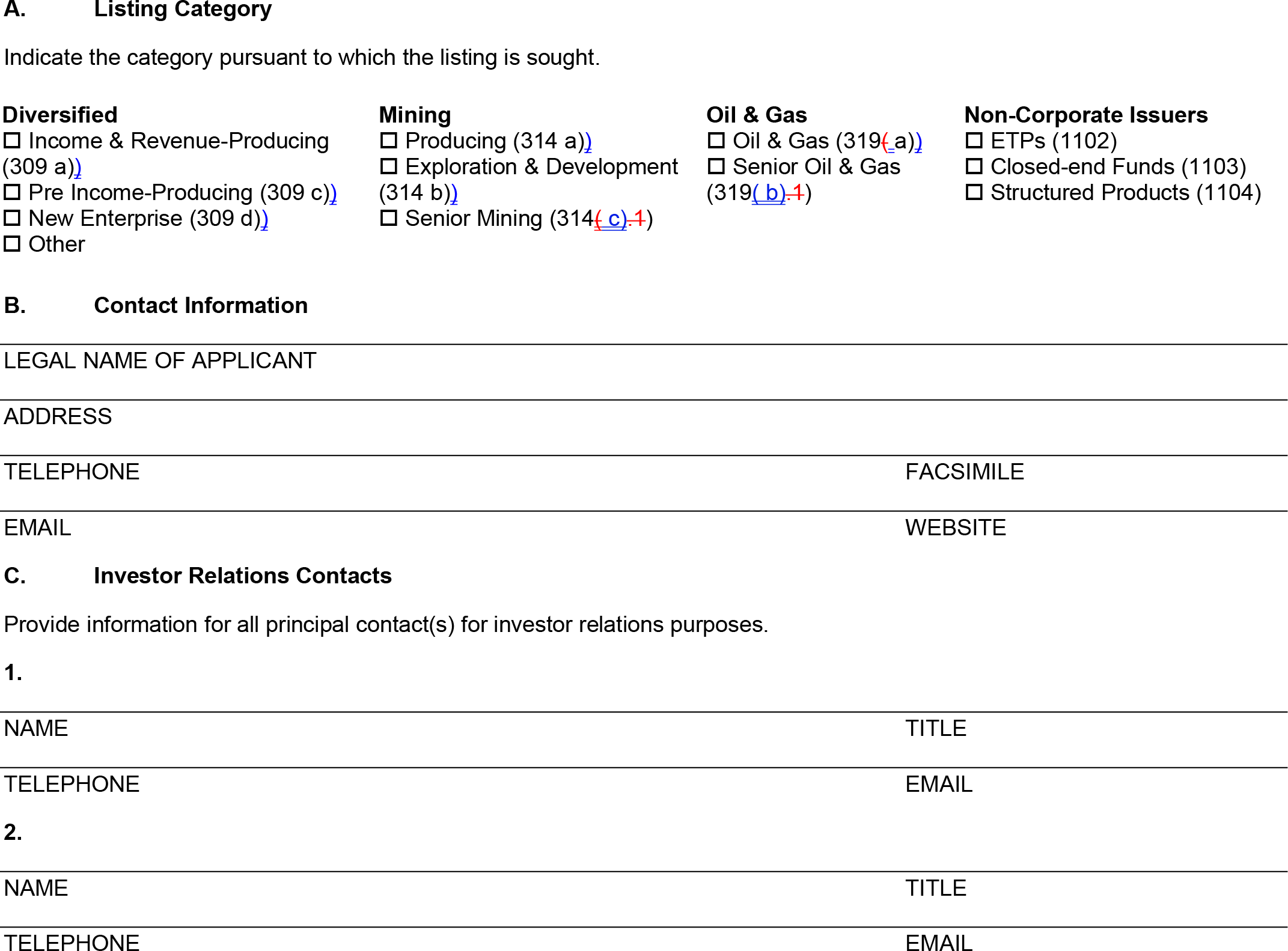
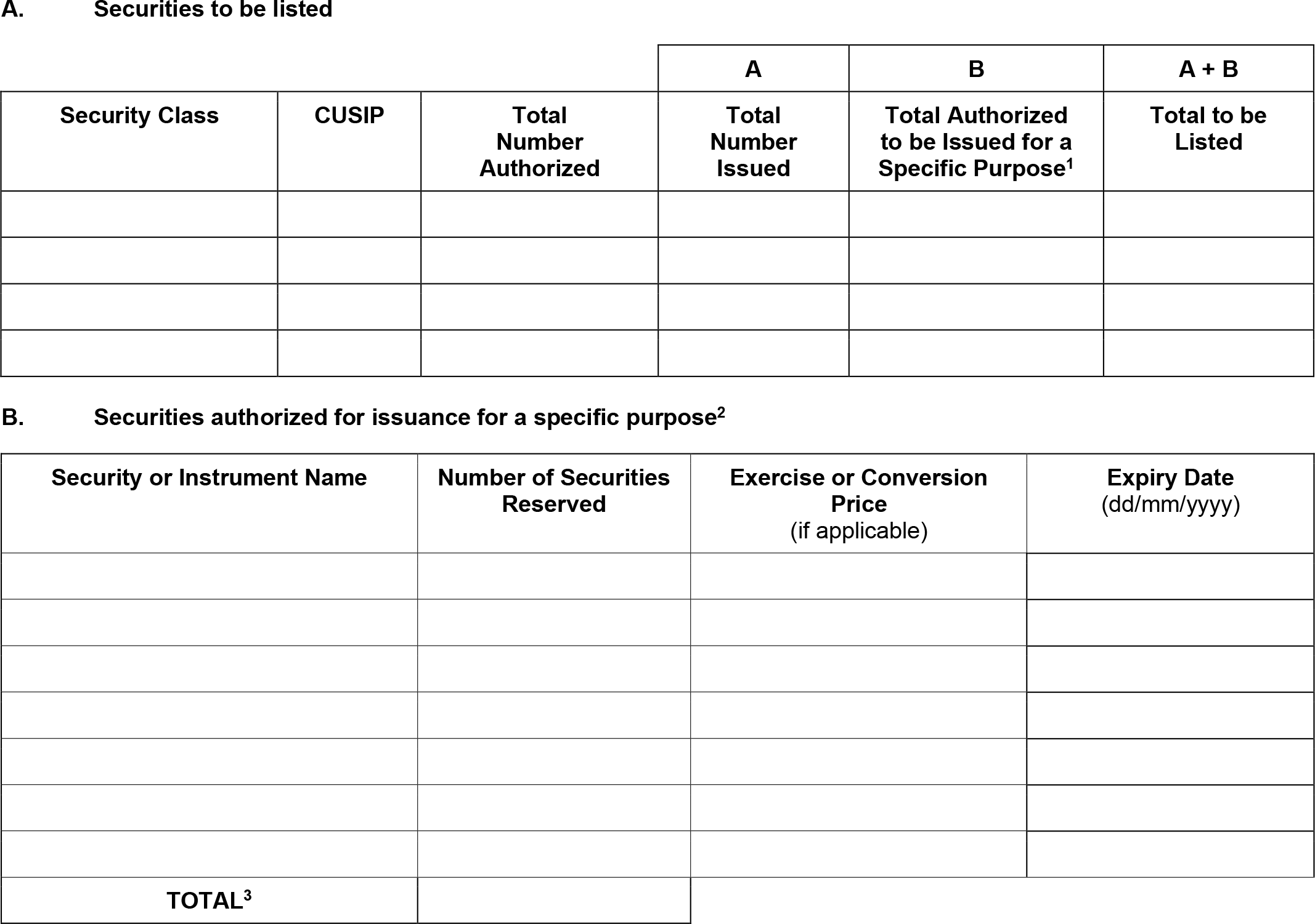
(A) If the Applicant has previously been denied its application to have its securities listed on any market, please provide all relevant information, including the name of the market, the date and reasons why application was denied or unsuccessful.
(I) Name the jurisdictions in which the Applicant is a reporting issuer (or equivalent status).
(ii) Date of most recent annual meeting and date and type of most recent financial report to security holders.
(iii) Describe any restrictions on the free tradeability of the securities to be listed. In the absence of restrictions, confirm that the securities will be freely tradeable in Canada.
After having received approval from its Board of Directors,
__________________________________________________________________________________________________________________________________________
LEGAL NAME OF APPLICANT
applies to list the securities designated in this application on Toronto Stock Exchange.
AUTHORIZATION AND CONSENT: THE APPLICANT HEREBY AUTHORIZES AND CONSENTS TO THE COLLECTION BY ANY OF TORONTO STOCK EXCHANGE, A DIVISION OF TSX INC., TSX VENTURE EXCHANGE INC. AND THEIR SUBSIDIARIES, AFFILIATES, REGULATORS AND AGENTS OF ANY INFORMATION WHATSOEVER (WHICH MAY INCLUDE PERSONAL, CREDIT, OR OTHER INFORMATION) FROM ANY SOURCE, INCLUDING WITHOUT LIMITATION FROM AN INVESTIGATIVE AGENCY OR A RETAIL CREDIT AGENCY, AS PERMITTED BY LAW IN ANY JURISDICTION IN CANADA OR ELSEWHERE. THE APPLICANT ACKNOWLEDGES AND AGREES THAT SUCH INFORMATION MAY BE SHARED WITH AND RETAINED BY TORONTO STOCK EXCHANGE, A DIVISION OF TSX INC., TSX VENTURE EXCHANGE INC. AND THEIR SUBSIDIARIES, AFFILIATES, REGULATORS AND AGENTS INDEFINITELY.
The two officers signing below solemnly declare that as of the date hereof they each: i) have been duly authorized by the Board of Directors (or similar body) of the Applicant to sign this certificate and declaration; ii) certify that all of the information in this Listing Application, any attachments, documents incorporated by reference and any other documentation filed in connection therewith, including documents obtained from SEDAR or from TSX Venture Exchange on consent and direction, is true and correct to the best of their knowledge, information and belief; and iii) make this solemn declaration conscientiously believing it to be true and knowing this it is of the same force and effect as if made under oath and by virtue of the Canada Evidence Act.
______________________________________________________________________________________________________________________ |
|
DATE |
POSITION WITH APPLICANT |
|
|
______________________________________________________________________________________________________________________ |
|
SIGNATURE OF AUTHORIZED OFFICER |
PRINT NAME |
|
|
______________________________________________________________________________________________________________________ |
|
DATE |
POSITION WITH APPLICANT |
|
|
______________________________________________________________________________________________________________________ |
|
SIGNATURE OF AUTHORIZED OFFICER |
PRINT NAME |
We hereby confirm that there are, as of [insert date], [insert number] holders of at least one board lot of [insert security name] of [insert Applicant name].
This statement is certified by:
________________________________________ |
________________________________________ |
Name of Authorized Individual |
Position with Transfer Agent |
|
|
________________________________________ |
|
Transfer Agent (company name) |
|
|
|
________________________________________ |
________________________________________ |
Signature |
Date |
Instructions:
This attachment to the Listing Application should be completed for each class of securities to be listed on TSX and should be certified by the transfer agent.
A "board lot" means 100 securities having a market value of $1.00 per security or greater; 500 securities having a market value of less than $1.00 and not less than $0.10 per security; or 1,000 securities having a market value of less than $0.10 per security.
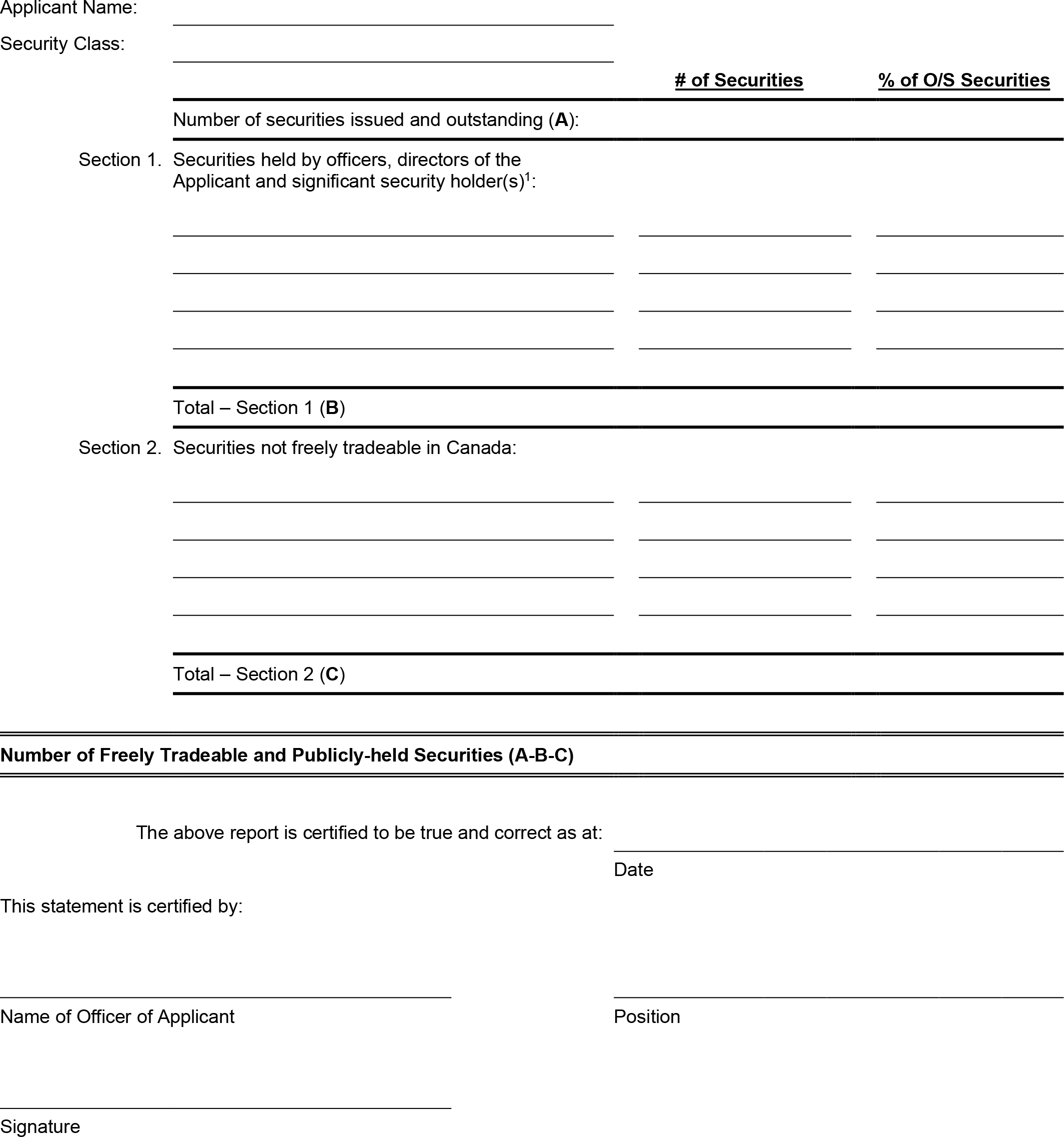
Instructions:
This attachment to the Listing Application should be completed for each class of securities to be listed on TSX.
In Section 1 -- Disclose the identity of each party who is the significant security holder{1} with their respective security holdings and the percentage it represents relative to the total number of outstanding securities of that class. Securities held by officers and directors may be aggregated as a group, unless such individual also is a significant security holder.
In Section 2 -- Disclose the agreement or circumstances under which the resale of the securities came to be restricted (e.g. escrow agreement, pooling agreement, private placement, etc.). Include number of securities subject to such restriction under each such circumstance and the percentage it represents relative to the total number of outstanding securities of that class.
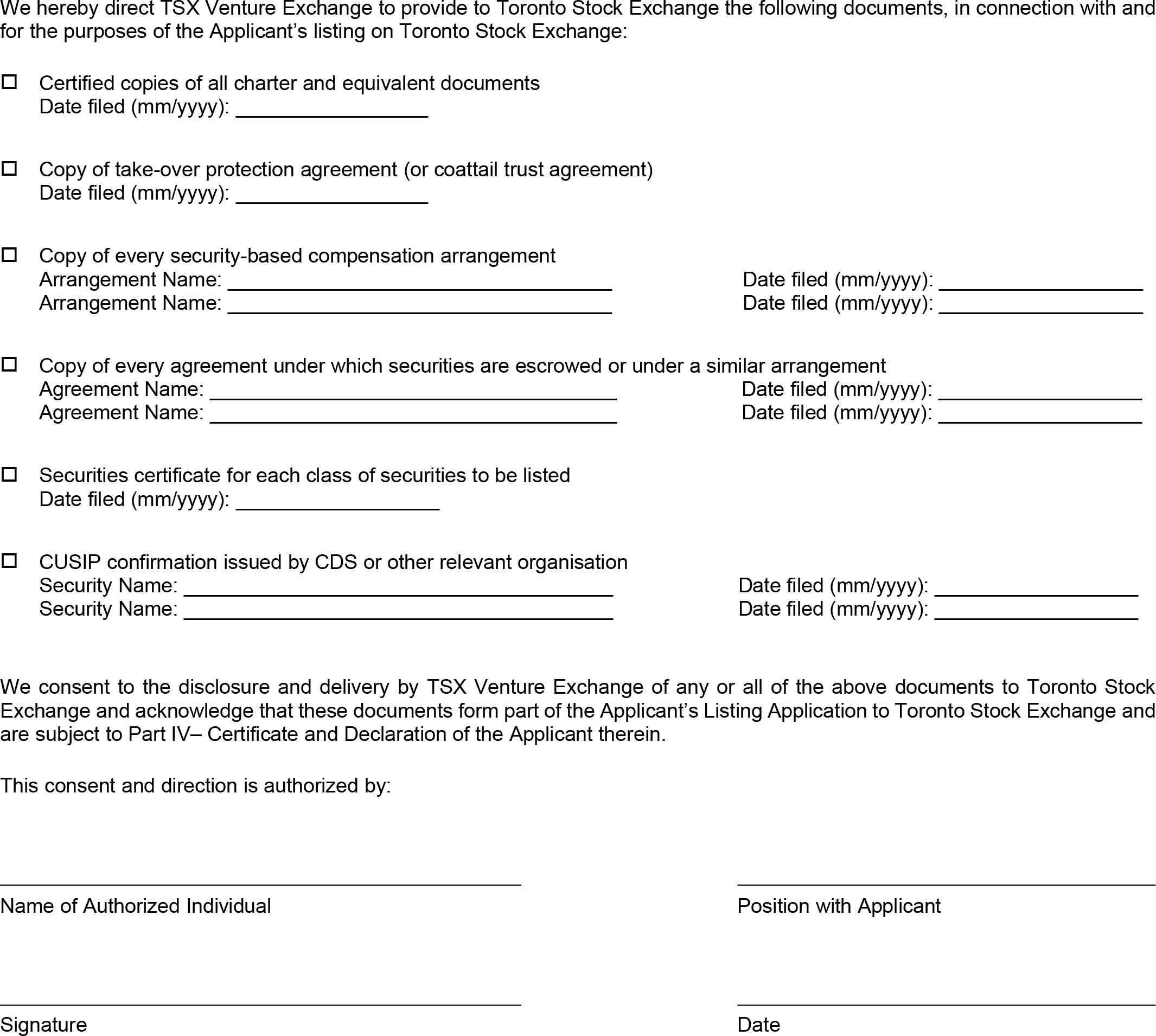
Instructions:
This attachment to the Listing Application may be completed by Applicants which are currently listed on TSX Venture Exchange and where such document has been submitted to TSX Venture Exchange in a form that would be acceptable to TSX. Indicate the date (mm/yyyy) when the most recent version of the document has been filed with TSX Venture Exchange.
If documents provided to TSX Venture Exchange are not current, it is the Applicant's responsibility to ensure it provides TSX with all current and updated information and documentation in accordance with the requirements of the Listing Application.
The requirements set by the Exchange relating to listed companies are a part of a substantial body of law and custom that, over the years, has evolved to ensure a fair and orderly market for listed securities. The Manual has been designed to provide a detailed and well-indexed compendium of these requirements.
The Exchange plays an important role in assisting in the recruitment of capital and in the maintenance of an effective secondary market for relatively new enterprises, as well as for established companies. Exchange listings range from junior mining, oil, gas and industrial issuesdiversified issuers to mature international companies. To accommodate companies with such a diversity of activity and size, while at the same time ensuring that certain basic standards are met, the Exchange maintains listing requirements for the various types of companies which list on the Exchange.
In thisThe Manual, for the purposes of clarity and convenience, the Exchange requirements that apply to special cases, such as junior companies, have been clearly separated from the general listing requirements. The Manual also segregates, in one part, all procedures and requirements applying at the time of listing, while requirements for the maintenance of a listing are brought together in other parts of the Manual.
[...]
[...]
"Exempt Issuer" means an issuer with a market capitalization of at least $100 million at the time of original listing on TSX;
[...]
"market capitalization" means the aggregate market price of all outstanding equity securities, being the product of (A) the market price and (B) the total number of equity securities outstanding as at the calculation date;
[...]
[...]
[...]
Companies applying for a listing on the Exchange are placed in one of three categories: Industrial (General)Diversified, Mining or Oil and Gas. All SPACs and Non-Corporate Issuers are listed under the Industrial (General)Diversified category. If the primary nature of a business cannot be distinctly categorized, the Exchange will designate the company to a listing category after a review of the company's financial statements and other documentation.
There are specific minimum listing requirements for each of the three categories of companies. These requirements are set out in the following sections:
|
Sections 309 to 313 |
|
|
Mining |
Sections 314 to 318 |
|
|
Oil and Gas |
Sections 319 to 323 |
For SPACs, the minimum listing requirements, as well as other requirements, are set out in Part X.
For Non-Corporate Issuers, the minimum listing requirements, as well as other requirements, are set out in Part XI.
The minimum listing requirements should be read in conjunction with the Exchange policy on quality of management, as set out in Section 325.
a)
Profitable Companies;
i) net tangible assets{2} of $2,000,000{3};
ii) earnings from ongoing operations of at least $200,000 before taxes and extraordinary items in the fiscal year immediately preceding the filing of the listing application;
iii) pre-tax cash flow of $500,000 in the fiscal year immediately preceding the filing of the listing application; and
iv) adequate working capital to carry on the business and an appropriate capital structure.a) Income & Revenue-Producing:
i) Operations: either (A) annual audited pre-tax net income from continuing operations of $750,000 in the fiscal year immediately preceding the filing of the listing application (the "Income Test"); or (B) annual audited revenue of $10,000,000 in the fiscal year immediately preceding the filing of the listing application (the "Revenue Test");
ii) Funding: if the Income Test is met, evidence of an appropriate capital structure{2}; or, if the Revenue Test is met, either (A) positive pre-tax cash flow from operations{3} evidenced in the most recently completed audited annual and interim financial statements; or (B) 12-month run rate calculation{4} demonstrating sufficient funding for the period; and
iii) Market Support: market capitalization{5} of at least $100,000,000.
OR
b) [Deleted.]
Companies Forecasting Profitability;
i) net tangible assets of $7,500,000{4};
ii) evidence, satisfactory to the Exchange, of earnings from ongoing operations for the current or next fiscal year of at least $200,000 before taxes and extraordinary items{5};
iii) evidence, satisfactory to the Exchange, of pre-tax cash flow for the current or next fiscal year of at least $500,000{6}; and
iv) adequate working capital to carry on the business and an appropriate capital structure.
OR
c) Technology Companies{7};
i) a minimum of $10,000,000 in the treasury, the majority of which has been raised by the issuance of securities qualified for distribution by a prospectus;
ii) adequate funds to cover all planned development and capital expenditures, and general and administrative expenses for a period of at least one year. A projection of sources and uses of funds including related assumptions covering the period (by quarter) signed by the Chief Financial Officer must be submitted{8}. The projection must also include actual financial results for the most recently completed quarter;
iii) evidence, satisfactory to the Exchange, that the company's products or services are at an advanced stage of development or commercialization and that the company has the required management expertise and resources to develop the business{9};
iv) minimum market value of the issued securities that are to be listed of at least $50,000,000; and
v) minimum public distribution requirements as set out in Section 310, except that the minimum aggregate market value of the freely tradeable, publicly held securities to be listed should be $10,000,000.
OR
c) Pre Income-Producing:
i) Operations: either (A) an audited income statement demonstrating at least one year of operating expenses to advance the business{6} (the "Expenses Test"); or (B) assets under construction reported in an audited balance sheet along with signed imminent leases (the "Lease Test");
ii) Funding: if the Expenses Test is met, a 24-month run rate calculation{7} demonstrating sufficient funding for the period; or, if the Lease Test is met and the primary business is to generate rental revenue from constructed assets, a 12-month run rate calculation{8} demonstrating sufficient funding for the period; and
iii) Market Support: market capitalization{9} of at least $50,000,000.
OR
d) Research and Development Companies.
i) a minimum of $12,000,000 in the treasury, the majority of which has been raised by the issuance of securities qualified for distribution by a prospectus;
ii) adequate funds to cover all planned research and development expenditures, general and administrative expenses and capital expenditures, for a period of at least 2 years. A projection of sources and uses of funds covering the period (by quarter) signed by the Chief Financial Officer must be submitted{10}. The projection must also include actual financial results for the most recently completed quarter;
iii) a minimum two-year operating history that includes research and development activities; and
iv) evidence, satisfactory to the Exchange, that the company has the technical expertise and resources to advance the company's research and development programme(s).11
Notwithstanding the above-mentioned requirements for eligibility for listing, exceptional circumstances may justify the granting of a listing to an applicant, in which case the application will be considered on its own merits. "Exceptional circumstances" for this purpose will normally be confined to an affiliation with a substantial established enterprise and/or an exceptionally strong financial position.
d) New Enterprise{10}:
i) Operations: (A) evidence acceptable to the Exchange of management experience and expertise{11}; and (B) proof of business concept{12};
ii) Funding: either (A) an equity raise of $100,000,000 in the six months preceding the filing of the listing application along with a 12-month run rate calculation{13} demonstrating sufficient funding to advance the project per stated targets identified in a feasibility report (the "12-month Test"); or (B) a 24-month run rate calculation{14} demonstrating sufficient funding to advance the project as per stated targets identified in a feasibility report (the "24-month Test"); and
iii) Market Support: if the 12-month Test is met, market capitalization{15} of at least $100,000,000; or if the 24-month Test is met, market capitalization{16} of at least $200,000,000.
a) net tangible assets of $7,500,000{13};
b) earnings from ongoing operations of at least $300,000 before taxes and extraordinary items, in the fiscal year immediately preceding the filing of the listing application;
c) pre-tax cash flow of $700,000 in the fiscal year immediately preceding the filing of the listing application and an average pre-tax cash flow of $500,000 for the two fiscal years immediately preceding the filing of the listing application; and
d) adequate working capital to carry on the business and an appropriate capital structure.
Exceptional circumstances may justify the granting of a listing to an applicant on an exempt basis, in which case the application will be considered on its own merits. "Exceptional Circumstances" for this purpose will normally be confined to an affiliation with a substantial established enterprise and/or an exceptionally strong financial position.
Special Purpose Issuers.-The Exchange will generally consider the listing of special purpose issuers other than Non-Corporate Issuers on an exceptional circumstances basis. The Exchange will consider all relevant factors in assessing these applicants including objectives and strategy, nature and size of the assets, anticipated operating and financial results, track record and expertise of managers and/or advisors, and level of investor and market support.
The Exchange encourages special purpose issuers and their advisors to contact Listings to discuss their specific circumstances.
At least 1,000,000 freely tradeable shares having an aggregate market value of $4,000,000 ($10,000,000 for companies qualifying for listing under section 309(c)) must be held by at least 300 public holders, each holding one board lot or more. In circumstances where public distribution is achieved other than by way of a public offering, e.g. by way of a reverse take-over, share exchange offer, or other distribution, the Exchange may require evidence that a satisfactory market in the company's securities will develop. Prior trading on another market or sponsorship by a Participating Organization, which will assist in maintaining an orderly market, may satisfy this condition.
The management of an applicant company shall be an important factor in the consideration of a listing application. In addition to the factors set out in Section 325, the Exchange will consider the background and expertise of management in the context of the business of the company. Management (including the company's board of directors) should have adequate experience and technical expertise relevant to the company's business and industry and adequate public company experience which demonstrates that they are able to satisfy all of their reporting and public company obligations. Companies will be required to have at least two independent directors{14,17}, a chief executive officer (CEO), a chief financial officer who is not also the CEO, and a corporate secretary.
Sponsorship of an applicant company by a Participating Organization of the Exchange is required for companies applying to list under the paragraphs 309(a), 309(b), 309(c) and 309(d). Sponsorship, or affiliation with an established enterprise, can be a significant factor in the determination of the suitability of the company for listing, particularly where the company only narrowly meets the prescribed minimum listing requirements. Consideration will be given to the nature of the sponsorship or affiliation. In additionPlease refer to the requirements detailed in Section 326Section 326 for Sponsorship of Companies Seeking Listing on The Exchange, sponsors for industrial applicants should also be responsible for reviewing and commenting on:the Exchange.
a) all visits to and/or inspections of the applicant's principal facilities and/or offices;
b) any future-oriented financial information that has been provided with the application;
c) management's experience and technical expertise relevant to the company's business; and
d) all other relevant factors including those listed in footnotes 7 and 8 applicable for technology companies and 10 and 11 applicable for research and development companies.
[...]
a) Producing Mining Companies
i) proven and probable reserves to provide a mine life of at least three years
, as calculatedon a Qualifying Property{18}, detailed in a report by an independent qualified person{16,19,} together with evidence satisfactory to the Exchange indicating a reasonable likelihood of future profitability supported by a feasibility study or documented historical production and financial performance;ii) either be in production or have made a production decision on the
qualifying project or mineQualifying Property referred to in subparagraph 314(a)(i) above;iii) an 18-month run rate calculation{20} demonstrating (A) sufficient
fundsfunding to bring themineQualifying Property into commercial production,; and (B) adequate working capital to fund all budgeted capital expenditures and carry on the businessand an appropriate capital structure. A management-prepared 18-month projection (by quarter) of sources and uses of funds detailing all planned and required expenditures signed by the Chief Financial Officer must be submitted. The projection must also include actual financial results for the most recently completed quarter; and, signed by a qualified person{21};iv)
net tangible assets{17} of $4,000,000.evidence of an appropriate capital structure{22}; andv) market capitalization{23} of at least $50,000,000.
Industrial Minerals--Industrial mineral companies (those with properties containing minerals which are not readily marketable) not currently generating revenues from production will normally be required to submit commercial contracts and meet the requirements under paragraph 314(a).
b) Mineral Exploration and Development--Stage Companies
i) an
Advanced Propertyadvanced property, detailed in a report prepared by an independent qualified person{18.24.} The Exchange will generally consider apropertyQualifying Property to be sufficiently advanced ifcontinuity of mineralization is demonstrated in three dimensions at economically interesting gradesit has or is supported by a current mineral resource estimate and/or a current reserve estimate, as defined in National Instrument 43-101 Standards of Disclosure for Mineral Projects ("NI 43-101");ii)
aplanned workprogrammeprogram of exploration and/or development, of at least $750,000195,000,000{25} that is satisfactory to the Exchange, will sufficiently advance the property and is recommended byan independenta qualified person{20}{26};iii) an 18-month run rate calculation{27} demonstrating sufficient funds to (A) complete the planned
programmeprogram of exploration and/or development on the company'sproperties, toproperty; and (B) meet estimated general and administrative costs, anticipated property payments and capital expenditures forat least 18 months. A management-prepared 18 month projection (by quarter) of sources and uses of funds detailing all planned and required expenditures signed by the Chief Financial Officer must be submittedthe period, signed by a qualified person{28};iv)
working capital of at least $2,000,000{21} andevidence of an appropriate capital structure{29}; andv)
net tangible assets{22} of $3,000,000.market capitalization{30} of at least $50,000,000.
Property Ownership--A company must hold or have a right to earn and maintain at least a 50% interest in the qualifying propertyQualifying Property. Companies holding less than a 50% interest, but not less than a 30% interest, in the qualifying propertyQualifying Property may be considered on an exceptional basis, based on programmeprogram size, stage of advancement of the property and strategic alliances. Where a company has less than a 100% interest in a qualifying propertyQualifying Property, the programmeprogram expenditure amounts attributable to the company will be determined based on its percentage ownership{23.}{31.}
c) Senior Mining Companies
a) net tangible assets25 of $7,500,000;
b)i) annual audited pre-taxprofitabilitynet income fromongoingcontinuing operations in the fiscal year immediately preceding the filing of the listing application;
c)ii) audited pre-laxtax cash flow from operations{32} of $700,0001,250,000 in the fiscal year immediately preceding the filing of the listing application and an average audited pre-tax cash flowfrom operations{33} of $500,000900,000 for the two fiscal years immediately preceding the filing of the listing application;
d)iii) proven and probable reserves to provide a mine life of at least3three years,calculateddetailed in a report prepared by an independent qualified person26and{34;}
e)iv) adequate working capital to carry on the business and an appropriate capital structure.{35}; andv) market capitalization{36} of at least $100,000,000.
Exceptional circumstances may justify the granting of an exemption from Section 501, in which case the application will be considered on its own merits. "Exceptional circumstances" for this purpose will normally be confined to an affiliation with a substantial established enterprise and/or an exceptionally strong financial position.
At least 1,000,000 freely tradeable shares having an aggregate market value of $4,000,000 must be held by at least 300 public holders, each holding one board lot or more. In circumstances where public distribution is achieved other than by way of a public offering, e.g., by way of a reverse take-over, share exchange offer, or other distribution, the Exchange may require evidence that a satisfactory market in the company's securities will develop. Prior trading on another market or sponsorship by a Participating Organization, which will assist in maintaining an orderly market, may satisfy this condition.
The management of an applicant company shall be an important factor in the consideration of a listing application. In addition to the factors set out in Section 325, the Exchange will consider the background and expertise of management in the context of the business of the company. Management (including the company's board of directors) should have adequate experience and technical expertise relevant to a company's mining projects and adequate public company experience, which demonstrates that they are able to satisfy all of their reporting and public company obligations. Companies will be required to have at least two independent directors{27,37,} a chief executive officer (CEO), a chief financial officer who is not also the CEO, and a corporate secretary.
Please refer to the requirements detailed in Section 326 for Sponsorship of Companies Seeking Listing on the Exchange. Sponsorship of an applicant company by a Participating Organization of the Exchange is required for companies applying to list under the paragraphs 314(a) and 314(b). Sponsorship, or affiliation with an established enterprise, can be a significant factor in the determination of the suitability of the company for listing, particularly where the company only narrowly meets the prescribed minimum listing requirements. Consideration will be given to the nature of the sponsorship or affiliation. In addition to the requirements detailed in Section 326 for Sponsorship Of Companies Seeking Listing On The Exchange, sponsors for mining applicants should also be responsible for reviewing and commenting on:
a) the company's management-prepared 18 month projection of sources and uses of funds to ensure that it reflects all of the company's planned and anticipated exploration and development programmes, general and administrative costs, property payments and other capital expenditures;
b) any site visits to the applicant's properties by the Sponsor;
c) issues and material agreements relating to land tenure for the company's principal properties, including the political risk, legal system, ability to mine, terms for maintaining mineral rights, legal impediments and any impediments to maintaining or securing the property: and
d) management's experience and technical expertise relevant to the company's mining projects.
[...]
(a)
ProducingOil&and Gas Companies
(i) proved developed reserves{29} of $3,000,000{30}:
(ii) a clearly defined programme, satisfactory to the Exchange, which can reasonably be expected to increase reserves;
(iii) adequate funds to execute the programme and cover all other capital expenditures as well as general, administrative and debt service expenses, for a period of 18 months with an allowance for contingencies. A management-prepared 18-month projection (by quarter) of sources and uses of funds detailing all planned and required expenditures signed by the Chief Financial Officer must be submitted. The projection must also include actual financial results for the most recently completed quarter; and,
(iv) an appropriate capital structure.(i) Operations: proved{38} and probable{39} reserves{40} of $100,000,000{41}, the majority of which is proved;
(ii) Funding: either (A) positive pre-tax cash flow from operations{42} evidenced in the most recently completed audited annual and interim financial statements; or (B) a 12-month run rate calculation{43} demonstrating sufficient funding for the period; and
(iii) Market Support: market capitalization{44} of at least $50,000,000.
(b) Oil & Gas Development Stage Companies{30C}
(i) contingent resources{30A} of $500,000,00030B;
(ii) a minimum market value of the issued securities that are to be listed of at least $200,000,000;
(iii) a clearly defined development plan, satisfactory to the Exchange, which can reasonably be expected to advance the property;
(iv) adequate funds to either: (A) execute the development plan and cover all other capital expenditures as well as general, administrative and debt service expenses, for a period of 18 months with an allowance for contingencies; or (B) bring the property into commercial production, and adequate working capital to fund all budgeted capital expenditures and carry on the business. A management-prepared 18-month projection (by quarter) of sources and uses of funds detailing all planned and required expenditures signed by the Chief Financial Officer must be submitted. The projection must also include actual financial results for the most recently completed quarter; and
(v) an appropriate capital structure.
(b) Senior Oil and Gas Companies
(a) (i) Operations: proved
developed{45} reserves{32}{46} of $7,500,000{33}100,000,000{47};(b)
pre-tax profitability from ongoing operations in the fiscal year preceding the filing of the listing application;(ii) Funding: both (A) average production rate of 10,000 boepd{48} for the most recently completed quarter; and (B) positive pre-tax cash flow from operations{49} evidenced in the most recently completed audited annual and interim financial statements; and(c)
pre-tax cash flow of $700,000 in the fiscal year preceding the filing of the listing application and an average annual pre-tax cash flow of $500,000 for the two fiscal years preceding the filing of the listing application; and(iii) Market Support: market capitalization{50} of at least $100,000,000.
(d) adequate working capital{34} to carry on the business and an appropriate capital structure.
Exceptional circumstances may justify the granting of an exemption from Section 501, in which case the application will be considered on its own merits. "Exceptional circumstances" for this purpose will normally be confined to an affiliation with a substantial established enterprise and/or an exceptionally strong financial position.
At least 1,000,000 freely tradeable shares having an aggregate market value of $4,000,000 must be held by at least 300 public holders, each holding one board lot or more. In circumstances where public distribution is achieved other than by way of a public offering, e.g., by way of a reverse take-over, share exchange offer, or other distribution, the Exchange may require evidence that a satisfactory market in the company's securities will develop. Prior trading on another market or sponsorship by a Participating Organization, which will assist in maintaining an orderly market, may satisfy this condition.
The management of' an applicant company shall be an important factor in the consideration of a listing application. In addition to the factors set out in Section 325, the Exchange will consider the background and expertise of management in the context of the business of the company. Management (including the company's board of directors) should have adequate experience and technical expertise relevant to a company's oil and gas projects and adequate public company experience, which demonstrates that they are able to satisfy all of their reporting and public company obligations. Companies will be required to have at least two independent directors{35,51,} a chief executive officer (CEO), a chief financial officer who is not also the CEO, and a corporate secretary.
Sponsorship of an applicant company by a Participating Organization of the Exchange is required unless the company meets the requirements for listing under Section 319.1. Sponsorship, or affiliation with an established enterprise, can be a significant factor in the determination of the suitability of the company for listing, particularly where the company only narrowly meets the prescribed minimum listing requirements. Consideration will be given to the nature of the sponsorship or affiliation. In additionPlease refer to the requirements detailed in Section 326Section 326 for Sponsorship of Companies Seeking Listing on The Exchange, sponsors for oil and gas applicants should also be responsible for reviewing and commenting on:the Exchange.
a) the common issues specific to oil and gas companies;
b) the company's management-prepared 18-month projection of sources and uses of funds to ensure that it reflects all of the company's planned and anticipated general, administrative and capital expenditures, as well as debt service;
c) the company's price sensitivity analysis, if required;
d) any site visits to the applicant's properties by the sponsor; and
e) management's experience and technical expertise relevant to the company's oil and gas projects.
[...]
[...]
Exemptions may be available from requirements set out in Parts IV, V and VI of the Manual to certain International Interlisted Issuers as provided in Section 401.1, Section 602.1 and TSX Staff Notice 2015-0002.
[...]
A company seeking listing on the Exchange must meet certain financial requirements. Management of the company is also important in the evaluation of a listing application by the Exchange. Sponsorship by a Participating Organization of the Exchange, as well as beingmay also be a significant factor in the consideration of an applicant, is mandatory for all companies that are applying to list under the criteria for non-exempt companies.particularly where there are facts and circumstances unique to the business, management or key assets that, in the view of the Exchange, merit further review to address risk or suitability issues. Sponsorship will be required for all applications:
a) submitted without the company having filed a prospectus for an offering of securities underwritten by a Participating Organization of the Exchange within six months prior to the date of listing, unless graduating from the TSX Venture Exchange;
b) related to an emerging market jurisdiction (refer to TSX Staff Notice 2015-0001);
c) that involve governance issues for which the Exchange requires additional commentary;
d) that, based on the Exchange's review of management personal information forms and experience, require additional commentary; or
e) that, based on the Exchange's review of title and ownership of a resource property, require additional commentary.
The Exchange may use discretion to require sponsorship for other reasons not specifically described above.
The weight attached to sponsorship in any particular case depends upon the financial and managerial strength of an applicant. It may be a determining factor in some instances. While the terms of any sponsorship are to be a matter of negotiation between the sponsor and the applicant company, in the view of the Exchange, the sponsor is responsible for reviewing and providing comments in writing on the following, as applicable:
a) the company's qualifications for meeting all relevant listing criteria;
b) the listing application together with all supporting documentation filed with the application for adequacy and completeness;
c) all matters related to the applicant company and the adequacy of disclosure made to the Exchange;
d) the company, its financial position and history, its business plan, its managerial expertise, any material transactions and all business affiliations or partnerships, and the likelihood of future profitability or viability of any exploration
programmeprogram;e) visits to and/or inspections of the company's principal facilities, offices and/or properties;
e)(f) any forecasts, projections, capital expenditure budgets, and independent technical reports, including the assumptions used in their development, submitted in support of the company's listing application;g) any future-oriented financial information that has been provided with the application (including any run rate caclulations);
h) management's experience and technical expertise relevant to the company's business, mining projects or oil and gas projects, as applicable;
i) for mining companies and oil and gas companies, issues and material agreements relating to land tenure for the company's principal properties, including the political risk, legal system, ability to mine/extract, terms for maintaining mineral/extraction rights, legal impediments and any impediments to maintaining or securing the property;
j) for oil and gas companies, issues specific to oil and gas companies and the company's price sensitivity analysis, if required;
f)k) the company's press releases and financial disclosures during at least the past twelve months to assess whether the company has complied with appropriate disclosure standards;
g)l) the past conduct, including history in the capital markets, of officers, directors, promoters and major shareholders of the company with a view'to ensuring that the business of the company will be conducted with integrity, in the best interests of its security holders and the investing public, and in compliance with the rules and regulations of the Exchange and all other regulatory bodies having jurisdiction. The sponsor should satisfy itself in particular, that:i) the company can be expected to prepare and publish all information required by the Exchange's policy on timely disclosure;
ii) the company's directors appreciate the nature of the responsibilities they will be undertaking as directors of a listed company; and
iii) the directors, officers, employees and insiders of the company appreciate the "insider trading" rules set out in the OSA; and
h) matters applicable specifically to industrial, mining and oil and gas companies as detailed in Sections 312, 317 and 322;and
i)m) all other factors deemed relevant by the sponsor.
The Exchange also considers the sponsor's responsibilities to include acting as a source of information for the company's security holders, providing advisory assistance to the applicant company, and assisting in maintaining active and orderly trading in the market for the company's securities.
The Exchange considers sponsorship to involve a relationship between the Participating Organization and its client applicant company for the first part and the Exchange for the second part. The terms of a sponsorship must, therefore, be confirmed by letter notice to the Exchange from the sponsoring Participating Organization, as part of a listing application. The weight attached to a particular sponsorship by the Exchange in reviewing a listing application will depend upon the nature of the sponsorship.
[...]
Sec. 346.
[...]
When securities have been conditionally approved for listing, the following notation on the face of the final prospectus or other offering document is permissible, but may only be used in its entirety:
Toronto Stock Exchange has conditionally approved the listing of these securities. Listing is subject to the Company fulfilling all of the requirements of the Exchange on or before (insert date{3652}), including distribution of these securities to a minimum number of public shareholders.
[...]
[...]
Part V Special Requirements for Non-Exempt Issuers(Repealed)
Part V has been repealed and deleted.
Sec. 501.
(a) This Part is applicable only to "non-exempt issuers". The decision as to whether an issuer is non-exempt is made by TSX at the time the issuer is originally approved for listing. Reference should be made to Section 309.1 (Industrial companies), 314.1 (Mining companies) or 319.1 (Oil and Gas companies) of this Manual, which outline the requirements for eligibility for exemption from this Section 501. If these requirements are not met at the time of original listing, the exemption may be granted at such later time as they are met either (i) on application in writing by the non-exempt issuer, or (ii) upon review by TSX. TSX may revoke a previously granted exemption in appropriate circumstances. Non-exempt issuers are designated in stock quotations in the financial press as "subject to special reporting rules".
(b) In addition to complying with all other parts of this Manual, every non-exempt issuer shall give prompt notice to TSX of any proposed material change in the business or affairs of the issuer. See Section 410 for a list of developments likely to require such notice. Material changes other than those described in Subsection 501(c) do not require TSX acceptance under this Part V and TSX will not issue a letter of confirmation or acceptance for such transactions.
(c) Transactions involving insiders or other related parties of the non-exempt issuer{1} (both as defined in Part I) and which (i) do not involve an issuance or potential issuance of listed securities; or (ii) that are initiated or undertaken by the non-exempt issuer and materially affect control (as defined in Part I) require TSX acceptance under this Part V before the non-exempt issuer may proceed with the proposed transaction. Failure to comply with this provision may result in the suspension and delisting of the non-exempt issuer's listed securities (see Part VII of this Manual).
If the value of the consideration to be received by the insider or other related party exceeds 2% of the market capitalization of the issuer, TSX will require that:
i) the proposed transaction be approved by the board on the recommendation of the directors who are unrelated to the transaction; and
ii) the value of the consideration be established in an independent report, other than for executive or director compensation for services rendered unless the consideration appears to be commercially unreasonable, as determined by TSX.
In addition, if the value of the consideration to be received by the insider or other related party exceeds 10% of the market capitalization of the issuer, TSX will require that the transaction be approved by the issuer's security holders, other than the insider or other related party.
During any six-month period, transactions with insiders or other related parties will be aggregated for the purposes of this Subsection.
(d) TSX will advise the non-exempt issuer in writing generally within seven (7) business days of receipt by TSX of the subsection 501(c) notice, of TSX's decision to accept or not accept the notice indicating any conditions to acceptance or its reasons for non-acceptance. Further information or documentation may be requested before TSX decides to accept or not accept notice of a transaction. In reviewing the transaction described in the notice, TSX will consider the applicable provisions of this Manual.
(e) Where a non-exempt issuer proposes to enter into a Subsection 501(c) transaction, any public announcement of the transaction must disclose that the transaction is subject to TSX acceptance or approval.
(f) Providing notice under Section 501(b) is in addition to the timely disclosure obligations of listed issuers set out in Sections 406 to 423.4 of this Manual, the provisions of Section 602 and all the other requirements set out in Part VI of this Manual.
(g) The notice required by this Section 501 should initially take the form of a letter addressed to TSX. For those transactions described in Subsection 501(c), the letter notice must also identify the application of Subsection 501(c) and must contain a request for acceptance. If applicable, the notice should include the appropriate Company Reporting Form (Appendix H: Company Reporting Forms). A press release or information circular filed with TSX does not constitute notice under this Section 501. The letter should contain the essential particulars of the transaction, and state whether: (i) any insider has a beneficial interest, directly or indirectly, in the transaction and the nature of such interest; and (ii) whether and how the transaction could materially affect control of the non-exempt issuer. Copies of all applicable executed agreements must be filed as part of the Section 501 notice as soon as they are available.
(h) If the proposed change entails an issuance, or potential issuance, of securities, the Section 501 and 602 notices should be combined in a single letter (see Part VI of this Manual).
(i) TSX must be provided with prompt notice of any changes to the material terms of the transaction described in the notice filed under Subsection 501(c). This applies even if the transaction previously accepted by TSX specifically contemplated future amendments, unless the amendment is solely due to standard anti-dilution provisions in the original agreement. Further information or documentation may be requested before TSX decides to accept or not accept notice of the proposed amendment.
The listed issuer may not proceed with the proposed amendment unless it is accepted by TSX.
Part VI Changes in Capital Structure of Listed Issuers
[...]
Sec. 602.1 Exemptions for Eligible Interlisted Issuers
Subject to prior approval and provided that the proposed transaction is being completed in accordance with the standards of a Recognized Exchange, TSX will not apply its standards to Eligible Interlisted Issuers in respect of the following Sections: 501 (special requirements for non-exempt issuers), 604 (security holder approval), 606 (prospectus offerings), 607 (private placements), 608 (unlisted warrants), 610(convertible securities), 611 (acquisitions), 612 (securities issued to registered charities), 613 (security based compensation arrangements) and 614 (rights offerings{1}).
Eligible Interlisted Issuers must obtain TSX acceptance of the proposed transaction by notifying TSX as required under SubsectionsSubsection 602 (a) or 501 (b), as applicable. The form of notice must comply with the requirements set out in Subsection 602 (e) or Subsection 501 (g) and also include: i) a notification that the listed issuer intends to rely on the exemption outlined in this Section 602.1; ii) the Recognized Exchange(s) on which it is listed; and iii) evidence that the volume of trading of the issuer's securities on all Canadian marketplaces in the 12 months immediately preceding the date of the application was less than 25%.
TSX will confirm its acceptance that the Eligible Interlisted Issuer may rely on the exemption as well as receipt of the documents and fees required for TSX acceptance. As a condition of acceptance, TSX will require evidence that the Recognized Exchange or relevant regulator has accepted the transaction, or confirmation from qualified legal counsel in the local jurisdiction that the proposed transaction is in compliance with applicable rules of the other exchange or marketplace, as well as applicable laws. Eligible Interlisted Issuers must disclose that they intend to or have relied on the exemption under this Section 602.1 in the press release(s) issued in connection with the transaction.
Sec. 603. Discretion
TSX has the discretion: (i) to accept notice of a transaction; (ii) to impose conditions on a transaction; and (iii) to allow exemptions from any of the requirements contained in Parts V orPart VI of this Manual.
[...]
G. Supplemental Listings
Sec. 623.
(a) A listed issuer proposing to list securities of a class not already listed should apply for the listing by letter addressed to TSX. The letter must be accompanied by one (1) copy of the preliminary prospectus or, if applicable, the draft circular describing the provisions attaching to the securities.
(b) If TSX conditionally approves the listing of the securities, this fact may be disclosed in the final prospectus, or in other documents, in accordance with Section 346, and TSX will so advise the securities regulatory authorities.
(c) The minimum public distribution requirements for a supplemental listing are the same as the minimum requirements for original listing as set out in Section 310. However, TSX will give consideration to listing non-participating preferred securities and debt securities that do not meet these requirements if the market value of such securities outstanding is at least $2,000,000 and
:
i)if the securities are convertible into participating securities, such participating securities are listed on TSX and meet the minimum public distribution requirements for original listing; or
ii) if the securities are not convertible into participating securities, the listed issuer is exempt from Section 501.
[...]
R. Approval of Changes in Capital Structure
Sec. 642.
Decisions in respect of the application of Part V and this Part VI are made by the Listings Committee or its delegates. If an issuer is dissatisfied with a decision under Part V or Part VI, the issuer may, within 30 calendar days of the original decision, request an appeal of such decision. The matter will be considered by a minimum of one and a maximum of three senior officer(s) of TSX who were not participants in making the original decision, as determined by the Exchange. The senior officer(s) may uphold the original decision or may render a new decision. Issuers must request the appeal in writing and make written submissions in support of an appeal under this section. If after being heard, the issuer remains dissatisfied with the decision, the issuer may, within 30 calendar days of the appeal decision by the senior officer(s) of TSX, appeal the decision to a three-person panel of TSX's Board of Directors. Issuers must request the appeal in writing and make written submissions in support of an appeal to TSX's Board of Directors.
[...]
Part VII Halting of Trading, Suspension and Delisting of Securities
[...]
Process
Sec. 707.
[...]
The delisting review process will be conducted through either the "Remedial Review Process" or the "Expedited Review Process", as follows:
Remedial Review Process
(a) A listed issuer that has been notified that it is under delisting review because of the applicability of any of the delisting criteria set out in Section 709, paragraphs (b) or (c) of Section 710, Section 711or Section 712 will normally be given up to 120 days from the date of such notification (the "delisting review period") to correct the deficiencies that triggered the delisting review.
At any time prior to the end of the delisting review period, TSX will provide the listed issuer with an opportunity to be heard where the listed issuer may present submissions to satisfy TSX that all deficiencies identified in TSX's notice have been rectified. If the listed issuer cannot satisfy TSX at the conclusion of the hearing that the deficiencies identified have been rectified and that no other delisting criteria are then applicable to the listed issuer, TSX will determine to delist the listed issuer's securities.
Upon such determination, TSX will issue a written notice to the market to confirm the date that the delisting will be effective, which date will generally be the 30th calendar day after the issuance of such notice.
TSX may abridge the term of the delisting review period at any time upon written notice to the listed issuer, particularly after the occurrence of any of the events described in Section 708, paragraph (a) of Section 710 or Sections 713 to 717 inclusive. In any such case, the listed issuer that is under a delisting review will be provided with an opportunity to be heard on an expedited basis where the listed issuer may present submissions as to why its securities should not be delisted. If the listed issuer cannot satisfy TSX that a delisting is unwarranted, TSX will determine to suspend the listed issuer's securities from trading as soon as practicable after such hearing and the listed issuer's securities will be delisted on the 30th calendar day after the suspension date. During the period between the suspension date and delisting date, the listed issuer remains subject to all TSX requirements, including compliance with the provisions of
Sections 501 andSection 602, regardless of whether the listed issuer had been exempted from the requirements of Section 501 prior to suspension; or
Expedited Review Process
(b) A listed issuer that has been notified that it is under delisting review:
i) because of the applicability of any of the delisting criteria in Section 708, paragraph (a) of Section 710 or Sections 713 to 716 inclusive; or
ii) because the listed issuer has failed to meet original listing requirements by the deadline set by TSX in connection with any of the events described in Section 717; or
iii) because TSX believes that the expedited suspension from trading and delisting of the listed issuer's securities is warranted;
will be provided an opportunity to be heard, on an expedited basis, generally within 48 hours of notification, where the listed issuer may present submissions as to why its securities should not continue to be suspended or be suspended from trading immediately and delisted. If the listed issuer cannot satisfy TSX that a continued or an immediate suspension is unwarranted, TSX will determine to suspend or continue to suspend the listed issuer's securities from trading as soon as practicable after such hearing and the listed issuer's securities will be delisted on the 30th calendar day after the suspension date. During the period between the suspension date and delisting date, the listed issuer remains subject to all TSX requirements, including compliance with the provisions of
Sections 501 andSection 602, regardless of whether the listed issuer had been exempted from the requirements of Section 501prior to suspension.
[...]
Sec. 710.
Specifically, securities of a listed issuer may be delisted if
[...]
IndustrialDiversified Issuers
(a)(b) the listed issuer fails to have:(i) total assets of at least $3,000,000; and
(ii) annual revenue from ongoing operations of at least $3,000,000 in the most recent year.
Criteria (b)(i) and (ii) above do not apply to a research and development listed issuer; however, such a company may be delisted if it has failed to spend at least $1,000,000 on research and development, acceptable to TSX, in the most recent year; or
[...]
Listing Agreement
Sec. 713.
TSX may delist the securities of a listed issuer that fails to comply with its Listing Agreement or other agreements with TSX, or fails to comply with TSX requirements and policies. Examples of failure to comply with the Listing Agreement include, but are not limited to, failure to obtain the prior consent of TSX to issue additional equity securities; failure to obtain the consent of TSX before undergoing a material change in the business if the listed issuer is subject to Section 501; and failure to comply with TSX's requirements for stock options and security based compensation arrangements.
[...]
Management
Sec. 716.
TSX requires that each listed issuer must meet on an ongoing basis the management requirements relevant to its category of listing that are described in Section 311 (for IndustrialDiversified Issuers), Section 316 (for Mining Issuers), Section 321 (for Oil &and Gas Issuers), Section 1102 (ETPs), Section 1103 (Closed-end Funds) and Section 1104 (Structured Products). TSX may delist the securities of a listed issuer that has failed to meet such management requirements.
[...]
Part X Special Purpose Acquisition Corporations (SPACs)
[...]
Other Requirements
Sec. 1021.
Prior to completion of its qualifying acquisition, in addition to this Part X, a listed SPAC will be subject to the following Parts of this Manual:
(a)
Parts IV andPartVIV, other than Section 464 in respect of the requirement to hold an annual meeting provided that an annual update is disseminated via press release and available on the SPAC's website;
[...]
Shareholder and Other Approvals
Sec. 1024.
The qualifying acquisition must be approved by: (i) a majority of directors unrelated to the qualifying acquisition; and (ii) a majority of the votes cast by shareholders of the SPAC at a meeting duly called for that purpose. Shareholder approval of the qualifying acquisition is not required where the SPAC has placed at least 100% of the gross proceeds raised in its IPO and any additional equity raised pursuant to Section 1019 in escrow in accordance with Section 1010. The shareholder approval requirements set out in Parts V andPart VI of the Manual will not apply to transactions concurrently effected with the qualifying acquisition, provided that they are disclosed in the prospectus for the resulting issuer and shareholder approval is not otherwise required for the qualifying acquisition. Where the qualifying acquisition is comprised of more than one acquisition, each acquisition must be approved.
[...]
Appendices
[...]
Appendix C Toronto Stock Exchange Escrow Policy Statement
[...]
II. Application of the National Policy
Under the National Policy, escrow is not required for an issuer listing on TSX that, immediately after completion of its IPO, is:
i) is classified by TSX
under sections 309.1, 314.1, or 319.1 of this Manual, as applicable,as an exempt issuer; orii) has a non-exempt issuer with a market capitalization of at least $100 million.
All other issuers completing initial public offerings and listing on TSX will be subject to the National Policy. Principals of such issuers will be required to place their securities in escrow under an escrow agreement in accordance with the terms of the National Policy, to be administered by the relevant CSA jurisdiction and not by TSX.
[...]
INSTRUCTIONS
Toronto Stock Exchange (TSX) has established separate requirements for three categories of issuers applying to list on TSX (Applicants): Industrial (general/technology/research & developmentDiversified (Income & Revenue-Producing, Pre Income-Producing, or New Enterprise (Excluding SPACs)), Mining, and Oil and Gas. Special purpose issuers such as exchange traded funds, split share corporations, income trusts, investment funds and limited partnerships are listed under the Industrial (General)Diversified category. These requirements are set out in Part III of the TSX Company Manual (the Company Manual).
The Listing Application is comprised of the following three principal components:
1. Principal Listing Document -- Applicants must file one of the following documents (a Principal Listing Document) with TSX:
a. Annual Information Form (using Form 51-102F2);
b. Prospectus (using Form 41-101F1);
c. Annual Report for U.S. Issuers (using Form 10K); or
d. Annual Report for Foreign Private Issuers (United States) (using Form 20-F).
Other documents and forms from other jurisdictions may also be acceptable to TSX insofar as they provide information that is similar to that of the forms mentioned above. The use of any other such form must be pre-cleared by TSX.
The Principal Listing Document filed in connection with the Listing Application should be for the most recently completed financial year. If the Principal Listing Document is a Prospectus, it must have been filed with the Canadian Securities Administrators within the last 12 months preceding the date at which the Applicant files its original listing application.
In an appendix to the Listing Application, Applicants must supplement the disclosure provided in the Principal Listing Document by attaching relevant subsequent continuous disclosure filings such as material change reports, business acquisition reports and press releases, and any other information required to ensure the disclosure provided to TSX is current.
Applicants who do not already have a Principal Listing Document available should provide material information on their business by completing and filing with TSX an Annual Information Form, using Form 51-102F2. In such instance, Applicants may present information as at the last day of their recently completed financial quarter or financial year and the Form 51-102F2 must specify the relevant date of the disclosure and include updated information in an appendix to the Listing Application, as required.
2. TSX Listing Application
The Listing Application should initially be submitted to TSX in draft form using the "Toronto Stock Exchange -- Listing Application" attached to this Appendix A. Questions should not be omitted or left unanswered; nor should the sequence be altered. The executed listing applicationListing Application in final form should only be provided as part of the final listing materials.
3. Documents to be filed in support of the TSX Listing Application
Documents which must be filed in support of the listing applicationListing Application are enumerated in the "List of Documents to be Filed" (the List of Documents). Some documents must be filed concurrently with the draft Listing Application while others must be filed after the Applicant has been conditionally approved for listing but prior to listing on TSX, as provided in the List of Documents.
DOCUMENTS AND INFORMATION AVAILABLE ON WWW.TMX.COM
The following documents which may be helpful in preparing your listing application are available on www.tmx.com.
Document
Format
TSX Listing Application (and Attachments)
Word
Personal Information Form and Consent for Disclosure of Criminal Record Information Form
Word
Statutory Declaration Form and Consent for Disclosure of Criminal Record Information Form
Word
TSX Original Listing Requirements
HTML
TMX LINX Registration Form
Word
TSX Listing Fee Schedule
For more information on the completion of the listing application, the listing requirements, or the listing process, please call (416) 947-4533 or email listedissuers@tmx.com.
PRODUCTS AND SERVICES AVAILABLE TO LISTED ISSUERS
Once listed on TSX, issuers have access to a variety of products and services. A description of these products and services is available on www.tmx.com.
Product/Service
TSX InfoSuite
TMX LINX(tm)
TSX Enhanced Broker Summary
Historical Data Access
Listed Logo Program
Hosting at the Exchange
TMX Learning Academy
For more information on TSX products and services, please call 1-888-788-2490 or email issuersupport@tmx.com.
LIST OF DOCUMENTS TO BE FILED
The following documents must be filed concurrently with the Principal Listing Document and the TSX Listing Application in draft form.
Applicants that are listed on the TSX Venture Exchange may be exempted from filing certain documents as noted below. Please refer to the footnotes for complete details.
1. A Personal Information Form and, if applicable, Consent for Disclosure of Criminal Record Information Form (collectively, a PIF), to be completed by every individual who will, at the time of listing:
a. be an officer or director of the Applicant; or
b. beneficially own or control, directly or indirectly, securities carrying greater than 10% of the voting rights attached to all outstanding voting securities of the Applicant.
Where an individual has submitted a PIF to TSX or to TSX Venture Exchange within the last 60 months and the information provided on such PIF has not changed, a Statutory Declaration Form and, if applicable, a Consent for Disclosure of Criminal Record Information Form may be completed and filed in lieu of a PIF{1},{2}.
Additional costs incurred to conduct searches on Individuals residing outside of Canada, the United States of America, the United Kingdom and Australia will be charged to and must be paid by the Applicant.
2. A cheque for the original listing application fee payable, as provided in the TSX Listing Fee Schedule{3}.
3. The following financial statements, as applicable, unless included in the Principal Listing Document or available on SEDAR:
a. audited financial statements for the most recently completed financial year, signed by two directors of the Applicant on behalf of the Board;
b. unaudited financial statements for the most recently completed financial quarter, signed by two directors of the Applicant on behalf of the Board; and
c. if the Applicant has recently completed or proposes to complete a transaction such as a business acquisition or a significant disposition and such transaction would materially affect the financial position or operating results of the Applicant, pro forma financial statements that give effect to the transaction must be submitted.
4. For Mining and Oil & Gas Applicants
a. full and up-to-date reports on the significant properties of the Applicant, prepared in compliance with the National Instrument 43-101
(Standards of Disclosure for Mineral Projects ("NI 43-101") for Mining Applicants and in compliance with National Instrument 51-101Standards of Disclosure for Oil and Gas Activities ("NI 51-101") for Oil & Gas Applicants. Reports prepared in conformity with other reporting systems deemed by TSX to be substantially equivalent to NI 43-101 and NI 51-101 may also be acceptable. Written consent from the author of the NI-51-101 report must be provided for the use of the report in support of the Listing Application;b. a certificate from the author of the reports confirming that
he/shethey: i)hashave reviewed the disclosures in the Principal Listing Document regarding the properties covered by such reports; and ii)considersconsider the disclosure to be accurate to the best ofhis/hertheir knowledge; andc.
projected sources and uses of funds statement for a period of 18 months, including related assumptionsif applying pursuant to Section 314(a) or (b), an 18-month run rate calculation, presented on a quarterly basis, prepared by managementand signed by the Chief Financial Officer, unlessand a qualified person; ord. if applying pursuant to Section 319(a), a 12-month run rate calculation presented on a quarterly basis and signed by the Chief Financial Officer.
5. For Senior Income & Revenue-Producing Applicants -- if the Applicant is applying for listing pursuant to Section 314.1 or 319.1 (Requirements for Eligibility for Listing Exempt from Section 501). 309(a)(ii)(ii), a 12-month run rate calculation presented on a quarterly basis and signed by the Chief Financial Officer.
6. For Pre Income-Producing Applicants -- a 24 or 12-month run rate calculation as applicable, presented on a quarterly basis and signed by the Chief Financial Officer.
7. 5. TechnologyFor New Enterprise Applicants -- Projected sources and uses of funds statement, including related assumptions, for a period of 12 months, presented on a quarterly basis, prepared by management and signed by the Chief Financial Officer.
6. Research and Development Applicants -- Projected sources and uses of funds statement, including related assumptions, for a period of 24 monthseither a 12-month (if applying for listing pursuant to Section 309(d)((ii)(A)) or a 24-month (if applying for listing pursuant to Section 309(d)(ii)(B)) run rate calculation, presented on a quarterly basis, prepared by management and signed by the Chief Financial Officer.
8. 7. Certified copies of all charter documents, including Articles of Incorporation, Letters Patent, Articles of Amendment, Articles of Continuance, Articles of Amalgamation, partnership agreements, trust indentures, declarations of trust or equivalent documents{1}. Applicants incorporated outside of Canada may be required to provide a reconciliation of the corporate laws in their home jurisdiction to those of the Canada Business Corporation Act.
9. 8. Applicants with Restricted Voting Securities -- One copy of the take-over protection agreement (or coattail trust agreement) which meets, or will be amended to meet, the requirements of Section 624 (l) of the Company Manual{1}.
10. 9. One copy of every security based compensation arrangement and any other similar agreement (a Plan) under which securities may be issued, together with a sample option agreement used for option grants if there is a Plan in place or all individual option agreements if the Applicant has no Plan. If security holder approval was required for the Plan, include a copy of the approval{1}.
11. 10. Copies of any agreements under which securities are held in escrow, pooled, or under a similar arrangement{1}.
12. 11. Reports evidencing the number of freely tradeable securities and the number of security holders in the form set out in Attachments 1 and 2 of the Listing Application for each class of securities to be listed including warrants and convertible debentures.
13. 12. SponsorshipIf required pursuant to Section 326 of the Company Manual, a sponsorship letter in draft form from a TSX participating organization in compliance with the requirements set out in Section 326 of the Company Manual, unless exempted by TSX{2}..
14. 13. Information required to update the Principal Listing Document, including continuous disclosure filings such as material change reports, business acquisition reports, press releases and any other information required to make the listing application current.
The following documents must be filed after the Applicant has been conditionally approved for listing on TSX, together with any additional documentation specified in the conditional approval letter.
4. TSX Listing Application duly completed in final form. The certificate and declaration accompanying the Listing Application must be signed by: i) the Chief Executive Officer (or President); and ii) the Corporate Secretary or the Chief Financial Officer of the Applicant, or if not available, by another duly authorized senior officer of the Applicant.
5. A letter from the trust company which acts as transfer agent and registrar in the City of Toronto stating that it has been duly appointed as transfer agent and registrar for the Applicant and is in a position to make transfers and make prompt delivery of security certificates. The letter must state what fee, if any, is charged for transfers{1}.
6. Security certificates -- Issuers must provide for evidence of security ownership, for each class of securities to be listed1, as set out in Appendix D of the Company Manual.
7. CUSIP confirmation -- one of the following, for each class of securities to be listed1:
a. for applicants incorporated in Canada -- an unqualified letter of confirmation from CDS confirming the CUSIP number assigned to each class of securities to be listed on TSX; or
b. for applicants incorporated outside of Canada -- an unqualified letter of confirmation from the entity which has the jurisdiction to assign CUSIPs confirming the CUSIP number assigned to each class of securities to be listed and a confirmation from CDS that the securities to be listed on TSX are eligible for clearing and settlement through CDS.
8. A letter from legal counsel setting out, in effect, that legal counsel has examined, or is familiar with, the records of the Applicant and is of the opinion that:
a. it is a valid and subsisting company (or other legal entity, as applicable);
b. all of the securities, which have been allotted and issued as set out in the
listing applicationListing Application, have been legally created; andc. all of the securities, which have been allotted and issued as set out in the
listing applicationListing Application, are or will be validly issued as fully paid and non-assessable.
6. A copy of every material contract referred to in the listing application, if not already provided pursuant to a different requirement in this list and if not available in current form on SEDAR+{1}.
7. Duly completed registration form for TMX LINX which is available on https://www.tsx.com/listings/tsx-and-tsxv-issuer-resources/tmx-linx-exchange-submission-portal.
TSX reserves the right to require any additional document or information as it deems appropriate in order to assess the Applicant's eligibility to list on TSX.
10. If the Applicant has previously been denied its application to have its securities listed on any market, please provide all relevant information, including the name of the market, the date and reasons why application was denied or unsuccessful.
11. Name the jurisdictions in which the Applicant is a reporting issuer (or equivalent status).
12. Date of most recent annual meeting and date and type of most recent financial report to security holders.
13. Describe any restrictions on the free tradeability of the securities to be listed. In the absence of restrictions, confirm that the securities will be freely tradeable in Canada.
After having received approval from its Board of Directors,
_______________________________________________________________________________________________________________________
applies to list the securities designated in this application on Toronto Stock Exchange.
AUTHORIZATION AND CONSENT: THE APPLICANT HEREBY AUTHORIZES AND CONSENTS TO THE COLLECTION BY ANY OF TORONTO STOCK EXCHANGE, A DIVISION OF TSX INC., TSX VENTURE EXCHANGE INC. AND THEIR SUBSIDIARIES, AFFILIATES, REGULATORS AND AGENTS OF ANY INFORMATION WHATSOEVER (WHICH MAY INCLUDE PERSONAL, CREDIT, OR OTHER INFORMATION) FROM ANY SOURCE, INCLUDING WITHOUT LIMITATION FROM AN INVESTIGATIVE AGENCY OR A RETAIL CREDIT AGENCY, AS PERMITTED BY LAW IN ANY JURISDICTION IN CANADA OR ELSEWHERE. THE APPLICANT ACKNOWLEDGES AND AGREES THAT SUCH INFORMATION MAY BE SHARED WITH AND RETAINED BY TORONTO STOCK EXCHANGE, A DIVISION OF TSX INC., TSX VENTURE EXCHANGE INC. AND THEIR SUBSIDIARIES, AFFILIATES, REGULATORS AND AGENTS INDEFINITELY.
The two officers signing below solemnly declare that as of the date hereof they each: i) have been duly authorized by the Board of Directors (or similar body) of the Applicant to sign this certificate and declaration; ii) certify that all of the information in this Listing Application, any attachments, documents incorporated by reference and any other documentation filed in connection therewith, including documents obtained from SEDAR or from TSX Venture Exchange on consent and direction, is true and correct to the best of their knowledge, information and belief; and iii) make this solemn declaration conscientiously believing it to be true and knowing this it is of the same force and effect as if made under oath and by virtue of the Canada Evidence Act.
_____________________________________________________________________________________________________________ |
|
DATE |
POSITION WITH APPLICANT |
|
|
_____________________________________________________________________________________________________________ |
|
SIGNATURE OF AUTHORIZED OFFICER |
PRINT NAME |
|
|
_____________________________________________________________________________________________________________ |
|
DATE |
POSITION WITH APPLICANT |
|
|
_____________________________________________________________________________________________________________ |
|
SIGNATURE OF AUTHORIZED OFFICER |
PRINT NAME |
ATTACHMENT 1 -- Statement from transfer agent relating to number of security holders
We hereby confirm that there are, as of [insert date], [insert number] holders of at least one board lot of [insert security name] of [insert Applicant name].
This statement is certified by:
___________________________________ |
___________________________________ |
Name of Authorized Individual |
Position with Transfer Agent |
|
|
___________________________________ |
|
Transfer Agent (company name) |
|
|
|
___________________________________ |
___________________________________ |
Signature |
Date |
Instructions:
This attachment to the Listing Application should be completed for each class of securities to be listed on TSX and should be certified by the transfer agent.
A "board lot" means 100 securities having a market value of $1.00 per security or greater; 500 securities having a market value of less than $1.00 and not less than $0.10 per security; or 1,000 securities having a market value of less than $0.10 per security.
ATTACHMENT 2 -- Statement evidencing the number of freely tradeable securities
Instructions:
This attachment to the Listing Application should be completed for each class of securities to be listed on TSX.
In Section 1 -- Disclose the identity of each party who is the significant security holder{1} with their respective security holdings and the percentage it represents relative to the total number of outstanding securities of that class. Securities held by officers and directors may be aggregated as a group, unless such individual also is a significant security holder.
In Section 2 -- Disclose the agreement or circumstances under which the resale of the securities came to be restricted (e.g. escrow agreement, pooling agreement, private placement, etc.). Include number of securities subject to such restriction under each such circumstance and the percentage it represents relative to the total number of outstanding securities of that class.
ATTACHMENT 3 -- Consent and direction form for TSX Venture Exchange to provide documents to Toronto Stock Exchange
Instructions:
This attachment to the Listing Application may be completed by Applicants which are currently listed on TSX Venture Exchange and where such document has been submitted to TSX Venture Exchange in a form that would be acceptable to TSX. Indicate the date (mm/yyyy) when the most recent version of the document has been filed with TSX Venture Exchange.
If documents provided to TSX Venture Exchange are not current, it is the Applicant's responsibility to ensure it provides TSX with all current and updated information and documentation in accordance with the requirements of the Listing Application.
The requirements set by the Exchange relating to listed companies are a part of a substantial body of law and custom that, over the years, has evolved to ensure a fair and orderly market for listed securities. The Manual has been designed to provide a detailed and well-indexed compendium of these requirements.
The Exchange plays an important role in assisting in the recruitment of capital and in the maintenance of an effective secondary market for relatively new enterprises, as well as for established companies. Exchange listings range from junior mining, oil, gas and diversified issuers to mature international companies. To accommodate companies with such a diversity of activity and size, while at the same time ensuring that certain basic standards are met, the Exchange maintains listing requirements for the various types of companies which list on the Exchange.
The Manual, for the purposes of clarity and convenience, segregates, in one part, all procedures and requirements applying at the time of listing, while requirements for the maintenance of a listing are brought together in other parts of the Manual.
[...]
[...]
"Exempt Issuer" means an issuer with a market capitalization of at least $100 million at the time of original listing on TSX;
[...]
"market capitalization" means the aggregate market price of all outstanding equity securities, being the product of (A) the market price and (B) the total number of equity securities outstanding as at the calculation date;
[...]
[...]
Sec. 307.
Companies applying for a listing on the Exchange are placed in one of three categories: Diversified, Mining or Oil and Gas. All SPACs and Non-Corporate Issuers are listed under the Diversified category. If the primary nature of a business cannot be distinctly categorized, the Exchange will designate the company to a listing category after a review of the company's financial statements and other documentation.
Sec. 308.
There are specific minimum listing requirements for each of the three categories of companies. These requirements are set out in the following sections:
Diversified (excluding SPACs and Non-Corporate Issuers) |
Sections 309 to 313 |
|
|
Mining |
Sections 314 to 318 |
|
|
Oil and Gas |
Sections 319 to 323 |
For SPACs, the minimum listing requirements, as well as other requirements, are set out in Part X.
For Non-Corporate Issuers, the minimum listing requirements, as well as other requirements, are set out in Part XI.
The minimum listing requirements should be read in conjunction with the Exchange policy on quality of management, as set out in Section 325.
Sec. 309. Requirements for Eligibility for Listing{1}
a) Income & Revenue-Producing:
i) Operations: either (A) annual audited pre-tax net income from continuing operations of $750,000 in the fiscal year immediately preceding the filing of the listing application (the "Income Test"); or (B) annual audited revenue of $10,000,000 in the fiscal year immediately preceding the filing of the listing application (the "Revenue Test");
ii) Funding: if the Income Test is met, evidence of an appropriate capital structure{2}; or, if the Revenue Test is met, either (A) positive pre-tax cash flow from operations{3} evidenced in the most recently completed audited annual and interim financial statements; or (B) 12-month run rate calculation{4} demonstrating sufficient funding for the period; and
iii) Market Support: market capitalization{5} of at least $100,000,000.
b) [Deleted.]
c) Pre Income-Producing:
i) Operations: either (A) an audited income statement demonstrating at least one year of operating expenses to advance the business{6} (the "Expenses Test"); or (B) assets under construction reported in an audited balance sheet along with signed imminent leases (the "Lease Test");
ii) Funding: if the Expenses Test is met, a 24-month run rate calculation{7} demonstrating sufficient funding for the period; or, if the Lease Test is met and the primary business is to generate rental revenue from constructed assets, a 12-month run rate calculation{8} demonstrating sufficient funding for the period; and
iii) Market Support: market capitalization{9} of at least $50,000,000.
OR
d) New Enterprise{10}:
i) Operations: (A) evidence acceptable to the Exchange of management experience and expertise{11}; and (B) proof of business concept{12};
ii) Funding: either (A) an equity raise of $100,000,000 in the six months preceding the filing of the listing application along with a 12-month run rate calculation{13} demonstrating sufficient funding to advance the project per stated targets identified in a feasibility report (the "12-month Test"); or (B) a 24-month run rate calculation{14} demonstrating sufficient funding to advance the project as per stated targets identified in a feasibility report (the "24-month Test"); and
iii) Market Support: if the 12-month Test is met, market capitalization{15} of at least $100,000,000; or if the 24-month Test is met, market capitalization{16} of at least $200,000,000.
Sec. 310. Public Distribution
At least 1,000,000 freely tradeable shares must be held by at least 300 public holders, each holding one board lot or more. In circumstances where public distribution is achieved other than by way of a public offering, e.g. by way of a reverse take-over, share exchange offer, or other distribution, the Exchange may require evidence that a satisfactory market in the company's securities will develop. Prior trading on another market or sponsorship by a Participating Organization, which will assist in maintaining an orderly market, may satisfy this condition.
Sec. 311. Management
The management of an applicant company shall be an important factor in the consideration of a listing application. In addition to the factors set out in Section 325, the Exchange will consider the background and expertise of management in the context of the business of the company. Management (including the company's board of directors) should have adequate experience and technical expertise relevant to the company's business and industry and adequate public company experience which demonstrates that they are able to satisfy all of their reporting and public company obligations. Companies will be required to have at least two independent directors{17}, a chief executive officer (CEO), a chief financial officer who is not also the CEO, and a corporate secretary.
Sec. 312. Sponsorship or Affiliation
Please refer to the requirements detailed in Section 326 for Sponsorship of Companies Seeking Listing on the Exchange.
[...]
Sec. 314. Requirements for Eligibility for Listing -- Mining Companies
a) Producing Mining Companies
i) proven and probable reserves to provide a mine life of at least three years on a Qualifying Property{18}, detailed in a report by an independent qualified person{19}, together with evidence satisfactory to the Exchange indicating a reasonable likelihood of future profitability supported by a feasibility study or documented historical production and financial performance;
ii) either be in production or have made a production decision on the Qualifying Property referred to in subparagraph 314(a)(i) above;
iii) an 18-month run rate calculation{20} demonstrating (A) sufficient funding to bring the Qualifying Property into commercial production; and (B) adequate working capital to fund all budgeted capital expenditures and carry on the business, signed by a qualified person{21};
iv) evidence of an appropriate capital structure{22}; and
v) market capitalization{23} of at least $50,000,000.
Industrial Minerals-Industrial mineral companies (those with properties containing minerals which are not readily marketable) not currently generating revenues from production will normally be required to submit commercial contracts and meet the requirements under paragraph 314(a).
b) Mineral Exploration and Development-Stage Companies
i) an advanced property, detailed in a report prepared by an independent qualified person{24}. The Exchange will generally consider a Qualifying Property to be sufficiently advanced if it has or is supported by a current mineral resource estimate and/or a current reserve estimate, as defined in National Instrument 43-101 Standards of Disclosure for Mineral Projects ("NI 43-101");
ii) planned work program of exploration and/or development, of at least $5,000,000{25} that is satisfactory to the Exchange, will sufficiently advance the property and is recommended by a qualified person{26};
iii) an 18-month run rate calculation{27} demonstrating sufficient funds to (A) complete the planned program of exploration and/or development on the company's property; and (B) meet estimated general and administrative costs, anticipated property payments and capital expenditures for the period, signed by a qualified person{28};
iv) evidence of an appropriate capital structure{29}; and
v) market capitalization{30} of at least $50,000,000.
Property Ownership-A company must hold or have a right to earn and maintain at least a 50% interest in the Qualifying Property. Companies holding less than a 50% interest, but not less than a 30% interest, in the Qualifying Property may be considered on an exceptional basis, based on program size, stage of advancement of the property and strategic alliances. Where a company has less than a 100% interest in a Qualifying Property, the program expenditure amounts attributable to the company will be determined based on its percentage ownership{31}.
c) Senior Mining Companies
i) annual audited pre-tax net income from continuing operations in the fiscal year immediately preceding the filing of the listing application;
ii) audited pre-tax cash flow from operations{32} of $1,250,000 in the fiscal year immediately preceding the filing of the listing application and an average audited pre-tax cash flow from operations{33} of $900,000 for the two fiscal years immediately preceding the filing of the listing application;
iii) proven and probable reserves to provide a mine life of at least three years, detailed in a report prepared by an independent qualified person{34};
iv) adequate working capital to carry on the business and an appropriate capital structure{35}; and
v) market capitalization{36} of at least $100,000,000.
Sec. 315. Public Distribution
At least 1,000,000 freely tradeable shares must be held by at least 300 public holders, each holding one board lot or more. In circumstances where public distribution is achieved other than by way of a public offering, e.g., by way of a reverse take-over, share exchange offer, or other distribution, the Exchange may require evidence that a satisfactory market in the company's securities will develop. Prior trading on another market or sponsorship by a Participating Organization, which will assist in maintaining an orderly market, may satisfy this condition.
Sec. 316. Management
The management of an applicant company shall be an important factor in the consideration of a listing application. In addition to the factors set out in Section 325, the Exchange will consider the background and expertise of management in the context of the business of the company. Management (including the company's board of directors) should have adequate experience and technical expertise relevant to a company's mining projects and adequate public company experience, which demonstrates that they are able to satisfy all of their reporting and public company obligations. Companies will be required to have at least two independent directors{37}, a chief executive officer (CEO), a chief financial officer who is not also the CEO, and a corporate secretary.
Sec. 317. Sponsorship or Affiliation
Please refer to the requirements detailed in Section 326 for Sponsorship of Companies Seeking Listing on the Exchange.
[...]
Sec. 319. Requirements for Eligibility for Listing -- Oil and Gas Companies
(a) Oil and Gas Companies
(i) Operations: proved {38} and probable{39} reserves{40} of $100,000,000{41}, the majority of which is proved;
(ii) Funding: either (A) positive pre-tax cash flow from operations{42} evidenced in the most recently completed audited annual and interim financial statements; or (B) a 12-month run rate calculation{43} demonstrating sufficient funding for the period; and
(iii) Market Support: market capitalization{44} of at least $50,000,000.
(b) Senior Oil and Gas Companies
(i) Operations: proved{45} reserves{46} of $100,000,000{47};
(ii) Funding: both (A) average production rate of 10,000 boepd{48} for the most recently completed quarter; and (B) positive pre-tax cash flow from operations{49} evidenced in the most recently completed audited annual and interim financial statements; and
(iii) Market Support: market capitalization{50} of at least $100,000,000.
Sec. 320. Public Distribution
At least 1,000,000 freely tradeable shares held by at least 300 public holders, each holding one board lot or more. In circumstances where public distribution is achieved other than by way of a public offering, e.g., by way of a reverse take-over, share exchange offer, or other distribution, the Exchange may require evidence that a satisfactory market in the company's securities will develop. Prior trading on another market or sponsorship by a Participating Organization, which will assist in maintaining an orderly market, may satisfy this condition.
Sec. 321. Management
The management of an applicant company shall be an important factor in the consideration of a listing application. In addition to the factors set out in Section 325, the Exchange will consider the background and expertise of management in the context of the business of the company. Management (including the company's board of directors) should have adequate experience and technical expertise relevant to a company's oil and gas projects and adequate public company experience, which demonstrates that they are able to satisfy all of their reporting and public company obligations. Companies will be required to have at least two independent directors{51}, a chief executive officer (CEO), a chief financial officer who is not also the CEO, and a corporate secretary.
Sec. 322. Sponsorship or Affiliation
Please refer to the requirements detailed in Section 326 for Sponsorship of Companies Seeking Listing on the Exchange.
[...]
Sec. 324.
[...]
Exemptions may be available from requirements set out in Parts IV and VI of the Manual to certain International Interlisted Issuers as provided in Section 401.1, Section 602.1 and TSX Staff Notice 2015-0002.
[...]
Sec. 326. Sponsorship
A company seeking listing on the Exchange must meet certain financial requirements. Management of the company is also important in the evaluation of a listing application by the Exchange. Sponsorship by a Participating Organization of the Exchange may also be a significant factor in the consideration of an applicant, particularly where there are facts and circumstances unique to the business, management or key assets that, in the view of the Exchange, merit further review to address risk or suitability issues. Sponsorship will be required for all applications:
a) submitted without the company having filed a prospectus for an offering of securities underwritten by a Participating Organization of the Exchange within six months prior to the date of listing, unless graduating from the TSX Venture Exchange;
b) related to an emerging market jurisdiction (refer to TSX Staff Notice 2015-0001);
c) that involve governance issues for which the Exchange requires additional commentary;
d) that, based on the Exchange's review of management personal information forms and experience, require additional commentary; or
e) that, based on the Exchange's review of title and ownership of a resource property, require additional commentary.
The Exchange may use discretion to require sponsorship for other reasons not specifically described above.
The weight attached to sponsorship in any particular case depends upon the financial and managerial strength of an applicant. It may be a determining factor in some instances. While the terms of any sponsorship are to be a matter of negotiation between the sponsor and the applicant company, in the view of the Exchange, the sponsor is responsible for reviewing and providing comments in writing on the following, as applicable:
a) the company's qualifications for meeting all relevant listing criteria;
b) the listing application together with all supporting documentation filed with the application for adequacy and completeness;
c) all matters related to the applicant company and the adequacy of disclosure made to the Exchange;
d) the company, its financial position and history, its business plan, its managerial expertise, any material transactions and all business affiliations or partnerships, and the likelihood of future profitability or viability of any exploration program;
e) visits to and/or inspections of the company's principal facilities, offices and/or properties;
f) any forecasts, projections, capital expenditure budgets, and independent technical reports, including the assumptions used in their development, submitted in support of the company's listing application;
g) any future-oriented financial information that has been provided with the application (including any run rate calculations);
h) management's experience and technical expertise relevant to the company's business, mining projects or oil and gas projects, as applicable;
i) for mining companies and oil and gas companies, issues and material agreements relating to land tenure for the company's principal properties, including the political risk, legal system, ability to mine/extract, terms for maintaining mineral/extraction rights, legal impediments and any impediments to maintaining or securing the property;
j) for oil and gas companies, issues specific to oil and gas companies and the company's price sensitivity analysis, if required;
k) the company's press releases and financial disclosures during at least the past twelve months to assess whether the company has complied with appropriate disclosure standards;
l) the past conduct, including history in the capital markets, of officers, directors, promoters and major shareholders of the company with a view to ensuring that the business of the company will be conducted with integrity, in the best interests of its security holders and the investing public, and in compliance with the rules and regulations of the Exchange and all other regulatory bodies having jurisdiction. The sponsor should satisfy itself in particular, that:
i) the company can be expected to prepare and publish all information required by the Exchange's policy on timely disclosure;
ii) the company's directors appreciate the nature of the responsibilities they will be undertaking as directors of a listed company; and
iii) the directors, officers, employees and insiders of the company appreciate the "insider trading" rules set out in the OSA; and
m) all other factors deemed relevant by the sponsor.
The Exchange also considers the sponsor's responsibilities to include acting as a source of information for the company's security holders, providing advisory assistance to the applicant company, and assisting in maintaining active and orderly trading in the market for the company's securities.
The Exchange considers sponsorship to involve a relationship between the Participating Organization and its client applicant company for the first part and the Exchange for the second part. The terms of a sponsorship must, therefore, be confirmed by letter notice to the Exchange from the sponsoring Participating Organization, as part of a listing application. The weight attached to a particular sponsorship by the Exchange in reviewing a listing application will depend upon the nature of the sponsorship.
[...]
Sec. 346.
[...]
When securities have been conditionally approved for listing, the following notation on the face of the final prospectus or other offering document is permissible, but may only be used in its entirety:
Toronto Stock Exchange has conditionally approved the listing of these securities. Listing is subject to the Company fulfilling all of the requirements of the Exchange on or before (insert date{52}), including distribution of these securities to a minimum number of public shareholders.
An "offering document" for this purpose includes any prospectus, rights offering circular, offering memorandum, securities exchange takeover bid circular or information circular concerning a proposed corporate reorganization or amalgamation that would result in the issuance of new securities.
[...]
Part V has been repealed and deleted.
[...]
[...]
Sec. 602.1 Exemptions for Eligible Interlisted Issuers
Subject to prior approval and provided that the proposed transaction is being completed in accordance with the standards of a Recognized Exchange, TSX will not apply its standards to Eligible Interlisted Issuers in respect of the following Sections: 604 (security holder approval), 606 (prospectus offerings), 607 (private placements), 608 (unlisted warrants), 610(convertible securities), 611 (acquisitions), 612 (securities issued to registered charities), 613 (security based compensation arrangements) and 614 (rights offerings{1}).
Eligible Interlisted Issuers must obtain TSX acceptance of the proposed transaction by notifying TSX as required under Subsection 602 (a). The form of notice must comply with the requirements set out in Subsection 602 (e) and also include: i) a notification that the listed issuer intends to rely on the exemption outlined in this Section 602.1; ii) the Recognized Exchange(s) on which it is listed; and iii) evidence that the volume of trading of the issuer's securities on all Canadian marketplaces in the 12 months immediately preceding the date of the application was less than 25%.
TSX will confirm its acceptance that the Eligible Interlisted Issuer may rely on the exemption as well as receipt of the documents and fees required for TSX acceptance. As a condition of acceptance, TSX will require evidence that the Recognized Exchange or relevant regulator has accepted the transaction, or confirmation from qualified legal counsel in the local jurisdiction that the proposed transaction is in compliance with applicable rules of the other exchange or marketplace, as well as applicable laws. Eligible Interlisted Issuers must disclose that they intend to or have relied on the exemption under this Section 602.1 in the press release(s) issued in connection with the transaction.
Sec. 603. Discretion
TSX has the discretion: (i) to accept notice of a transaction; (ii) to impose conditions on a transaction; and (iii) to allow exemptions from any of the requirements contained in Part VI of this Manual.
[...]
Sec. 623.
(a) A listed issuer proposing to list securities of a class not already listed should apply for the listing by letter addressed to TSX. The letter must be accompanied by one (1) copy of the preliminary prospectus or, if applicable, the draft circular describing the provisions attaching to the securities.
(b) If TSX conditionally approves the listing of the securities, this fact may be disclosed in the final prospectus, or in other documents, in accordance with Section 346, and TSX will so advise the securities regulatory authorities.
(c) The minimum public distribution requirements for a supplemental listing are the same as the minimum requirements for original listing as set out in Section 310. However, TSX will give consideration to listing non-participating preferred securities and debt securities that do not meet these requirements if the market value of such securities outstanding is at least $2,000,000 and if the securities are convertible into participating securities, such participating securities are listed on TSX and meet the minimum public distribution requirements for original listing.
[...]
Sec. 642.
Decisions in respect of the application of this Part VI are made by the Listings Committee or its delegates. If an issuer is dissatisfied with a decision under Part VI, the issuer may, within 30 calendar days of the original decision, request an appeal of such decision. The matter will be considered by a minimum of one and a maximum of three senior officer(s) of TSX who were not participants in making the original decision, as determined by the Exchange. The senior officer(s) may uphold the original decision or may render a new decision. Issuers must request the appeal in writing and make written submissions in support of an appeal under this section. If after being heard, the issuer remains dissatisfied with the decision, the issuer may, within 30 calendar days of the appeal decision by the senior officer(s) of TSX, appeal the decision to a three-person panel of TSX's Board of Directors. Issuers must request the appeal in writing and make written submissions in support of an appeal to TSX's Board of Directors.
[...]
[...]
Sec. 707.
[...]
The delisting review process will be conducted through either the "Remedial Review Process" or the "Expedited Review Process", as follows:
(a) A listed issuer that has been notified that it is under delisting review because of the applicability of any of the delisting criteria set out in Section 709, paragraphs (b) or (c) of Section 710, Section 711or Section 712 will normally be given up to 120 days from the date of such notification (the "delisting review period") to correct the deficiencies that triggered the delisting review.
At any time prior to the end of the delisting review period, TSX will provide the listed issuer with an opportunity to be heard where the listed issuer may present submissions to satisfy TSX that all deficiencies identified in TSX's notice have been rectified. If the listed issuer cannot satisfy TSX at the conclusion of the hearing that the deficiencies identified have been rectified and that no other delisting criteria are then applicable to the listed issuer, TSX will determine to delist the listed issuer's securities.
Upon such determination, TSX will issue a written notice to the market to confirm the date that the delisting will be effective, which date will generally be the 30th calendar day after the issuance of such notice.
TSX may abridge the term of the delisting review period at any time upon written notice to the listed issuer, particularly after the occurrence of any of the events described in Section 708, paragraph (a) of Section 710 or Sections 713 to 717 inclusive. In any such case, the listed issuer that is under a delisting review will be provided with an opportunity to be heard on an expedited basis where the listed issuer may present submissions as to why its securities should not be delisted. If the listed issuer cannot satisfy TSX that a delisting is unwarranted, TSX will determine to suspend the listed issuer's securities from trading as soon as practicable after such hearing and the listed issuer's securities will be delisted on the 30th calendar day after the suspension date. During the period between the suspension date and delisting date, the listed issuer remains subject to all TSX requirements, including compliance with the provisions of Section 602; or
(b) A listed issuer that has been notified that it is under delisting review:
i) because of the applicability of any of the delisting criteria in Section 708, paragraph (a) of Section 710 or Sections 713 to 716 inclusive; or
ii) because the listed issuer has failed to meet original listing requirements by the deadline set by TSX in connection with any of the events described in Section 717; or
iii) because TSX believes that the expedited suspension from trading and delisting of the listed issuer's securities is warranted;
will be provided an opportunity to be heard, on an expedited basis, generally within 48 hours of notification, where the listed issuer may present submissions as to why its securities should not continue to be suspended or be suspended from trading immediately and delisted. If the listed issuer cannot satisfy TSX that a continued or an immediate suspension is unwarranted, TSX will determine to suspend or continue to suspend the listed issuer's securities from trading as soon as practicable after such hearing and the listed issuer's securities will be delisted on the 30th calendar day after the suspension date. During the period between the suspension date and delisting date, the listed issuer remains subject to all TSX requirements, including compliance with the provisions of Section 602.
[...]
Sec. 710.
Specifically, securities of a listed issuer may be delisted if
[...]
Diversified Issuers
(b) the listed issuer fails to have:
(i) total assets of at least $3,000,000; and
(ii) annual revenue from ongoing operations of at least $3,000,000 in the most recent year.
Criteria (b)(i) and (ii) above do not apply to a research and development listed issuer; however, such a company may be delisted if it has failed to spend at least $1,000,000 on research and development, acceptable to TSX, in the most recent year; or
[...]
Sec. 713.
TSX may delist the securities of a listed issuer that fails to comply with its Listing Agreement or other agreements with TSX, or fails to comply with TSX requirements and policies. Examples of failure to comply with the Listing Agreement include, but are not limited to, failure to obtain the prior consent of TSX to issue additional equity securities; and failure to comply with TSX's requirements for stock options and security based compensation arrangements.
[...]
Sec. 716.
TSX requires that each listed issuer must meet on an ongoing basis the management requirements relevant to its category of listing that are described in Section 311 (for Diversified Issuers), Section 316 (for Mining Issuers), Section 321 (for Oil and Gas Issuers), Section 1102 (ETPs), Section 1103 (Closed-end Funds) and Section 1104 (Structured Products). TSX may delist the securities of a listed issuer that has failed to meet such management requirements.
[...]
[...]
Sec. 1021.
Prior to completion of its qualifying acquisition, in addition to this Part X, a listed SPAC will be subject to the following Parts of this Manual:
(a) Part IV, other than Section 464 in respect of the requirement to hold an annual meeting provided that an annual update is disseminated via press release and available on the SPAC's website;
[...]
Sec. 1024.
The qualifying acquisition must be approved by: (i) a majority of directors unrelated to the qualifying acquisition; and (ii) a majority of the votes cast by shareholders of the SPAC at a meeting duly called for that purpose. Shareholder approval of the qualifying acquisition is not required where the SPAC has placed at least 100% of the gross proceeds raised in its IPO and any additional equity raised pursuant to Section 1019 in escrow in accordance with Section 1010. The shareholder approval requirements set out in Part VI of the Manual will not apply to transactions concurrently effected with the qualifying acquisition, provided that they are disclosed in the prospectus for the resulting issuer and shareholder approval is not otherwise required for the qualifying acquisition. Where the qualifying acquisition is comprised of more than one acquisition, each acquisition must be approved.
[...]
[...]
[...]
Under the National Policy, escrow is not required for an issuer listing on TSX that, immediately after completion of its IPO:
i) is classified by TSX as an exempt issuer; or
ii) has a market capitalization of at least $100 million.
All other issuers completing initial public offerings and listing on TSX will be subject to the National Policy. Principals of such issuers will be required to place their securities in escrow under an escrow agreement in accordance with the terms of the National Policy, to be administered by the relevant CSA jurisdiction and not by TSX.
[...]
Toronto Stock Exchange (TSX) has established separate requirements for three categories of issuers applying to list on TSX (Applicants): Diversified (Income & Revenue-Producing, Pre Income-Producing, or New Enterprise (Excluding SPACs)), Mining, and Oil and Gas. Special purpose issuers such as exchange traded funds, split share corporations, income trusts, investment funds and limited partnerships are listed under the Diversified category. These requirements are set out in Part III of the TSX Company Manual (the Company Manual).
The Listing Application is comprised of the following three principal components:
1. Principal Listing Document -- Applicants must file one of the following documents (a Principal Listing Document) with TSX:
a. Annual Information Form (using Form 51-102F2);
b. Prospectus (using Form 41-101F1);
c. Annual Report for U.S. Issuers (using Form 10K); or
d. Annual Report for Foreign Private Issuers (United States) (using Form 20-F).
Other documents and forms from other jurisdictions may also be acceptable to TSX insofar as they provide information that is similar to that of the forms mentioned above. The use of any other such form must be pre-cleared by TSX.
The Principal Listing Document filed in connection with the Listing Application should be for the most recently completed financial year. If the Principal Listing Document is a Prospectus, it must have been filed with the Canadian Securities Administrators within the last 12 months preceding the date at which the Applicant files its original listing application.
In an appendix to the Listing Application, Applicants must supplement the disclosure provided in the Principal Listing Document by attaching relevant subsequent continuous disclosure filings such as material change reports, business acquisition reports and press releases, and any other information required to ensure the disclosure provided to TSX is current.
Applicants who do not already have a Principal Listing Document available should provide material information on their business by completing and filing with TSX an Annual Information Form, using Form 51-102F2. In such instance, Applicants may present information as at the last day of their recently completed financial quarter or financial year and the Form 51-102F2 must specify the relevant date of the disclosure and include updated information in an appendix to the Listing Application, as required.
2. TSX Listing Application
The Listing Application should initially be submitted to TSX in draft form using the "Toronto Stock Exchange -- Listing Application" attached to this Appendix A. Questions should not be omitted or left unanswered; nor should the sequence be altered. The executed Listing Application in final form should only be provided as part of the final listing materials.
3. Documents to be filed in support of the TSX Listing Application
Documents which must be filed in support of the Listing Application are enumerated in the "List of Documents to be Filed" (the List of Documents). Some documents must be filed concurrently with the draft Listing Application while others must be filed after the Applicant has been conditionally approved for listing but prior to listing on TSX, as provided in the List of Documents.
The following documents which may be helpful in preparing your listing application are available on www.tmx.com.
Document
Format
TSX Listing Application (and Attachments)
Word
Personal Information Form and Consent for Disclosure of Criminal Record Information Form
Word
Statutory Declaration Form and Consent for Disclosure of Criminal Record Information Form
Word
TSX Original Listing Requirements
HTML
TMX LINX Registration Form
Word
TSX Listing Fee Schedule
For more information on the completion of the listing application, the listing requirements, or the listing process, please call (416) 947-4533 or email listedissuers@tmx.com.
Once listed on TSX, issuers have access to a variety of products and services. A description of these products and services is available on www.tmx.com.
Product/Service
TSX InfoSuite
TMX LINXTM
TSX Enhanced Broker Summary
Listed Logo Program
Hosting at the Exchange
TMX Learning Academy
For more information on TSX products and services, please call 1-888-788-2490 or email issuersupport@tmx.com.
The following documents must be filed concurrently with the Principal Listing Document and the TSX Listing Application in draft form.
Applicants that are listed on the TSX Venture Exchange may be exempted from filing certain documents as noted below. Please refer to the footnotes for complete details.
1. A Personal Information Form and, if applicable, Consent for Disclosure of Criminal Record Information Form (collectively, a PIF), to be completed by every individual who will, at the time of listing:
a. be an officer or director of the Applicant; or
b. beneficially own or control, directly or indirectly, securities carrying greater than 10% of the voting rights attached to all outstanding voting securities of the Applicant.
Where an individual has submitted a PIF to TSX or to TSX Venture Exchange within the last 60 months and the information provided on such PIF has not changed, a Statutory Declaration Form and, if applicable, a Consent for Disclosure of Criminal Record Information Form may be completed and filed in lieu of a PIF{1},{2}.
Additional costs incurred to conduct searches on Individuals residing outside of Canada, the United States of America, the United Kingdom and Australia will be charged to and must be paid by the Applicant.
2. A cheque for the original listing application fee payable, as provided in the TSX Listing Fee Schedule{3}.
3. The following financial statements, as applicable, unless included in the Principal Listing Document or available on SEDAR:
a. audited financial statements for the most recently completed financial year, signed by two directors of the Applicant on behalf of the Board;
b. unaudited financial statements for the most recently completed financial quarter, signed by two directors of the Applicant on behalf of the Board; and
c. if the Applicant has recently completed or proposes to complete a transaction such as a business acquisition or a significant disposition and such transaction would materially affect the financial position or operating results of the Applicant, pro forma financial statements that give effect to the transaction must be submitted.
4. For Mining and Oil & Gas Applicants
a. full and up-to-date reports on the significant properties of the Applicant, prepared in compliance with the National Instrument 43-101 Standards of Disclosure for Mineral Projects ("NI 43-101") for Mining Applicants and in compliance with National Instrument 51-101 Standards of Disclosure for Oil and Gas Activities ("NI 51-101") for Oil & Gas Applicants. Reports prepared in conformity with other reporting systems deemed by TSX to be substantially equivalent to NI 43-101 and NI 51-101 may also be acceptable. Written consent from the author of the NI-51-101 report must be provided for the use of the report in support of the Listing Application;
b. a certificate from the author of the reports confirming that they: i) have reviewed the disclosures in the Principal Listing Document regarding the properties covered by such reports; and ii) consider the disclosure to be accurate to the best of their knowledge; and
c. if applying pursuant to Section 314(a) or (b), an 18-month run rate calculation, presented on a quarterly basis and signed by the Chief Financial Officer and a qualified person; or
d. if applying pursuant to Section 319(a), a 12-month run rate calculation presented on a quarterly basis and signed by the Chief Financial Officer.
5. For Senior Income & Revenue-Producing Applicants -- if the Applicant is applying for listing pursuant to Section 309(a)(ii)(ii), a 12-month run rate calculation presented on a quarterly basis and signed by the Chief Financial Officer.
6. For Pre Income-Producing Applicants -- a 24 or 12-month run rate calculation as applicable, presented on a quarterly basis and signed by the Chief Financial Officer.
7. For New Enterprise Applicants -- either a 12-month (if applying for listing pursuant to Section 309(d)((ii)(A)) or a 24-month (if applying for listing pursuant to Section 309(d)(ii)(B)) run rate calculation, presented on a quarterly basis and signed by the Chief Financial Officer.
8. Certified copies of all charter documents, including Articles of Incorporation, Letters Patent, Articles of Amendment, Articles of Continuance, Articles of Amalgamation, partnership agreements, trust indentures, declarations of trust or equivalent documents{1}. Applicants incorporated outside of Canada may be required to provide a reconciliation of the corporate laws in their home jurisdiction to those of the Canada Business Corporation Act.
9. Applicants with Restricted Voting Securities -- One copy of the take-over protection agreement (or coattail trust agreement) which meets, or will be amended to meet, the requirements of Section 624 (l) of the Company Manual{1}.
10. One copy of every security based compensation arrangement and any other similar agreement (a Plan) under which securities may be issued, together with a sample option agreement used for option grants if there is a Plan in place or all individual option agreements if the Applicant has no Plan. If security holder approval was required for the Plan, include a copy of the approval{1}.
11. Copies of any agreements under which securities are held in escrow, pooled, or under a similar arrangement{1}.
12. Reports evidencing the number of freely tradeable securities and the number of security holders in the form set out in Attachments 1 and 2 of the Listing Application for each class of securities to be listed including warrants and convertible debentures.
13. If required pursuant to Section 326 of the Company Manual, a sponsorship letter in draft form from a TSX participating organization in compliance with the requirements set out in Section 326.
14. Information required to update the Principal Listing Document, including continuous disclosure filings such as material change reports, business acquisition reports, press releases and any other information required to make the listing application current.
The following documents must be filed after the Applicant has been conditionally approved for listing on TSX, together with any additional documentation specified in the conditional approval letter.
1. TSX Listing Application duly completed in final form. The certificate and declaration accompanying the Listing Application must be signed by: i) the Chief Executive Officer (or President); and ii) the Corporate Secretary or the Chief Financial Officer of the Applicant, or if not available, by another duly authorized senior officer of the Applicant.
2. A letter from the trust company which acts as transfer agent and registrar in the City of Toronto stating that it has been duly appointed as transfer agent and registrar for the Applicant and is in a position to make transfers and make prompt delivery of security certificates. The letter must state what fee, if any, is charged for transfers{1}.
3. Security certificates -- Issuers must provide evidence of security ownership, for each class of securities to be listed{1}, as set out in Appendix D of the Company Manual.
4. CUSIP confirmation -- one of the following, for each class of securities to be listed{1}:
a. for applicants incorporated in Canada -- an unqualified letter of confirmation from CDS confirming the CUSIP number assigned to each class of securities to be listed on TSX; or
b. for applicants incorporated outside of Canada -- an unqualified letter of confirmation from the entity which has the jurisdiction to assign CUSIPs confirming the CUSIP number assigned to each class of securities to be listed and a confirmation from CDS that the securities to be listed on TSX are eligible for clearing and settlement through CDS.
5. A letter from legal counsel setting out, in effect, that legal counsel has examined, or is familiar with, the records of the Applicant and is of the opinion that:
a. it is a valid and subsisting company (or other legal entity, as applicable);
b. all of the securities, which have been allotted and issued as set out in the Listing Application, have been legally created; and
c. all of the securities, which have been allotted and issued as set out in the Listing Application, are or will be validly issued as fully paid and non-assessable.
6. A copy of every material contract referred to in the listing application, if not already provided pursuant to a different requirement in this list and if not available in current form on SEDAR+{1}.
7. Duly completed registration form for TMX LINX which is available on https://www.tsx.com/listings/tsx-and-tsxv-issuer-resources/tmx-linx-exchange-submission-portal.
TSX reserves the right to require any additional document or information as it deems appropriate in order to assess the Applicant's eligibility to list on TSX.
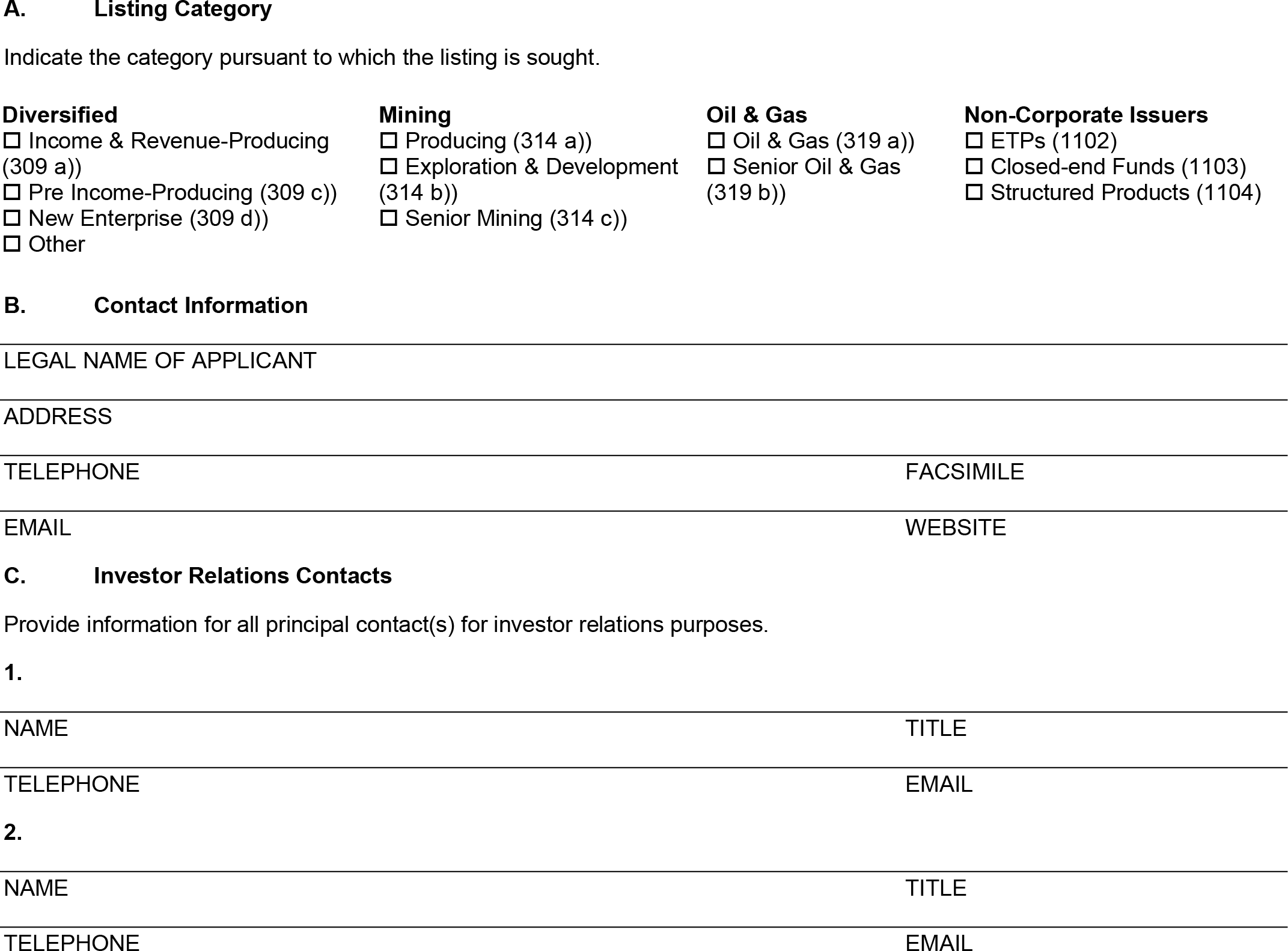
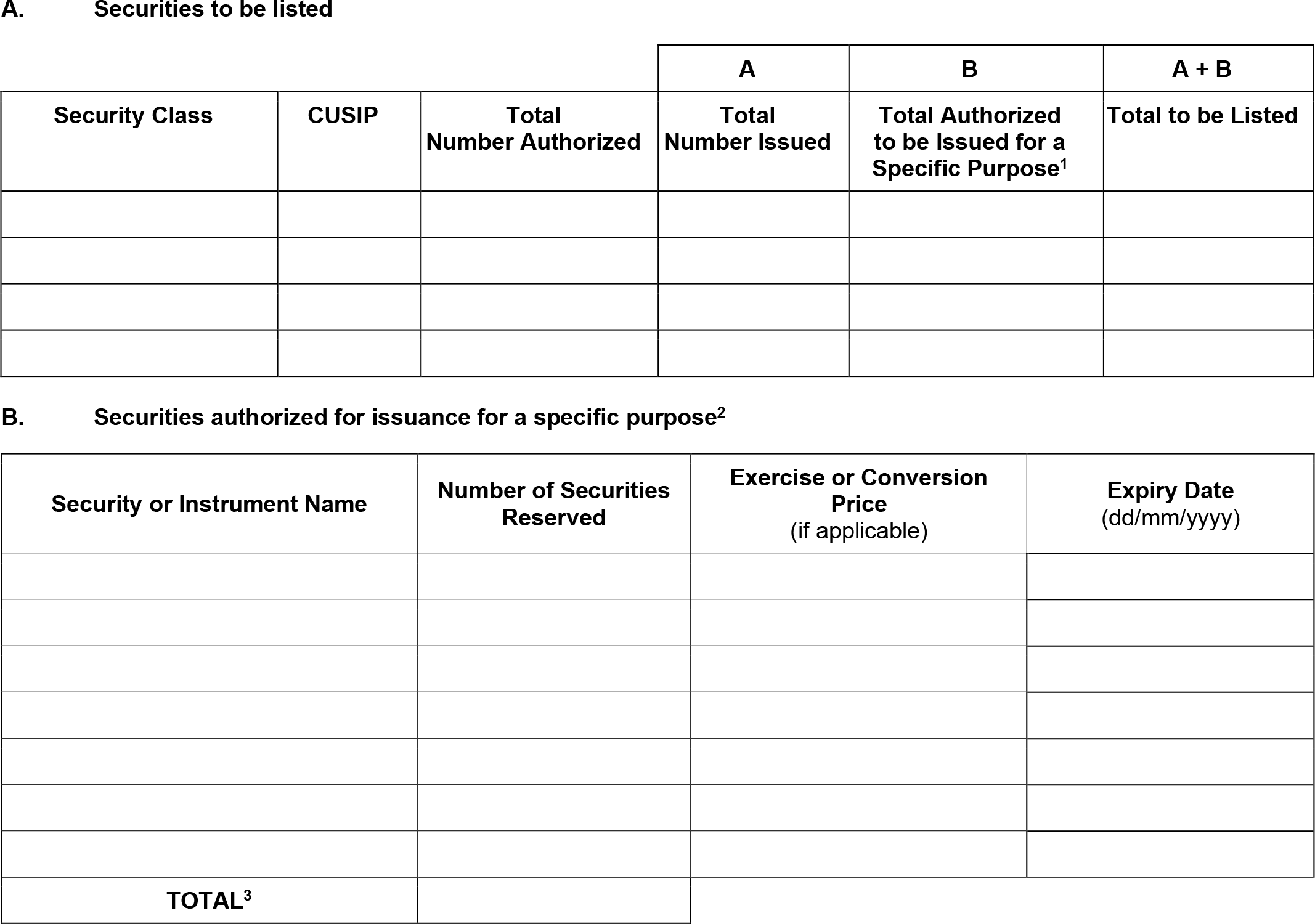
(A) If the Applicant has previously been denied its application to have its securities listed on any market, please provide all relevant information, including the name of the market, the date and reasons why application was denied or unsuccessful.
(i) Name the jurisdictions in which the Applicant is a reporting issuer (or equivalent status).
(ii) Date of most recent annual meeting and date and type of most recent financial report to security holders.
(iii) Describe any restrictions on the free tradeability of the securities to be listed. In the absence of restrictions, confirm that the securities will be freely tradeable in Canada.
After having received approval from its Board of Directors,
_______________________________________________________________________________________________________________________
applies to list the securities designated in this application on Toronto Stock Exchange.
AUTHORIZATION AND CONSENT: THE APPLICANT HEREBY AUTHORIZES AND CONSENTS TO THE COLLECTION BY ANY OF TORONTO STOCK EXCHANGE, A DIVISION OF TSX INC., TSX VENTURE EXCHANGE INC. AND THEIR SUBSIDIARIES, AFFILIATES, REGULATORS AND AGENTS OF ANY INFORMATION WHATSOEVER (WHICH MAY INCLUDE PERSONAL, CREDIT, OR OTHER INFORMATION) FROM ANY SOURCE, INCLUDING WITHOUT LIMITATION FROM AN INVESTIGATIVE AGENCY OR A RETAIL CREDIT AGENCY, AS PERMITTED BY LAW IN ANY JURISDICTION IN CANADA OR ELSEWHERE. THE APPLICANT ACKNOWLEDGES AND AGREES THAT SUCH INFORMATION MAY BE SHARED WITH AND RETAINED BY TORONTO STOCK EXCHANGE, A DIVISION OF TSX INC., TSX VENTURE EXCHANGE INC. AND THEIR SUBSIDIARIES, AFFILIATES, REGULATORS AND AGENTS INDEFINITELY.
The two officers signing below solemnly declare that as of the date hereof they each: i) have been duly authorized by the Board of Directors (or similar body) of the Applicant to sign this certificate and declaration; ii) certify that all of the information in this Listing Application, any attachments, documents incorporated by reference and any other documentation filed in connection therewith, including documents obtained from SEDAR or from TSX Venture Exchange on consent and direction, is true and correct to the best of their knowledge, information and belief; and iii) make this solemn declaration conscientiously believing it to be true and knowing this it is of the same force and effect as if made under oath and by virtue of the Canada Evidence Act.
_____________________________________________________________________________________________________________ |
|
DATE |
POSITION WITH APPLICANT |
|
|
_____________________________________________________________________________________________________________ |
|
SIGNATURE OF AUTHORIZED OFFICER |
PRINT NAME |
|
|
_____________________________________________________________________________________________________________ |
|
DATE |
POSITION WITH APPLICANT |
|
|
_____________________________________________________________________________________________________________ |
|
SIGNATURE OF AUTHORIZED OFFICER |
PRINT NAME |
We hereby confirm there are, as of [insert date], [insert number] holders of at least one board lot of [insert security name] of [insert Applicant name].
This statement is certified by: |
|
|
|
___________________________________ |
___________________________________ |
Name of Authorized Individual |
Position with Transfer Agent |
|
|
___________________________________ |
|
Transfer Agent (company name) |
|
|
|
___________________________________ |
___________________________________ |
Signature |
Date |
Instructions:
This attachment to the Listing Application should be completed for each class of securities to be listed on TSX and should be certified by the transfer agent.
A "board lot" means 100 securities having a market value of $1.00 per security or greater; 500 securities having a market value of less than $1.00 and not less than $0.10 per security; or 1,000 securities having a market value of less than $0.10 per security.
ATTACHMENT 2 -- Statement evidencing the number of freely tradeable securities
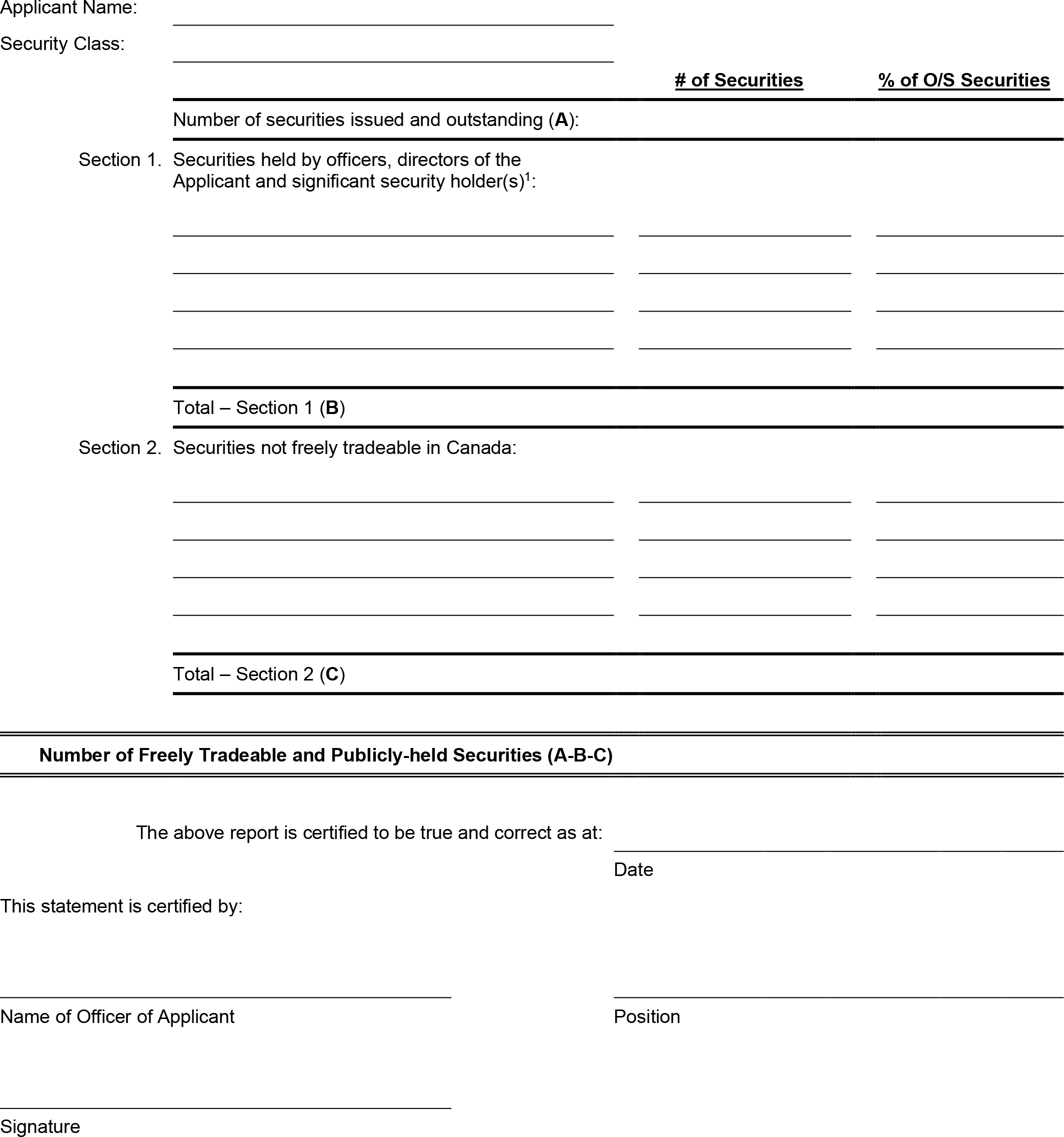
Instructions:
This attachment to the Listing Application should be completed for each class of securities to be listed on TSX.
In Section 1 -- Disclose the identity of each party who is the significant security holder{1} with their respective security holdings and the percentage it represents relative to the total number of outstanding securities of that class. Securities held by officers and directors may be aggregated as a group, unless such individual also is a significant security holder.
In Section 2 -- Disclose the agreement or circumstances under which the resale of the securities came to be restricted (e.g. escrow agreement, pooling agreement, private placement, etc.). Include number of securities subject to such restriction under each such circumstance and the percentage it represents relative to the total number of outstanding securities of that class.
ATTACHMENT 3 -- Consent and direction form for TSX Venture Exchange to provide documents to Toronto Stock Exchange
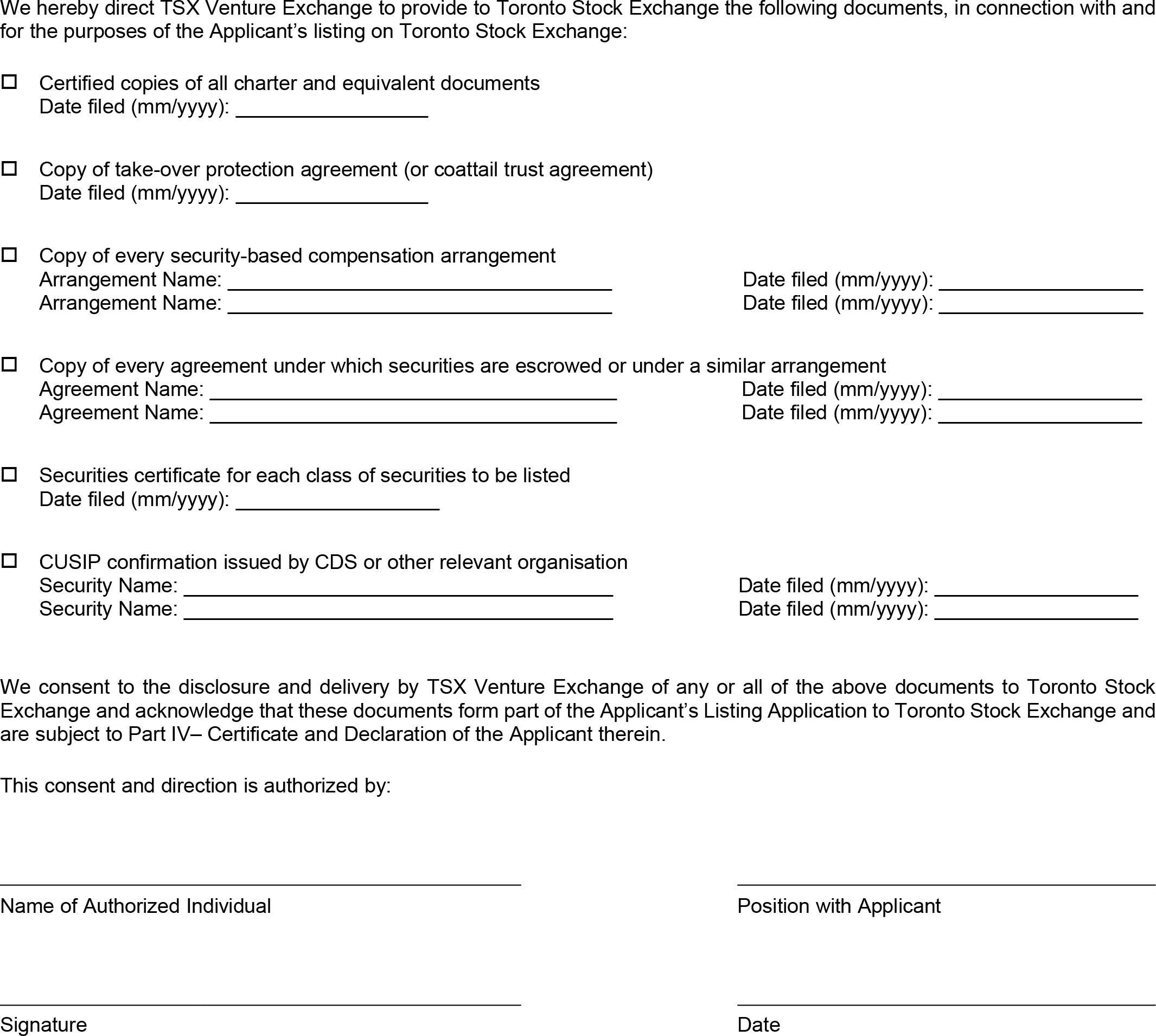
Instructions:
This attachment to the Listing Application may be completed by Applicants which are currently listed on TSX Venture Exchange and where such document has been submitted to TSX Venture Exchange in a form that would be acceptable to TSX. Indicate the date (mm/yyyy) when the most recent version of the document has been filed with TSX Venture Exchange.
If documents provided to TSX Venture Exchange are not current, it is the Applicant's responsibility to ensure it provides TSX with all current and updated information and documentation in accordance with the requirements of the Listing Application.
{1} Applicants required by law to produce a technical
resourcesreport pursuant to either National Instrument 43-101 Standards of Disclosure for Mineral Projects or National Instrument 51-101 Standards of Disclosure for Oil and Gas Activities must apply pursuant to sections 314 or 319 of the Manual, respectively.{2} Evidence of an "appropriate capital structure" may be satisfied by demonstrating either (a) positive working capital (calculated as excess of current assets over current liabilities in the most recent interim and audited annual periods) or (b) alternate evidence of liquidity, which may include (i) undrawn capacity on existing credit facilities sufficient to cover current deficit and/or (ii) other firm funding commitments.
{3} "cash flow from operations" for this purpose is calculated as cash flow from operating activities before changes in working capital.
{4} "run rate calculation" is an extrapolation of current financial performance, assuming that current conditions continue but accounting for seasonality and other significant factors in the issuer's operating cycle. Adjustments are permitted to address material changes to the business during the run rate period but such adjustments are generally limited to: recently completed acquisitions and/or dispositions, proposed transactions that have progressed to a state where a reasonable person would conclude the likelihood for completion is high and for which the financial effects are objectively determinable, and other expected inflows or outflows of cash where a reasonable person would conclude that the likelihood of receipt or payment is high. Generally, the run rate calculation should (i) include committed unconditional funding, committed expenses, current sales backlogs and expected capital expenditures for the run rate period consistent with the work programs disclosed in the issuer's public filings; and (ii) exclude projections, uncommitted or contingent cash receipts and non-binding or conditional arrangements unless a reasonable person would conclude that the likelihood of realization is high. The run rate calculation must be presented on a quarterly basis and signed by the applicant's Chief Financial Officer and should include a list of assumptions applied. Past transactions that are non-recurring or exceptional or other past activities not expected to be part of normal course operations going forward that are included in the run rate analysis because such items have a material effect on committed cash inflows or outflows during the run rate period should be clearly identified.
{5} For the purposes of Part III
3, market capitalization will be calculated as follows: (i) for initial public offerings, the product of (A) the offering price and (B) the total number of equity securities outstanding on the listing date; (ii) for direct listings, including graduations from the TSX Venture Exchange, the product of (A) the 20-day average closing price of the equity securities on such stock exchange on which such securities are listed and posted for trading and on which the greatest volume of trading occurs and (B) the total number of equity securities outstanding calculated as at the date on which TSX conditional listing approval is granted; (iii) for spin-offs of a publicly listed issuer, the appropriate proportion of the pre spin-off market capitalization of the parent issuer; or (iv) for other instances, the aggregate value of the listed equity securities as set out in a formal valuation prepared in accordance with Multilateral Instrument 61-101 Protection of Minority Security Holders in Special Transactions.{6} If the applicant has not yet operated for one year the business that, once listed, would reasonably be considered to be the applicant's primary business, the Exchange may, in lieu of an audited income statement, accept audited historical financial statements for the business.
{7} See footnote 4.
{8} See footnote 4.
{9} See footnote 5.
{10} Excludes Special Purpose Acquisition Corporations, which must apply pursuant to Part X of the Manual.
{11} TSX will view management experience and expertise holistically and will broadly consider the experience and expertise of an issuer's management team and board of directors in the public markets, the relevant business sector and corporate governance matters. TSX will generally expect at least one member of the issuer's board of directors to have recent Canadian public markets experience.
{12} TSX will consider evidence specific to the case at hand, such as having obtained regulatory approval to proceed with a stated project, a bankable feasibility report, or such other factors as determined by the Exchange.
{13} See footnote 4.
{14} See footnote 4.
{15} See footnote 5.
{16} See footnote 5.
{17} An independent director is defined as a person who:
a) is not a member of management and is free from any interest and any business or other relationship which in the opinion of the Exchange could reasonably be perceived to materially interfere with the director's ability to act in the best interest of the company; and
b) is a beneficial holder, directly or indirectly, or is a nominee or associate of a beneficial holder, collectively of 10% or less of the votes attaching to all issued and outstanding securities of the applicant.
The Exchange will consider all relevant factors in assessing the independence of the director. As a general rule, the following persons would not be considered an independent director
i) a person who is currently, or has been within the past three years, an officer, employee of or service provider to the company or any of its subsidiaries or affiliates; or
ii) a person who is an officer, employee or controlling shareholder of a company that has a material business relationship with the applicant.
{18} "Qualifying Property" means any property upon which an Issuer applying under Section 314 is relying on in order to meet the minimum listing requirements.
{19} Reports prepared by independent qualified persons, and the acceptability of the authors, shall conform to NI 43-101 and be acceptable to the Exchange.
{20} See footnote 4.
{21} "qualified person" is as defined by NI 43-101.
{22} See footnote 2.
{23} See footnote 5.
{24} See footnote 19.
{25} Work Program -- The Exchange will consider companies undertaking an exploration or development program of at least $3,500,000 on a Qualifying Property if planned program expenditures on all properties aggregate at least $5,000,000. The additional properties will be considered with the submission of appropriate technical documentation, conforming to NI 43-101.
{26} See footnote 21.
{27} See footnote 4.
{28} See footnote 21.
{29} See footnote 2.
{30} See footnote 5.
{31} See footnote 25.
{32} See footnote 3.
{33} See footnote 3.
{34} See footnote 19.
{35} See footnote 2.
{36} See footnote 5.
{37} See footnote 17.
{38} "proved reserves" are as defined in National Instrument 51-101 Standards of Disclosure for Oil and Gas Activities ("NI 51-101") and the Canadian Oil and Gas Evaluation Handbook maintained by the Society of Petroleum Evaluation Engineers (Calgary Chapter)( "COGE Handbook"), as amended from time to time.
{39} "probable reserves" are as defined in NI 51-101 and the COGE Handbook, as amended from time to time.
{40} The company must submit a technical report prepared by an independent technical consultant that conforms to NI 51-101 and be acceptable to the Exchange. Reports prepared in conformity with other reporting systems deemed acceptable by the CSA as evidenced by a CSA exemption will also be acceptable to the Exchange.
{41} The value of reserves should be calculated as the net present value of future cash flows before income taxes, prepared on a forecast basis, and discounted at a rate of 10%. The Exchange may, at its discretion, also require the provision of a price sensitivity analysis.
{42} See footnote 3.
{43} See footnote 4.
{44} See footnote 5.
{45} See footnote 37.
{46} See footnote 39.
{47} See footnote 40.
{48} "boepd" means barrels of oil equivalent per day.
{49} See footnote 3.
{50} See footnote 5.
{51} See footnote 17.
{52} Date to be 90 days from the date of conditional approval of the listing application by the Exchange or such other date as the Exchange may stipulate.
{1} Contact TSX to discuss the relief for rights offerings as certain elements related to trading, notice and mechanics will still be required.
{1} In the context of the listing of a special purpose issuer, where an individual has submitted a PIF to TSX within the last 12 months and the information provided on such PIF has not changed, such individual will be exempted from providing a PIF or a Statutory Declaration Form and a Consent for Disclosure of Criminal Record Information Form, as applicable.
{2} In the context of Applicants listed on TSX Venture Exchange, individuals who have previously submitted a PIF to the TSX Venture Exchange in connection with the Applicant will generally be exempted from providing a PIF or a Statutory Declaration Form and a Consent for Disclosure of Criminal Record Information Form, as applicable. TSX reserves the right to request a PIF or a Statutory Declaration Form and a Consent for Disclosure of Criminal Record Information Form, as applicable, in exceptional circumstances including where a significant number of the directors and/or officers of the Applicant are replaced in connection with the Applicants listing on TSX.
{3} The original listing application fee is waived for Applicants listed on TSX Venture Exchange.
{1} If the Applicant has previously submitted these documents to TSX Venture Exchange in a form acceptable to TSX, then the Applicant may provide a consent and direction to TSX Venture Exchange to provide it to TSX.
{1} If the Applicant has previously submitted these documents to TSX Venture Exchange in a form acceptable to TSX, then the Applicant may provide a consent and direction to TSX Venture Exchange to provide such documents to TSX.
{1} The number of securities authorized to be issued for a specific purpose should correspond to the number of securities reserved for issuance provided in section B of Part II of this Listing Application.
{2} For example, include the number of securities which can be issued pursuant to outstanding warrants, convertible debentures, stock options plans, share purchase plans and conversion rights.
{3} The total number of securities reserved for issuance should correspond to the total number of securities authorized to be issued for a specific purpose provided in Section A of Part II of this Listing Application.
{1} A significant security holder is an entity or individual who beneficially own or control, directly or indirectly, securities carrying greater than 10% of the voting rights attached to all outstanding voting securities of the Applicant.
{1}
Section 501 requires listed companies to obtain prior Exchange acceptance for filing of all proposed material changes, including changes which do not entail an issuance of securities, as detailed in Part V of this Manual.Applicants required by law to produce a technicalresourcesreport pursuant to either National Instrument 43-101 Standards of Disclosure for Mineral Projects or National Instrument 51-101 Standards of Disclosure for Oil and Gas Activities must apply pursuant to sections 314 or 319 of the Manual, respectively.{2}
Consideration will be given to permitting the inclusion of deferred development charges or other intangible assets in the calculation of net tangible assets if in the opinion of the Exchange, the circumstances so warrant.Evidence of an "appropriate capital structure" may be satisfied by demonstrating either (a) positive working capital (calculated as excess of current assets over current liabilities in the most recent interim and audited annual periods) or (b) alternate evidence of liquidity, which may include (i) undrawn capacity on existing credit facilities sufficient to cover current deficit and/or (ii) other firm funding commitments.{3}
Companies with less than $2,000,000 in net tangible assets may qualify for listing if they meet the earnings and cash flow requirements detailed in paragraphs 309.1 b) and c)."cash flow from operations" for this purpose is calculated as cash flow from operating activities before changes in working capital.{4}
See footnote 2."run rate calculation" is an extrapolation of current financial performance, assuming that current conditions continue but accounting for seasonality and other significant factors in the issuer's operating cycle. Adjustments are permitted to address material changes to the business during the run rate period but such adjustments are generally limited to: recently completed acquisitions and/or dispositions, proposed transactions that have progressed to a state where a reasonable person would conclude the likelihood for completion is high and for which the financial effects are objectively determinable, and other expected inflows or outflows of cash where a reasonable person would conclude that the likelihood of receipt or payment is high. Generally, the run rate calculation should (i) include committed unconditional funding, committed expenses, current sales backlogs and expected capital expenditures for the run rate period consistent with the work programs disclosed in the issuer's public filings; and (ii) exclude projections, uncommitted or contingent cash receipts and non-binding or conditional arrangements unless a reasonable person would conclude that the likelihood of realization is high. The run rate calculation must be presented on a quarterly basis and signed by the applicant's Chief Financial Officer and should include a list of assumptions applied. Past transactions that are non-recurring or exceptional or other past activities not expected to be part of normal course operations going forward that are included in the run rate analysis because such items have a material effect on committed cash inflows or outflows during the run rate period should be clearly identified.{5} For the purposes of Part III, market capitalization will be calculated as follows: (i) for initial public offerings, the product of (A) the offering price and (B) the total number of equity securities outstanding on the listing date; (ii) for direct listings, including graduations from the TSX Venture Exchange, the product of (A) the 20-day average closing price of the equity securities on such stock exchange on which such securities are listed and posted for trading and on which the greatest volume of trading occurs and (B) the total number of equity securities outstanding calculated as at the date on which TSX conditional listing approval is granted; (iii) for spin-offs of a publicly listed issuer, the appropriate proportion of the pre spin-off market capitalization of the parent issuer; or (iv) for other instances, the aggregate value of the listed equity securities as set out in a formal valuation prepared in accordance with Multilateral Instrument 61-101 Protection of Minority Security Holders in Special Transactions.
As a general rule, applicants should file a complete set of forecast financial statements covering the current and/or the next fiscal year (on a quarterly basis), accompanied by an independent auditor's opinion that complies with the CICA Auditing Standards for future oriented financial information. The applicant should have at least six months of operating history, including gross revenues at commercial levels for the last six months.{6}
See footnote 5.If the applicant has not yet operated for one year the business that, once listed, would reasonably be considered to be the applicant's primary business, the Exchange may, in lieu of an audited income statement, accept audited historical financial statements for the business.{7}
Generally would include innovative growth companies engaged in hardware, software, telecommunications, data communications information technology and new technologies.See footnote 4.{8}
As a general rule, the projection should exclude uncommitted payments from third parties or other contingent cash receipts.See footnote 4.{9}
As a general rule, evidence of "being at an advanced stage of development or commercialization" will be restricted to historical revenues from the company's current main business or contracts for future sales of products or services in such business. The Exchange will also consider all relevant factors in assessing the company's ability to develop its business including:
a) affiliations or strategic partnerships with major industry enterprises;
b) commercial or technical endorsements of the company's products or services from recognized industry participants;
c) existing or potential markets for the products or services and the company's marketing infrastructure and sales support dedicated to service these markets; and
d) the background and expertise of management including its record of raising funds.See footnote 5.{10}
As a general rule, the projection should exclude cash flows from future revenues, uncommitted payments from third parties or contingent cash receipts.Excludes Special Purpose Acquisition Corporations, which must apply pursuant to Part X of the Manual.{11} TSX will view management experience and expertise holistically and will broadly consider the experience and expertise of an issuer's management team and board of directors in the public markets, the relevant business sector and corporate governance matters. TSX will generally expect at least one member of the issuer's board of directors to have recent Canadian public markets experience.
The Exchange will consider all relevant factors including:
a) the stage of development of the company's products or services and prospects for commercialization;
b) commercial or technical endorsements of the company's products or services from recognized academic institutions or industry participants;
c) the existing or potential markets for the company's products or services and the marketing infrastructure and sales support necessary to service these markets;
d) the background and expertise of management including its record of raising funds to finance research and development projects and ongoing operations;
e) the existence and composition of any scientific advisors board; and
f) affiliations with major industry enterprises or strategic partners.{12} TSX will consider evidence specific to the case at hand, such as having obtained regulatory approval to proceed with a stated project, a bankable feasibility report, or such other factors as determined by the Exchange.
{13} See footnote 4.
{14} See footnote 4.
{15} See footnote 5.
{16} See footnote 5.
{
12}See footnote 1.{
13}See footnote 2.{
1417} An independent director is defined as a person who:(a) is not a member of management and is free from any interest and any business or other relationship which in the opinion of the Exchange could reasonably be perceived to materially interfere with the director's ability to act in the best interest of the company; and
(b) is a beneficial holder, directly or indirectly, or is a nominee or associate of a beneficial holder, collectively of 10% or less of the votes attaching to all issued and outstanding securities of the applicant.
The Exchange will consider all relevant factors in assessing the independence of the director. As a general rule
., the following persons would not be considered an independent director(i) a person who is currently, or has been within the past three years, an officer, employee of or service provider to the company or any of its subsidiaries or affiliates; or
(ii) a person who is an officer, employee or controlling shareholder of a company that has a material business relationship with the applicant.
{
15}See footnote 1{18} "Qualifying Property" means any property upon which an Issuer applying under Section 314 is relying on in order to meet the minimum listing requirements.
{
1619} Reports prepared by independent qualified persons, and the acceptability of the authors, shall conform toNational InstrumentNI 43-101 and be acceptable to the Exchange.Reports prepared in conformity with other reporting systems deemed to be the equivalent of NI 43-101 will normally be acceptable also.{
17}Net Tangible Assets-Consideration will be given to including deferred exploration expenditures on a company's currently active mineral properties in the Net Tangible Asset calculation if, in the opinion of the Exchange, the evidence provided so warrants.{20} See footnote 4.
{21} "qualified person" is as defined by NI 43-101.
{
1822} See footnote162.{23} See footnote 5.
{24} See footnote 19.
{
1925}Work Programme-Work Program -- The Exchange will consider companies undertaking an exploration or developmentprogrammeprogram of at least $500,0003,500,000 on aqualifying propertyQualifying Property if plannedprogrammeprogram expenditures on all properties aggregate at least $750,000.5,000,000. The additional properties will be considered with the submission of appropriate technical documentation, conforming toNational InstrumentNI 43-101.{
20}See footnote 16{
21}Working Capital-Consideration may be given to companies with less than $2,000,000 in working capital if all or part of the company's minimum work programme expenditure requirement will be funded by a substantial industry partner, such that an equivalent working capital amount would be recognized.{
22}See footnote 17{
23}See footnote 19{26} See footnote 21.
{27} See footnote 4.
{28} See footnote 21.
{29} See footnote 2.
{30} See footnote 5.
{31} See footnote 25.
{32} See footnote 3.
{33} See footnote 3.
{
2434} See footnote119.{
2535} See footnote172.{
2636} See footnote165.{
2737} See footnote1417.{
28}See footnote 1{
29}"Proved developed reserves" are defined as those reserves that are expected to be recovered from existing wells and installed facilities, or, if facilities have not been installed, that would involve a low expenditure, when compared to the cost of drilling a well, to put those reserves on production.{
30}The Company must submit a technical report prepared by an independent technical consultant that conforms to National Instrument 51-101 and be acceptable to the Exchange. Reports prepared in conformity with other reporting systems deemed by the Exchange to be equivalent of National Instrument 51-101 will normally be acceptable also. The value of reserves should be calculated as the net present value of future cash flows before income taxes, prepared on a forecast basis, and discounted at a rate of 10%. The Exchange may, at its discretion, also require the provision of a price sensitivity analysis.{
30A}"contingent resources" are defined in accordance with Canadian Oil and Gas Evaluation Handbook and National Instrument 51-101, however the Exchange in its discretion may exclude certain resources classified as contingent resources after taking into consideration the nature of the contingency. The Exchange will use the best-case estimate for contingent resources, prepared in accordance with National Instrument 51-101.{38} "proved reserves" are as defined in National Instrument 51-101 Standards of Disclosure for Oil and Gas Activities ("NI 51-101") and the Canadian Oil and Gas Evaluation Handbook maintained by the Society of Petroleum Evaluation Engineers (Calgary Chapter)("COGE Handbook"), as amended from time to time.
{39} "probable reserves" are as defined in NI 51-101 and the COGE Handbook, as amended from time to time.
{
30B40} TheCompanycompany must submit a technical report prepared by an independent technical consultant that conforms toNational InstrumentNI 51-101 and be acceptable to the Exchange. Reports prepared in conformity with other reporting systems deemed acceptable bythe Exchange to be the equivalent of National Instrument 51-101 will normally be acceptablethe CSA as evidenced by a CSA exemption will alsobe acceptable to the Exchange.{41} The value of
the resourcesreserves should be calculated as thebest case scenario of thenet present value of future cash flows before income taxes, prepared on a forecast basis, and discounted at a rate of 10%. The Exchange may, at its discretion, also require the provision of a price sensitivity analysis.{
30C}The Exchange strongly recommends pre-consultation with the Exchange for any applicant applying under this listing category. Generally, this category will be limited to issuers with unconventional oil & gas assets, such as oil sands.{42} See footnote 3.
{43} See footnote 4.
{44} See footnote 5.
{
31}See footnote 1{
32}"Proved developed reserves" are defined as those reserves that are expected to be recovered from existing wells and installed facilities, or, of facilities have not been installed, that would involve a low expenditure, when compared to the cost of drilling a well, to put the reserves on production.{
33}See footnote 30{
34}In assessing the adequacy of funds, credit facilities with recognized financial institutions will be considered.{45} See footnote 37.
{46} See footnote 39.
{47} See footnote 40.
{48} "boepd" means barrels of oil equivalent per day.
{49} See footnote 3.
{50} See footnote 5.
{
3551} See footnote1417.{
3652} Date to be 90 days from the date of conditional approval of the listing application by the Exchange or such other date as the Exchange may stipulate.{
1}For the purposes of this section, "transactions involving insiders and other related parties of the non-exempt issuer" includes, but is not limited to, (a) services rendered for which fees and commissions are payable; (b) purchases and sales of assets; (c) interest to be received by an insider or other related party pursuant to a loan, but does not include the principal amount of a loan which must be repaid; and (d) a loan by a non-exempt issuer to an insider or a related party, which includes both the principal and interest on any loan.{1} Contact TSX to discuss the relief for rights offerings as certain elements related to trading, notice and mechanics will still be required.
{1} In the context of the listing of a special purpose issuer, where an individual has submitted a PIF to TSX within the last 12 months and the information provided on such PIF has not changed, such individual will be exempted from providing a PIF or a Statutory Declaration Form and a Consent for Disclosure of Criminal Record Information Form, as applicable.
{2} In the context of Applicants listed on TSX Venture Exchange, individuals who have previously submitted a PIF to the TSX Venture Exchange in connection with the Applicant will generally be exempted from providing a PIF or a Statutory Declaration Form and a Consent for Disclosure of Criminal Record Information Form, as applicable. TSX reserves the right to request a PIF or a Statutory Declaration Form and a Consent for Disclosure of Criminal Record Information Form, as applicable, in exceptional circumstances including where a significant number of the directors and/or officers of the Applicant are replaced in connection with the Applicants listing on TSX.
{3} The original listing application fee is waived for Applicants listed on TSX Venture Exchange.
{1} If the Applicant has previously submitted these documents to TSX Venture Exchange in a form acceptable to TSX, then the Applicant may provide a consent and direction to TSX Venture Exchange to provide it to TSX.
{1} If the Applicant has previously submitted these documents to TSX Venture Exchange in a form acceptable to TSX, then the Applicant may provide a consent and direction to TSX Venture Exchange to provide such documents to TSX.
{2}
Applicants currently listed on TSX Venture Exchange should contact TSX to discuss providing a sponsorship letter. Generally, TSX Venture Exchange Applicants are not required to submit a sponsorship letter if they have: i) provided a sponsorship letter as a result of a major transaction pursuant to TSX Venture Exchange policy within the last 18 months; ii) cleared a prospectus in the past 12 months; iii) traded on the TSX Venture Exchange for a minimum period of 24 months, meet the original listing requirements detailed in Part III of the Company Manual and are in good standing with all TSX Venture Exchange regulatory requirements; or iv) completed an eligibility review as outlined in Sec. 305 of the Company Manual and the TSX has determined that the issuer meets the listing requirements and no sponsorship letter is required.{1} If the Applicant has previously submitted these documents to TSX Venture Exchange in a form acceptable to TSX, then the Applicant may provide a consent and direction to TSX Venture Exchange to provide such documents to TSX.
{1} The number of securities authorized to be issued for a specific purpose should correspond to the number of securities reserved for issuance provided in section B of Part II of this Listing Application.
{2} For example, include the number of securities which can be issued pursuant to outstanding warrants, convertible debentures, stock options plans, share purchase plans and conversion rights.
{3} The total number of securities reserved for issuance should correspond to the total number of securities authorized to be issued for a specific purpose provided in Section A of Part II of this Listing Application.
{1} A significant security holder is an entity or individual who beneficially own or control, directly or indirectly, securities carrying greater than 10% of the voting rights attached to all outstanding voting securities of the Applicant.
{1} Applicants required by law to produce a resources report pursuant to either National Instrument 43-101 Standards of Disclosure for Mineral Projects or National Instrument 51-101 Standards of Disclosure for Oil and Gas Activities must apply pursuant to sections 314 or 319 of the Manual, respectively.
{2} Evidence of an "appropriate capital structure" may be satisfied by demonstrating either (a) positive working capital (calculated as excess of current assets over current liabilities in the most recent interim and audited annual periods) or (b) alternate evidence of liquidity, which may include (i) undrawn capacity on existing credit facilities sufficient to cover current deficit and/or (ii) other firm funding commitments.
{3} "cash flow from operations" for this purpose is calculated as cash flow from operating activities before changes in working capital.
{4} "run rate calculation" is an extrapolation of current financial performance, assuming that current conditions continue but accounting for seasonality and other significant factors in the issuer's operating cycle. Adjustments are permitted to address material changes to the business during the run rate period but such adjustments are generally limited to: recently completed acquisitions and/or dispositions, proposed transactions that have progressed to a state where a reasonable person would conclude the likelihood for completion is high and for which the financial effects are objectively determinable, and other expected inflows or outflows of cash where a reasonable person would conclude that the likelihood of receipt or payment is high. Generally, the run rate calculation should: (i) include committed unconditional funding, committed expenses, current sales backlogs and expected capital expenditures for the run rate period consistent with the work programs disclosed in the issuer's public filings; and (ii) exclude projections, uncommitted or contingent cash receipts and non-binding or conditional arrangements unless a reasonable person would conclude that the likelihood of realization is high. The run rate calculation must be presented on a quarterly basis and signed by the applicant's Chief Financial Officer and should include a list of assumptions applied. Past transactions that are non-recurring or exceptional or other past activities not expected to be part of normal course operations going forward that are included in the run rate analysis because such items have a material effect on committed cash inflows or outflows during the run rate period should be clearly identified.
{5} For the purposes of Part 3, market capitalization will be calculated as follows: (i) for initial public offerings, the product of (A) the offering price and (B) the total number of equity securities outstanding on the listing date; (ii) for direct listings, including graduations from the TSX Venture Exchange, the product of (A) the 20-day average closing price of the equity securities on such stock exchange on which such securities are listed and posted for trading and on which the greatest volume of trading occurs and (B) the total number of equity securities outstanding calculated as at the date on which TSX conditional listing approval is granted; (iii) for spin-offs of a publicly listed issuer, the appropriate proportion of the pre spin-off market capitalization of the parent issuer; or (iv) for other instances, the aggregate value of the listed equity securities as set out in a formal valuation prepared in accordance with Multilateral Instrument 61-101 Protection of Minority Security Holders in Special Transactions.
{6} If the applicant has not yet operated for one year the business that, once listed, would reasonably be considered to be the applicant's primary business, the Exchange may, in lieu of an audited income statement, accept audited historical financial statements for the business.
{7} See footnote 4.
{8} See footnote 4.
{9} See footnote 5.
{10} Excludes Special Purpose Acquisition Corporations, which must apply pursuant to Part X of the Manual.
{11} TSX will view management experience and expertise holistically and will broadly consider the experience and expertise of an issuer's management team and board of directors in the public markets, the relevant business sector and corporate governance matters. TSX will generally expect at least one member of the issuer's board of directors to have recent Canadian public markets experience.
{12} TSX will consider evidence specific to the case at hand, such as having obtained regulatory approval to proceed with a stated project, a bankable feasibility report, or such other factors as determined by the Exchange.
{13} See footnote 4.
{14} See footnote 4.
{15} See footnote 5.
{16} See footnote 5.
{17} An independent director is defined as a person who:
a) is not a member of management and is free from any interest and any business or other relationship which in the opinion of the Exchange could reasonably be perceived to materially interfere with the director's ability to act in the best interest of the company; and
b) is a beneficial holder, directly or indirectly, or is a nominee or associate of a beneficial holder, collectively of 10% or less of the votes attaching to all issued and outstanding securities of the applicant.
The Exchange will consider all relevant factors in assessing the independence of the director. As a general rule, the following persons would not be considered an independent director:
i) a person who is currently, or has been within the past three years, an officer, employee of or service provider to the company or any of its subsidiaries or affiliates; or
ii) a person who is an officer, employee or controlling shareholder of a company that has a material business relationship with the applicant.
{18} "Qualifying Property" means any property upon which an Issuer applying under Section 314 is relying on in order to meet the minimum listing requirements.
{19} Reports prepared by independent qualified persons, and the acceptability of the authors, shall conform to NI 43-101 and be acceptable to the Exchange.
{20} See footnote 4.
{21} "qualified person" is as defined by NI 43-101.
{22} See footnote 2.
{23} See footnote 5.
{24} See footnote 19.
{25} Work Program -- The Exchange will consider companies undertaking an exploration or development program of at least $3,500,000 on a Qualifying Property if planned program expenditures on all properties aggregate at least $5,000,000. The additional properties will be considered with the submission of appropriate technical documentation, conforming to NI 43-101.
{26} See footnote 21.
{27} See footnote 4.
{28} See footnote 21.
{29} See footnote 2.
{30} See footnote 5.
{31} See footnote 25.
{32} See footnote 3.
{33} See footnote 3.
{34} See footnote 19.
{35} See footnote 2.
{36} See footnote 5.
{37} See footnote 17.
{38} "proved reserves" are as defined in National Instrument 51-101 Standards of Disclosure for Oil and Gas Activities ("NI 51-101") and the Canadian Oil and Gas Evaluation Handbook maintained by the Society of Petroleum Evaluation Engineers (Calgary Chapter)("COGE Handbook"), as amended from time to time.
{39} "probable reserves" are as defined in NI 51-101 and the COGE Handbook, as amended from time to time.
{40} The company must submit a technical report prepared by an independent technical consultant that conforms to NI 51-101 and be acceptable to the Exchange. Reports prepared in conformity with other reporting systems deemed acceptable by the CSA as evidenced by a CSA exemption will also be acceptable to the Exchange.
{41} The value of reserves should be calculated as the net present value of future cash flows before income taxes, prepared on a forecast basis, and discounted at a rate of 10%. The Exchange may, at its discretion, also require the provision of a price sensitivity analysis.
{42} See footnote 3.
{43} See footnote 4.
{44} See footnote 5.
{45} See footnote 37.
{46} See footnote 39.
{47} See footnote 40.
{48} "boepd" means barrels of oil equivalent per day.
{49} See footnote 3.
{50} See footnote 5.
{51} See footnote 17.
{52} Date to be 90 days from the date of conditional approval of the listing application by the Exchange or such other date as the Exchange may stipulate.
{1} Contact TSX to discuss the relief for rights offerings as certain elements related to trading, notice and mechanics will still be required.
{1} In the context of the listing of a special purpose issuer, where an individual has submitted a PIF to TSX within the last 12 months and the information provided on such PIF has not changed, such individual will be exempted from providing a PIF or a Statutory Declaration Form and a Consent for Disclosure of Criminal Record Information Form, as applicable.
{2} In the context of Applicants listed on TSX Venture Exchange, individuals who have previously submitted a PIF to the TSX Venture Exchange in connection with the Applicant will generally be exempted from providing a PIF or a Statutory Declaration Form and a Consent for Disclosure of Criminal Record Information Form, as applicable. TSX reserves the right to request a PIF or a Statutory Declaration Form and a Consent for Disclosure of Criminal Record Information Form, as applicable, in exceptional circumstances including where a significant number of the directors and/or officers of the Applicant are replaced in connection with the Applicants listing on TSX.
{3} The original listing application fee is waived for Applicants listed on TSX Venture Exchange.
{1} If the Applicant has previously submitted these documents to TSX Venture Exchange in a form acceptable to TSX, then the Applicant may provide a consent and direction to TSX Venture Exchange to provide it to TSX.
{1}The number of securities authorized to be issued for a specific purpose should correspond to the number of securities reserved for issuance provided in section B of Part II of this Listing Application.
{2}For example, include the number of securities which can be issued pursuant to outstanding warrants, convertible debentures, stock options plans, share purchase plans and conversion rights.
{3}The total number of securities reserved for issuance should correspond to the total number of securities authorized to be issued for a specific purpose provided in Section A of Part II of this Listing Application.
{1} A significant security holder is an entity or individual who beneficially own or control, directly or indirectly, securities carrying greater than 10% of the voting rights attached to all outstanding voting securities of the Applicant.
Mount Logan Capital Inc. -- s. 21(b) of Ont. Reg. 398/21 of the OBCA
Consent given to an offering corporation under the Business Corporations Act (Ontario) to continue under the General Corporation Law of the State of Delaware
Business Corporations Act, R.S.O. 1990, c. B.16, as am., s. 181.
Securities Act, R.S.O. 1990, c. S.5, as am.
Regulation made under the Business Corporations Act, Ont. Reg. 398/21, as am., s. 21(b)
(Subsection 21(b) of the Regulation)
UPON the application (the "Application") of the Applicant to the Ontario Securities Commission (the "Commission") requesting the consent of the Commission, pursuant to subsection 21(b) of the Regulation, for the Applicant to continue in another jurisdiction pursuant to section 181 of the OBCA (the "Continuance");
AND UPON considering the Application and the recommendation of the staff of the Commission;
AND UPON the Applicant having represented to the Commission that:
1. The Applicant is an offering corporation existing under the OBCA.
2. The Applicant's head office is located at 650 Madison Avenue, 3rd Floor, New York, New York, 10022 and the Applicant's registered office is located at 365 Bay Street, Suite 800, Toronto, Ontario, M5H 2V1.
3. The Applicant is authorized to issue an unlimited number of common shares (the "MLC Common Shares") and an unlimited number of preference shares, issuable in series, of which 29,305,030 MLC Common Shares and nil preference shares were issued and outstanding as at the close of business on August 28, 2025. The MLC Common Shares are listed on Cboe Canada ("Cboe") under the stock symbol MLC.NE.
4. The Applicant intends to apply (the "Application for Continuance") to the Director under the OBCA pursuant to section 181 of the OBCA for authorization to continue under the General Corporation Law of the State of Delaware (the "DGCL").
5. Pursuant to subsection 21(b) of the Regulation, where a corporation is an offering corporation, the Application for Continuance must be accompanied by a consent from the Commission.
6. The Applicant is a reporting issuer under the Securities Act, R.S.O. 1990, c. S.5, as amended (the "Act") and the securities legislation of each of British Columbia, Alberta, Saskatchewan, Manitoba, Québec, New Brunswick, Nova Scotia, Prince Edward Island and Newfoundland and Labrador (collectively with Ontario, the "Jurisdictions").
7. The Applicant is not in default under any provision of the OBCA, the Act or the regulations or rules made thereunder, or any regulations or rules made under the securities legislation of any other Jurisdiction.
8. The Applicant is not in default under any provisions of the rules, regulations or policies of the Cboe.
9. Except proceedings before the Ontario Superior Court of Justice (Commercial List) relating to the Arrangement, described below, the Applicant is not a party to any proceedings under the Act or the OBCA or, to the best of its knowledge, information and belief, any pending proceeding under the Act or the OBCA.
10. The Commission is currently the Applicant's principal regulator.
11. The Application for Continuance is being made in connection with a proposed business combination (the "Transaction") among the Applicant, 180 Degree Capital Corp. ("TURN"), Yukon New Parent, Inc. ("New Parent", and upon closing of the Transaction, "New Mount Logan"), Polar Merger Sub, Inc. ("TURN Merger Sub"), and Moose Merger Sub, LLC ("MLC Merger Sub") pursuant to an Agreement and Plan of Merger dated January 16, 2025 (the "Merger Agreement"), as amended by written instruments to amend the Merger Agreement dated July 6, 2025 and August 17, 2025 (the "Merger Agreement Amendments" and collectively, the Merger Agreement as amended by the Merger Agreement Amendments is referred to herein as the "Amended Merger Agreement"). In accordance with the Amended Merger Agreement, the Transaction will involve, among other things, the following:
a. the Applicant will effect the Continuance by continuing out from the jurisdiction of the OBCA and domesticate as a corporation existing under and governed by the DGCL, to be effected by way of a plan of arrangement (the "Plan of Arrangement") pursuant to section 182 of the OBCA (the "Arrangement"). Pursuant to the Arrangement, among other things:
i. upon and following the Continuance under the DGCL, the name of the Applicant will be "Mount Logan Capital Intermediate Inc." ("MLC Delaware"); and
ii. upon effectiveness of the Continuance, each MLC Common Share issued and outstanding immediately prior to the effective time of the Continuance (other than any MLC Common Shares held by dissenting shareholders of the Applicant) will be converted into and will for all purposes be deemed to be one one-hundred-thousandth of a share of MLC Delaware common stock with no par value per share (each such one one-hundred thousandth of a share of MLC Delaware common stock, a "MLC Delaware Share"); and
b. 25 minutes after the effective time of the Continuance, MLC Delaware will be converted to a limited liability company in accordance with a plan of domestication (the "Plan of Domestication") under the DGCL (the "LLC Conversion"), and the name of the Applicant upon and following the LLC Conversion shall be "Mount Logan Capital Intermediate LLC" ("MLC Delaware LLC"). Pursuant to the terms of the Plan of Domestication, each MLC Delaware Share shall be converted to one unit representing a membership interest of MLC Delaware LLC (each, a "MLC Delaware Unit");
c. TURN Merger Sub will merge with and into TURN (the "TURN Merger").
d. MLC Merger Sub will merge with and into MLC Delaware LLC (the "MLC Merger" and collectively with the TURN Merger, the "Mergers" and the resulting entity referred to herein as "Merged MLC").
e. Pursuant to the TURN Merger, the former holders of common shares of TURN will receive shares of common stock of New Mount Logan ("New Mount Logan Common Stock") in exchange for their common shares of TURN.
f. Pursuant to the MLC Merger, the holders of MLC Delaware Units (being the former holders of MLC Common Shares and, after giving effect to the Continuance, the MLC Delaware Shares) will receive shares of New Mount Logan Common Stock in exchange for their MLC Delaware Units.
12. Upon and following closing of the Transaction (the "Closing"), it is anticipated that: (i) the New Mount Logan Common Stock will be listed on the Nasdaq Capital Market, or any higher tier of the Nasdaq market structure; (ii) New Mount Logan will become a reporting issuer in each of the Jurisdictions; (iii) Merged MLC will have applied to have the MLC Common Shares delisted from Cboe; (iv) Merged MLC will apply to cease to be a reporting issuer in the Jurisdictions; and (v) the business of New Mount Logan will primarily be that of the Applicant.
13. On August 29, 2025, the holders of MLC Common Shares passed a special resolution (the "Arrangement Resolution") approving the Arrangement, and therefore the Continuance, under the provisions of section 182 of the OBCA at a special meeting of the shareholders of the Applicant (the "Meeting") called to order on August 22, 2025 and which was adjourned and reconvened on August 29, 2025. The Meeting was adjourned in order to provide holders of MLC Common Shares with sufficient time to review the supplement, dated August 19, 2025, to the management information circular of the Applicant dated July 11, 2025 prepared and delivered to the holders of MLC Common Shares in connection with the Meeting (the "MLC Circular"). The Meeting was called and held in accordance with an interim order of the Ontario Superior Court of Justice (Commercial List) made pursuant to the OBCA dated July 10, 2025 (the "Interim Order").
14. In accordance with the OBCA, the Applicant's articles and by-laws (collectively, the "MLC Constating Documents") and the Interim Order, the Arrangement Resolution required the approval of not less than two-thirds of the aggregate votes cast by holders of MLC Common Shares present in person or represented by proxy at the Meeting. The Arrangement Resolution was approved by approximately 99.90% of the votes cast at the Meeting.
15. Pursuant to the Interim Order, registered holders of MLC Common Shares as of the close of business on July 8, 2025, the record date for the Meeting, were entitled to exercise dissent rights with respect to the Arrangement Resolution in accordance with the provisions of section 185 of the OBCA as modified by the Interim Order and the Plan of Arrangement. The MLC Circular advised such holders of the foregoing dissent rights, including in respect of the deadline to exercise dissent rights in connection with the Meeting or any adjournment or postponement thereof. No holders of MLC Common Shares exercised dissent rights in connection with the Meeting.
16. In addition, at the Meeting, the holders of MLC Common Shares (including in their capacity as unitholders of MLC Delaware LLC following the Continuance and the LLC Conversion) passed a resolution (the "MLC Merger Resolution") to authorize, approve and adopt the Amended Merger Agreement and the MLC Merger. The MLC Merger Resolution required the approval of (i) holders representing greater than 50% of all the issued and outstanding MLC Common Shares on the MLC Merger Resolution; and (ii) at least a majority of the votes cast on the MLC Merger Resolution by all holders of MLC Common Shares, other than New Mount Logan, TURN and any holder of MLC Common Shares that met the criteria set out in Section 8.1(2)(a) to (d), inclusive, of Multilateral Instrument 61-101 -- Protection of Minority Security Holders in Special Transactions present or represented by proxy at the Meeting and entitled to vote (the "Minority MLC Shareholders"). The MLC Merger Resolution was approved by holders representing 99.90% of all the issued and outstanding MLC Common Shares, and by approximately 99.89% of the votes cast by the Minority MLC Shareholders at the Meeting.
17. A hearing for a final order for the Arrangement is scheduled to be heard at the Ontario Superior Court of Justice (Commercial List) on September 2, 2025 (the "Final Order"). At the hearing, the court is expected to consider, among other things, the fairness of the terms and conditions of the Arrangement and the rights and interests of every person affected. The Arrangement, and therefore the Continuance, cannot proceed unless approved by the Ontario Superior Court of Justice (Commercial List) in the Final Order.
18. New Parent is, and upon Closing New Mount Logan will be, a corporation existing under the DGCL.
19. The Arrangement, and therefore the Continuance, will not be completed unless the LLC Conversion and the Mergers will be completed immediately thereafter resulting in the completion of the Transaction. Accordingly, the MLC Delaware Shares, initially, and the MLC Delaware Units, subsequently, will each exist and be outstanding for a moment in time after completion of the Continuance and the LLC Conversion, respectively, and prior to the completion of the Mergers. Following the Continuance, the LLC Conversion and the MLC Merger, the rights of the holders of MLC Common Shares who become holders of New Mount Logan Common Stock pursuant to the MLC Merger will be governed by the DCGL and the amended and restated certificate of incorporation of New Mount Logan and the amended and restated by-laws of New Mount Logan (collectively, the "New Mount Logan Constating Documents").
20. A comparison of the material differences between the rights of holders of MLC Common Shares under the OBCA and the MLC Constating Documents, and the rights of holders of shares of New Mount Logan Common Stock under the DGCL and the New Mount Logan Constating Documents, were disclosed to the holders of MLC Common Shares in the MLC Circular. Given that, as a result of the Mergers, holders of MLC Common Shares who receive MLC Delaware Units following the completion of the Continuance and upon the completion of the LLC Conversion will only hold such MLC Delaware Units for a moment in time pending completion of the Mergers, the MLC Circular did not include a comparison of the differences between the rights of holders of MLC Common Shares and the rights of holders of MLC Delaware Shares or MLC Delaware Units.
21. The principal reason for the Continuance is that the Continuance is a condition precedent and a point-in-time step to the Transaction in order to facilitate the issuance of shares of New Mount Logan Common Stock to the former holders of MLC Common Shares on the basis of the MLC Merger being treated as a tax-deferred "foreign merger" for Canadian federal income tax purposes.
22. Following the Continuance, MLC Delaware's head office shall be located at 650 Madison Avenue, 3rd Floor, New York, New York, 10022 and MLC Delaware's registered office shall be located at 1209 Orange St, Wilmington, Delaware, 19801.
23. As the Applicant does not intend to maintain a corporate office in Canada subsequent to the Continuance, the Applicant has provided an undertaking (the "Undertaking") to the Commission that it will complete and file an "Issuer Form of Submission to Jurisdiction and Appointment of Agent for Service of Process" in the form of Annex "A" thereto (the "Submission to Jurisdiction Form") with the Commission through the System for Electronic Document Analysis and Retrieval+ (SEDAR+) promptly following the effective date of the Continuance. The Undertaking also provides that the Applicant will maintain and update the information contained in the Submission to Jurisdiction Form, or furnish a new submission to Jurisdiction Form, in accordance with the provisions contained therein. The form of Undertaking provided to the Commission is attached as Appendix "A".
AND UPON the Commission being satisfied that to do so would not be prejudicial to the public interest;
THE COMMISSION HEREBY CONSENTS to the continuance of the Applicant under the DGCL.
DATED at Toronto on this 29th day of August, 2025.
OSC File #: 2025/0334
To: Ontario Securities Commission (the "Commission")
RE: Application of Mount Logan Capital Inc. (the "Applicant") dated May 22, 2025 for a Consent to continue under the laws of the State of Delaware (the "Continuance") pursuant to subsection 21(b) of O. Reg. 398/21 (the "Regulation") made under the Business Corporations Act (Ontario)
The Applicant hereby undertakes that it will complete and file an "Issuer Form of Submission to Jurisdiction and Appointment of Agent for Service of Process" in the form of Annex "A" hereto (the "Submission to Jurisdiction Form") with the Commission through the System for Electronic Document Analysis and Retrieval+ (SEDAR+) promptly following the effective date of the Continuance.
The Applicant hereby further undertakes that it will maintain and update the information contained in the Submission to Jurisdiction Form, or furnish a new Submission to Jurisdiction Form, in accordance with the provisions contained therein.
DATED this 22nd day of May, 2025. |
||
MOUNT LOGAN CAPITAL INC. |
||
By: |
(Signed) "Nikita Klassen" |
|
___________________________ |
||
Name: Nikita Klassen |
||
Title: Chief Financial Officer |
||
Issuer Form of Submission to Jurisdiction and Appointment of Agent for Service of Process
1. Name of issuer (the "Issuer"):
______________________________
2. Jurisdiction of incorporation, or equivalent, of Issuer:
______________________________
3. Address of principal place of business of Issuer:
______________________________
4. Description of securities (the "Securities"):
______________________________
5. Name of agent for service of process (the "Agent"):
______________________________
6. Address for service of process of Agent in Canada (the address may be anywhere in Canada):
______________________________
7. The Issuer designates and appoints the Agent at the address of the Agent stated above as its agent upon whom may be served any notice, pleading, subpoena, summons or other process in any action, investigation or administrative, criminal, quasi-criminal, penal or other proceeding (the "Proceeding") arising out of, relating to or concerning the obligations of the Issuer as a reporting issuer, and irrevocably waives any right to raise as a defence in any such Proceeding any alleged lack of jurisdiction to bring such Proceeding.
8. The Issuer irrevocably and unconditionally submits to the non-exclusive jurisdiction of
a. the judicial, quasi-judicial and administrative tribunals of each of the provinces and territories of Canada in which the securities have been distributed; and
b. any administrative proceeding in any such province or territory,
in any Proceeding arising out of or related to or concerning the obligations of the issuer as a reporting issuer.
9. Until six years after it has ceased to be a reporting issuer in any Canadian province or territory, the Issuer shall file a new submission to jurisdiction and appointment of agent for service of process in this form at least 30 days before termination of this submission to jurisdiction and appointment of agent for service of process.
10. Until six years after it has ceased to be a reporting issuer in any Canadian province or territory, the Issuer shall file an amended submission to jurisdiction and appointment of agent for service of process at least 30 days before any change in the name or above address of the Agent.
11. This submission to jurisdiction and appointment of agent for service of process shall be governed by and construed in accordance with the laws of Ontario.
AGENT
The undersigned accepts the appointment as agent for service of process of Mount Logan Capital Inc. under the terms and conditions of the appointment of agent for service of process stated above.
Print name of person signing and, if Agent
is not an individual, the title of the person signing
Global Copper Corp. -- s. 21(b) of Ont. Reg. 398/21 of the OBCA
Consent given to an offering corporation under the Business Corporations Act (Ontario) to continue under the Business Corporations Act (British Columbia).
Business Corporations Act, R.S.O. 1990, c. B.16, s. 181.
Securities Act, R.S.O. 1990, c. S.5.
Regulation made under the Business Corporations Act, O. Reg. 398/21, s. 21(b).
(subsection 21(b) of the Regulation)
UPON the application of Global Copper Corp. (the "Applicant") to the Ontario Securities Commission (the "Commission") requesting the consent of the Commission pursuant to subsection 21(b) of the Regulation, for the Applicant to continue into the Province of British Columbia pursuant to section 181 of the OBCA (the "Continuance");
AND UPON considering the application and the recommendation of the staff of the Commission;
AND UPON the Applicant having represented to the Commission that:
1. The Applicant was incorporated by way of articles of incorporation under the OBCA on December 20, 1988 as 810563 Ontario Limited. By articles of amendment filed on November 8, 1989 the Applicant changed its name to Western Troy Capital Resources Inc. On August 2, 2022, the Applicant changed its name by articles of amendment to L13 Lithium Corp. and on September 13, 2024, by articles of amendment, changed its name to its present name, Global Copper Corp.
2. The Applicant's head office is located at Suite 250, 750 West Pender Street, Vancouver, British Columbia, V6C 2T7.
3. The authorized capital of the Applicant consists of an unlimited number of common shares (the "Common Shares") and an unlimited number of Class A shares. As of October 8, 2025, 45,322,738 Common Shares were issued and outstanding and nil Class A shares were issued and outstanding.
4. The Applicant's common shares are listed for trading on the TSX Venture Exchange (the "Exchange") under the symbol "CUCU".
5. The Applicant intends to apply to the Director under the OBCA pursuant to Section 181 of the OBCA for authorization to continue as a corporation under the Business Corporations Act (British Columbia), SBC 2002, c. 57 (the "BCBCA").
6. For corporate and administrative reasons, the Applicant is of the view it would be appropriate to pursue the Continuance as the Applicant's head office is located in British Columbia and certain business functions are carried out therein.
7. Pursuant to subsection 21(b) of the Regulation, an application for authorization to continue in another jurisdiction under Section 181 of the OBCA must, in the case of an "offering corporation" (as that term is defined in the OBCA), be accompanied by a consent from the Commission.
8. The Applicant is an "offering corporation" under the OBCA and is a reporting issuer under the Securities Act (Ontario), R.S.O. 1990, c. S.5, as amended (the "Securities Act"), and the securities legislation of each of the provinces of British Columbia, Alberta and Nova Scotia (the "Legislation"). The Applicant intends to remain a reporting issuer in the provinces of Ontario, British Columbia, Alberta and Nova Scotia following the Continuance.
9. The Commission is currently the Applicant's principal regulator. Following the Continuance, the Applicant will change its principal regulator to the British Columbia Securities Commission.
10. The Applicant is not in default of (i) any of the provisions of the OBCA, the Act or the Legislation, including any of the rules or regulations made thereunder; and (ii) any of the rules, regulations or policies of the Exchange.
11. The Applicant is not a party to any proceeding or, to the best of its knowledge, information and belief, pending proceeding under the OBCA, the Act or Legislation.
12. A summary of the material provisions respecting the proposed Continuance is contained in the management information circular of the Applicant dated September 5, 2025 (the "Circular") filed on SEDAR+ in respect of the Applicant's annual general and special meeting of shareholders held on October 8, 2025 (the "Meeting"). The Circular includes disclosure of the reasons for, and the implications of, the proposed Continuance and a summary of the material differences between the OBCA and the BCBCA.
13. The Applicant's shareholders have the right to dissent with respect to the proposed Continuance pursuant to Section 185 of the OBCA, and the Circular disclosed full particulars of this right in accordance with applicable law.
14. The material rights, duties and obligations of a corporation governed by the BCBCA are substantially similar to those of a corporation governed by the OBCA.
15. The Continuance required the approval by a special resolution of not less than two-thirds of the aggregate votes cast by shareholders of the Applicant present in person or by proxy at the Meeting. The Applicant's shareholders authorized the Continuance at the Meeting by a special resolution that was approved by 93.25% of the votes cast by the shareholders of the Applicant in person or represented by proxy. No shareholders exercised dissent rights pursuant to section 185 of the OBCA.
AND UPON the Commission being satisfied that to do so would not be prejudicial to the public interest;
THE COMMISSION CONSENTS to the continuance of the Applicant under the BCBCA.
DATED at Toronto on this ___30th___ day of October, 2025.
OSC File #: 2025/0606